
Tag Archives: Weakness

Exceptional speech on foreign policy by Tim Pawlenty

Tim Pawlenty delivered this must-read speech on foreign policy to the Council on Foreign Relations today.

Excerpt:

President Obama has failed to formulate and carry out an effective and coherent strategy in response to these events.  He has been timid, slow, and too often without a clear understanding of our interests or a clear commitment to our principles.

And parts of the Republican Party now seem to be trying to out-bid the Democrats in appealing to isolationist sentiments.  This is no time for uncertain leadership in either party.  The stakes are simply too high, and the opportunity is simply too great.

No one in this Administration predicted the events of the Arab spring – but the freedom deficit in the Arab world was no secret.  For 60 years, Western nations excused and accommodated the lack of freedom in the Middle East.  That could not last.  The days of comfortable private deals with dictators were coming to an end in the age of Twitter, You Tube, and Facebook.  And history teaches there is no such thing as stable oppression.

President Obama has ignored that lesson of history.  Instead of promoting democracy – whose fruit we see now ripening across the region – he adopted a murky policy he called “engagement.”

“Engagement” meant that in 2009, when the Iranian ayatollahs stole an election, and the people of that country rose up in protest, President Obama held his tongue.  His silence validated the mullahs, despite the blood on their hands and the nuclear centrifuges in their tunnels.

While protesters were killed and tortured, Secretary Clinton said the Administration was “waiting to see the outcome of the internal Iranian processes.”  She and the president waited long enough to see the Green Movement crushed.

“Engagement” meant that in his first year in office, President Obama cut democracy funding for Egyptian civil society by 74 percent.  As one American democracy organization noted, this was “perceived by Egyptian democracy activists as signaling a lack of support.”  They perceived correctly.  It was a lack of support.

“Engagement” meant that when crisis erupted in Cairo this year, as tens of thousands of protesters gathered in Tahrir Square, Secretary Clinton declared, “the Egyptian Government is stable.”  Two weeks later, Mubarak was gone.  When Secretary Clinton visited Cairo after Mubarak’s fall, democratic activist groups refused to meet with her.  And who can blame them?

The forces we now need to succeed in Egypt — the pro-democracy, secular political parties — these are the very people President Obama cut off, and Secretary Clinton dismissed.

The Obama “engagement” policy in Syria led the Administration to call Bashar al Assad a “reformer.”  Even as Assad’s regime was shooting hundreds of protesters dead in the street, President Obama announced his plan to give Assad “an alternative vision of himself.”  Does anyone outside a therapist’s office have any idea what that means?  This is what passes for moral clarity in the Obama Administration.

By contrast, I called for Assad’s departure on March 29; I call for it again today.  We should recall our ambassador from Damascus; and I call for that again today.  The leader of the United States should never leave those willing to sacrifice their lives in the cause of freedom wondering where America stands.  As President, I will not.

I blogged quite a bit about the peaceful protestors in Iran. Remember Neda Soltan who was shot down in the streets? And yet Obama had almost nothing to say about the pro-democracy movements. And Obama was on the wrong side in the Honduras election, as well – he backed Manuel Zelaya. It’s good that Tim Pawlenty has something to say about it.

And a bit more  of his speech:

The third category consists of states that are directly hostile to America.  They include Iran and Syria.  The Arab Spring has already vastly undermined the appeal of Al Qaeda and the killing of Osama Bin Laden has significantly weakened it.

The success of peaceful protests in several Arab countries has shown the world that terror is not only evil, but will eventually be overcome by good.  Peaceful protests may soon bring down the Assad regime in Syria.  The 2009 protests in Iran inspired Arabs to seek their freedom.  Similarly, the Arab protests of this year, and the fall of regime after broken regime, can inspire Iranians to seek their freedom once again.

We have a clear interest in seeing an end to Assad’s murderous regime.  By sticking to Bashar al Assad so long, the Obama Administration has not only frustrated Syrians who are fighting for freedom—it has demonstrated strategic blindness.  The governments of Iran and Syria are enemies of the United States.  They are not reformers and never will be.  They support each other.  To weaken or replace one, is to weaken or replace the other.

The fall of the Assad mafia in Damascus would weaken Hamas, which is headquartered there.  It would weaken Hezbollah, which gets its arms from Iran, through Syria.  And it would weaken the Iranian regime itself.

To take advantage of this moment, we should press every diplomatic and economic channel to bring the Assad reign of terror to an end.  We need more forceful sanctions to persuade Syria’s Sunni business elite that Assad is too expensive to keep backing.  We need to work with Turkey and the Arab nations and the Europeans, to further isolate the regime.  And we need to encourage opponents of the regime by making our own position very clear, right now:  Bashar al-Assad must go.

When he does, the mullahs of Iran will find themselves isolated and vulnerable.  Syria is Iran’s only Arab ally.  If we peel that away, I believe it will hasten the fall of the mullahs.  And that is the ultimate goal we must pursue.  It’s the singular opportunity offered to the world by the brave men and women of the Arab Spring.

The march of freedom in the Middle East cuts across the region’s diversity of religious, ethnic, and political groups.  But it is born of a particular unity.  It is a united front against stolen elections and stolen liberty, secret police, corruption, and the state-sanctioned violence that is the essence of the Iranian regime’s tyranny.

So this is a moment to ratchet up pressure and speak with clarity.  More sanctions.  More and better broadcasting into Iran.  More assistance to Iranians to access the Internet and satellite TV and the knowledge and freedom that comes with it.  More efforts to expose the vicious repression inside that country and expose Teheran’s regime for the pariah it is.

And, very critically, we must have more clarity when it comes to Iran’s nuclear program.  In 2008, candidate Barack Obama told AIPAC that he would “always keep the threat of military action on the table to defend our security and our ally Israel.”  This year, he told AIPAC “we remain committed to preventing Iran from acquiring nuclear weapons.”  So I have to ask: are all the options still on the table or not?  If he’s not clear with us, it’s no wonder that even our closest allies are confused.

The Administration should enforce all sanctions for which legal authority already exits.  We should enact and then enforce new pending legislation which strengthens sanctions particularly against the Iranian Revolutionary Guards who control much of the Iranian economy.

Here’s a clip from the discussion with CFR after the speech:

You know, I was listening to a fiscal conservative being interviewed on the radio the other day and the person was saying that he had more fear of Obama’s foreign policy than of Obama’s economic policy. This was after he had laid out a gloomy economic picture.
Harvard University professor blasts Obama’s foreign policy failures

Awesome video from the ultra left-wing MSNBC. (H/T Newsbusters)

Here is an article about Obama’s foreign policy failures in Egypt by the Harvard professor.

Excerpt:

Last week, while other commentators ran around Cairo’s Tahrir Square, hyperventilating about what they saw as an Arab 1989, I flew to Tel Aviv for the annual Herzliya security conference. The consensus among the assembled experts on the Middle East? A colossal failure of American foreign policy.

This failure was not the result of bad luck. It was the predictable consequence of the Obama administration’s lack of any kind of coherent grand strategy, a deficit about which more than a few veterans of U.S. foreign-policymaking have long worried. The president himself is not wholly to blame. Although cosmopolitan by both birth and upbringing, Obama was an unusually parochial politician prior to his election, judging by his scant public pronouncements on foreign-policy issues.

Yet no president can be expected to be omniscient. That is what advisers are for. The real responsibility for the current strategic vacuum lies not with Obama himself, but with the National Security Council, and in particular with the man who ran it until last October: retired Gen. James L. Jones. I suspected at the time of his appointment that General Jones was a poor choice. A big, bluff Marine, he once astonished me by recommending that Turkish troops might lend the United States support in Iraq. He seemed mildly surprised when I suggested the Iraqis might resent such a reminder of centuries of Ottoman Turkish rule.

The best national-security advisers have combined deep knowledge of international relations with an ability to play the Machiavellian Beltway game, which means competing for the president’s ear against the other would-be players in the policymaking process: not only the defense secretary but also the secretary of state and the head of the Central Intelligence Agency. No one has ever done this better than Henry Kissinger. But the crucial thing about Kissinger as national-security adviser was not the speed with which he learned the dark arts of interdepartmental turf warfare. It was the skill with which he, in partnership with Richard Nixon, forged a grand strategy for the United States at a time of alarming geopolitical instability.

The essence of that strategy was, first, to prioritize (for example, détente with the Soviets before human-rights issues within the USSR) and then to exert pressure by deliberately linking key issues. In their hardest task—salvaging peace with honor in Indochina by preserving the independence of South Vietnam—Nixon and Kissinger ultimately could not succeed. But in the Middle East they were able to eject the Soviets from a position of influence and turn Egypt from a threat into a malleable ally. And their overtures to China exploited the divisions within the communist bloc, helping to set Beijing on an epoch-making new course of economic openness.

The contrast between the foreign policy of the Nixon-Ford years and that of President Jimmy Carter is a stark reminder of how easily foreign policy can founder when there is a failure of strategic thinking. The Iranian revolution of 1979, which took the Carter administration wholly by surprise, was a catastrophe far greater than the loss of South Vietnam.

Remind you of anything? “This is what happens when you get caught by surprise,” an anonymous American official told The New York Times last week. “We’ve had endless strategy sessions for the past two years on Mideast peace, on containing Iran. And how many of them factored in the possibility that Egypt moves from stability to turmoil? None.”

I can think of no more damning indictment of the administration’s strategic thinking than this: It never once considered a scenario in which Mubarak faced a popular revolt. Yet the very essence of rigorous strategic thinking is to devise such a scenario and to think through the best responses to them, preferably two or three moves ahead of actual or potential adversaries. It is only by doing these things—ranking priorities and gaming scenarios—that a coherent foreign policy can be made. The Israelis have been hard at work doing this. All the president and his NSC team seem to have done is to draft touchy-feely speeches like the one he delivered in Cairo early in his presidency.

These were his words back in June 2009:

“America and Islam are not exclusive and need not be in competition. Instead, they overlap, and share common principles—principles of justice and progress; tolerance and the dignity of all human beings.”

Those lines will come back to haunt Obama if, as cannot be ruled out, the ultimate beneficiary of his bungling in Egypt is the Muslim Brotherhood, which remains by far the best organized opposition force in the country—and wholly committed to the restoration of the caliphate and the strict application of Sharia. Would such an outcome advance “tolerance and the dignity of all human beings” in Egypt? Somehow, I don’t think so.

It’s a disaster. The Obama presidency is a disaster in every area – fiscally, socially and even in foreign policy.

His strategy of giving happy-clappy speeches, bowing to enemy dictators, pussyfooting around terrorists and cutting the defense budget has emboldened our enemies. Barack Obama enables evil to thrive. Now Lebanon is run by Hezbollah and Egypt is poised to fall to Hamas. It’s a disaster. A colossal failure.

The fact that so many well-meaning Americans voted for this man disgusts me. So many left-wing Americans are spoiled, lazy, envious and ignorant. They vote based on what they see on the Comedy Channel, and so that they would fit in with their wordsmith professors. What a disaster. People are dying because the people who voted for Obama were too lazy to look at his voting record. They had no time to look at his record. No time to read ratings by groups like Citizens Against Goverment Waste or the National Taxpayers Union. Obama-voters wanted to be entertained. Their hatred of Sarah Palin for trivialities has increased the evil in the world. That makes Obama voters evil.

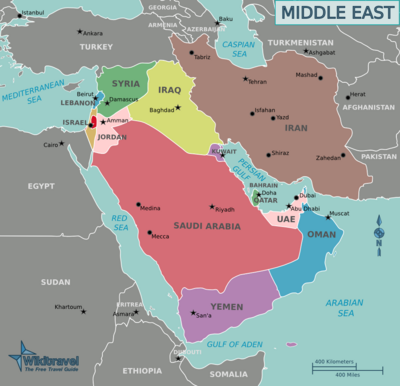
Obama’s weak foreign policy may lead to WAR in the Middle East

Map of Middle East
Map of Middle East

First article from the left-wing Huffington Post. (H/T Gateway Pundit)

Excerpt:

In its first year, the Obama administration cut funding for democracy and governance programming in Egypt by more than half, from $50 million in 2008 to $20 million in 2009 (Congress later appropriated another $5 million). The level of funding for civil society programs and non-governmental organizations (NGOs) was cut disproportionately, from $32 million to only $7 million. Though funding levels for 2010 are not yet available, they are expected to show an increase to $14 million, says Stephen McInerny, the director of advocacy at the Project on Middle East Democracy. He notes that the Bush administration slashed economic aid to Egypt in the 2009 budget but kept the funding for democracy and governance programs constant, while Obama cut funding to those programs in an effort to make the cuts more proportional and under pressure from the American embassy in Cairo.

Second article, from the LA Times. (H/T Gateway Pundit)

Excerpt:

The Obama administration said for the first time that it supports a role for groups such as the Muslim Brotherhood, a banned Islamist organization, in a reformed Egyptian government.

[…]The statement was an acknowledgment that any popularly accepted new government will probably include groups that are not considered friendly to U.S. interests, and was a signal that the White House is prepared for that probability after 30 years of reliable relations with Egyptian President Hosni Mubarak.

Third article, from National Review. (H/T Hyscience)

Excerpt:

Hamas’s overt intervention in Egypt is an alarming development, although a predictable one. It is worth pointing out that Hamas is not merely colluding with the Muslim Brotherhood. Hamas is the Muslim Brotherhood. That, of course, will not be what you hear from our foreign-policy experts, such as Obama adviser Bruce Riedel, who are busily sculpting their narrative about how the Brotherhood — the font on modern jihadist terror — has renounced violence and is really nothing for us to be very concerned about. But the stubborn fact is that Hamas is the most prominent of the Brotherhood’s Palestinian branches, whose operations long predated Hamas and brought Hamas (a/k/a, the Islamic Resistance Movement) into being.

So that’s what’s happening in Egypt… Hamas is moving in to take control, just like Hezbollah controls Lebanon (now). But why now? Why didn’t this happen when George W. Bush was President?

Well, Barack Obama is no George W. Bush.

Let’s review:

  • Obama insulted our British allies
  • Obama insulted our Afghan allies
  • Obama backed Iran’s suppression of pro-democracy protestors
  • Obama did nothing when Russian tanks rolled through Georgia
  • Obama did nothing when Hezbollah took over Lebanon
  • Obama backed the socialist Zeyala in Honduras
  • Obama met with Chavez, Ortega and Morales and kept silent while they insulted the United States
  • Obama did nothing while Turkey became increasingly Islamicized
  • Obama cut funding to democracy and governance programs in Egypt

And what is the end game of all of this weakness and moral equivalence?

Excerpt:

The circle is now complete. This week Barack Obama truly became what many people believe he was all along, the long lost second term of Jimmy Carter’s presidency.

[…]First he criticized the weakened leader of Egypt, Hosni Mubarak. Next Obama threatened to emasculate Mubarak’s standing with the Egyptian military by reducing US financial aid if Mubarak didn’t allow the protests and revolution in the streets to continue.

Obama followed up by tacitly signaling that he supports the violent Islamic protests which are backed by the Shariah-compliant extremists of the Moslem Brotherhood, which is the only real opposition party in Egypt to the thirty-year dictator Mubarak. After that, like Carter, Obama showed constant indecision and weakness, which is having the result of undermining our allies and empowering the forces of insanity and evil on the ground in Egypt and other destabilized countries in the region like Tunisia, Lebanon and Jordan.

Just like Carter, Obama got us to this point by undermining our only ally in the area, Israel, and empowering all of her regional enemies for the first two years of his presidency. That undermining has led us directly to these out of control events.

At this moment, of the four nations that border Israel, two of them, Syria and Lebanon, are client states of Iran waging constant war and the other two which both have brokered peace are facing internal turmoil, Jordan is facing Islamic protests in her streets and the relatively stable tourist destination Egypt, is exploding in revolution.

The way Obama is handling the Egyptian crisis there can only be one outcome. The Moslem brotherhood will seize total control of the nation and turn the Arab world’s most populace country into a totalitarian Islamic theocracy just like Iran. Egypt’s fall will be a strategic disaster for the US because Egypt borders Israel and controls the vital Suez Canal which connects the Indian Ocean to the Mediterranean Sea. The Suez is one of the most vital water-ways in the entire world because it is the shipping lane that allows Middle East oil to get to the consumer countries in Europe.

If Egypt falls to this kind of governance total war will quickly come to the Middle East with catastrophic strategic and economic consequences for the whole world.

Strength doesn’t cause wars – weakness causes wars. When you are strong, aggressors know that aggression will cause them plenty. Obama, and his constant apologizing and appeasing and siding with terrorists and dictators, is what REALLY causes wars.