The administration announces a leaner version of our military involving the cutting of tens of thousands of ground troops as a leading defense contractor closes a major plant due to budget cuts.
In an unusual appearance at the Pentagon on Thursday, President Obama laid out his plans for a “leaner” military based on the need “to renew our economic strength here at home, which is the foundation of our strength in the world.”
In other words, failed domestic policies require us to cut our military in a dangerous world.
[…]Yet as Russia rearms, Iran pursues its nukes and China pushes toward a global reach, it is hard to argue that less is more.
[…]Defense cuts are already having a domestic effect. Boeing Co. announced Wednesday it will close its defense plant in Wichita, Kan., by the end of 2013, moving future aircraft maintenance, modification and support to other facilities.
The closure, prompted by defense cuts, will cost 2,160 workers their jobs.
[…]A 14-page analysis by the Republican majority staff of the House Armed Services Committee says the cumulative cuts will result in the Army and Marines losing 200,000 troops.
The Navy will shrink to 238 vessels from today’s 300 and would lose two carrier battle groups needed to project American power and influence. Strategic bombers will fall from 153 to 101. Air Force fighters would drop by more than half, from 3,602 aircraft to 1,512 planes.
As a chart produced by the committee shows, the cumulative cuts are real cuts, both in spending levels and in military capability. The Joint Chiefs of Staff chairman, Army Gen. Martin Dempsey, said in written statements released during his recent confirmation hearings, “National security didn’t cause the debt crisis, nor will it solve it.”
We would note that defense is a constitutional imperative — not an optional budget item — and that the question should be what do we need to defend ourselves and our interests, not simply what we can afford as the result of failed administration policies.
If you are expecting the President to keep the country safe and to protect our interests abroad, then you don’t elect a Democrat. Democrats can’t do national security or foreign policy, because they think that a weaker America is better than a stronger America. And, when elected, Democrats weaken America.
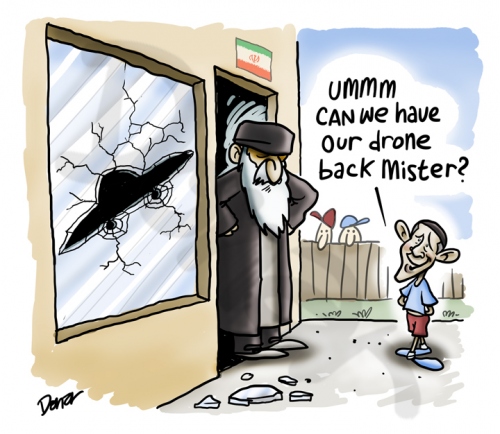
President Barack Obama said Monday that the United States has asked Iran to return a U.S. drone aircraft that Iran claims it recently brought down in Iranian territory.
“We’ve asked for it back. We’ll see how the Iranians respond,” Obama said in a news conference, alongside Iraqi Prime Minister Nouri al-Maliki.
A top Iranian military official previously vowed not to return the unmanned American stealth plane that it says it has.
[…]Former U.S. Vice President Dick Cheney on Monday criticized Obama’s decisions on the drone, but for an entirely different reason. He said that, after the aircraft went down, the president should have ordered an airstrike over Iran.
“The right response to that would have been to go in immediately after it had gone down and destroy it,” the Republican, who served with President George W. Bush, told CNN’s Erin Burnett. “You can do that from the air … and, in effect, make it impossible for them to benefit from having captured that drone.”
Instead, “he asked nicely for them to return it, and they aren’t going to,” Cheney said.
[…]One U.S. official said the United States can’t be certain it’s the real stealth drone, because U.S. personnel don’t have access to it. But he added there’s no reason to think it’s a fake. However, a second senior U.S. military official said that a big question is to how the drone could have remained virtually intact given the high altitude it is believed to have crashed from.
In an interview broadcast live Monday night on Venezuelan state television, Iranian President Mahmoud Ahmadinejad said nothing to suggest his country would grant the U.S. request.
“The Americans have perhaps decided to give us this spy plane,” Ahmadinejad said. “We now have control of this plane.”
Speaking through an interpreter, Ahmadinejad said: “There are people here who have been able to control this spy plane, who can surely analyze this plane’s system also. … In any case, now we have this spy plane.”
He added, “Very soon, they’re going to learn more about the abilities and possibilities of our country.”
On Tuesday, a semi-official Iranian news agency said authorities have shrugged off the U.S. request. Defense Minister Gen. Ahmad Vahidi said the United States should apologize for invading Iranian air space instead of asking for the return of the unmanned aircraft.
Remember when Iran was having their elections and they started shooting people down in the street? Unlike Germany, France and Canada, Obama had nothing to say about that. Ronald Reagan would have had something to say. Margaret Thatcher would have something to say. But Obama had nothing to say. Maybe the Iranians looked at what Obama did and decided that Obama is a paper tiger.
Let’s see what everyone thinks about Obama’s decision withdraw 40,000 troops from Iraq, effectively handing control of much of the Middle East to Iran.
No doubt this will be politically popular—at least in the short-term. Mr. Obama can say he honored a campaign pledge, Congress will move to spend the money on domestic programs, and a war-weary American public will be relieved to carry fewer overseas burdens. Or at least Americans will feel such relief as long as this total withdrawal doesn’t cost the hard-fought political and strategic gains that our intervention has won.
There are serious risks in this complete withdrawal. Iraq has made great progress in providing its own security, with some 600,000 Iraqi troops gradually taking the handoff from U.S. forces. But the Iraqis still lack vital military assets in intelligence and logistics, not to mention naval and air power. Mr. Obama said the U.S. will continue to discuss “how we might help Iraq train and equip its forces,” but this is no substitute for a more robust, long-term presence of the kind we retain in South Korea and Japan 60 years after the end of the Korean War.
The U.S. commander in Iraq, General Lloyd Austin, had requested between 15,000 and 18,000 troops, before reducing it to 10,000 under pressure. Such a U.S. presence would reassure Iraq and its neighbors of our continuing commitment to the region. It would help play the role of honest broker among Iraq’s ethnic factions as it continues to build a more durable political system.
And above all it would reduce Iran’s ability to meddle in Iraq, building local militias on the Hezbollah model with a goal of making its neighbor a Shiite vassal state. Iran’s Quds force—the same outfit that wanted to assassinate a Saudi ambassador on U.S. soil—is the biggest winner from Mr. Obama’s pullout.
“Iraq is not a normal country, the security environment is not normal, the embassy is not a normal embassy,” said Marisa Cochrane Sullivan, managing director at the Institute for the Study of War, who traveled to Iraq this summer and has been sounding the alarm about what she saw as the mishandling of the negotiations ever since.
For more evidence that the administration actually wanted to extend the troop presence in Iraq, despite today’s words by Obama and McDonough, one only has to look at the statements of Defense Secretary Leon Panetta.
In July, Panetta urged Iraqi leaders to, “Dammit, make a decision” about the U.S. troop extension. In August, he told reporters that, “My view is that they finally did say, ‘Yes.'” On Oct. 17, he was still pushing for the extension and said, “At the present time I’m not discouraged because we’re still in negotiations with the Iraqis.”
Sullivan was one of 40 conservative foreign policy professionals who wrote to Obama in September to warn that even a residual force of 4,000 troops would “leave the country more vulnerable to internal and external threats, thus imperiling the hard-fought gains in security and governance made in recent years at significant cost to the United States.”
She said that the administration’s negotiating strategy was flawed for a number of reasons: it failed to take into account Iraqi politics, failed to reach out to a broad enough group of Iraqi political leaders, and sent contradictory messages on the troop extension throughout the process.
“From the beginning, the talks unfolded in a way where they largely driven by domestic political concerns, both in Washington and Baghdad. Both sides let politics drive the process, rather than security concerns,” said Sullivan.
The announcement of our total withdrawal comes just weeks after the revelation of an Iranian plot to execute the Saudi ambassador to the U.S. on our soil. It comes as Iran’s key Arab ally, the Assad regime in Syria, is rocked by a revolt. Just as Tehran’s dangerousness is put in stark relief and as events in Syria threaten to deal it a strategic setback, it gets this windfall.
[…][Obama’s] commanders on the ground wanted to keep more than 20,000 troops in Iraq (the administration had bid this number down to several thousand, perhaps convincing Iraqi political players that cutting a painful deal on immunity wouldn’t have enough of a corresponding upside). Such a force would have enhanced our political leverage in Baghdad, checked Iran’s already considerable influence, ensured against a return of al-Qaeda, and helped keep a lid on Arab–Kurdish tensions in the north. Now, we’ll simply have to hope for the best. Deputy National Security Advisor Dennis McDonough said Iraq is “secure, stable, and self-reliant.” It is none of these things. Its government is still inchoate and it is not capable of defending itself from Iran in the air or on the ground.
Our pullout is a bonanza for Tehran. Its militias were already active in Iraq. Now, it can use Iraq for bases for its proxy forces to spread its tentacles in the rest of the Persian Gulf. Independent ayotollahs in Iraq will have an incentive to keep their heads down. Political decisions of the Iranian-influenced Shiite bloc running the country are sure to begin to tilt more and more Iran’s way. Our diplomatic leverage will diminish, even as maintain our largest embassy in the world in Baghdad. The Iranians will crow in Iraq and throughout the region that they were right that the Americans would eventually leave.
We expended a great deal of blood and treasure to topple Saddam Hussein, and then to establish enough order so that George W. Bush’s successor would only have to consolidate our gains. President Obama is careless enough to risk throwing it all away, and shameless enough to call it success.
For those who are not aware of the looming storm in the Middle East, you should read in full this article from the Washington Times. It is authored by Frank Gaffney, the President of the Center for Security Policy. He covers several troubling data points in Libya, Egypt, Afghanistan, Iraq, China, Russia and Mexico. As if that were not bad enough, it looks as if the debt limit super-committee is now deadlocked in negotiations, which will trigger automatic cuts to our defense budget, at the worst possible moment.

 WINTERY KNIGHT