Why would anyone support the idea of ending the life of a convicted criminal? What are the reasons for governments to support the death penalty for certain crimes? What does the Bible have to say about capital punishment? Reformed Baptist theologian Wayne Grudem did a Sunday school presentation on the Bible and capital punishment. Let’s take a look.
About Wayne Grudem:
Grudem holds a BA from Harvard University, a Master of Divinity from Westminster Theological Seminary, and a PhD from the University of Cambridge. In 2001, Grudem became Research Professor of Bible and Theology at Phoenix Seminary. Prior to that, he had taught for 20 years at Trinity Evangelical Divinity School, where he was chairman of the department of Biblical and Systematic Theology.
Grudem served on the committee overseeing the English Standard Version translation of the Bible, and in 1999 he was the president of the Evangelical Theological Society. He is a co-founder and past president of the Council on Biblical Manhood and Womanhood. He is the author of, among other books, Systematic Theology: An Introduction to Biblical Doctrine, which advocates a Calvinistic soteriology, the verbal plenary inspiration and inerrancy of the Bible, the body-soul dichotomy in the nature of man, and the complementarian (rather than egalitarian) view of gender equality.
what does it mean that man is made in the image of God?
is CP just about taking revenge?
what does CP say about the value of human life?
does CP apply to animals, too?
could the statements supporting CP be understood as symbolic?
one purpose of CP is to protecting the public
another purpose of CP is to deter further wrongdoing
but the Biblical purpose of CP is to achieve justice by retribution
does the Pope make a good argument against CP?
what is the role of civil government in achieving retribution?
do people in Heaven who are sinless desire God to judge sinners?
should crimes involving property alone be subject to CP?
is the Mosaic law relevant for deciding which crimes are capital today?
should violent crimes where no one dies be subject to CP?
is CP widespread in the world? why or why not?
what are some objections to CP from the Bible?
how do you respond to those objections to CP?
should civil government also turn the other cheek for all crimes?
what is the “whole life ethic” and is it Biblical?
what do academic studies show about the deterrence effect of CP?
how often have innocent people been executed in the USA?
should there be a higher burden of proof for CP convictions?
The Bible is awesome because it gives us knowledge about God’s character. How are we supposed to act in a way that is pleasing to God if we don’t know what he thinks of the issues of the day? We won’t know how we are supposed to act unless we know who God is first. And that’s why when we read the Bible we should be looking to find out the truth about who God is.
I saw that there was a capital punishment case in the news, coming out of Florida. A very handsome bad boy with tattoos on his face murdered two women. Prosecutors are seeking the death penalty. But the judge in the case has received letters from female admirers of the killer arguing against the death penalty. Is it wrong to have the death penalty as a punishment for murderers? What does the Bible say?
First, here’s the case reported by the far-left UK Independent:
Women have been sending letters to a Florida judge begging him to spare the life of a heavily-tattooed convicted killer who brutally murdered two women in 2019.
Wade Wilson, 30, was found guilty last month of killing Kristine Melton, 35, and Diane Ruiz, 43.
The defendant killed the women within hours of each other. He met Melton at a live music bar on 6 October 2019 before strangling her to death at her home in Cape Coral, where her body was discovered, prosecutors said.
The following day, Ruiz was reported missing. She was walking to the bar where she worked when Wilson approached her in a car that he had stolen from Melton’s home and asked her for directions.
Ruiz got in the car, Wilson strangled her and “ran her over until she looked like spaghetti” the court heard.
I thought this part was interesting:
Wilson has also been flooded with love letters, according to the Lee County Sheriff’s Office.
He has received nearly 4,000 messages online 754 photos and 65 letters in the mail, in total. The sheriff’s office said they rejected 163 photos for their “inappropriate nature.”
A sheriff’s office spokesperson told The Independent that “inappropriate” was classed as “sexual organs, content that is deemed indecent or controversial.”
What should Christians think about the death penalty? Reformed Baptist theologian Wayne Grudem did a Sunday school lesson about Bible and capital punishment. Let’s look at it.
About Wayne Grudem:
Grudem holds a BA from Harvard University, a Master of Divinity from Westminster Theological Seminary, and a PhD from the University of Cambridge. In 2001, Grudem became Research Professor of Bible and Theology at Phoenix Seminary. Prior to that, he had taught for 20 years at Trinity Evangelical Divinity School, where he was chairman of the department of Biblical and Systematic Theology.
what does it mean that man is made in the image of God?
is CP just about taking revenge?
what does CP say about the value of human life?
does CP apply to animals, too?
could the statements supporting CP be understood as symbolic?
one purpose of CP is to protecting the public
another purpose of CP is to deter further wrongdoing
but the Biblical purpose of CP is to achieve justice by retribution
does the Pope make a good argument against CP?
what is the role of civil government in achieving retribution?
do people in Heaven who are sinless desire God to judge sinners?
should crimes involving property alone be subject to CP?
is the Mosaic law relevant for deciding which crimes are capital today?
should violent crimes where no one dies be subject to CP?
is CP widespread in the world? why or why not?
what are some objections to CP from the Bible?
how do you respond to those objections to CP?
should civil government also turn the other cheek for all crimes?
what is the “whole life ethic” and is it Biblical?
what do academic studies show about the deterrence effect of CP?
how often have innocent people been executed in the USA?
should there be a higher burden of proof for CP convictions?
The Bible is awesome because it gives us knowledge about God’s character. How are we supposed to act in a way that is pleasing to God if we don’t know what he thinks of the issues of the day? We won’t know how we are supposed to act unless we know who God is first. And that’s why when we read the Bible we should be looking to find out the truth about who God is.
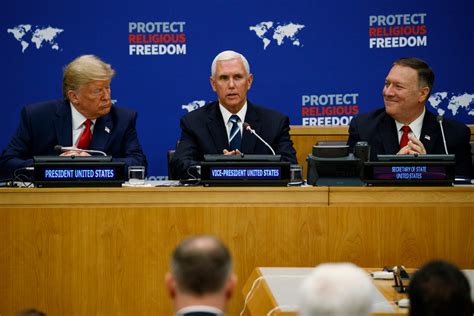
Trump, Pence and Pompeo champion religious freedom at the United Nations
Laura send me this amazing article from the Christian Post, written by famous evangelical theologian Dr. Wayne Grudem. He was responding to a blue state pastor named John Piper. Piper has made a name for himself by emphasizing emotions, piety and “Christian hedonism”. Let’s take a look at what Wayne Grudem had to say about Christians who support Joe Biden and Kamala Harris.
Here’s the intro:
[John Piper] and I have reached different conclusions about this year’s presidential election. His October 22 article, “Policies, Persons, and Paths to Ruin,” explained why he thought it would be wrong for him to support either candidate in this election.
Here is Grudem’s summary of Piper’s argument:
1. The personal sins of a leader can be as harmful to persons and to nations as morally evil laws.
2. Christians communicate a falsehood when we act as if policies and laws are more precious than being a certain kind of person.
3. The horrible sin of pride leads people to other sins, including defending abortion, and therefore voting for a clearly boastful candidate might also be indirectly supporting abortion.
4. Voting for either candidate would compromise a person’s Christian witness
I have a friend in my office, Scott, who has exactly these views. He is pro-life and pro-family, but he thinks voting for Trump’s policies would be wrong, because of Trump’s past moral failings.
Here’s part of his response to point 1:
Americans are perfectly free to say, “Trump’s boastfulness offends me and I don’t want to act that way myself.” But if laws are passed (and upheld by the courts) that enforce the LGBT agenda, no creative professional like a cake decorator (or photographer or florist) will be free to say, “I believe same-sex marriage is morally wrong, and I won’t use my artistic talent to decorate a cake celebrating same-sex marriage.” No high school girl will be free to say, “I won’t undress and change clothes for my gym class because there are boys in the locker room who claim to be girls.” No Christian adoption agency will be free to say, “We will not place children with same-sex couples.”
And if Democrats gain control of our government and the Supreme Court, and enact their desired policies, no Christian taxpayer will be free to say, “I refuse to pay that portion of my taxes that the government is using to pay for abortions.” No business owner will be free to say, “I will not buy medical insurance for my employees that pays for abortions and sex-change surgeries.” There will be only two choices: violate your conscience or else be driven to bankruptcy or go to jail.
Trump’s first four years not a parade of immoral actions:
[A]fter his nearly four years in office, I would add that he has shown remarkable courage of his convictions, faithfulness to his campaign promises, steadfastness of purpose in spite of an astoundingly hostile press, incredible energy in the performance of his job, dignity and even eloquence in many formal speeches and ceremonies at home and abroad, respect and appreciation for his wife Melania and his sons and daughters, and a wide-ranging understanding of the hundreds of different issues that every president faces. In contrast to his past life, during his term in office there is not been even a hint of any sexual impropriety. He is sometimes boastful but on a number of occasions I have seen him publicly give credit to many other people for things that have been accomplished. And I think he has shown mature and wise judgment in a variety of situations that he has faced as president.
Biden’s character not exemplary:
It is easy to compare President Trump with a hypothetical “perfect” president and to conclude that he falls short, but that is not our choice. If Trump is not reelected, we will have President Biden, with an entirely different set of character flaws. The multiple allegations that Vice President Biden used his government office and influence to enrich members of his own family with millions of dollars from China, Russia, and Ukraine should be of deep concern, because using government power to enrich one’s own family is the consistent characteristic of corrupt leaders in many countries of the world.
Conservative Christians occupy prominent positions in Trump’s Cabinet, and they make many decisions that affect voters:
Donald Trump is not the only person we are voting for. It is remarkable that the Trump administration has elevated so many self-professing evangelical Christians – far more than any in my lifetime – into positions of high influence in our government. They also provide role models for Americans. To vote for Trump as president is also to vote for Mike Pence as vice president, Mike Pompeo as Secretary of State, Ben Carson as Secretary of Housing and Urban Development, Betsy DeVos as Secretary of Education, Russell Vought as director of the Office of Management and Budget, and numerous others. In addition, Trump has appointed numerous deeply committed Roman Catholics to various positions, the most recent being Amy Coney Barrett to the Supreme Court. The character of these leaders is also a role model for the nation.
We will look at responses to the points 2-4 in another post.
For my part, I think that if Trump’s character was going to be a major factor, it would all have come out in his first term. Instead, we’ve seen him act in a way that is friendly to evangelical Christians. I don’t expect him to write systematic theology or do philosophical apologetics or discover a new example of cosmic fine-tuning. He doesn’t have to be a Christian in order to push for laws and policies that allow me to run my Christian life-plan. I need to be able to earn money without compromising my values, and spend it on the Christian causes I care about. I need to be protected from people like Antifa and gay rights extremists, who don’t seem to be at all concerned about moving from angry words to property damage to actual violence against those who disagree with them.



 WINTERY KNIGHT