the commandment to not kill does not apply to killing enemy soldiers in war
government is authorized to prevent foreign countries from harming citizens the same way it prevents criminals from harming citizens
there are examples in the Bible of using military force to stop an aggressive nation, e.g. – David vs Goliath
principles of a just war, and relevant Bible passages, e.g. – just cause, only as a last resort
Moral principles for the conduct of a just war, e.g. – proportionality, combatants vs non-combatants
Can a Christian serve in a just war in good conscience?
What should a Christian do if called upon to fight in an unjust war?
Part 2 topics: (responses to pacificism)
what are the arguments in favor of pacifism?
government can do some things that individuals cannot do, e.g. – taxing vs stealing, punishing criminals vs revenge
it’s wrong for individuals to use force to advance the gospel, but not wrong for government to use force to restrain evil
Jesus loves everyone, but even he will come in judgment one day and use force to punish evil
what about nuclear weapons, nuclear arsenals for deterrence, and defenses to long-range nuclear missiles?
missile defense systems work, e.g – Iron Dome in Israel stopped about 85% of incoming missiles
building defenses does not embolden the enemy to attack us, it deters the enemy from attacking us
“turn the other cheek” means don’t return an insult, but you can defend yourself from physical threats
My favorite part of this two-part series was the midpoint of part 2, when a lady asked him a question about what is behind pacificism. Dr. Grudem runs through all the places in society where the secular left is opposed to authorities judging and punishing bad behavior with force. There are so many examples of this: parents disciplining rebellious children, teachers disciplining misbehaving kids, police catching criminals (lots of that lately!), courts putting criminals in jail for long periods of time, giving murderers the death penalty, using waterboarding on terrorists, and of course pacifism in the face of aggression, e.g. – Iran vs Israel, Russia vs Ukraine. Then another lady asked him why the same people who are so concerned about going easy on violent criminals and aggressive nations are so intent on being able to kill defenseless innocent children in the womb. Good question.
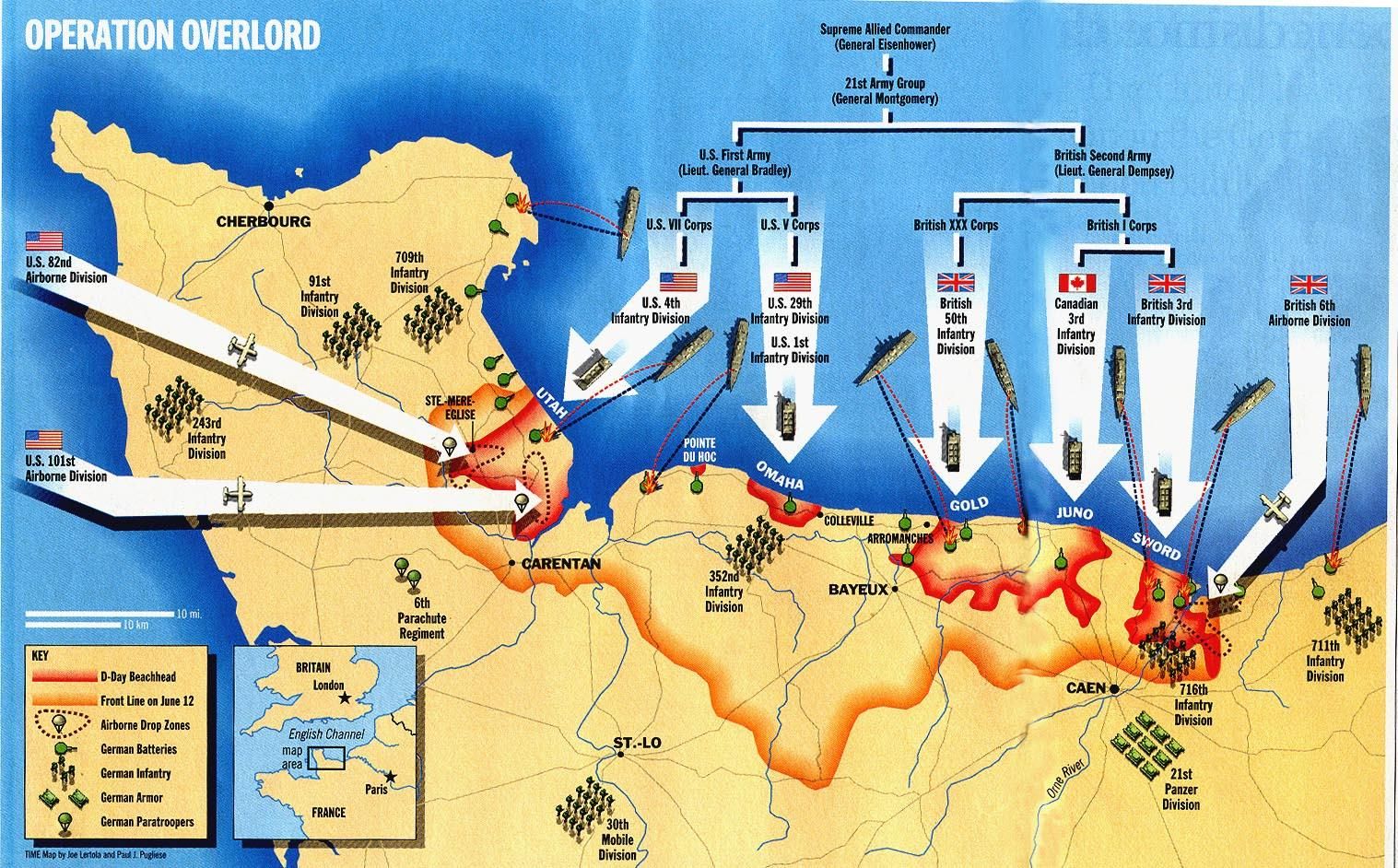
Map of D-Day landings (click for larger image) (courtesy of Time magazine)
I thought it might be a good idea to write up something about D-Day in order to help people understand some of our military history, and to put the spotlight on some real heroes. I don’t regard artists, athletes, dancers, singers, actors, or other celebrities as heroes. It really alarms me that so many people know more about these fake heroes than they do about real ones.
Weakness emboldens aggressors
For one thing, many people don’t understand how British and American libertarian isolationism made World War 2 into a much bigger mess than it needed to be. As historian Victor Davis Hanson explains in the lecture I linked below, the Allied nations were much stronger and better equipped than the Axis nations before the war started. The Axis nations developed better weapons after the war started. But Germany and Japan didn’t think that the Allied nations would do anything if they were aggressive. We know this from their writings and correspondence. They thought that British and Americans were just too scared of war to stop them.
Germany and Japan tested their hypothesis out by re-arming and annexing territory from their neighbors. Britain and America were led by libertarian isolationists, so they didn’t fight back. The aggressors correctly understood that libertarian isolationists didn’t have the will to oppose them, even if they were weaker than the Allies. But the more they re-armed and annexed territory, the stronger they became. The Allied nations waited too long to confront them. And that’s why World War 2 was much harder to win than it needed to be.
Here’s a very good lecture about the causes of World War 2 by an actual military historian, Victor Davis Hanson:
So, that’s the first point I wanted to make: libertarian isolationism causes wars. Although libertarians claim to oppose war, they actually cause war, due to their weakness in the face of evil. So who stops wars? People who favor a strong defense, and show a willingness to fight back against aggression are the ones who REALLY oppose wars. This is called “peace through strength”, and you can see it in action in the Cold War, where Ronald Reagan defeated the Soviet Union by making their aggression costly.
Heroes of D-Day
My second concern was to promote the real heroes of D-Day, over the fictional heroes of movies, fiction, music, dancing, sports, and other entertainment nonsense.
Here are the four heroes I chose:
Major John Howard
Lieutenant Colonel Benjamin Vandervoort
Brigadier General Norman Cota
Major Richard Winters
Let’s take a look at each of them.
John Howard
Major John Howard led elements of the British 6th Airborne Division to take two vital bridges southeast of Sword beach. He did this in order to prevent German socialist counterattacks coming from the east. After they took the bridges, they had to repulse German tanks with nothing more than their useless PIAT (Projector Infantry Anti-Tank) grenade launchers. The PIAT was nothing more than a grenade launcher powered by a coiled spring. It was very inaccurate, and only effective to 50 yards. But that’s all the British paratroops had to stop tanks, and they made it work. You can read about him in this book by Stephen E. Ambrose, entitled: “Pegasus Bridge: June 6, 1944“. This New York Times article tells the story in brief. He also is played by Richard Todd in the famous movie “The Longest Day“.
Benjamin Vandervoort
Lt. Col. Ben Vandervoort served with the 82nd Airborne Division. I read about how he lead an infantry attack against German Tiger tanks (!) and infantry in Stephen E. Ambrose’s book “Citizen Soldiers: The U.S. Army from the Normandy Beaches to the Bulge to the Surrender of Germany“. Ben Vandervoort broke his ankle during the D-Day landing, but he insisted that the medic just “lace it up tight” so that he could supervise the attacking and holding of Ste. Mere Eglise, southwest of Utah beach, against a vastly superior enemy force. This article tells about how he defended against elite German SS infantry and heavy Tiger tanks at Trois-Ponts, during the Battle of the Bulge. He was outgunned and outnumbered 20 to 1, and had just a few lightly-armed soldiers, two weak 57mm anti-tank guns and some bazookas. He is portrayed by John Wayne in the famous movie “The Longest Day“.
Norman Cota
Brig. General Norman Cota is my favorite person in World War 2. At 51 years old, he nevertheless landed at D-Day, and rallied terrified Army Rangers to follow him up the bluff, by telling them that Rangers ought to lead the way. “Rangers Lead The Way” later became the motto of the Army Rangers. He always led from the front, demonstrating how to attack a German machine gun position in a farmhouse to a group of American soldiers who were pinned down. He actually grabbed a bunch of grenades and led the assault team against a heavy machine gun! You can read about him in this short article and in Stephen E. Ambrose’s “D-Day: June 6, 1944: The Climactic Battle of World War II“. He is portrayed by Robert Mitchum in the famous movie “The Longest Day“.
Richard Winters
Major Richard Winters served in the 101st Airborne Division. Winters led an assault against a superior force of heavy machine guns and 105mm field guns. His tactics were so brilliant that they are still studied at West Point today. You can see Richard Winters and Carwood Lipton in the HBO “Band of Brothers” series, or read this book by Stephen E. Ambrose entitled “Band of Brothers: E Company, 506th Regiment, 101st Airborne, from Normandy to Hitler’s Eagle’s Nest“, which is the basis for that series.
I hope this convinces you that military heroes are far more important than the “heroes” of fiction and entertainment. It’s alarming to me that people invest more and have more respect for characters in Hollywood science fiction movies, and other such make-believe nonsense. We need to be rooted in reality. In reality, men who fight and die fighting evil to protect your freedoms are the real heroes. People who take military history seriously are able to give respect and gratitude where it is due – a very important part of being a mature, moral human being.
I talked to a few progressives and libertarians on the weekend. They seemed to think that Trump’s decision to sanction two Iranian generals would lead to war. Now, I asked the libertarians and progressives a bit about how World War 2 started. They didn’t know anything about how it started. Let’s see what Trump did in Iran, and then look at WW2 history to see if it is likely to stop or start a war.
Before I start, I just want to say that someone shared a post by far-left filmmaker Michael Moore claiming that Americans had ever heard of Soleimani or the Quds Force. Here are my previous 134 posts on Iran, my previous 9 posts on the Quds Force, and my previous post on Soleimani. Speak for yourself, Michael Moore.
First, who is Solemani, and what is the Quds Force? The New York Times explains:
More than any other American military operation since the invasion of Iraq, the assassination yesterday of Maj. Gen. Qassim Suleimani, the head of Iran’s Qods Force of its Islamic Revolutionary Guards Corps, is a seismic event. The killings of Osama bin Laden and Abu Bakr al-Baghdadi, the leaders of al-Qaeda and the Islamic State, were certainly meaningful, but they were also largely symbolic, because their organizations had been mostly destroyed. Taking out the architect of the Islamic Republic’s decades-long active campaign of violence against the United States and its allies, especially Israel, represents a tectonic shift in Middle Eastern politics.
[…]In Lebanon, Mr. Suleimani built Lebanese Hezbollah into the powerful state within a state that we know today. A terrorist organization receiving its funds, arms and marching orders from Tehran, Hezbollah has a missile arsenal larger than that of most countries in the region. The group’s success has been astounding, helping to cement Iran’s influence not just in Lebanon but farther around the Arab world.
Building up on this successful experience, Mr. Suleimani spent the last decade replicating the Hezbollah model in Iraq, Syria and Yemen, propping up local militias with precision weapons and tactical know-how. In Syria, his forces have allied with Russia to prop up the regime of Bashar al-Assad, a project that, in practice, has meant driving over 10 million people from their homes and killing well over half a million. In Iraq, as we have seen in recent days, Mr. Suleimani’s militias ride roughshod over the legitimate state institutions. They rose to power, of course, after participating in an insurgency, of which he was the architect, against American and coalition forces. Hundreds of American soldiers lost their lives to the weapons that the Qods Force provided to its Iraqi proxies.
I think this part is worth emphasizing – Solemani was the aggressor in the Iraq embassy attack, and he has a record of attacking American armed forces:
Soleimani, who was designated and sanctioned by the U.N., E.U., and U.S. alike, directly approved Tuesday’s U.S. embassy storming in Baghdad by Iranian proxy militia Kataib Hezbollah, and was credibly assessed by Secretary of State Mike Pompeo as actively planning more “imminent” attacks against hard American assets in the Middle East, has been directly active in the mass murder of Americans. He personally oversaw the mass arming of Shiite Iraqi insurgents and it is estimated that the IRGC-QF targeted and killed over 600 Americans in Iraq from 2003–2011. The State Department asserts that this personally amounts to a whopping 17% of all deaths of U.S. military personnel during the Iraq War.
So, far from Trump’s response being disproportionate, this was actually a long-overdue response. It was even overdue from Trump.
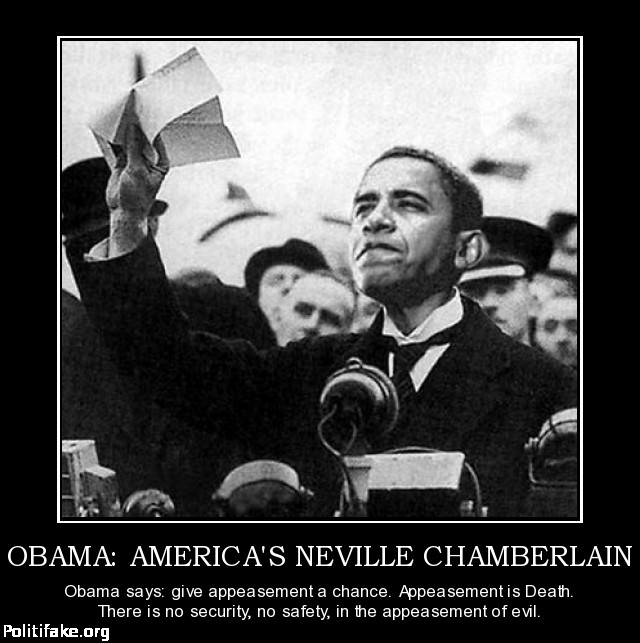
The message that Iran got after 8 years of Obama was clear: acts of aggression committed by Iran against the United States and her allies would be rewarded, including the $1.7 BILLION payoff from the Obama administration. The Obama administration’s policy was isolationism and appeasement. And this was fine with Democrat voters, because not a single Democrat voter (or libertarian ) knew anything about Iran, the Iran deal, Soleimani, or the Quds Force. They are low-information voters.
Now let’s see how World War 2 started.
Here is a helpful lecture by military historian Victor Davis Hanson.
Germany re-armed in 1936. Austria was annexed in 1938. The Rhineland was re-occupied in 1938. Czechoslovakia was invaded in 1939. And the allied democracies did nothing to stop Hitler. Similarly, Japan also re-armed, broke treaties and invaded neighbors. And the allied democracies did nothing to stop them, despite having superior planes, tanks, and ships. This allowed the Axis powers time to research better weapons, re-arm, and gain a strategic advantage. The Axis powers could have been stopped early on, at a much lower cost in blood and treasure. It was the libertarians and the progressives with their policies of isolationism and appeasement that made World War 2 much worse than it needed to be.
Hitler assumed the United States either could not or would not offer much military help to his intended European targets.
Why, then, did a relatively weak Nazi Germany between 1939 and 1941 believe that it could take on much of the world, and inspire Axis partners such as Italy and Japan to follow its suicidal lead?
The answer is obvious. British and French appeasement, Soviet collaboration and American isolation had together convinced Hitler and his Axis allies that the victors of World War I were more eager to grant concessions at any cost than were the defeated.
In the lecture, VDH explains that we know from the writings of the leaders of Germany and Japan that they interpreted the isolationist / appeasement policies of the libertarian progressives as weakness, and this is what caused them to re-arm and attack their neighbors. Prior to the historical start of WW2, the Western nations had better tanks, planes and ships than the Axis powers. But they refused to use them to deter the Axis powers. And that’s why World War 2 was much more costly and bloody than it needed to be.
Finally, I should quickly note that America pursued a different strategy in the Cold War, under Ronald Reagan. Reagan was villified by the libertarians and progressives for taking a strong stand against communism. Instead of appeasing and isolating, he put America on a war footing, making aggression costly to the Soviet Union. This approach worked to avoid an actual World War 3. Although his critics attacked him for being pro-war, his tough approach was exactly what was needed to cause the bully to back down.