Tag Archives: War

On wargames, history and heroes: “this story shall the good man teach his son”

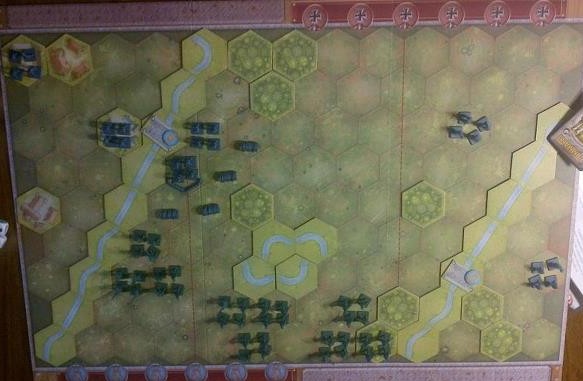
Memoir '44: Pegasus Bridge setup
Memoir ’44: Pegasus Bridge setup

Last night, I played through the Pegasus Bridge scenario from the Memoir ’44 wargame with Dina a few times. We actually played the online version of the game, using Steam. She was very gracious to play a wargame with me, which I don’t think is necessarily the first thing on most women’s lists of things to do on a Thursday night! I appreciated her agreeing to learn how to play and then playing with me several times. I think that Christians need to plan and execute more “together” activities like that – activities that involve interaction, co-operation, communication and engagement. We try to avoid doing things where we are both spectators. Playing wargames is not the only thing we do – we also do Bible study and cooking lessons (for me), for example.

Anyway, the point of this post is to express the deeper meaning behind playing wargames. I think that it is important to recognize and celebrate those who have demonstrated good character, whether it be now, or in the past. I think that it is important for us to search out the best role models ourselves, so that they will influence the way we act in our own lives. The second world war was a clear example of good versus evil. Anyone on the Allied side who demonstrated bravery and courage should be celebrated for safeguarding the security, liberty and prosperity that we enjoy today. In the case of Pegasus bridge, the hero is Major John Howard of the British paratroops.

Here is a quick re-cap of his exploits that day from the New York Times:

Maj. John Howard, the commander of glider-borne British infantrymen who seized the strategically vital Pegasus Bridge in the first battle of the D-Day invasion of Normandy, died Wednesday in a hospital in Surrey, England. He was 86 and had lived in Burford, near Oxford.

Under cover of night on June 6, 1944, six gliders carrying 181 officers and men of the Second Oxfordshire and Buckinghamshire Light Infantry landed on the eastern flank of a 60-mile invasion front on the northern coast of France. The regiment had a heritage going back to the battles of Bunker Hill and New Orleans, to Waterloo and to World War I. Now its soldiers were in the vanguard of the invasion of Hitler’s Europe.

Major Howard’s D Company was ordered to seize two bridges, one over the Caen Canal and the other spanning the parallel Orne River. If the Germans held on to those bridges, panzer units could move across them in a counterattack isolating 10,000 British paratroopers jumping behind the British invasion beach known as Sword, where infantry forces would arrive at daybreak. And Major Howard’s men sought to strike swiftly to prevent the Germans from blowing up the bridges if they were overwhelmed; the British needed those bridges to resupply their airborne units.

British Halifax bombers towed the gliders over the English Channel, then cut them loose.

Major Howard’s lead glider landed at 12:16 A.M., only 50 yards from the Caen Canal bridge, but the glider’s nose collapsed on impact, knocking everybody aboard unconscious for a few seconds. The soldiers quickly emerged, and over the next five minutes the men directly under Major Howard killed the surprised German defenders.

The nearby Orne River bridge was captured by other troops in Major Howard’s unit, and soon the words ”Ham and Jam,” signifying mission accomplished, were radioed to the airborne.

Two British soldiers were killed and 14 wounded in the operation.

Over the next 12 hours, British paratroopers and commandos reinforced Major Howard’s men, and British forces were able to move toward the city of Caen, their flank having been protected by the capture of the bridges.

On July 16, Major Howard received the Distinguished Service Order, Britain’s second-highest award for valor. On the 10th anniversary of D-Day, he received the Croix de Guerre Avec Palme from the French Government, which had renamed the Caen Canal span Pegasus Bridge, for the flying horse symbolizing the British airborne. The road crossing the bridge was later renamed Esplanade Major John Howard.

Why is this important? Well, it’s important to think on the things that are excellent. There are so many things in the culture that are not excellent that we are confronted with every day. We have to make it our business to do things together where goodness is celebrated. Especially when manly virtues like courage are celebrated. We don’t do that much anymore. And I think there’s a connection between wargames and Christian apologetics that we need to deliberately encourage.

Here’s an excellent passage from Shakespeare’s “Henry V” that makes the point:

This day is called the feast of Crispian:
He that outlives this day and comes safe home,
Will stand a tip-toe when this day is named,
And rouse him at the name of Crispian.
He that shall live this day, and see old age,
Will yearly on the vigil feast his neighbours,
And say, ‘To-morrow is Saint Crispian:’
Then will he strip his sleeve and show his scars,
And say, ‘These wounds I had on Crispin’s day.’
Old men forget: yet all shall be forgot,
But he’ll remember with advantages
What feats he did that day. Then shall our names,
Familiar in his mouth as household words,
Harry the King, Bedford and Exeter,
Warwick and Talbot, Salisbury and Gloucester,
Be in their flowing cups freshly remembered.
This story shall the good man teach his son;
And Crispin Crispian shall ne’er go by,
From this day to the ending of the world,
But we in it shall be rememberèd;
We few, we happy few, we band of brothers;
For he to-day that sheds his blood with me
Shall be my brother; be he ne’er so vile
This day shall gentle his condition:
And gentlemen in England, now a-bed
Shall think themselves accursed they were not here,
And hold their manhoods cheap whiles any speaks
That fought with us upon Saint Crispin’s day. (4.3.43)

This is from the famous speech in which King Henry charges his men to fight well before the famous Battle of Agincourt.

You can read more about the history of the British Airborne division and Pegasus bridge. The famous historian of the second world war Stephen E. Ambrose also wrote a history of the Pegasus bridge battle, called “Pegasus Bridge: June 6, 1944“. You won’t find many military historians better than Stephen E. Ambrose!

You might be surprised how many men are interested in military history and wargames, precisely because men instinctively look up to men like John Howard who embody qualities like bravery and courage. We have a dearth of moral character in this society. And we don’t do much to teach young men about manly virtues, even in the church. I think that it is important for us to think of creative ways for us to present good character to our young men. Young women should also learn about good character, because they must separate out the good men from the bad when they are courting.

Thanks to Dina for helping me to edit this post!

Defense cuts to an already weakened military exposes us to aggression

Mackenzie Eaglen is a defense policy analyst for the American Enterprise Institute.

Here’s a recent article that she wrote from the Wall Street Journal. (Full text also here on the AEI web site)

Excerpt:

Washington is battling these days over “sequestration,” the $500 billion additional cut to the defense budget looming in January.

[…]In April 2011—long before the near shutdown of the government and the last-minute debt-ceiling deal, which paved the way for sequestration—the president outlined $400 billion in defense cuts he had already approved. He also said that he wanted to “do that again” and find another $400 billion in military spending reductions. All this without any talk of threats, strategy or requirements—just arbitrary budget targets imposed on the military.

Even before sequestration and the possible loss of a half-trillion dollars, the U.S. military has seen three years of budget cuts. The consequences are already here. We have to look all the way back to 1916 to find a year when the Air Force purchased fewer aircraft than are included in Mr. Obama’s 2013 budget request.

Many of the Air Force’s aerial refueling tankers predate human space flight. Training aircraft are twice as old as the students flying them. The F-15 fighter first flew 40 years ago. A-10 ground-attack planes were developed in the Carter years. And all of our B-52 bombers predate the Cuban missile crisis.

Then there’s the Navy, which is the smallest it has been since 1916. At 286 combat and combat-support ships, the Navy today is less than half the size it reached during the Reagan administration. And what about those men and women who have been fighting America’s wars in Afghanistan and Iraq since 2001? They’re losing 100,000 in active duty personnel. Surely some will go from the front lines to unemployment lines as a result.

[…]Military leaders have suggested that taking on Syrian President Bashar al-Assad and his Third World army would be an operation of “many, many months.” The so-called “pivot” to Asia is being mimed with fewer ships on longer deployments and a shrinking, aging air force. We’re ignoring a wholesale Chinese power grab in the South China Sea and watching the nuclearization of Iran.

In another article on AOL Defense, she focuses in on the cuts to the U.S. Air Force. (Full text also here on the AEI web site)

Excerpt:

Between the existing reduction of $487 billion and sequestration’s additional half-trillion dollar cut, the Pentagon faces a very profound strategic turning point — one entirely different than that articulated by Secretary Panetta. Instead of prudently posturing for future successes, America’s armed forces are headed for a crash.

These pressures are perhaps best illustrated within the Air Force. The service absorbed 90 percent of the cuts levied on the Department of Defense in the 2013 budget — $4.8 billion of $5.2 billion. The effects have been immediate and pronounced: nearly 10,000 airmen are being cut; 227 aircraft are being prematurely retired; and critical capability shortfalls are on the rise.

[…]These budget cuts would not present such dire effects if the Air Force had been able to use the past decade to recapitalize its fleet and overarching infrastructure. At the end of World War Two, the Korean War, Vietnam, and the Cold War, the service was able to weather post-war budget downturns precisely because it had reset the majority of its capabilities during wartime.

Circumstances were different this past decade. The Air Force, already stretched thin by the 1990s procurement holiday, actually saw its percentage of the defense budget decline by one-third during the wars in Iraq and Afghanistan. The service canceled or delayed the vast majority of its modernization portfolio to sustain wartime operational demands.

So 20 years of underfunding has given us an Air Force on the brink. Its aircraft average a quarter of a century in age-with many dating back to the Eisenhower Administration. The wings of Carter-era A-10 ground attack airplanes are riddled with structural cracks. Airmen learning to fly are strapping into T-38s over twice their age. B-52s, all of which pre-date the Cuban missile crisis, are spending up to a year in depot-level maintenance. In light of the F-22 shortage, the Air Force is now extending the lifespan of its 28 year-old F-15s to 18,000 hours — more than three times their original design life.

The Air Force also spent the last decade retiring nearly a quarter of its bombers, fighters, and cargo aircraft in an attempt to free up money for immediate priorities. While helpful on a budget spreadsheet in the near-term, this has stretched the remaining tails even thinner. Shrinking the fleet makes little sense when the mission demand is constant. Aircraft availability rates and maintenance statistics clearly illustrate the rising costs associated with this decision.

Obama is also in favor of the complete disarmament of the United States with respect to nuclear weapons.

The Wall Street Journal explains:

The White House and Pentagon are considering several proposals that would deeply cut the nation’s stockpile of nuclear weapons, potentially to as low as 300 warheads under one such plan, according to a U.S. official.

The proposals haven’t been presented to President Barack Obama but are being debated by lower-level officials on the national-security staff and in the Pentagon.

The U.S. official said the government isn’t considering a unilateral cut to the nation’s nuclear arsenal. Instead, the different proposals represent arsenal levels that could be negotiated with Russia in a future round of arms-control talks.

Nonetheless, the prospect of nuclear-arsenal cuts during a hard-fought presidential campaign is certain to stoke political controversy.

Under current treaty obligations, the U.S. must reduce its nuclear arsenal to 1,550 warheads by 2018 from just below 1,800 now. One of the new proposals would cut the arsenal to between 1,000 and 1,100; another proposes an arsenal of between 700 to 800; and the most drastic proposal would cut the arsenal to between 300 and 400, according to the official.

The fact of the matter is that there are hot spots and threats all over the world. If we want to work towards peace and protect the weak, then we need a large, capable military force. This is the doctrine of peace through strength. Talk is cheap, and disarmament only emboldens evildoers to be aggressive. If we want to stop war, we have to make it costly for aggressors and tyrants. They have to know that there is a cost.

Richard Miniter: Obama canceled Bin Laden kill mission THREE TIMES

What kind of foreign policy do you get when you put radical leftists in charge?

This kind. (H/T Richard M.)

Excerpt:

At the urging of Valerie Jarrett, PresidentBarack Obama canceled the operation to kill Osama bin Laden on three separate occasions before finally approving the May 2, 2011 Navy SEAL mission, according to an explosive new book scheduled for release August 21. The Daily Caller has seen a portion of the chapter in which the stunning revelation appears.

In ”Leading From Behind: The Reluctant President and the Advisors Who Decide for Him,“ Richard Miniter writes that Obama canceled the “kill” mission in January 2011, again in February, and a third time in March. Obama’s close adviser Valerie Jarrett persuaded him to hold off each time, according to the book.

Miniter, a two-time New York Times best-selling author, cites an unnamed source with Joint Special Operations Command who had direct knowledge of the operation and its planning.

Obama administration officials also said after the raid that the president had delayed giving the order to kill the arch-terrorist the day before the operation was carried out, in what turned out to be his fourth moment of indecision. At the time, the White House blamed the delay on unfavorable weather conditions near bin Laden’s compound in Abbottabad, Pakistan.

But when Miniter obtained that day’s weather reports from the U.S. Air Force Combat Meteorological Center, he said, they showed ideal conditions for the SEALs to carry out their orders.

“President Obama’s greatest success was actually his greatest failure,” Miniter told The Daily Caller Friday. ”Leading From Behind,“ he said, traces the arc of six key Obama administration decisions, and shows how the president made them — and, often, failed to make them.

Should we give Obama any credit for killing Bin Laden?

I’ve written before about how George W. Bush deserves credit for Bin Laden kill.

But there are a couple of other data points to add that recently emerged, as well.

First, the decision on the Bin Laden raid was made by the American Armed Forces, not by Barack Obama, as a newly released memo reveals.

Second, Obama had already drafted a memo to blame the military if the operation failed.

In fact, Obama has weakening our counter-terrorism and defense capabilities from the day he took office.

Excerpt:

Sen. Jim Inhofe, R-Okla., a senior member of the Senate Armed Services Committee, called the president’s victory lap in Afghanistan on the anniversary of the death of Osama bin Laden at the hands of the Navy SEALs “an attempt to shore up his national security credentials, because he has spent the past three years gutting our military.”

Indeed he has. “He cut the F-22, future combat system, C-17 and our ground-based interceptor in Poland, to name a few,” Inhofe noted.

[…]President Obama’s defense policies fulfill a campaign pledge he made to the far-left group Caucus for Priorities a month before the January 2008 Iowa caucuses. Caucus for Priorities is an offshoot of a bigger group, Priorities Action Fund, created by Ben Cohen, the peace activist and co-founder of Ben & Jerry’s ice cream.

In a video made for the group, Obama called for a further deterioration in our military strength.

“I will cut investments in unproven missile defense systems. I will not weaponize space. I will slow our development of future combat systems,” he said.

So far, he has kept his word.

In the video, he also vowed, “I will set a goal of a world without nuclear weapons. To seek that goal, I will not develop new nuclear weapons, I will seek a global ban on the production of fissile material and I will negotiate with Russia to take our ICBMs off hair-trigger alert, and to achieve deep cuts in our nuclear arsenals.”

He has kept that promise as well.

As the Heritage Foundation notes, since Obama took office, over 50 major weapons programs of more than $300 billion have been cut or delayed.

Obama, who betrayed Poland and Czechoslovakia on missile defense and shut down key weapon systems like the F-22 Raptor, has vowed to veto any changes to the mandated cuts, including $650 billion from defense as called for by the Budget Control Act over the next decade.

That comes on top of $460 billion in defense cuts already agreed to — a total of $1.1 trillion in defense cuts our commander in chief is OK with.

A 14-page analysis by the Republican majority staff of the House Armed Services Committee says the cumulative cuts will result in Army and Marine Corps losing 200,000 troops.

The Navy will shrink from 300 ships to 238 vessels and would lose two carrier battle groups needed to project American power and influence. Strategic bombers will fall from 153 to 101. Air Force fighters would drop by more than half, from 3,602 aircraft to 1,512 planes. These are real cuts, both in spending and in military capability.

In fact, the main priority of the Obama administration seems to be redirecting the U.S. military to fight global warming intervening in favor of South American socialist dictatorsdismantling our nuclear arsenal, allowing Iranian Islamists to rig elections and shoot pro-democracy protestersgiving drone technology to the Iranianssetting up the the Muslim Brotherhood in Egypt and Libya, and handing over the keys to our European missile defense system to the Russians.

This is not the full list of how this man has been a disaster for world peace and national security. And it is a list that is ignored by his supporters who think with their emotions and who have their hands out for more of their share of their neighbor’s earnings.