
Tag Archives: Wait Time

How well is Canada’s “Medicare for All” health care working for patients?

Wait times in weeks (Source: Maclean's magazine)
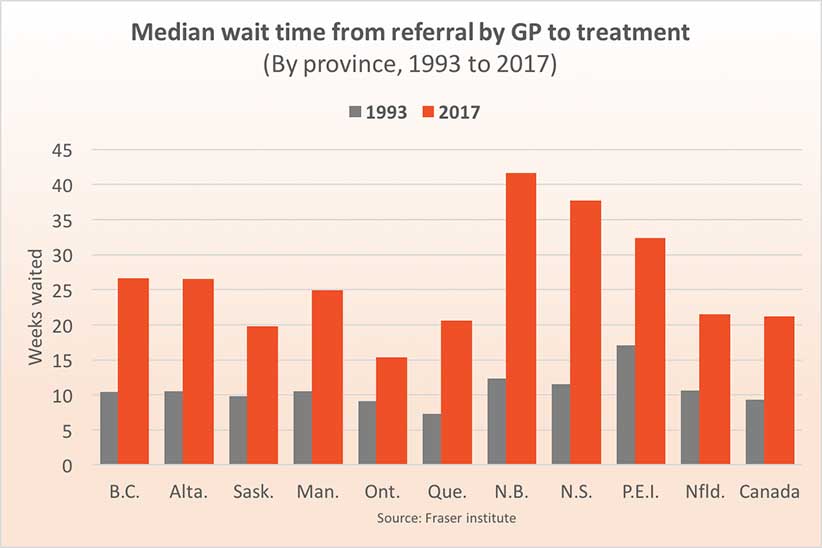
Wait times for health care treatment in Canada (Source: Fraser institute)

I get into conversations about politics with my co-workers about who they like in the 2020 election. And I also ask them which particular policies of the candidates they like best. The one they like most is Medicare for All, with “for All” including illegal immigrants. When I ask them which country has got Medicare for All working, they say “Canada”. Let’s take a look at Canada’s health care system.

Here’s a nice article from Mona Charen, posted in TownHall.

She writes:

It’s true that all Canadian citizens and legal residents (though not immigrants there illegally) get “free” health care, but only in the sense that you don’t get a bill after seeing a doctor or visiting a hospital. Medical care is subsidized by taxes, but the price comes in another form as well — rationing. A 2018 report from the Fraser Institute, a Canadian think tank, found that wait times between seeing a general practitioner and a specialist average 19.8 weeks. That’s the average. There are variations among specialties. Those hoping to see an orthopedist wait an average of 39 weeks in Nova Scotia, while those seeking an oncologist wait about 3.8 weeks.

[…]Imagine the anxiety of learning that you need an MRI to find out whether the mass in your breast is anything to worry about and then being told that the next available appointment is in 10 weeks. In addition to the psychic price, Canadians who had to wait for treatment expended an average of $1,822 out of pocket last year, due to lost wages and other costs. The Fraser Institute also calculated the value of the lost productivity of those waiting for treatment — nearly $5,600 per patient, totaling $5.8 billion nationally.

[…]When there’s an artificial shortage of a good or service, a black market usually follows. I have heard from several Canadians that paying doctors bribes to jump the line is not uncommon. But Canada has another pressure reliever: Ninety percent of Canadians live within 90 miles of the U.S. border, and medical centers in Buffalo, Chicago, Rochester and elsewhere receive tens of thousands of Canadian patients every year.

Regarding that last point, I’ve written many times about socialist politicians in Canada electing to travel to the United States for care, and that’s because (as you might expect) health care outcomes for Canadians are vastly inferior to health care outcomes for Americans. And keep in mind that the delay from specialist to GP does not take into account the delay to see the GP, or the delay from seeing the specialist to actually getting treatment.

And how much are Canadians spending for the privilege of waiting 19.8 weeks to see a specialist? Well, the average cost of Canadian health care is about $13,000 per household per year, paid through taxes. What that means is that people who work pay for all the health care being provided, including the health care for people who don’t work. But when it’s time to get treatment, those who pay the bills get in line behind those who don’t pay anything.

So how good is American health care? Maybe Canadians are waiting in line because their health care is so much better than ours.

American health care

One of the best health care policy experts writing today is Avik Roy, who writes for Forbes magazine.

Here is a recent column, which I think is useful for helping us all get better at debating health care policy.

Excerpt:

If you really want to measure health outcomes, the best way to do it is at the point of medical intervention. If you have a heart attack, how long do you live in the U.S. vs. another country? If you’re diagnosed with breast cancer? In 2008, a group of investigators conducted a worldwide study of cancer survival rates, called CONCORD. They looked at 5-year survival rates for breast cancer, colon and rectal cancer, and prostate cancer. I compiled their data for the U.S., Canada, Australia, Japan, and western Europe. Guess who came out number one?

The United States came out number one, and you can click here to see the larger graph of the complete results.

Some people like to point out that the United States has a low life expectancy, but there’s a problem with those numbers.

The article continues:

Another point worth making is that people die for other reasons than health. For example, people die because of car accidents and violent crime. A few years back, Robert Ohsfeldt of Texas A&M and John Schneider of the University of Iowa asked the obvious question: what happens if you remove deaths from fatal injuries from the life expectancy tables? Among the 29 members of the OECD, the U.S. vaults from 19th place to…you guessed it…first. Japan, on the same adjustment, drops from first to ninth.

It’s great that the Japanese eat more sushi than we do, and that they settle their arguments more peaceably. But these things don’t have anything to do with socialized medicine.

Finally, U.S. life-expectancy statistics are skewed by the fact that the U.S. doesn’t have one health-care system, but three: Medicaid, Medicare, and private insurance. (A fourth, the Obamacare exchanges, is supposed to go into effect in 2014.) As I have noted in the past, health outcomes for those on government-sponsored insurance are worse than for those on private insurance.

To my knowledge, no one has attempted to segregate U.S. life-expectancy figures by insurance status. But based on the data we have, it’s highly likely that those on private insurance have the best life expectancy, with Medicare patients in the middle, and the uninsured and Medicaid at the bottom.

If we’re going to discuss health care, then let’s discuss facts. We shouldn’t be picking a health care system from the campaign speeches of politicians who tell us that we can keep our doctor, and keep our health plan, and our premiums will go down. We tried electing a charismatic deceiver in 2008, and it didn’t work out. We lost our doctors, lost our health plans, and our premiums went up astronomically. We can do better than single-payer health care. We can do better than socialism.
We have single-payer health care already in the VA system – is it working?

VA health care wait times

This is health care policy expert Sally Pipes, writing in Investors Business Daily.

She writes:

new report from the Government Accountability Office has confirmed that the Department of Veterans Affairs can’t take care of those it’s supposed to serve.

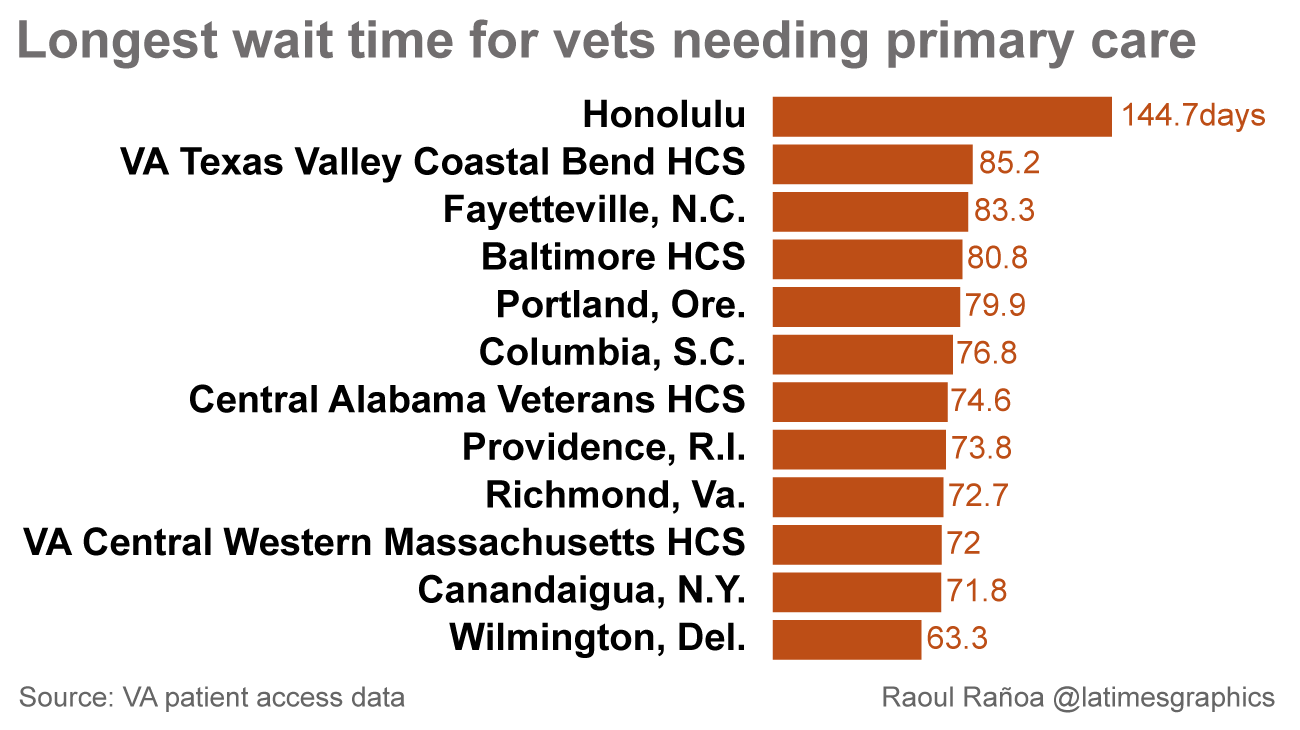
The GAO has placed the VA’s health system on the “high risk” list of federal programs that are vulnerable to “fraud, waste, abuse, and mismanagement.” The agency is still struggling to recover from an 8-month-old internal audit that revealed that returning soldiers had to wait more than 90 days for care. Some patients died while waiting.

The GAO’s findings apply far beyond the VA. The agency’s problems — which include long wait-times and out-of-control costs — demonstrate what happens in any government-run, single-payer health care system.

The VA’s failings ought to give pause to the liberal politicians and policy analysts who would love to introduce single-payer health care for all Americans. But they don’t seem to have heeded the GAO report. Within a week of its release, Rep. John Conyers, D-Mich., called for “Medicare for All.”

Champions of socialized medicine used to point to the VA as proof that single-payer worked. In 2011, economist Paul Krugman called it “a huge policy success story, which offers important lessons for future health reform.” In a 2009 debate with me, Princeton professor Uwe Reinhardt said that there’s an example of a single-payer system in the U.S. that works — the VA.

The VA offers lessons about health reform — just not the ones single-payer’s proponents have in mind.

Defenders of government-run health care claim that it will control costs by cutting out middlemen such as insurance companies. The evidence shows otherwise. According to the GAO, the VA budget more than doubled between 2002 and 2013 even as enrollment increased by less than a third.

Single-payer’s “guarantee” of access to high-quality care is a myth, too.

“Despite these substantial budget increases,” the GAO report says, “for more than a decade there have been numerous reports … of VA facilities failing to provide timely health care.”

Over the last decade, more than 63,000 veterans have been unable to get a doctor’s appointment. At least 40 veterans have died because of long waits.

Things aren’t likely to get better anytime soon. The VA has yet to act on more than 100 GAO recommendations for improving care.

Last summer, lawmakers allocated $10 billion to a program intended to reduce wait times by permitting veterans to see private doctors outside the VA system. So far, the agency has only authorized 31,000 vets to seek private care — out of a possible 8.5 million.

That has to change — 88% of veterans say that they want the ability to choose where they receive their care.

However, there is one military person who is getting health care – convicted traitor Bradley Manning. He’s getting sex-change surgery while he is in jail for leaking national security secrets to our enemies. He won’t have to wait at all for his health care. This is what happens when you take money out of your wallet, give it to the government, and then hope that when you get sick, someone in the government will decide that you are worthy of treatment. Which you aren’t, unless they want your vote.

It’s not just the VA health care system – government-run health care doesn’t work in other places:

The United Kingdom’s National Health Service, for instance, is notorious for denying patients everything from certain cancer medications to hip replacements.

The program is also financially unsustainable. According to its own medical director, Bruce Keogh, “if the NHS continues to function as it does now, it’s going to really struggle to cope because the model of delivery and service that we have at the moment is not fit for the future.”

In Canada’s single-payer system, the average wait time between referral from a general practitioner and the actual receipt of treatment by a specialist was more than four months in 2014. That’s nearly double the wait time of two decades ago.

The Canadian system is the one that Democrats want to emulate – but Canada’s rich left-wing politicians come here when they want care. They don’t want to wait in line. Why should we want to wait in line? We need to prefer consumer-driven health care over government-controlled health care.

White House review of VA finds “corrosive culture” to blame for poor patient care

The Wall Street Journal reports.

Excerpt:

A White House review of the VA health system points to a culture that has degraded the timely delivery of care and requires a restructuring to improve transparency and accountability.

Acting Secretary of Veterans Affairs Sloan Gibson and Rob Nabors, White House deputy chief of staff, told President Barack Obama on Friday that significant further action was needed to address systemic problems.

Six weeks after the president dispatched Mr. Nabors to assess problems within the VA, the president’s aide outlined a long list of issues affecting access to timely care at VA medical facilities.

Mr. Nabors’s work is the latest in a series of reviews and reports issued in the past two months, including those from the VA’s independent inspector general, the Office of the Special Counsel and the VA itself. The new report found what Mr. Nabors described as a “corrosive culture” that affects employee performance and patient care. He added that the Veterans Health Administration structure has “impeded appropriate management, supervision and oversight.”

The review also found that the VA’s goal for scheduling many medical appointments within 14 days is “arbitrary, ill-defined and misunderstood.” That goal had been set in 2011. The VA recently eliminated that 14-day target.

Mr. Gibson praised the report. “We know that unacceptable, systemic problems and cultural issues within our health system prevent veterans from receiving timely care,” he said in a statement.

The White House has scrambled to respond to evidence of widespread mismanagement within the VA and to fill a growing number of vacancies in top posts. An internal assessment also revealed improper appointment-scheduling procedures and efforts to hide long wait times across the VA health system.

Another interim report from the VA inspector general confirms that:

The VA’s independent inspector general office has said it would likely issue in August its full report on its sweeping review of the department. An interim report, issued just days before Mr. Shinseki’s resignation, showed problems throughout the VA. They included employees tinkering with official patient appointment wait times to make them seem much shorter than the actual times veterans were having to wait.

In case you were wondering why this is all happening in the VA health care system and not in the private health care system, it’s because the VA is 100% pure government-run health care, as health care expert Avik Roy explains in Forbes magazine. The VA is not scandal is not some sort of aberration from government-run health care. Long wait times and patient deaths are essential to government run health care, in practice.