Tag Archives: Venezuela

Good news: Venezuela and Argentina eject socialist governments

Political Map of South America

Investors Business Daily has some good news for us. The Democrat Party of Venezuela has been CRUSHED in a recent election.

Excerpt:

Venezuela’s voters delivered a sledgehammer blow to the country’s ruling Chavista socialists Sunday, winning a likely supermajority in the National Assembly. It’s a great awakening from a 17-year nightmare.

Given the past two decades of near-victories, electoral fraud, chicanery and fractious political opposition mistakes, many Venezuelans are still in disbelief at the scale of the victory in the nation’s legislative elections, which have decisively handed one of Venezuela’s leading governing bodies over to the democratic, pro-free-market opposition.

As this was written, the opposition, known by its Spanish initials MUD, had declared a 112-seat, or two-thirds, supermajority in the National Assembly as a result of Sunday’s vote. The Chavistas won just 46 seats.

It’s total victory in legislative terms and will enable the legislature to throw out politicized Supreme Court justices and appoint honest ones.

The new Congress can also boot corrupt election officials and appoint fair ones. And they will even be able to declare President Nicolas Maduro — the late dictator Hugo Chavez’s hand-picked successor — mentally unstable and unfit for office, or remove him for incompetence. They can also stop his executive orders dead.

The Congress also will have the power to free the 71 or so political prisoners now rotting in Chavista dungeons without trial, including top opposition leader Leopoldo Lopez. And Venezuela’s central bank will stop destroying the country’s money, now nearly worthless.

[…]Most important, the leftist government’s mismanagement of the economy — through currency controls that prevented imports of spare parts, created shortages of basics such as toilet paper and devastated the health care system — and the central bank’s infamous money-printing spree, which has pushed Venezuelan inflation to near 700%, made ordinary life for Venezuelans hellish. There also was corruption, with as much as 1 trillion dollars in oil earnings stolen or misappropriated over the years by high-living Chavista elites, whose lavish lifestyles mocked ordinary, poor Venezuelans.

Top it with the monstrous infiltration of the country by the drug lords, and the likelihood of an electoral housecleaning was perfectly clear.

Still, an element of disbelief remains, given how dirty the Chavista rulers have played their democracy game.

They have broken election rules, violated ballot secrecy, shut voters out and banned popular candidates from running. Many of those dirty tricks were evident in this election, too — the Chavistas illegally extended voting hours and campaigned at polling stations, to cite just a couple of examples.

But the opposition won anyway — with turnout so high, at 74.5%, and margins of victory so wide that the election was impossible to steal.

It helped that the the opposition had the wind at its back with the disastrous result of socialism. But it also helped that MUD had improved its electoral game over the years, learning from each near-miss election.

It also helped that MUD had strong leaders such as Maria Corina Machado and put out strong candidates with a clear, unified message — often summed up as “Down with the left.” And with all the pain of 17 years, it helped most of all that they never lost heart.

There is literally no different between the socialists of Venezuela and the Democrat Party in the United States. They are in lock step on every issue. Should the Democrat Party continue to hold power in America, we can look forward to a reckoning like this one in the future.
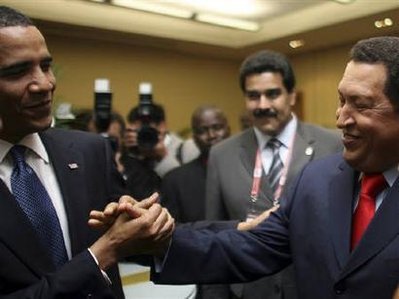
Two socialists shake hands: Barack Obama and Hugo Chavez

The Wall Street Journal says that the whole country is basically in the grip of ignorant socialists at every level, so there is lots to do.

Excerpt:

Pulling out of that death spiral, economists say, will require a series of painful and unpopular adjustments, rolling back more than a decade of populist and statist policies. Among the measures needed is raising the price of the world’s cheapest gasoline—which goes for less than one U.S. penny a gallon—overhauling a cumbersome and inefficient foreign-exchange system, and cutting generous social programs on which Venezuela’s poor depend.

[…]The government still controls more than 20 governorships, hundreds of mayors, the judiciary, much of the press and all auditing agencies. It will be up to Mr. Maduro whether to take steps to stabilize the economy, like loosening currency or price controls.

It’s not just Venezuela that has hit bottom under socialism. Recently, the people of Argentina also threw out their socialists after years and years of disastrous leftist policies.

The Chicago Tribune reports on last month’s election in Argentina.

Excerpt:

Under the current president, Cristina Fernandez, Argentina has become an international financial pariah. The country defaulted on debt last year in a long-running feud with hedge funds — remarkably, that was the eighth default in Argentina’s history.

Fernandez refused to settle. That’s left the country to squeak by in isolation, using protectionism and capital controls in a quixotic battle with globalism. The economy is stagnant, foreign currency reserves are dwindling and the inflation rate is around 30 percent. Last week, American Airlines said it stopped accepting pesos for ticket sales because it was tired of collecting revenue it couldn’t convert to dollars.

At times Argentina has embraced trade and economic openness, only to slip back into bad habits thanks to populist Peronistas like Fernandez. Macri, a conservative, wants to re-establish free market principles, but there are a lot of details he didn’t fully explain before his November victory because they will require some short-term pain, and he wanted to win the election.

Everything Macri is talking about makes sense. He says he will lift the capital controls that have wrecked the peso’s credibility. Like other backwaters it shouldn’t resemble, Argentina has a thriving black market because the government insists the peso is worth a lot more than its actual value. Freeing the currency would devalue it, a first step toward making Argentina more competitive.

The next big step would be to negotiate a settlement with the hedge funds that bought up Argentina’s debt after its previous default in 2002 and demand repayment. Fernandez got political mileage from attacking the “vultures,” but Macri seems to understand Argentina can’t get unstuck when it’s essentially shut out of international capital markets. He sounds like he wants to do a deal.

Macri’s got a tremendous balancing act to pull off: He’ll need to cut spending and reduce taxes without destroying the country’s big social safety net, while walking the country through a devaluation.

This is how countries that are ruled for a prolonged period by the political left eventually end up. I know so many of you lose heart and think that there is no hope, but there is hope. Even in countries where the left is running everything from the universities, to the judiciaries, to the mainstream media, there is hope.

Over the last 7 years, Obama added $10 trillion to the national debt. And although few of his Democrat low-information voters know about that, they will be able to tell the difference between prosperity and poverty when the United States reaches the Venezuela / Argentina tipping point. There comes a time when there are no more bailouts for the economics deniers. Reality wins in the end.

How well are Democrat Party economic policies working out in Venezuela?

I think that when we discuss economics, we should try to identify where specific policies have been tried and then we should observe the consequences to the people who tried them. Often, in college and university classrooms, one view of economics is sold to students by professors as the “nice” view. The professors, many of whom have never worked in the private sector in their entire lives, tell the students that socialism is the “nice” point of view, and anyone who disagrees is “mean”. Is that the right approach to teaching young people what to believe about economics?

Are Barack Obama and Hugo Chavez very different?

Let’s take a look at this article from Yahoo News about socialist dictator Hugo Chavez’s country of Venezuela, a country much admired by people on the socialist left.

It says:

All the lady wanted was some chicken. But in shortage-plagued Venezuela, she waited in line five hours, only to go home empty-handed.

“I got here at 5:30 am and came away with nothing! It is just not fair that you have to work so hard — and then put up with these lines,” said an exasperated Lileana Diaz, a 49-year-old receptionist at a hospital emergency room.
Venezuelans have been enduring shortages of the most basic goods, such as toilet paper, for more than a year.

In Caracas, a cottage industry has emerged with people who will wait in line for you — at a price.

But things are even worse outside the capital.

The problems are staggering here in Valencia, an industrial city west of the capital of this oil-rich country.

Valencia has big factories that produce food and other essentials. Still, the list of goods in short supply is long.

It includes coffee, cooking oil, cornmeal, soap, detergent, you name it.

Chicken is one of the most coveted.

Frustrated shoppers like Diaz are legion.

One tells the story of people who climbed over a fence to get a good place in line outside a store, prompting police to intervene and stop scuffles that broke out.

Another lady shopper shows off a nasty bruise on her right leg, thanks to a fight she got into as she tried to buy disposable diapers.

In recent weeks, the lines of people waiting hopefully outside supermarkets and stores have grown longer in cities away from the coast, such as Maracaibo, Puerto Ordaz and Cumana.

Venezuelan media have reported situations of nerves running very, very high and shoppers coming close to looting.

At times it has gotten that bad, in fact. In late January, one person died and dozens were arrested in the chaos of a looting outbreak at stores in the town of San Felix in the southern state of Bolivar.

[…]In another supermarket in Valencia, a line 50 meters (yards) long snakes away from the entrance.

“We call these ‘holding out hope lines,’ because once you get inside, there is nothing on the shelves,” said Oscar Oroste, a 53-year-old chef.

Oroste said that until recently, people would wait in line knowing what was available to buy. “Now, people are in line but do not even know what they will be sold.”

Venezuelans go from supermarket to supermarket, and store to store, clamoring for basic necessities which have prices regulated by the leftist government.

But some buy just to resell at a handsome profit, and economists say that is another source of the shortages.

Egne Casano, a 28-year-old homemaker, said things are a bit better in Caracas. “I went there not long ago and saw that there is a better supply,” she said.

[…]In the long lines, people digest their woes with a mix of humor, resignation and anger.

At another supermarket in Valencia, a whopping 600 people stood in line under a blazing sun to buy powdered milk.

Graciela Duran, a retiree, got a kilo of it after waiting for four hours.

“I was lucky today, Sometimes I come and there is nothing,” she said.

“Waiting in huge lines is what we do all day, every day,” said Duran, shielding herself from the sun with an umbrella.

A dozen police were stationed at the entrance of the store and around the parking lot through which the queue moved.

A truck drove by and the driver shouted out sarcastically: “Homeland, homeland, beloved homeland.”

That comes from a song that late president Hugo Chavez used to sing and is heard often on government-run media and at official events.

If you’re interested in real statistics on Venezuela, I recommend this recent article from The Economist, which is as far left as Venezuela is, and endorsed Barack Obama.

In socialism, the main purpose of policies is to make the leftist leaders at the top receive applause. They say things that will get them applause from the people. The policies are not intended to lift people out of poverty, otherwise Zimbabwe, North Korea, Cuba, Venezuela, etc. would all be rich and prosperous. The policies are intended to make the leaders feel good about themselves. “If you like your doctor, you can keep your doctor”. “If you like your health plan, you can keep your health plan”. It’s not true, it’s just meant to make economically-illiterate people applaud.

So why do we keep voting for socialism, when we know it doesn’t work?

Related posts

Eight predictions for 2015

These are from The Federalist.

The list:

  1. The oil stimulus
  2. The EPA’s war on energy
  3. The Supreme Court gets another shot at ObamaCare
  4. Republicans will have just enough power to fight over it
  5. Will anyone challenge Hillary?
  6. A police rebellion
  7. Russia will be in trouble and will be trouble
  8. Did anybody tell the enemy the war is over?

Here’s the one I want to highlight, because it’s the one that concerns me most, at least until we get a Republican President:

7) Russia will be in trouble and will be trouble.

One of the most enjoyable consequences of the oil price collapse is seeing how it takes the wind out of the sails of a whole collection of evil regimes.

Oil is the dictators’ best friend. It is a steady source of revenue that can be maintained and controlled by the government, often with the help of foreign subcontractors, even when government controls, corruption, and cronyism have crushed the rest of the economy. So a collapse in the price of oil is a disaster for the bad guys.

Nobody is getting hit worse than the regime in Venezuela, which is now on the verge of defaulting on its debt. Since Venezuela has been a big economic sponsor of the regime in Cuba, you can see how a Venezuelan collapse will affect Cuba—and may well be the reason the Castros are seeking a lifeline from President Obama.

But the big geopolitical implications will come from the impact of the oil collapse on Russia. For years, the conventional wisdom has been that Europe is dependent on buying Russian oil and gas; now we’re about to see to what extent Russia is dependent on selling its oil and gas to Europe.

The downside is, as Megan McArdle puts it, “Russia’s Problems Are Everyone’s Problems.” “[T]he world is about to experience a major financial crisis in a country that seems to deal with its internal troubles by slicing off bits of neighboring countries.” Like its leader, Vladimir Putin, Russia is a country with a Napoleon complex: the smaller and weaker it gets, the more belligerent it becomes, as a form of overcompensation.

But shirtless macho posturing only gets you so far when you don’t have the cash to back it up. There is some speculation that a financial crisis could lead to defections in Russia’s “near abroad,” its ring of former Soviet republics and fellow kleptocracies. Then there’s the fact that Putin’s aggression has permanently alienated Ukraine, which is now taking steps toward joining NATO. Meanwhile, the Baltic states are increasing their defense budgets. One hopes that other European nations will follow, at a time when Russia is not in a position to match their spending.

I think Russia is weak enough that Putin would slink away with his tail between his legs, if we had an American leader with the guts to call his bluff. But that’s not going to happen, so in 2015, look for a volatile mix of greater belligerence and diminished capability.

When I hear about the collapse of the Russian currency, it makes me worry that we could a lot of scary scenarios as Putin tries to hold his state together.