Tag Archives: Venezuela

Do young Americans know how well socialism is working in Venezuela?

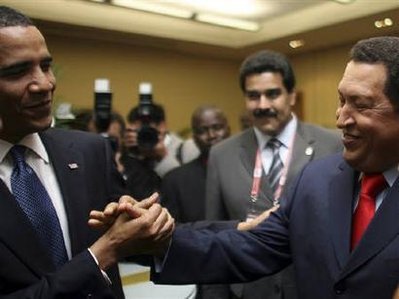
Two socialists shake hands: Barack Obama and Hugo Chavez

I’m very interested in how economic policy in different times and places affects the ability of Christians to carry out their Christian life plans. What economic policies should Christians support in order to be able to carry out their lives? Do Christians need to eat? Do they need to be safe from criminals? Do they need to be able to work or run a business without violating their consciences? Can a Christian be as charitable when he cannot even feed himself or his family?

When I talk to young evangelicals, they seem to be pretty in lockstep with the left on policies like raising the minimum wage, having government take over health care, environmental regulations on private sector energy companies to stop global warming, etc.

So, it’s worth it to look at how things work in places where socialism is actually being tried.

Here is an article from March 2013 from the radically leftist Slate. The headline is “Hugo Chavez’s economic miracle: The Venezuelan leader was often marginalized as a radical. But his brand of socialism achieved real economic gains”. The author is “a senior writer for the International Business Times”.

He writes:

Chavez became the bugaboo of American politics because his full-throated advocacy of socialism and redistributionism at once represented a fundamental critique of neoliberal economics, and also delivered some indisputably positive results. Indeed, as shown by some of the most significant indicators, Chavez racked up an economic record that a legacy-obsessed American president could only dream of achieving.

What did Chavez do, precisely, that caused the Venezuelan economic to boom? Well, he nationalized private industry and redistributed wealth from job creators and entrepreneurs to the poor.

As The Week correctly put it, while “Chavez’s policies of redistribution and nationalization of oil assets endeared him to Venezuela’s working class” and produced many laudable results, the country’s “oil-centric economy has taken away resources from other areas that are badly in need of development.”

Well, what happened next?

Consider this long and detailed article from the left-leaning The Atlantic. I can only quote part of it, but you really need to read this to understand what happens when country attacks all the people who were creating wealth and jobs with regulations, taxes, price controls and property seizure.

It says:

In the last two years Venezuela has experienced the kind of implosion that hardly ever occurs in a middle-income country like it outside of war. Mortality rates are skyrocketing; one public service after another is collapsing; triple-digit inflation has left more than 70 percent of the population in poverty; an unmanageable crime wave keeps people locked indoors at night; shoppers have to stand in line for hours to buy food; babies die in large numbers for lack of simple, inexpensive medicines and equipment in hospitals, as do the elderly and those suffering from chronic illnesses.

But why? It’s not that the country lacked money. Sitting atop the world’s largest reserves of oil at the tail end of a frenzied oil boom, the government led first by Chavez and, since 2013, by Maduro, received over a trillion dollars in oil revenues over the last 17 years. It faced virtually no institutional constraints on how to spend that unprecedented bonanza. It’s true that oil prices have since fallen—a risk many people foresaw, and one that the government made no provision for—but that can hardly explain what’s happened: Venezuela’s garish implosion began well before the price of oil plummeted. Back in 2014, when oil was still trading north of $100 per barrel, Venezuelans were already facing acute shortages of basic things like bread or toiletries.

The real culprit is chavismo, the ruling philosophy named for Chavez and carried forward by Maduro, and its truly breathtaking propensity for mismanagement(the government plowed state money arbitrarily into foolish investments);institutional destruction (as Chavez and then Maduro became more authoritarian and crippled the country’s democratic institutions); nonsense policy-making (like price and currency controls); and plain thievery (as corruption has proliferated among unaccountable officials and their friends and families).

A case in point is the price controls, which have expanded to apply to more and more goods: food and vital medicines, yes, but also car batteries, essential medical services, deodorant, diapers, and, of course, toilet paper. The ostensible goal was to check inflation and keep goods affordable for the poor, but anyone with a basic grasp of economics could have foreseen the consequences: When prices are set below production costs, sellers can’t afford to keep the shelves stocked. Official prices are low, but it’s a mirage: The products have disappeared.

When a state is in the process of collapse, dimensions of decay feed back on each other in an intractable cycle. Populist giveaways, for example, have fed the country’s ruinous flirtation with hyperinflation; the International Monetary Fund now projects that prices will rise by 720 percent this year and 2,200 percent in 2017. The government virtually gives away gasoline for free, even after having raised the price earlier this year. As a result of this and similar policies, the state is chronically short of funds, forced to print ever more money to finance its spending. Consumers, flush with cash and chasing a dwindling supply of goods, are caught in an inflationary spiral.

The rest of the article has horrifying details about what socialism really means: businesses shut down, shortages of food and medicine, government waste, skyrocketing crime, failing education system, Zika epidemic, water rationing, blackouts, and so on.

There was even an article this weekend in the radically leftist New York Times about the horrifying conditions of hospitals in Venezuela:

By morning, three newborns were already dead.

The day had begun with the usual hazards: chronic shortages of antibiotics, intravenous solutions, even food. Then a blackout swept over the city, shutting down the respirators in the maternity ward.

Doctors kept ailing infants alive by pumping air into their lungs by hand for hours. By nightfall, four more newborns had died.

“The death of a baby is our daily bread,” said Dr. Osleidy Camejo, a surgeon in the nation’s capital, Caracas, referring to the toll from Venezuela’s collapsing hospitals.

The economic crisis in this country has exploded into a public health emergency, claiming the lives of untold numbers of Venezuelans. It is just part of a larger unraveling here that has become so widespread it has prompted President Nicolás Maduro to impose a state of emergency and has raised fears of a government collapse.

Hospital wards have become crucibles where the forces tearing apart Venezuela have converged. Gloves and soap have vanished from some hospitals. Cancer medicines are often found only on the black market. There is so little electricity that the government works only two days a week to save what energy is left.

At the University of the Andes Hospital in the mountain city of Mérida, there was not enough water to wash blood from the operating table. Doctors preparing for surgery cleaned their hands with bottles of seltzer water.

“It is like something from the 19th century,” said Dr. Christian Pino, a surgeon at the hospital.

The figures are devastating. The rate of death among babies under a month old increased more than a hundredfold in public hospitals run by the Health Ministry, to just over 2 percent in 2015 from 0.02 percent in 2012, according to a government report provided by lawmakers.

The rate of death among new mothers in those hospitals increased by almost five times in the same period, according to the report.

Here in the Caribbean port town of Barcelona, two premature infants died recently on the way to the main public clinic because the ambulance had no oxygen tanks. The hospital has no fully functioning X-ray or kidney dialysismachines because they broke down long ago. And because there are no open beds, some patients lie on the floor in pools of their own blood.

This is not happening because of capitalism and the greedy rich. It is happening because of hatred and persecution of entrepreneurs and job creating private businesses. But, if you read books on economic policy like “The Spirit Level”, which is written by socialists, countries like Venezuela that have lower income inequality have lower infant mortality, lower crime rates and better health care. Socialism works great in academia, not so well in a North Korean work camp.

It’s not just Venezuela. This article from Investors Business Daily covers how well socialism is going in countries like France, Brazil and Argentina. It never works.

Now, in most churches, pastors are more concerned with making people feel good so that the coins continue to fall into the offering plate. Therefore, they carefully stay clear of topics like economics, business and entrepreneurship. The question that we need to ask ourselves is this: how easy is it for you to live out a Christian life in a country where poverty, crime, and government suppression of free speech and religious liberty are rampant? Shouldn’t part of being a Christian mean voting for public policies that actually help poor people have opportunities, children in broken homes and victims of crime, instead of just embracing what sounds nice and makes us feel good?

In case I need to be clearer, I mean that Christians who embrace socialism are taking us down the road to serfdom because of their ignorance of economics. And it’s not just the Democrats. Christians who support Donald Trump are embracing import tariffs, opposing free trade, raising taxes, raising the minimum wage, government seizing private property, and so on. That’s socialism, too. And we won’t escape the consequences of our economic ignorance anymore than the well-meaning Venezuelan voters did when they elected their strong man to rescue them.
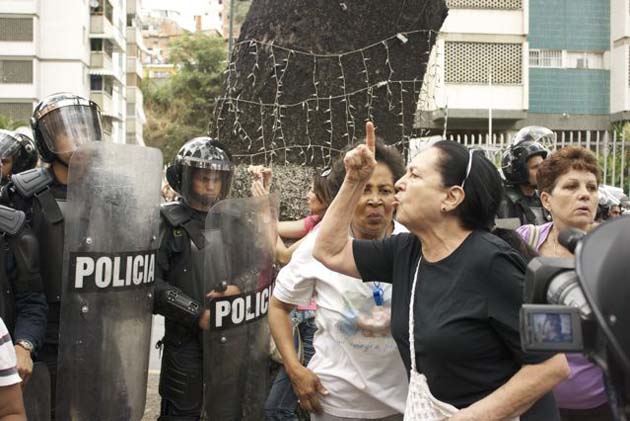

How well does socialism work in countries and cities that adopt it?

Socialism in Venezuela

I noticed this article by Frank Luntz in USA Today, which talks about the political views of young people.

Excerpt:

If you want to understand today’s young Americans, consider this: 58% of them think “socialism” is the most compassionate political system, compared with just 33% who pick “capitalism.”  Heck, 9% even voted for “communism.”

That’s right: Two-thirds in a poll I did last month say socialism or communism is more compassionate than capitalism.

[…]In our recent national survey of 1,000 first- and second-time voters ages 18 to 26, Republicans weren’t just off on the wrong track. They were barely on the radar with this Snapchat generation, as it is sometimes called.

[…]The younger generation and the Republican Party simply see the world, and America, very differently. For instance, 58% in our poll say that “America isn’t any better or worse than most other countries,”compared with a 42% minority that believes “America is exceptional. It’s better than every other country in the world.

So how to respond to this? Well, I think it is important for us to be aware of how other countries are doing, especially the ones that are implementing socialism.

Socialism abroad

Take Venezuela for example. They’ve had socialism for a good long time under Hugo Chavez, and now his socialist successor Nicolas Maduro.

The left-leaning The Economist explained what’s happening there:

The regime has greatly compounded the damage with policies that, though designed to favour the poor, end up impoverishing them and the state. Price controls—along with the shortage of foreign exchange—have led to acute shortages of basic goods, forcing people to queue for hours to buy necessities. Inflation is officially running at 141% as of September last year (the latest available figure). Analysts believe the true figure is at least 200% a year; some predict hyperinflation in 2016. The massive budget deficit, which the Central Bank finances by printing money, contributes to that risk.

[…]Recent surveys have shown that alongside the economy and shortages, security is a major concern. The government stopped publishing comprehensive crime statistics in 2005, though it does admit there is a problem. The attorney-general has said that Venezuela’s murder rate last year was 62 per 100,000 people, ten times the global average. The Venezuelan Violence Observatory, an independent research institute, says the rate is higher. The murder rate in Caracas is the highest in the region for a country’s biggest city. Countrywide, 90% of murders go unpunished.

Radically leftist NPR notes:

Last week, opposition lawmakers in Venezuela declared a “food emergency.” That’s because Venezuela is facing widespread shortages of milk, meat, bread and other staples. Critics blame the government’s socialist economic policies. But instead of changing course, President Nicolás Maduro is calling on Venezuelans to help feed themselves — by starting urban gardens.

[…]In addition, falling prices for oil — Venezuela’s main export — mean the government has fewer dollars to import food. There’s also a severe shortage of imported farm machinery and supplies, says Vicente Perez, director of FEDEAGRO, Venezuela’s main farm organization.

“There is nothing — just like there’s no food, there are no seeds, no herbicides … and no medicines to vaccinate farm animals,” says Perez.

Phil Gunson, who is based in Caracas for the International Crisis Group, warns of a pending humanitarian crisis.

“At least one in 10 people is eating two meals a day or less. There isn’t starvation. We are not talking about famine,” Gunson says. “But we are talking about malnutrition, particularly in the case of children.”

If you’re looking for a country that’s embraced socialism, you can’t do much better than Venezuela. Maybe Argentina, but they are also in serious economic trouble. Do you know any young people who are not being told about that?

Well, what about closer to home? How are the major cities in the United States doing?

Socialism at home

This article from Investors Business Daily takes a look at it.

Excerpt:

America is awash with troubled, dysfunctional cities that have been electing Democratic mayors for decades.

  • Detroit last elected a Republican mayor in 1957. It is now the model of urban failure — it’s recognized more for its poverty, crime, rot and bankruptcy than the great cars that it turned out into the early 1970s. It is the poorest big city in the nation, with almost 40% of the population living below the poverty line. The website Law Street actually ranks Detroit ahead of Flint as the country’s most dangerous city. Either way, it’s clear that both cities have institutionalized crime problems.

Detroit is also a pit of political corruption. Just in recent years, one mayor, Kwame Kilpatrick, was convicted of corruption and sent to federal prison for 28 years, while building inspectors have been indicted on federal felony bribery charges and a former city council member was investigated in a bribery and kickback scandal.

  • Chicago’s last GOP mayor was elected in 1927. The nation’s third-largest city is home to some of the worst inner-city violence imaginable. More than 2,300 people were shot there last year, and nearly 400 lost their lives to homicides.

Its finances are just as grim. “Chicago is so broke,” IBD contributor Stephen Moore explained months ago, “that its bonds are junk status, and Mayor Rahm Emanuel had to go hat in hand last week to the state capital, Springfield, for bailout money to pay the bills.” Things have been rotten enough, Moore said, to send “a record number of people … fleeing Cook County, home to Chicago.” Only a little more than half of the city’s pension liabilities are funded.

  • St. Louis has been electing Democratic mayors since 1949. The Gateway to the West has become the gateway for crime. Law Street says that it’s the fourth most dangerous city in the country, Forbes says it’s the second. It had the sixth-highest poverty rate among big cities in 2014.
  • The last GOP mayor of Philadelphia left office in 1952. A few years ago, Moore identified it as a favorite to follow Detroit into bankruptcy.
  • Both Baltimore and Oakland had Republican mayors as late as the 1960s. In the era of Democratic rule, both are now more well known for their crime and poverty problems than for their charm and character.
  • Newark, N.J., hasn’t had a GOP mayor in more than a century. It was ranked as the fifth-worst city to live in in 2015. Detroit, of course, was first.

When Democrats are in control, cities tend to go soft on crime, reward cronies with public funds, establish hostile business environments, heavily tax the most productive citizens and set up fat pensions for their union friends. Simply put, theirs is a Blue State blueprint for disaster.

If you want to know how well Democrats do at running things, why not look to the places where Republicans have been out of power for decades and decades?

If you don’t tell the young people you know about socialist countries and socialist cities, then how will they ever learn how socialism actually works in practice? They are learning that socialism is wonderful from their unionized public school teachers, Hollywood elites, the mainstream media, artists and musicians and Democrat politicians. Are you doing your part to educate them with real facts?

New study: incomes of the poorest 20% of households are much lower than in 2007

Is Barack Obama focused on protecting the American people?
Does Barack Obama’s knowledge of policy match his confidence?

Now, many American voters like to think that if the President expresses concern about things like poverty and income inequality, then that means that whatever he does to “fix” it will automatically work to benefit the poor. Is it true?

Here is an article from Investors Business Daily, which talks about a study from the respected, leftist Brookings Institute.

Excerpt:

President Obama’s upbeat assessment of the economy is not likely to sit well with low-income families living in major urban or metro areas. For them, economic decline is a harsh reality, not “fiction.”

In his State of the Union speech, Obama declared that “anyone claiming that America’s economy is in decline is peddling a fiction.”

But a new report from the liberal-leaning Brookings Institution finds that incomes among the poorest fifth of households was significantly lower than it was in 2007. Of the 100 cities it examined, incomes fell an overall average of 12%, according to the report’s data. In some, the drop was huge — 34% in Stockton, Calif., 31% in New Haven, Conn., and 30% in Lakeland, Fla.

At the other end of the spectrum, the top 5% of households saw incomes climb, but not by much. The average income for this group was basically unchanged over those years.

As a result, income inequality has increased, but not — as Obama, Bernie Sanders and the chorus of liberal Democrats would have you believe — because the rich are getting richer.

“It’s really about the poor losing ground rather than these upper-class households pulling away,” Brookings senior fellow Alan Berube told AP.

[…]Added to this, many of the cities that saw the biggest increases in income inequality — like Boston; New Orleans; Providence, R.I.; New Haven, Conn.; San Francisco, Washington, D.C. — have been bastions of “spread the wealth around” liberalism.

Another example of this would be Obamacare. Obama got up in front of his teleprompters and told everyone that he was going to make changes to health care policy. He promised that it would not add one dime to the deficit, that we could keep our doctors, that we could keep our health plans and that our health insurance premiums would go down. Every single one of those promises were lies.

We don’t know if Obama knows that he is lying when he says these things. I prefer to think that he is just too stupid to know what he is talking about. He says things that make him feel good. Things that would have pleased his professors in college. But since he has no practical experience of achieving results in any of these areas, he fails again and again. He is confident because he assumes a knowledge of how to obtain results that he does not actually have, owing to his lack of experience. And yet we elected him, then re-elected him.

He is in his own little world, where the people around him carefully insulate him from a reality where all his confident prescriptions have failed to produce what he intended.

Could it be that the free enterprise system of economics that was “built in” to America at the founding actually works better than the failed systems of socialism and communism that Obama was taught in college? Could it be that if we just stuck with the free enterprise system that made us the most powerful economy in the world, that things would be better for the poor than in places where capitalism is rejected for socialism?

We don’t have to guess at what the economic policies of the left produce. You can see it with your own eyes in socialist countries like Venezuela, Cuba, North Korea, Argentina, and so on.