
Tag Archives: Values

How faith, virtues and marriage are declining among blue collar Americans

Brad Wilcox writes about a new book entitled “Coming Apart” in the Wall Street Journal.

Excerpt:

So much for the idea that the white working class remains the guardian of core American values like religious faith, hard work and marriage. Today the denizens of upscale communities like McLean, Va., New Canaan, Conn., and Palo Alto, Calif., according to Charles Murray in “Coming Apart,” are now much more likely than their fellow citizens to embrace these core American values. In studying, as his subtitle has it, “the state of white America, 1960-2010,” Mr. Murray turns on its head the conservative belief that bicoastal elites are dissolute and ordinary Americans are virtuous.

Focusing on whites to avoid conflating race with class, Mr. Murray contends instead that a large swath of white America—poor and working-class whites, who make up approximately 30% of the white population—is turning away from the core values that have sustained the American experiment. At the same time, the top 20% of the white population has quietly been recovering its cultural moorings after a flirtation with the counterculture in the 1960s and 1970s. Thus, argues Mr. Murray in his elegiac book, the greatest source of inequality in America now is not economic; it is cultural.

He is particularly concerned with the ways in which working-class whites are losing touch with what he calls the four “founding virtues”—industriousness, honesty (including abiding by the law), marriage and religion, all of which have played a vital role in the life of the republic.

Consider what has happened with marriage. The destructive family revolution of the late 1960s and 1970s has gradually eased—at least in the nation’s most privileged precincts. In the past 20 years, divorce rates have come down, marital quality (self-reported happiness in marriage) has risen and nonmarital childbearing (out-of-wedlock births) is a rare occurrence among the white upper class. Marriage is not losing ground in America’s best neighborhoods.

But it’s a very different story in blue-collar America. Since the 1980s, divorce rates have risen, marital quality has fallen and nonmarital childbearing is skyrocketing among the white lower class. Less than 5% of white college-educated women have children outside of marriage, compared with approximately 40% of white women with just a high-school diploma. The bottom line is that a growing marriage divide now runs through the heart of white America.

This whole article is worth reading, because it talks about some of the other areas that are declining in middle class America. I have added the book to my wishlist.

It seems as though Theodore Dalrymple’s description of the British lower classes in his book “Life at the Bottom” has come to America. He argues in that book that the new moral relativism of the elites works well enough for them because they have money, but it is very harmful to the poor, if the poor adopt moral relativism. I always believed that America would be safe from moral relativism. Recently, I was trying to argue with some British Christians about how the secularization of Britain was leading to the decline of marriage and the nuclear family. I point out their 45% out-of-wedlock birth rate, and they pointed out our 40% out-of-wedlock birth rate. We are right behind them, and it really makes me sad. Children need a mother and a father to take care of them.

When arguing with liberals about the importance of marriage, I like to use two good articles from the Heritage Foundation. I argue that when marriage goes, many bad things happen, like child poverty and child abuse. You would think that the government would do something about the decline of marriage, but people on the secular left often don’t like marriage, because there are traditional roles for husbands and wives that clash with their feminism. They don’t like the working father and the mother staying at home – not even if that creates the most stable environment for the children
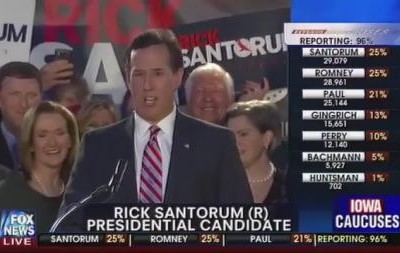
150 evangelical leaders agree to endorse Rick Santorum after two-day conference

Rick Santorum Iowa Caucuses

From Life News.

Excerpt:

After a Friday-Saturday meeting with more than 150 leaders and representatives of evangelical, pro-family and pro-life groups, the organizations have declared consensus support for Rick Santorum’s Republican presidential campaign.

Tony Perkins, the president of the Family Research Council and a participant in last night’s private meeting, addressed a press conference call today to provide additional information about the decision and expected endorsements from some of those attending.

Perkins said the leaders of the evangelical groups came to the meeting each supporting the various different GOP candidates seeking to replace pro-abortion President Barack Obama. Participants engaged in a question and answer session with representatives of each of the campaigns, except for former Utah Governor Jon Huntsman, who did not send a spokesman to the event.

After the session, the leaders discussed the presidential race amongst themselves and then undertook a three-round ballot process. Perkins said the discussion culminated in an agreement that the groups and leaders each have “an overriding passion and desire to defeat Barack Obama” this November. Although the leaders of the various organizations strongly support various candidates, they eventually decided to support Santorum.

“I think it was vigorous discussion of who they felt best represented the conservative movement and who they think had the best chance of succeeding,” he said, but adding that there would not be a “coordinated effort” amongst the groups and leaders to endorse Santorum.

“There is a hope and expectation that those represented by the constituency will make a difference in South Carolina,” he said, adding that some in attendance threw their support behind Santorum to avoid having a repeat of 2008 where conservative candidates split the vote.

Perkins indicated Santorum, Newt Gingrich and Rick Perry but only Gingrich and Santorum made the final ballot. There were 114 votes on the final ballot, as some leaders had to catch returning flights home, and Santorum emerged with a majority (85) of those voting, the FRC president said.

[…]The names and groups participating were not released, but Perkins mentioned former Republican presidential candidate Gary Bauer as another organizer of the private meeting. He said the names of organizations and leaders participating will become public as they begin making endorsements.

[…]Last week, the pro-life group CatholicVote issued an endorsement for Santorum.

Bauer has already endorsed Santorum. I agree that Gingrich is definitely the runner-up, and would be a fine choice for conservatives, but Santorum really is the best overall. My biggest concern about this is how younger evangelicals are so apathetic when it comes to politics and have no idea how to think carefully about things like free market capitalism, abortion, marriage and peace through strength. The young evangelicals are largely illiterate, making their decisions based on emotions and intuitions, because they think that Christianity is about being “nice” so that more people like them. Oh well.

What I find interesting is when even moderate conservative bloggers – ones who are not evangelical – are beginning to notice that there is an integrity argument for Rick Santorum.

Look at this comment from Jeff Goldstein – he’s replying to some Ron Paul person, I guess:

BMoe –

We’ve talked at length about this here, so if you haven’t already done so, I’d say go back and look at the various riffs on how Santorum’s ideas of family as the unit of individual autonomy is tied to his Catholicism / Thomism. Also, how family communitarianism is not at all like collectivism.

My own belief — and James Pethokoukis took this up, as well (I believe I did a post on it), is that Santorum is reacting in the excerpt on individualism you cite, to the Objectivists — those whose ideological foundation is Rand. That is, the libertarians. You may disagree with Santorum — and there’s plenty of room to do so — but it does no good to caricature the belief. Santorum is not a collectivist. And his ideas about the family — and government’s role in nurturing that unit — amount to things like increased tax credits for producing new citizens, or increased credit for charitable giving, so that charity is taken away from the state.

And he tries to balance his own views with the constraints placed on elected officials by the Constitution, which for Santorum includes the 9th and 10th Amendments.

These are often difficult waters to traverse. But with Santorum, he tells you what he thinks and believes. For me, that’s a net positive.

Romney mouths platitudes about limited government, and yet it’s clear he doesn’t believe a word of it. Santorum believes in a social safety net for the truly disadvantaged and indigent, but he tempers that with an animus toward those who would game the system — and toward programs that have the net impact of institutionalizing dependence on government.

What I liked about Cain — he didn’t have all the answers, because he hasn’t studied every question — I like about Santorum. You can see his thinking. He shows his work.

And a bit later, same guy:

Also, BMoe, I think it pretty obvious by now I’m not a social conservative. I’m just far less bothered by them then I used to be back when I was given to accepting the caricature of such creatures.

Nowadays I see that it is the “liberal” secularists who are far more dangerous, because their God is the State, and they therefore serve their God by granting that ever more power comes from the State.

The religious folk simply want the state to leave them the f**k alone, often times. And me and my spaghetti bulbs tend to commiserate.

I think that’s right. I am not thrilled with Santorum’s blue-collar worker economic plan. I’m an investor and a white collar software engineer. I’m chaste and have no children and no plans to marry, so Santorum’s tripling of the tax deduction for children won’t help me. But what is appealing about the man is his vision: he wants more working families and he wants them to face less financial pressure if they have more children, and more choice in education. I get that. It’s not applicable to me, but I get it. I get what his vision is.

Rick Santorum at the Values Voters Summit

Here’s a 3-part speech by Rick Santorum at the Family Research Council:

Part 1:

Part 2:

Part 3:

The Family Research Council is my third favorite think tank, behind the Heritage Foundation and the American Enterprise Institute.

Here’s something to read if you can’t see the speech.

Related posts

How health care mandates drive up health care costs

From Investors Business Daily.

Excerpt:

The ObamaCare legislation gives the administration the authority to compile a list of female preventive services that all new health insurance plans will have to cover without employing deductibles or charging co-payments. A medical advisory panel is recommending that birth control services should be one of these services.

The committee from the National Academy of Sciences’ Institute of Medicine that issued the guidelines also suggests that free breast-pump rentals, counseling for domestic violence, annual wellness exams and HIV tests be part of all health insurance plans.

These mandates won’t come without significant costs. The additional benefits won’t be free, despite the left’s loose usage of that word in association with health care. The mandates will force insurance premiums higher and someone will pay.

The Congressional Budget Office said years ago that existing mandates at the state level — there are more than 2,000 of them, according to the Council for Affordable Health Insurance — raise premiums by 15%.

That’s just a starting point. CAHI, which has done heavy work on this issue, believes that state mandates push premiums up by 20%. In some states, the increase can be as high as 50%. The result is a cost curve that bends upward, not down.

Mandates at the state level run from the expected to the bizarre. They require insurers to provide such unorthodox coverage as wigs (hair prostheses), Oriental medicine, port-wine stain elimination, smoking cessation, acupuncture, midwives, counseling, and marriage, occupational and massage therapists.

As we’ve noted before on these pages, the state mandates are an insult to common sense. Why would a single man need an insurance package that covers in vitro fertilization, maternity leave, midwives, breast reduction or mammograms?

Does it make sense for a childless, unmarried woman to be forced into a plan that includes care for a newborn and screening for prostate cancer? And is there any reason a teetotaler’s policy should cover alcohol abuse?

These regulations are not only asinine, they wreck the health insurance marketplace. The longer the list of mandates, the less competition there is. When insurers have to carry these gold-plated packages, they can’t compete with lower-priced plans that have fewer benefits. This can price some customers entirely out of the private market.

Here’s a post from Ruth Blog that makes the financial aspects clearer, using “free” contraception as an example.

Excerpt:

First of all, preventive medicine implies the prevention of a pathological condition. Pregnancy is anything but pathological. Artificial contraception is an elective medical therapy for those desiring to block a totally normal and healthy physical condition. Not only is contraception elective, but the decision to have sex should be elective as well.

Secondly… If an unmarried woman makes the conscious decision to be sexually active, it seems she should also bear the consequences of such a decision. Her partner should be willing to share any burdens of the relationship, including the financial cost of sexual relations. If a woman is not in a stable relationship, it seems unreasonable to demand someone else has to pay for her sexual dalliances.

[…]Sexual activity is elective. Preventing the normal consequence of sexual activity, pregnancy, is elective. The use of artificial contraception to prevent pregnancy is a personal lifestyle choice, not a medically recommended therapy. Therefore, artificial contraception should not be considered mandated preventive medical care. In these tight fiscal times, we cannot afford to be too inclusive with what constitutes preventive medicine.

Note that the artificial conception would be free for women who want to have children without fathers. And we know how that works out.

The Heritage Foundation points out that mandates actually reduce the freedom and prosperity of women who don’t use these services.

Excerpt:

Many Americans find the use of birth control morally objectionable, and some women may simply have no need for a health plan that covers these services, based on any number of personal choices and other factors. Those that fall into this category would have no choice but to pay for unnecessary coverage if the recommendations are made law.

[…]If HHS takes an overly prescriptive approach regarding these particular measures, women who would prefer not to pay the higher premiums to carry health benefits they don’t need or to which they object won’t have that option.

In a truly market-based insurance exchange, women would be able to choose a health plan that met their needs and was consistent with their values, and those who wished to forgo certain benefits would have the freedom to do so. If any attempt at health reform is to succeed at reducing costs and tailoring coverage to the specific needs of each individual, it must ensure that consumers are able to choose the plan and benefits that work best for them, rather than submitting to the decisions of a bureaucratic board.

There is no opt out for moral women when these things are mandated as minimum coverages in every policy. There is no escape. My fear is that women would be forced to pay for these services and then feel obligated to use them since that is the only way to get any value for the money that is being forcibly extracted from them.

What health care mandates really achieve is 1) to buy votes from the providers of the mandated services, and 2) to transfer wealth from people who don’t want or need these elective services (e.g. – single chaste Christian men) to people who need it because of their own elective lifestyle choices. And the more I have to pay to subsidize other people’s breast implants, contraceptives, STI  treatments, abortions and in vitro fertilizations, the less I can afford to do the things that I want to do, which isn’t fair. My money is my money, and their money is their money. I should be allowed to keep what I earn and buy only the health care that I need. I have other uses for that money. Let the government do-gooders find some other way to boost their self-esteem instead of playing Robin Hood with health care.