Tag Archives: VA

We have single-payer health care already in the VA system – is it working?

VA health care wait times

This is health care policy expert Sally Pipes, writing in Investors Business Daily.

She writes:

new report from the Government Accountability Office has confirmed that the Department of Veterans Affairs can’t take care of those it’s supposed to serve.

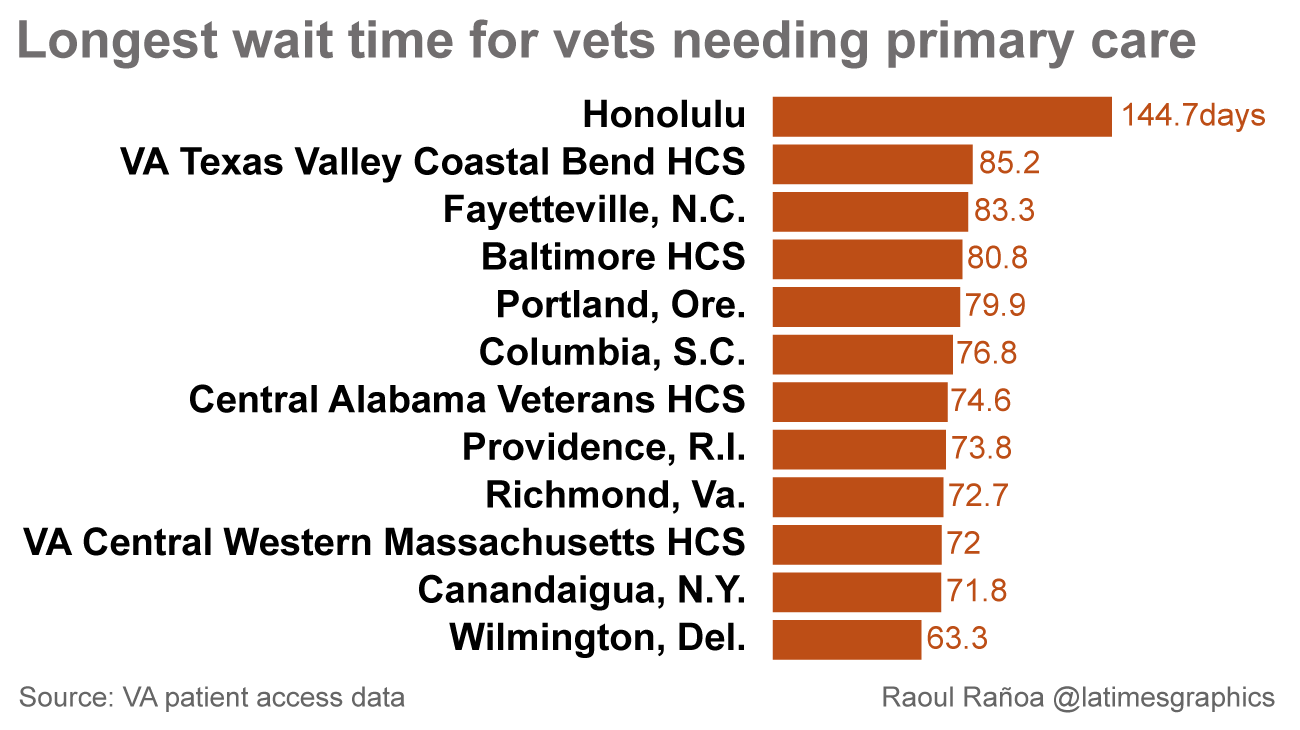
The GAO has placed the VA’s health system on the “high risk” list of federal programs that are vulnerable to “fraud, waste, abuse, and mismanagement.” The agency is still struggling to recover from an 8-month-old internal audit that revealed that returning soldiers had to wait more than 90 days for care. Some patients died while waiting.

The GAO’s findings apply far beyond the VA. The agency’s problems — which include long wait-times and out-of-control costs — demonstrate what happens in any government-run, single-payer health care system.

The VA’s failings ought to give pause to the liberal politicians and policy analysts who would love to introduce single-payer health care for all Americans. But they don’t seem to have heeded the GAO report. Within a week of its release, Rep. John Conyers, D-Mich., called for “Medicare for All.”

Champions of socialized medicine used to point to the VA as proof that single-payer worked. In 2011, economist Paul Krugman called it “a huge policy success story, which offers important lessons for future health reform.” In a 2009 debate with me, Princeton professor Uwe Reinhardt said that there’s an example of a single-payer system in the U.S. that works — the VA.

The VA offers lessons about health reform — just not the ones single-payer’s proponents have in mind.

Defenders of government-run health care claim that it will control costs by cutting out middlemen such as insurance companies. The evidence shows otherwise. According to the GAO, the VA budget more than doubled between 2002 and 2013 even as enrollment increased by less than a third.

Single-payer’s “guarantee” of access to high-quality care is a myth, too.

“Despite these substantial budget increases,” the GAO report says, “for more than a decade there have been numerous reports … of VA facilities failing to provide timely health care.”

Over the last decade, more than 63,000 veterans have been unable to get a doctor’s appointment. At least 40 veterans have died because of long waits.

Things aren’t likely to get better anytime soon. The VA has yet to act on more than 100 GAO recommendations for improving care.

Last summer, lawmakers allocated $10 billion to a program intended to reduce wait times by permitting veterans to see private doctors outside the VA system. So far, the agency has only authorized 31,000 vets to seek private care — out of a possible 8.5 million.

That has to change — 88% of veterans say that they want the ability to choose where they receive their care.

However, there is one military person who is getting health care – convicted traitor Bradley Manning. He’s getting sex-change surgery while he is in jail for leaking national security secrets to our enemies. He won’t have to wait at all for his health care. This is what happens when you take money out of your wallet, give it to the government, and then hope that when you get sick, someone in the government will decide that you are worthy of treatment. Which you aren’t, unless they want your vote.

It’s not just the VA health care system – government-run health care doesn’t work in other places:

The United Kingdom’s National Health Service, for instance, is notorious for denying patients everything from certain cancer medications to hip replacements.

The program is also financially unsustainable. According to its own medical director, Bruce Keogh, “if the NHS continues to function as it does now, it’s going to really struggle to cope because the model of delivery and service that we have at the moment is not fit for the future.”

In Canada’s single-payer system, the average wait time between referral from a general practitioner and the actual receipt of treatment by a specialist was more than four months in 2014. That’s nearly double the wait time of two decades ago.

The Canadian system is the one that Democrats want to emulate – but Canada’s rich left-wing politicians come here when they want care. They don’t want to wait in line. Why should we want to wait in line? We need to prefer consumer-driven health care over government-controlled health care.

White House review of VA finds “corrosive culture” to blame for poor patient care

The Wall Street Journal reports.

Excerpt:

A White House review of the VA health system points to a culture that has degraded the timely delivery of care and requires a restructuring to improve transparency and accountability.

Acting Secretary of Veterans Affairs Sloan Gibson and Rob Nabors, White House deputy chief of staff, told President Barack Obama on Friday that significant further action was needed to address systemic problems.

Six weeks after the president dispatched Mr. Nabors to assess problems within the VA, the president’s aide outlined a long list of issues affecting access to timely care at VA medical facilities.

Mr. Nabors’s work is the latest in a series of reviews and reports issued in the past two months, including those from the VA’s independent inspector general, the Office of the Special Counsel and the VA itself. The new report found what Mr. Nabors described as a “corrosive culture” that affects employee performance and patient care. He added that the Veterans Health Administration structure has “impeded appropriate management, supervision and oversight.”

The review also found that the VA’s goal for scheduling many medical appointments within 14 days is “arbitrary, ill-defined and misunderstood.” That goal had been set in 2011. The VA recently eliminated that 14-day target.

Mr. Gibson praised the report. “We know that unacceptable, systemic problems and cultural issues within our health system prevent veterans from receiving timely care,” he said in a statement.

The White House has scrambled to respond to evidence of widespread mismanagement within the VA and to fill a growing number of vacancies in top posts. An internal assessment also revealed improper appointment-scheduling procedures and efforts to hide long wait times across the VA health system.

Another interim report from the VA inspector general confirms that:

The VA’s independent inspector general office has said it would likely issue in August its full report on its sweeping review of the department. An interim report, issued just days before Mr. Shinseki’s resignation, showed problems throughout the VA. They included employees tinkering with official patient appointment wait times to make them seem much shorter than the actual times veterans were having to wait.

In case you were wondering why this is all happening in the VA health care system and not in the private health care system, it’s because the VA is 100% pure government-run health care, as health care expert Avik Roy explains in Forbes magazine. The VA is not scandal is not some sort of aberration from government-run health care. Long wait times and patient deaths are essential to government run health care, in practice.

VA socialized medicine: bonuses awarded as customers died on waiting lists

In the private sector, bonuses are paid to people who can offer customers the best products and services at the lowest price. That’s how a firm like Apple or Amazon makes a profit. By pleasing customers. But government-run firms make money a different way – by killing customers.

Stephen Moore explains in Investors Business Daily.

Excerpt:

The Veterans Affairs Department health care scandal has deepened in recent days, with new revelations of incompetent management and misplaced spending priorities, including millions of dollars paid out in bonuses at the very hospitals where services were the worst.

[…]Freedom of Information Act requests by Illinois-based watchdog group Open the Books reveal that the VA spent millions on bonuses during the last three years at Hines.

Worse, in 2013, only about one-in-four of Hines’ 4,230 employees were those providing the actual primary care: doctors (309) or nurses (about 800), Open the Books found.

Five veterans died waiting for care at Hines.

As far back as 1999, the VA had found systemic quality-of-care problems at Hines with little done to correct them. A VA study concluded that “Hines has the most inefficient physical plant for inpatient care and the most significant compliance issues with patient privacy.”

In 2005, a VA study rated Chicago the worst regional office in the country. Now the man in charge at Hines, Murawsky, has been elevated to oversight of the entire VA system.

Democrats have been trying to say that the problem is that they were not able to spend even more money, because the national debt at 17.5 trillion is not high enough.

Moore notes that the problem is misspending:

The revelations of bonuses suggest that misspending may be the biggest problem.

The VA’s own budget numbers indicate a more-than doubling of the agency’s expenditures to $57 billion from $28 billion since 2003. The patient load is up only about one-third over the decade.

So the VA has more money than ever per patient, even after adjusting for inflation.

As far as mismanagement, the problem of “performance” bonuses at the VA appears to have been systemic. An Open the Books investigation has found:

  • One in five employees at the Phoenix VA received bonuses in 2013, with some receiving extra pay of $5,000 or more. The total bonus payouts were $337,885.
  • As many as 40 veterans may have died awaiting care at this hospital system and about 1,300 waited more than six months for care.
  • In 2013, Phoenix VA Director Sharon Helman received the No. 1 bonus out of 3,170 employees (at Phoenix): $9,345. The number of avoidable deaths was higher than at nearly any other hospital.
  • In Chicago, $1 billion in salaries were supplemented with $4 million in bonuses over a three-year period.
  • At the seven most troubled VA facilities, almost $9 million in bonuses were paid out to 13,000 employees.

This might remind you of the National Health Service’s “Liverpool Care Pathway” program, in which doctors were awarded bonuses for freeing up hospital beds by transferring patients to terminal care.

Paul Krugman approves

Supporters of more government-run health care like Paul Krugman had previously praised the VA system as “huge policy success story, which offers important lessons for future health reform.”

Ben Shapiro has a full quote from Krugman:

Paul Krugman in 2011 wrote of the VA’s “huge success story”:

Multiple surveys have found the VHA providing better care than most Americans receive, even as the agency has held cost increases well below those facing Medicare and private insurers…the VHA is an integrated system, which provides health care as well as paying for it. So it’s free from the perverse incentives created when doctors and hospitals profit from expensive tests and procedures, whether or not those procedures actually make medical sense.

Krugman added, “Yes, this is ‘socialized medicine’…But it works, and suggests what it will take to solve the troubles of US health care more broadly.”

This is what people on the left wanted. The VA system is even WORSE than single-payer. At least in a single-payer system, only the payment is government-run. But the VA system is completely government-run. And the outcomes we are seeing in the system is exactly what you would expect when the people running the system are paid regardless of whether the customer is served. Or whether the customer even lives! At least in the private sector system, you have to serve the customer to make money – otherwise they will take their money to a competitor. Not so in the VA system, and that’s the problem. They don’t have to make a profit to survive, so they don’t care about winning business from customers in a competitive market.