

First, let’s talk about Stephen Harper. I sometimes blog about conservative Canadian prime minister Stephen Harper, who Dennis Prager calls “the leader of the free world”. He has a record of putting into place laws that cut off the ability of the left to get campaign funding without consent from the people supplying the money.
Here’s an article from Canada’s National Post.
Excerpt:
While the political showdown making news this month has pitted Prime Minister Stephen Harper against Senator Mike Duffy, a more important battle is shaping up for the 2015 election. It’s between the Conservative Party and organized labour — as evidenced by the resolutions the party will be debating at its policy convention in Calgary this week.
Proposals include allowing secret ballots during strikes, banning the use of dues for political purposes, requiring increased financial disclosure by unions, and passing right-to-work legislation. The resolutions are moved by electoral district associations in Alberta, Ontario and Quebec, and together represent what appears to be the largest block of resolutions on any one theme.
Why the focus on organized labour, and why now? In part, it’s ideological. While small-c conservatives respect freedom of association, they also respect the freedom not to associate. The labour movement’s rules — particularly the RAND formula, which obliges workers in unionized workplaces to join whether they want to or not — restricts workers’ freedom of choice. Unions also spend dues on causes that workers may not support, and demand workers follow their direction on strike action, even if workers may be opposed or not be able to afford the loss in pay.
[…]The Conservatives have pledged to balance the federal budget by the time they go to the polls. One of the elements of their plan is downsizing government, which pits them directly against the Public Service Alliance of Canada. For two years now, PSAC has been fighting against Conservative cuts to the bureaucracy and the party’s policy of reduction by attrition. PSAC’s rallies and campaigns, however, have done nothing to dent the Tories’ resolve (long overdue, considering that they substantially grew the size of the bureaucracy during the early years of their mandate). Curtailing PSAC’s power and voice would help the Tories achieve their downsizing goals for both the short and long term.
Back in 2006, Stephen Harper banned political contributions from corporations and unions. Nasty! And he’s not done yet, according to this article. It’s good to win, and win, and win again. I am tired of conservatives losing, even in other countries.
Governor Scott Walker
Now when I look around at the Republican Party, I rarely see the same will to do effective things that will cripple the left financially. It’s like Republicans don’t want to offend people, especially journalists. They want to be liked at cocktail parties.
But there is one Republican who is fine with being hated by his enemies, and he is getting a lot of attention from conservatives ahead of the 2016 election.
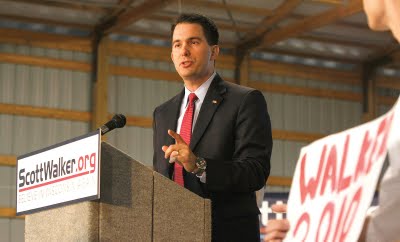
Here’s the story from the Associated Press.
Excerpt:
The 2011 state law that all but ended collective bargaining for most public workers has hit Wisconsin’s second largest union particularly hard.
The latest tax documents available show combined income of American Federation of State, County and Municipal Employees (AFSCME) dropped 45 percent in 2012 _ the first full year of the law, according to The Capital Times.
In 2011, the four councils that make up the state organization reported a combined income of $14.9 million. In 2012 that dropped to $8.3 million. Dues revenue dropped 40 percent to $7.1 million.
Walker and supporters of the law said it was a way to help local governments reduce the costs of employee benefits, but the legislation also included measures aimed at financially weakening unions by ending automatic dues deductions.
The union’s Council 40 executive director, Rick Badger, says that while the declines in revenue stemming from the law were expected, he has been encouraged by the number of workers who have continued to pay voluntary dues.
“In fact, what (the law’s) architects might find surprising is our resilience,” he wrote in an email. He said thousands of “front-line workers are remaining engaged in fighting for their rights despite heavy-handed political attempts to silence them.”
While public unions no longer enjoy the official bargaining power that they exercised in recent decades, he said many public workers continue to value their presence as advocates for their rights and welfare.
AFSCME is second only to the Wisconsin Education Association Council, or WEAC, in members in Wisconsin. It has long been a powerful player in state politics, funneling money directly to campaigns and running independent television ads in support of pro-labor candidates, as well as providing a legion of employees and member volunteers who made sure their union brethren voted on Election Day.
The law has also hit other big unions in the state. For instance, WEAC, the state’s largest teachers union, saw its revenue drop from $26 million in 2011 to $20 million in 2012.
This is definitely someone we conservatives need to look at in 2016. He has had to face the left in a blue-ish state, and he won.
During the Christmas vacation, I read governor Walker’s new book, which was a Christmas present from my friend ECM. If you want to learn more about governor Walker, I recommend picking that up. I actually got the audio version, and it’s read by governor Walker himself.
Related posts
- An interview with Wisconsin governor Scott Walker
- Wisconsin judge defends free speech rights of conservative groups against Democrat censors
- George Will: Governor Scott Walker is a good pick for Republicans in 2016
- Kenosha teachers vote to de-certify their teacher union, 63 – 37
- Wisconsin abortions decline again by 4.4% after Governor Walker’s pro-life laws
- Governor of Wisconsin Scott Walker signs pro-life ultrasound bill
- Governors Bobby Jindal and Scott Walker refuse to implement Obamacare
- Scott Walker defeats Tom Barrett to win 2012 Wisconsin recall election
- Should Wisconsin voters recall governor Scott Walker?
- Wisconsin public school teachers protest the publication of their salaries in flier
- Wisconsin Supreme Court strongly upholds Walker’s union restrictions
- What is a “right-to-work” law, and why do Democrats oppose them?
- Wisconsin governor’s union regulation bans automatic deduction of dues
- Democrat lawmakers flee state to avoid voting on spending cuts
 WINTERY KNIGHT