Tag Archives: Theology

Dr. William Lane Craig answers questions about Jesus in the New York Times

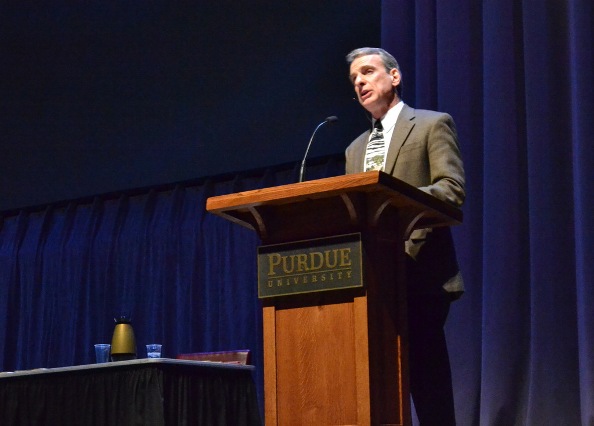
William Lane Craig lecturing to university students
William Lane Craig lecturing to university students at Purdue University

Nicholas Kristof, a secular leftist writer for the New York Times, is interested in Jesus, but he doesn’t want a Jesus who can perform miracles. He decided to ask the best living philosphical theologian, Dr. William Lane Craig, some questions. As you’ll see, Dr. Craig’s answers to his questions are perfect for the secular left audience of the New York Times.

Before we start looking at the questions and answers, I want to mention one important point. When discussing Christianity, it’s very important that Christians not allow the atheist to nitpick about minor details of Christian history or Christian theology. The Christian needs to ALWAYS redirect the discussion to the question of God’s existence. There, we are strongly supported by mainstream science. Only when the skeptic accepts a Creator and Designer can we allow ourselves to be moved on to specific points of theology or history.

Like this:

  • Skeptic: was Jesus born of a virgin?
  • Christian: do you accept a Creator and Designer of the universe?
  • Skeptic: no
  • Christian: then let’s discuss the scientific evidence for that first

And again:

  • Skeptic: am I going to Hell?
  • Christian: do you accept a Creator and Designer of the universe?
  • Skeptic: no
  • Christian: then let’s discuss the scientific evidence for that first

Why is this important? It’s important because most skeptics are fundamentalists. They think that if they can refute Christianity on an edge case issue, then the core crumbles. It’s very important to frame the discussion so that the skeptic understands that there are core claims of Christianity which are important and strongly evidenced, and there are less important claims, and also claims that are not well evidenced. The goal of any discussion with a skeptic is to get them to accept the important core claims which are strongly evidenced. If they accept the core, that’s enough to get them out of atheism, and into a relationship with God, where they can continue to grow.

I wrote a whole post about this that you can read later, but let’s get to the interview with Dr. Craig.

Let’s start with the first question and answer:

Kristof: Merry Christmas, Dr. Craig! I must confess that for all my admiration for Jesus, I’m skeptical about some of the narrative we’ve inherited. Are you actually confident that Jesus was born to a virgin?

Craig: Merry Christmas to you, too, Nick! I’m reasonably confident. When I was a non-Christian, I used to struggle with this, too. But then it occurred to me that for a God who could create the entire universe, making a woman pregnant wasn’t that big a deal! Given the existence of a Creator and Designer of the universe (for which we have good evidence), an occasional miracle is child’s play. Historically speaking, the story of Jesus’ virginal conception is independently attested by Matthew and Luke and is utterly unlike anything in pagan mythology or Judaism. So what’s the problem?

Did you notice what Dr. Craig did there? Regarding the evidence from science, Dr. Craig has defended that in two separate academic books, both with Oxford University Press. (Theism, Atheism and Big Bang Cosmology and God? A Debate Between A Christian and An Atheist)

Here it is again:

Kristof: How do you account for the many contradictions within the New Testament? For example, Matthew says Judas hanged himself, while Acts says that he “burst open.” They can’t both be right, so why insist on inerrancy of Scripture?

Craig: I don’t insist on the inerrancy of Scripture. Rather, what I insist on is what C.S. Lewis called “mere Christianity,” that is to say, the core doctrines of Christianity. Harmonizing perceived contradictions in the Bible is a matter of in-house discussion amongst Christians. What really matters are questions like: Does God exist? Are there objective moral values? Was Jesus truly God and truly man? How did his death on a Roman cross serve to overcome our moral wrongdoing and estrangement from God? These are, as one philosopher puts it, the “questions that matter,” not how Judas died.

For those who are concerned by this answer, you should know Dr. Craig is the former president of the Evangelical Philosophical Society, and they do indeed sign a statement of faith that includes inerrancy. But again, an interview in the New York Times is not the place to focus on defending inerrancy. This is the place to have secular left elites contend with the core claims of Christianity.

In the next question and answer, notice how Dr. Craig refuses to yield that the skeptic is rational and evidence-driven. You should never let atheists assume that atheism is the “default” view of people who are reasonable and evidence-driven. Atheism is NOT the default view for reasonable people who are evidence-driven. Atheism is a furious retreat away from reason and evidence. In particular, it’s a refusal to bound your worldview with science and history.

More Dr. Craig:

Kristof: Over time, people have had faith in Zeus, in Shiva and Krishna, in the Chinese kitchen god, in countless other deities. We’re skeptical of all those faith traditions, so should we suspend our emphasis on science and rationality when we encounter miracles in our own tradition?

Craig: I don’t follow. Why should we suspend our emphasis on science and rationality just because of weakly evidenced, false claims in other religions? I champion a “reasonable faith” that seeks to provide a comprehensive worldview that takes into account the best evidence of the sciences, history, philosophy, logic and mathematics. Some of the arguments for God’s existence that I’ve defended, such as the arguments from the origin of the universe and the fine-tuning of the universe, appeal to the best evidence of contemporary science. I get the impression, Nick, that you think science is somehow incompatible with belief in miracles. If so, you need to give an argument for that conclusion. David Hume’s famous argument against miracles is today recognized, in the words of philosopher of science John Earman, as “an abject failure.” No one has been able to do any better.

This is the book he’s alluding to, there. Oxford University Press.

Please read the whole interview.

If you have non-Christian friends who think that all the “smart people” reject Christianity, and you don’t now how to talk to them, why not send them this article from the New York Times? There are also resources that you can use to train yourself to answer questions like he did.

Some people reading may not like Dr. Craig’s approach. That might be because you’re only able to talk about Christianity to people by quoting the Bible to them. Maybe you think that quoting the Bible to a non-Christian will cause them to become a Christian. This approach, (I call it the “magic words” approach), is popular in many churches. It will work on people who are already Christians, but it won’t work on non-Christians, since they don’t accept the Bible. It’s also not how anyone in the New Testament talked about spiritual things. (See Acts 17 for an example, or read what Jesus does to prove his claims to skeptics in the gospel of John). If you want to discuss Christianity outside the church, then I recommend Dr. Craig’s approach.

Positive arguments for Christian theism

The Wintery Knight’s favorite Bible verses

Bible study that hits the spot

Dina asked me to post my favorite Bible verses, so here are 8 of my favorites.

Psalm 27:14:

11 Teach me Your way, O Lord,
And lead me in a level path
Because of my foes.

12 Do not deliver me over to the desire of my adversaries,
For false witnesses have risen against me,
And such as breathe out violence.

13 I would have despaired unless I had believed that I would see the goodness of the Lord
In the land of the living.

14 Wait for the Lord;
Be strong and let your heart take courage;
Yes, wait for the Lord.

1 Corinthians 4:2:

1 This is how one should regard us, as servants of Christ and stewards of the mysteries of God.

2 Moreover, it is required of stewards that they be found faithful.

3 But with me it is a very small thing that I should be judged by you or by any human court. In fact, I do not even judge myself.

4 For I am not aware of anything against myself, but I am not thereby acquitted. It is the Lord who judges me.

Matthew 5:13:

10 “Blessed are those who have been persecuted for the sake of righteousness, for theirs is the kingdom of heaven.

11 “Blessed are you when people insult you and persecute you, and falsely say all kinds of evil against you because of Me.

12 Rejoice and be glad, for your reward in heaven is great; for in the same way they persecuted the prophets who were before you.

13 “You are the salt of the earth; but if the salt has become tasteless, how can it be made salty again? It is no longer good for anything, except to be thrown out and trampled under foot by men.

14 “You are the light of the world. A city set on a hill cannot be hidden;

15 nor does anyone light a lamp and put it under a basket, but on the lampstand, and it gives light to all who are in the house.

2 Timothy 2:4:

1 You therefore, my son, be strong in the grace that is in Christ Jesus.

The things which you have heard from me in the presence of many witnesses,entrust these to faithful men who will be able to teach others also.

Suffer hardship with me, as a good soldier of Christ Jesus.

No soldier in active service entangles himself in the affairs of everyday life, so that he may please the one who enlisted him as a soldier.

Also if anyone competes as an athlete, he does not win the prize unless he competes according to the rules.

Daniel 3:18:

13 Then Nebuchadnezzar in rage and anger gave orders to bring Shadrach, Meshach and Abed-nego; then these men were brought before the king.

14 Nebuchadnezzar responded and said to them, “Is it true, Shadrach, Meshach and Abed-nego, that you do not serve my gods or worship the golden image that I have set up?

15 Now if you are ready, at the moment you hear the sound of the horn, flute, lyre, trigon, psaltery and bagpipe and all kinds of music, to fall down and worship the image that I have made, very well. But if you do not worship, you will immediately be cast into the midst of a furnace of blazing fire; and what god is there who can deliver you out of my hands?”

16 Shadrach, Meshach and Abed-nego replied to the king, “O Nebuchadnezzar, we do not need to give you an answer concerning this matter.

17 If it be so, our God whom we serve is able to deliver us from the furnace of blazing fire;and He will deliver us out of your hand, O king.

18 But even if He does not,let it be known to you, O king, that we are not going to serve your gods or worship the golden image that you have set up.”

Esther 4:14:

10 Then Esther spoke to Hathach and ordered him to reply to Mordecai:

11 “All the king’s servants and the people of the king’s provinces know that for any man or woman who comes to the king to the inner court who is not summoned, he has but one law, that he be put to death, unless the king holds out to him the golden scepter so that he may live. And I have not been summoned to come to the king for these thirty days.”

12 They related Esther’s words to Mordecai.

13 Then Mordecai told them to reply to Esther, “Do not imagine that you in the king’s palace can escape any more than all the Jews.

14 For if you remain silent at this time, relief and deliverance will arise for the Jews from another place and you and your father’s house will perish. And who knows whether you have not attained royalty for such a time as this?”

Philippians 1:9:

I thank my God in all my remembrance of you,

always offering prayer with joy in my every prayer for you all,

in view of your participation in the gospel from the first day until now.

For I am confident of this very thing, that He who began a good work in you will perfect it until the day of Christ Jesus.

For it is only right for me to feel this way about you all, because I have you in my heart, since both in my imprisonment and in the defense and confirmation of the gospel, you all are partakers of grace with me.

For God is my witness, how I long for you all with the affection of Christ Jesus.

And this I pray, that your love may abound still more and more in real knowledge and all discernment,

10 so that you may approve the things that are excellent, in order to be sincere and blameless until the day of Christ;

11 having been filled with the fruit of righteousness which comes through Jesus Christ, to the glory and praise of God.

Numbers 13:30:

25 When they returned from spying out the land, at the end of forty days,

26 they proceeded to come to Moses and Aaron and to all the congregation of the sons of Israel in the wilderness of Paran, at Kadesh; and they brought back word to them and to all the congregation and showed them the fruit of the land.

27 Thus they told him, and said, “We went in to the land where you sent us; and it certainly does flow with milk and honey, and this is its fruit.

28 Nevertheless, the people who live in the land are strong, and the cities are fortified and very large; and moreover, we saw the descendants of Anak there.

29 Amalek is living in the land of the Negev and the Hittites and the Jebusites and the Amorites are living in the hill country, and the Canaanites are living by the sea and by the side of the Jordan.”

30 Then Caleb quieted the people before Moses and said, “We should by all means go up and take possession of it, for we will surely overcome it.”

If you have a favorite Bible verse or two, post them in the comments.

Making monergism make sense: reconciling divine sovereignty and free will

Lets take a closer look at a puzzle

This article at Free Thinking Ministries was written by my friend Tim Stratton. In it, presents a view of God’s sovereignty over salvation without falling into the error of double-predestination.

Excerpt: (links removed)

Many reformed folks (freely?) choose to reject Molinism because they contend that this theological view “smells of synergism.” What is this stench that reportedly makes John Calvin turn over in his grave? Simply put, synergism is the view that man plays at least a small part in his own salvation process. Monergism, on the other hand, is the view that God is the author of salvation from beginning to end.

Since Molinism affirms that man is free to choose to reject God’s saving grace or not, many Calvinists jump to the conclusion and assume that Molinism must be synergistic. This does not necessarily follow.[1] Consider one possible model:

1- God, by nature, is a volitional unmoved mover who is free to choose between options in accord with His nature. (This is supported via the Kalam and the Argument from Time).

2- By God’s grace, humans are created in the “image of God.” By nature, then, we are free to choose between options in accord with our nature. (This is supported via the Freethinking Argument).

3- Adam & Eve freely chose to disobey God and this sin completely separates humanity from God. This is what it means to have a “totally depraved sin nature.” (Every aspect of man is separated from God).

4- In this state of depraved separation from God (sin nature), humans do not even know God exists if merely left to our own devices.

5- If humans do not even know God exists, then, left to our own devices and apart from God’s grace, it would be impossible to choose to love and follow God (thus, Pelagianism is impossible on this view).

6- God, in His love for all people, provides amazing prevenient grace to all people (Romans 1:20), writing the law on the human heart (Romans 2:15), conviction of the Holy Spirit (John 16:8-9), and draws all men (John 12:32). This is commonly referred to as “common grace.”

7- Therefore, by God’s grace, human nature has changed from a “totally separated from God nature” to a nature that has now experienced enough divine revelation (influences) allowing all mankind to start making some free and volitional choices in accord with our new nature; namely, to choose to resist God’s grace and revelation, or not.[2] Mankind is without excuse because we do not have to resist what God has made clear (Romans 1:18-20).[3]

[Note: According to Calvinist, Matt Slick (albeit inadvertently), Mark 4:10-12 implies that if an unregenerate person gets access to clear and accurate information, then they possess the ability to become Christians!]

8- If one does not reject or continually resist the grace and revelation God provides them, then God will continually provide more and more until the person reaches the point of “no return” and will become saved.

Thus, God does ALL the work in salvation from beginning to end on this Molinistic model; all the human can do is freely resist God’s grace and revelation, but he or she does not have to! The human does nothing to gain salvation apart from God’s grace on this Monergistic Model of Molinism.

I think that Stratton’s formulation above does indeed keep God as the sole initiator of salvation. And that’s good. But it also makes sure that human who resist God’s leading are responsible for their choice to resist God, and that’s good. We want salvation to be 100% by faith alone in Christ alone. But we don’t want God to be the cause of people not being saved. On Stratton’s view, God wants everyone to be saved. If anyone is saved, it’s because God did ALL THE WORK to lead them and secure their salvation with the death of Jesus on the cross. But, on Stratton’s view, humans do get a choice – the choice to trust God or not. And so, if a person is not saved, then it’s their fault – not God’s. This works.

Read his whole post, and see what you think about it.