Tag Archives: Theology

Christianity and the doctrines of exclusivism, inclusivism and pluralism

Are you familiar with the differences between exclusivism, inclusivism and pluralism? This article from Leadership University explains all three of them.

Here’s exclusivism:

The following is a succinct explanation of the central characters and ideas behind each position. The exclusivist position has been the dominant position of the church as a whole through much of its history until the Enlightenment. Major representatives include Karl Barth, Emil Brunner, Hendrick Kraemer, D.A. Carson, William Lane Craig, and R. Douglas Geivett.

Key to this position is the understanding of God’s general and special revelations. God is manifested through creation (general revelation), but Man has responded by freely going against this revelation and, thus, stands guilty before a holy God. However, God has demonstrated a reconciliatory mercy through His word and deed, fulfilled completely in Jesus Christ. The historical person of Jesus, then, is the unique, final, decisive, and normative self-revelation of God to Man (special revelation). Exclusivists believe that Jesus Christ is the sole criterion by which all religions, including Christianity, should be understood and evaluated. Calvin Shenk explains:

Christ did not come just to make a contribution to the religious storehouse of knowledge. The revelation which he brought is the ultimate standard. Since in Christ alone is salvation and truth, many religious paths do not adequately reflect the way of God and do not lead to truth and life. Jesus is not, therefore, just the greatest lord among other lords. There is no other lord besides him.

Specific texts often employed by exclusivists include Acts 4:12; John 14:6; 1 Corinthians 3:11; and 1 Timothy 2:5-6.

And inclusivism:

Inclusivism is a blanket term to characterize a sort of “middle way” between exclusivism and pluralism. Most prominent within mainline Protestantism and post-Vatican II Catholicism, its notable proponents (in one formor another) include Karl Rahner, Raimundo Panikkar and Stanley Samartha, and Hans Kung. Evangelical theologians such as Clark Pinnock, Norman Anderson, and John Sanders have also identified themselves with this position. Herein, the agnosticism associated with the latter option above is replaced with outright optimism. Christian salvation is not confined to the historical or geographic extent special revelation has spread, rather it must be available to all cultures, irrespective of age or geography.Salvation is still posited wholly in Christ and his salvific work. Specific knowledge of this work, however, is not necessary for the effect (i.e., salvation) to apply to those within a different religious culture who have responded to the general revelation available. Once again, Shenk explains:

Inclusivists want to avoid monopolizing the gospel of redemption. They acknowledge the possibility of salvation outside of Christian faith or outside the walls of the visible church, but the agent of such salvation is Christ, and the revelation in Jesus is definitive and normative for assessing that salvation. Jesus Christ is believed to be the center, and other ways are evaluated by how they relate to him. Other religions are not just a preparation for Christ, but Christ is actually present in them.

The fundamental differences between exclusivism and inclusivism… are the nature and the content of “saving faith.” The former emphasizes explicit faith while the latter points to an implicit faith.

And pluralism:

Finally, there is the pluralist position. This is undoubtedly the most difficult of the three to define in any general sense. The spectrum of pluralistic thought is as wide as it is long. The focusof this particular study will examine the contributions of its key figures: Paul Knitter, John Hick, and Wilfred Cantwell Smith. Just as in the previous positions, the interpretative range within just these three individuals varies. It is fitting, however, to focus primarily on them since they are the most vocal and influential figures espousing pluralism today.

Hick and Knitter argue the case for pluralism on the following grounds: (1) ethically, it is the only way to promote justice in an intolerant world; (2) in terms of the “ineffability of religious experience,” so no religion can claim an absolutist stance; and (3) through the understanding that historical and cultural contexts must be the filter for any absolute religious claim. Hick has argued that all world religions attempt to relate to the unknowable Ultimate Reality (or, the Real), but because of their various cultural and historical contexts these attempts are all naturally different. Hence the various conceptions of the Real and the salvation(s) sought. The common soteriological goal, toward which all religions strive, though, is rooted in the desire to transcend self-centeredness and, in turn, encounter a new (unexplainable) experience with the Real. But, he emphatically emphasizes the fact that there is “no public evidence that any one religion is soteriologically unique or superior to others and thus has closer access to Ultimate Reality.”

Therefore, with pluralism, Christ is no more definitive or normative than any religious figure or concept. Or, as Andrew Kirk explains, “Rather than confessing that Jesus Christ is the one Lord over all, this view asserts that the one Lord who has manifested himself in other names is also known as Jesus.” By “crossing the Rubicon,” as Hick and Knitter illustrate, Christians are encouraged to abandon any claim of Christian uniqueness and the possibility of absolute revelation, accepting the fact that the Christian faith is one among many options.

Now maybe you didn’t know this, but Roman Catholics seem to have taken a turn away from exclusivism and towards inclusivism in the last century.

So, I thought I would post a rebuttal to the Roman Catholic embrace of inclusivism from one of my favorite Christian apologists, Greg Koukl.

Excerpt:

There are some issues of Christianity that are intra-Nicene, intramural discussions between believers, in which I think a charitable person can easily see how another Christian can hold a different view because there are things that are difficult to understand in Scripture. For instance, though I’m Reformed in my soteriology, my understanding of salvation–I’m a Calvinist–I am sympathetic to an Arminian perspective because I can see how they, in lines of reasoning from the New Testament and verses themselves from the New Testament, can come to their view. So, though I would disagree, and I think they’re mistaken, I understand how they can see it.But there are other positions that I cannot understand because there is no New Testament evidence in favor of it, and, to the contrary, almost to a word, as the New Testament touches the issue, it says quite the opposite.

Earlier this week, I was honored, flattered, and, frankly, humbled to have a very unique opportunity on Monday to address an audience of about 150 Jewish people that were in the midst of Jewish High Holy Day services–morning services, evening services–at kind of a pause time in the afternoon, in which my host and I and another guest had a discussion about Jews and Christians. The three of us were on the panel:  my host, Dennis Prager, a man I have a tremendous admiration and affection for, and Greg Coiro, a Roman Catholic priest and a professional friend. I’ve known both of these men over 20 years and have been in many discussions, both in private and public on the air with Dennis and Greg Coiro.

It was in this opportunity that, in a sense, the ancient quarrel of sorts, theologically, was revisited, that I’ve had in the past many years ago when we were talking about this in interfaith dialogues. This difference of opinion is a historically new development in Roman Catholicism that stunned me when I first encountered it in the early days of being on Religion on the Line in the late eighties, a radio panel Dennis Prager hosted for many years. The priests on the panel uniformly held the conviction, informed by Vatican II, that Jews don’t have to believe in Jesus in order to receive the benefits of Jesus’ salvation. This is a view called “inclusivism.” It’s not the same as pluralism, but in my view, it seems to have the same impact: “Yes, Jesus is necessary for salvation, but you don’t have to believe in Jesus to benefit from Jesus.”

Now, at this afternoon panel recently, the very first question that came up was whether trust in Jesus is necessary for salvation. “Greg, do you believe that? Do Protestants believe that?” I answered, “Yes, I believe that. And no, not all Protestants believe that. But let me try to explain it to you in a way that doesn’t sound so stark. Let me try to give it some perspective.” I explained that it wasn’t as if God was up there looking down at a bunch of religious clubs and prefers some over others. He used to prefer the Jewish club and now He prefers the Christian club. It may sound that way to many when this doctrine of Christianity is put forward: Jesus is the only way of salvation; you must believe in Jesus in order to benefit from what Jesus did.

Talk about Daniel in the lions’ den. Anyway, click through and read the whole article to get an idea of how to make your stand for exclusivism in difficult places. By the way I am not a Calvinist (I accept some Calvinist doctrines, but not irresistible grace), but I think Greg is right to defend exclusivism. I realize that I have a lot of Roman Catholic readers, and I hope that you won’t be too upset that we disagree on this. In fact, I’m hoping that you’ll change your minds and agree with me!

For a general article defending the Christian doctrine of exclusivism, check out this article by William Lane Craig. One of my favorites, from way way back to when I was an undergraduate.

If you want to hear Paul Knitter in a debate, check out the Greer-Heard forums. The 2009 forum can be had as MP3s for $15, and you will not be disappointed with the response by Doug Geivett. The 2005 set with Crossan is also worth buying. If you really really like them, then get the 2008 one with Bart Ehrman and Dan Wallace. Chuck Quarles’ response will knock your socks off. I actually met him at the EPS apologetics conference this year. Doug Geivett’s response is worth the price of the whole set. Unfortunately, that Crossan set is not on MP3 – you have to get CDs. Crossan and Ehrman are back for the 2010 and 2011 forums, but I have not heard those yet.
William Lane Craig answers questions from an arrogant atheist

Mary sent me this question and answer from William Lane Craig’s Question of the Week.

Here are the questions:

Hi there, I’m writting in regards to your “Q&A 170: So many athiests, so little time” answer. First of all, your two simple questions have very simple answers, and an athiest who can’t answer them isn’t a true athiest.

1)
Q. What do you mean by (you don’t believe in God)
A. I mean that I have a lack of belief the the existance of a deity, your christian God or any other.

2)
Q. What reasons do you have to think that (there is no God)
A. The Earth shows no proof of creation, every single thing on this Earth has a natural explanation, simply becasue modern science has not yet solved every problem, does not mean it never will. I’d go in to detail, but no need to bore you with the science of it all.
So, I’ve given my proof and will give far more if you ask it of me, and any wel linformed athiest will be able to answer those questions in a flash and have the burden of proof back in your hands.
In regards to scholarly work, may I point out Charles Darwin’s “The Origins of Species”, the works of Gregor Mendel, father of Genetics, William “Strata” Smith, father of Geology, Alfred Wegener “The Origin of Continents and Oceans”, Issac Newton, Galileo, On and on I go, where I stop, nobody knows!
Now, if I may turn to the real point of this e-mail besides to point out that you havent really told anyone how to argue christianity other than asking easy questions and throwing names at them. Your God is Omnicient so you say, operating on this assumption, here is how morality plays out in the bible…
1) God creates heaven and Earth and then he creates Humans.
2) God KNOWS that humans will sin
3) God puts the tree of knowledge in the garden of Eden KNOWING it will drive Adam to sin.
4) God Determines that Adams sin is transmutable down to every single person that will ever exist. (Moral objection 1: The sins of the father are logically not related to the son in any way shape or form)
5) God decides that to punish people for this one sin they had nothing to do with or anything else he deams bad, they shall be sentenced to an eternity of burning hellfire. Infinite punishment for a finite crime? That sounds like Moral objection #2 to me!
6) When God sees that his creations have really gone bad, he drowns the world, killing millions of innocent people.
7) only 1600 years after the mass murder of his creations(following biblical chronology) they’ve already fallen back in to sin. So God, in his infinite wisdom, determines the best course of action, is to sacrafice his Son, who is part of himself, TO HIMSELF, to make up for the sins of the creations he made knowing they would sin!

How in the world do you rectify this!?

Cheers,

Luke

I think that Bill is doing a great thing to come down to the level of village atheist once in a while and reply, and if you read his answer, he’s actually pretty mean. And it’s a good thing, in this case, because the worldview of village atheists is a lot like the worldview of Islamic terrorists. They are so insulated from outside criticism that you really have to thrash them around a little bit in order to get them to see that they have been involved with a cult their whole lives. That’s not going to be the case with some of the better atheists like Austin Dacey and Paul Draper, but it is going to be the case with many rank and file atheists, and we need to know how to answer them, too.

What is the meaning of Christmas? Why Celebrate Christmas?

I thought that I would try to write a post to explain Christmas as I understand it to everyone who is foggy on what it is all about. I hope I am not making any theological errors here, after all, I am just a software engineer.

Basically, we know from a variety of scientific arguments that the universe was created and fine-tuned for life by an intelligent agent that existed causally prior to the beginning of the universe, because this agent brought the universe into being. Our purpose as humans is to enter into a two-way loving relationship with this Creator/Designer of the universe. This is the only way that we can ultimately be happy and fulfilled.

The mess we were in

Now, when you look at human experience, none of us is interested in finding out about the character of this Creator/Designer, because we are afraid that if we find out too much about him then we will have our freedom to do as we please constrained by the demands of a relationship with an all-powerful, all-good being. Just knowing that such a person exists and has a character distinct from our own is enough to cause us to flee from him so that we can stay autonomous from the obligations of the moral law that he expects us to follow.

Christians believe that this universal desire to avoid an all-powerful, all-good God who will judge us is a result of bad behaviors inherited by us from the very first rebellion against God by our ancestors. Ever since that rebellion, the capability for relating to God has been lost, because we no longer have the ability to stop our rebellion against God. Christians call the first rebellion of our ancestors “The Fall of Man”.

What does this rebellion look like for us today? Well, we want to do whatever we want, in order to be happy, and to ignore God’s demands. We want to have happy feelings, including security, community and being morally good, all without a relationship with God. We want to acquire and rearrange matter for our selfish ends without acknowledging and honoring the Creator/Designer of that matter. And, of course, we would like other people to affirm, voluntarily or involuntarily, that our rebellion against God is really the height of moral goodness.

Additionally, some people imagine that God, if he exists at all, must desire our happiness. And of course when their needs are not met by this invented God, then they become even more bitter at God, and eventually decide that God could not really exist since their selfish needs are not being met by him. It never seems to occur to us humans that some pain and suffering may be permitted by God in order to turn our attention away from pleasure and security in this life, and back towards a relationship with him.

This is the mess we find ourselves in. This propensity for turning away from God and trying to pursue selfish happiness and security apart from a relationship with God is what the Bible calls “sin”. Every single one of us deserves severe punishment for refusing to pursue a genuine two-way love relationship with the God who is there. That is the mess we are in before Jesus appears to address this problem.

The birth of Jesus

I cannot say much about how Jesus solves the problem of rebellion against God, because that is really the story of Easter, and today we are dealing with the story of Christmas. But I can say that the solution to the problem requires that God step into history to communicate with his creatures and to perform actions in order to be reconciled with them. That is the message of Christmas: God is stepping into history to do something to end our rebellion. Easter is the story of what he does.

This is talked about in the Bible in John 1, for example.

John 1:1-5:

1In the beginning was the Word, and the Word was with God, and the Word was God.

2He was with God in the beginning.

3Through him all things were made; without him nothing was made that has been made.

4In him was life, and that life was the light of men.

5The light shines in the darkness, but the darkness has not understood it.

You can substitute the word “Word” there for Logos, which really means logic or reason or wisdom. This is a person with a divine nature, identified with the eternal being of God, who exists causally prior to the creation of the universe, who is going to take on an additional human nature, including a human body. (Christians believe that there is one divine “what” being and three divine “who” persons). Software engineers, you can think of Jesus having two natures as multiple inheritance in C++.

And it continues in John 1:10-14:

10He was in the world, and though the world was made through him, the world did not recognize him.

11He came to that which was his own, but his own did not receive him.

12Yet to all who received him, to those who believed in his name, he gave the right to become children of God—

13children born not of natural descent, nor of human decision or a husband’s will, but born of God.

14The Word became flesh and made his dwelling among us. We have seen his glory, the glory of the One and Only, who came from the Father, full of grace and truth.

Here the word grace doesn’t mean like a graceful ballet dancer. It means an instance of mercy received from a superior. A person (a “who”) identified with the divine being (a “what”) has decided to make us a top-down offer of mercy.

The same message of God stepping into history is found in the Christmas carols that people sing at Christmas.

Christmas carols

Here’s the best one, “O, Holy Night“, and it says:

O holy night! The stars are brightly shining.
It is the night of the dear Savior’s birth.
Long lay the world in sin and error pining,
Till He appeared and the soul felt its worth.

When we were in rebellion, we had lost our most valuable capacity – the capacity of being in a direct relationship with God. And if Jesus can accomplish his mission, then we are going to regain that capacity for a direct relationship with God.

Now look at “Hark! The Herald Angels Sing“, which one of my favorites:

Hark! The herald angels sing,
“Glory to the newborn King!
Peace on earth and mercy mild,
God and sinners reconciled.”

Basically, as I often say, there are only two kinds of people in the world. There are people who are willing to respond to the offer of a relationship with God, with all the little sacrifices and compromises that a relationship entails, and then there are people who are not willing to respond. For the people who are willing to respond, the appearance of Jesus is the best thing that could possibly happen, because now we are finally going to have a chance to deal directly with God, face-to-face, to find out what he is like, and change ourselves to be more like him, with his help.

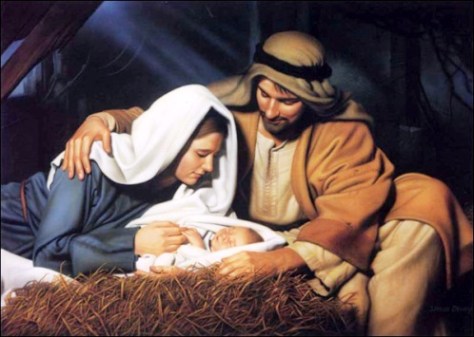
And that is why people celebrate Christmas. It’s the anniversary of the birth of Jesus. It is the story of God stepping into history to be reconciled with his rebellious creatures. It’s the story of the divine Logos divesting himself of his glory and subjecting himself to the life of a creature in order to rescue us from our sinful, self-destructive rebellion. This love for undeserving creatures is above and beyond the call of duty. We didn’t love him, but instead he loved us first, and he loved us enough to come down here and suffer with us so that we could be reconciled with God.

MERRY CHRISTMAS!