I was browsing over at the Anchoress and I found some very interesting links in her link-filled post here. She runs a blog that features a mix of Catholic-oriented reflections and a conservative perspective on the news of the day.
Here’s the part of her post that caught my attention:
Disagreements between the European Union and the US over how to combat the global recession widened on Tuesday as EU governments made clear they had little appetite for piling up more debt to fight the collapse in output and jobs.
Finance ministers from the 27-nation bloc insisted in Brussels that it was doing enough to support world demand and did not need at present to adopt another fiscal stimulus plan, as Washington is urging.
The US-European differences are casting a shadow over next month’s summit in London of leaders from the G20 group of advanced and emerging economies, an event to be attended by Barack Obama on his first visit to Europe as US president.
It’s true that France, Germany and Italy have all elected conservative leaders recently, (along with Japan, Canada, the Czech Republic and Mexico). I thought that these European socialist countries were to the left of the USA. Are we now to the left of France, Germany and Italy?
You might remember that I posted recently about former-communist Russia warning Obama about the dangers of socialism. Former-communist China also warned Obama to stimulate the economy with tax cuts, not spending. Instead, Obama raised taxes and spent trillions.
Canada, Japan and Mexico also elected conservatives governments. Why can’t we be more like them? Why do we have to embrace Obama’s unilateral, cowboy-communism? Why must Obama anger the world with unpopular economic policies that fail the “global test”? Why does Obama make the world hate us?
Here are the details of China’s sales tax cuts on new vehicle sales from Time Magazine:
On Jan. 20, the Beijing government slashed the sales tax on cars with engines of up to 1.6 liters from 10% to 5%. The measure, designed to get Chinese to buy smaller, more fuel-efficient vehicles, has had an immediate impact. January sales of small cars jumped 19% compared with the previous month, according to the China Association of Automobile Manufacturers. Also boosting buyer interest: Lower road taxes and fuel prices, which are set by the government.
…The surge in small-car sales helped China pass a milestone. For the first time ever, more cars were sold in China (735,000 vehicles) in a month than were sold in the U.S. (657,000). In January at least, China was the world’s largest car market. “The tax reduction was an obvious help to our sales,” says a sales manager surnamed Feng at the biggest Hyundai dealer in Beijing. “Since the new policy started, sales of our three models with 1.6 liter engines or below have gone up by 30% compared to the same period last year.“
…China’s stimulus plans “could have an enormous difference in whether or not people want to buy cars,” says Ben Simpfendorfer, chief China economist for the Royal Bank of Scotland. “What’s unusual about this cycle is that China faces the same problems as everywhere else in the world. The big question is how to spur consumer spending. Strong auto sales will help China, just like they’ll help America or Europe.”
And it works the same way for jobs! If you want to create jobs, what should you do? Should you waste 1.5 trillion dollars of money stolen from the private sector in order to expand government, pay off special interests, fund pork projects and thousands wasteful earmarks? Of course not! What you need to do is what China did. They made cars go on sale. We need to make employees go on sale. How?
The answer is to do what the Arnold Kling of the Cato Institute says and temporarily cut the employer portion of payroll taxes. This means that employers get all of the productive capacity of new employees hired within the United States, but the cost of hiring new employees is reduced. All the productivity at a much cheaper cost. Total cost of this stimulus plan: 230 billion dollars!
This plan is actually from Harvard economics professor Greg Mankiw, who describes it more fully here, but couples it with off-setting gas tax hikes.
I would institute an immediate and permanent reduction in the payroll tax, financed by a gradual, permanent, and substantial increase in the gasoline tax. I would make the two tax changes equal in present value, so while the package results in a short-run budget deficit, there is no long-term budget impact. Call it the create-jobs, save-the-environment, reduce-traffic-congestion, budget-neutral tax shift.
But who cares what Harvard economists think? The tax-cheat says that you can fix the economy by raising taxes on companies that actually hire people:
The Treasury chief today also defended the carbon emissions cap-and-trade proposals in the plan, saying the policy would raise hundreds of billions of dollars and help the country achieve energy independence. “It is critically important for our country that we begin the process now of changing the incentives Americans face for how they use energy,” he said. “It’s important to reduce our dependence on foreign oil, it is critical for climate change.”
Who cares if consumers have to pay more for oil and gas in a recession? We need to think of the trees and whales! Won’t someone please think of the sea-kittens?
China cut taxes, and a part of its economy started to boom.
Cutting taxes equals economic growth.
The Chinese Commies get it.
…Still waiting for the American Democrats to get it.
Tax cuts = Jobs. Jobs = economic recovery. Why is it that we are disregarding capitalist recommendations from former communist countries like Russia and China? Why is it that we insist on angering the world with our socialist policies? Why is that we are going out of our way to impose new taxes on products that consumers rely on? We can’t afford this much spending no matter how much we tax the rich.
Here’s Michele Bachmann, on the floor of Congress, explaining economics and defending free market capitalism. She touches on many important topics: intentions versus incentives, learning from past economic failures, American exceptionalism, economic growth, private ownership of property, the rule of law, private contracts, tax law, the law of unintended consequences and the “forgotten man”.
Well, if we’re going down as a nation, it won’t be because no one understood what was happening. Michele knows – because she is a trained tax lawyer and she understands economics and business – she and her husband Markus own a small business. They have 5 children and 23 foster children, so they know enough not to saddle the next generation of Americans with debt. Life experience matters.
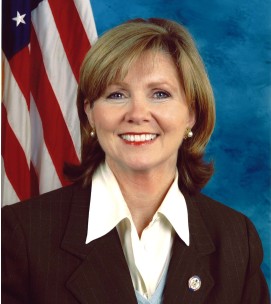
And then there is another “M.B.” in the house, Marsha Blackburn.
Congressman Marsha Blackburn (TN-7) today voted against passage of H.R. 1106, a housing bill that will allow bankruptcy judges to “cramdown” the principle on a mortgage, change the interest rate, or extend the life of the loan. The consequence of this legislation for new homebuyers and homeowners who have lived within their means is dire. As banks attempt to absorb the cost of crammed down mortgages, they will be forced to raise fees, increase down payment requirements, and increase interest rates for potential home buyers.
“This is yet another bailout for bad actors. It rewards those that gamed the system or knowingly lived beyond their means at the expense of responsible taxpayers. I would have been more comfortable with a bill that helped those who legitimately fell on hard times and excluded unscrupulous borrowers and lenders.” Blackburn said.
“Some of my colleagues claim that this program is cost-free. It isn’t. Struggling banks, who are at the core of our economic problems, will be forced to rebuild their bottom line somehow in order to remain solvent. That cost will be paid for by the first time home buyer who will now have a much harder time getting a mortgage as banks insure themselves against risky loans. It will be paid for by responsible home owners who will watch their bank fees increase as bankruptcy judges cram down home values in their neighborhood.”
Congressman Blackburn supported proposed Republican changes to the bill that would have prohibited taxpayer assistance to any borrower that misrepresented or lied about their income on a mortgage or to any lender that failed to follow proper underwriting standards.
Mary Fallin and Sue Myrick, two of my other favorite representatives, also voted against all 3 of these socialist bills. Not only are these 4 representatives fiscal conservatives, but they are also pro-life.


 WINTERY KNIGHT