
Tag Archives: Tariff

Jay Richards: eight common myths about wealth, poverty and the free market

Have you read Jay Richards’ book “Money, Greed and God?” Because if you haven’t, he’s written a series of articles that summarize the main points of the book.

The index post is here.

Here are the posts in the series:

  • Part 1: The Eight Most Common Myths about Wealth, Poverty, and Free Enterprise
  • Part 2: Can’t We Build A Just Society?
  • Part 3: The Piety Myth
  • Part 4: The Myth of the Zero Sum Game
  • Part 5: Is Wealth Created or Transferred?
  • Part 6: Is Free Enterprise Based on Greed?
  • Part 7: Hasn’t Christianity Always Opposed Free Enterprise?
  • Part 8: Does Free Enterprise Lead to An Ugly Consumerist Culture?
  • Part 9: Will We Use Up All Our Resources?
  • Part 10: Are Markets An Example of Providence?

Parts 4 and 5 are my favorites. It’s so hard to choose one to excerpt, but I must. I will choose… Part 4.

Here’s the problem:

Myth #3: The Zero Sum Game Myth – believing that trade requires a winner and a loser. 

One reason people believe this myth is because they misunderstand how economic value is determined. Economic thinkers with views as diverse as Adam Smith and Karl Marx believed economic value was determined by the labor theory of value. This theory stipulates that the cost to produce an object determines its economic value.

According to this theory, if you build a house that costs you $500,000 to build, that house is worth $500,000. But what if no one can or wants to buy the house? Then what is it worth?

Medieval church scholars put forth a very different theory, one derived from human nature: economic value is in the eye of the beholder. The economic value of an object is determined by how much someone is willing to give up to get that object. This is the subjective theory of value.

And here’s an example of how to avoid the problem:

How you determine economic value affects whether you view free enterprise as a zero-sum game, or a win-win game in which both participants benefit.

Let’s return to the example of the $500,000 house. As the developer of the house, you hire workers to build the house. You then sell it for more than $500,000. According to the labor theory of value, you have taken more than the good is actually worth. You’ve exploited the buyer and your workers by taking this surplus value. You win, they lose.

Yet this situation looks different according to the subjective theory of value. Here, everybody wins. You market and sell the house for more than it cost to produce, but not more than customers will freely pay. The buyer is not forced to pay a cost he doesn’t agree to. You are rewarded for your entrepreneurial effort. Your workers benefit, because you paid them the wages they agreed to when you hired them.

This illustration brings up a couple important points about free enterprise that are often overlooked:

1. Free exchange is a win-win game.

In win-win games, some players may end up better off than others, but everyone ends up better off than they were at the beginning. As the developer, you might make more than your workers. Yet the workers determined they would be better off by freely exchanging their labor for wages, than if they didn’t have the job at all.

A free market doesn’t guarantee that everyone wins in every competition. Rather, it allows many more win-win encounters than any other alternative.

2. The game is win-win because of rules set-up beforehand. 

A free market is not a free-for-all in which everybody can do what they want. Any exchange must be free on both sides. Rule of law, contracts, and property rights are needed to ensure exchanges are conducted rightly. As the developer of the house, you’d be held accountable if you broke your contract and failed to pay workers what you promised.

An exchange that is free on both sides, in which no one is forced or tricked into participating, is a win-win game.

On this view, what you really need to fear as a consumer is government intervention that restricts your choices in the marketplace.

Free trade in the real world

This is not a theoretical problem, either. Millions of people in the Ukraine are protesting against Vladimir Putin and his restrictive Russian policies in order to get more economic freedom by signing a free trade deal with the European Union.

Rick Pearcey posted about it on the Pearcey Report:

France24.com reports:

Hundreds of thousands of protesters swarmed Ukraine’s capital Kiev on Sunday, where the country’s opposition leaders urged them to continue heaping pressure on President Viktor Yanukovich to sack his government and abandon plans for closer ties with Russia.

Many of the demonstrators who gathered at the city’s central Independence Square are furious with the government over its decision to back out of a historic agreement with the European Union in favour of a possible trade deal with Russia, Ukraine’s Soviet-era ruler.

The protest . . . is just the latest sign of mounting tensions in Ukraine over the past two weeks, raising fears over the country’s political and economic stability.

That’s a real crisis: freedom-loving people fighting for their right to be prosperous by adopting the economic policies that produce wealth.

If you care about poverty, it’s often tempting to think that it can only be solved one way – by transferring wealth from the rich to the poor. But that is a very mistaken view, as any economist will tell you. The right way to create prosperity is by creating laws and policies that unleash individual creativity. Letting individuals create innovative products and services, letting them keep what they earn, making sure that the law doesn’t punish entrepreneurs – that incentivizes wealth creation. Fixing poverty does not mean transferring wealth, it means giving people more freedom to create wealth on their own. Free trade between nations is an important way that we encourage people to create better products and services that what they have available in their own countries.

Economists agree on the benefits of free trade

Who could possibly disagree with free trade? Well, many people on the left do. They favor imposing restrictions on free trade. For example, people on the left favor making those who import goods pay tariffs, which makes it harder to trade with other nations. People on the left want to pass rent control laws to block landlords and tenants from trading more freely. People on the left want to pass minimum wage laws that block employers and workers from trading wages for labor more freely. But economists generally don’t agree with any of restrictions on free trade. In fact, even across the ideological spectrum, the majority of economists view free trade as a wealth creating policy, and restrictions on free trade as a wealth destroying policy.

Harvard economist Greg Mankiw explains what most professional economists agree on.

Excerpt:

Here is the list, together with the percentage of economists who agree:

  1. A ceiling on rents reduces the quantity and quality of housing available. (93%)
  2. Tariffs and import quotas usually reduce general economic welfare. (93%)
  3. Flexible and floating exchange rates offer an effective international monetary arrangement. (90%)
  4. Fiscal policy (e.g., tax cut and/or government expenditure increase) has a significant stimulative impact on a less than fully employed economy. (90%)
  5. The United States should not restrict employers from outsourcing work to foreign countries. (90%)
  6. The United States should eliminate agricultural subsidies. (85%)
  7. Local and state governments should eliminate subsidies to professional sports franchises. (85%)
  8. If the federal budget is to be balanced, it should be done over the business cycle rather than yearly. (85%)
  9. The gap between Social Security funds and expenditures will become unsustainably large within the next fifty years if current policies remain unchanged. (85%)
  10. Cash payments increase the welfare of recipients to a greater degree than do transfers-in-kind of equal cash value. (84%)
  11. A large federal budget deficit has an adverse effect on the economy. (83%)
  12. A minimum wage increases unemployment among young and unskilled workers. (79%)
  13. The government should restructure the welfare system along the lines of a “negative income tax.” (79%)
  14. Effluent taxes and marketable pollution permits represent a better approach to pollution control than imposition of pollution ceilings. (78%)

Now when you are talking to a Democrat, you are talking to someone who disagrees with most or all of those common sense economic policies. For example, Obama’s backers in the labor movement inevitably endorse higher import tariffs, which discourage free trade between countries. No economist supports these tariffs on imports, because history has shown (e.g. – Smoot-Hawley Act) that tariffs destroy economic growth and reduce wealth creation. And that’s what I mean when I talk about economic illiteracy – I mean ignoring what we know from economics and our own experience with bad policies when we make policy.

Democrat economic policies don’t work because they are making policies that are based on economic myths. We know that these myths are myths because of economics is a mathematical science, and because we have tried good and bad policies in different times and places. We have calculations and we have experience to know what works and what doesn’t work. If you want to help the poor, you have to respect what economists know about how wealth is created. The solution is not to “spread the wealth around”, it’s to encourage people to create more wealth by inventing things that people freely choose to buy.
Jay Richards: eight common myths about wealth, poverty and free enterprise

Have you read Jay Richards’ book “Money, Greed and God?” Because if you haven’t, he’s written a series of articles that summarize the main points of the book.

The index post is here.

Here are the posts in the series:

  • Part 1: The Eight Most Common Myths about Wealth, Poverty, and Free Enterprise
  • Part 2: Can’t We Build A Just Society?
  • Part 3: The Piety Myth
  • Part 4: The Myth of the Zero Sum Game
  • Part 5: Is Wealth Created or Transferred?
  • Part 6: Is Free Enterprise Based on Greed?
  • Part 7: Hasn’t Christianity Always Opposed Free Enterprise?
  • Part 8: Does Free Enterprise Lead to An Ugly Consumerist Culture?
  • Part 9: Will We Use Up All Our Resources?
  • Part 10: Are Markets An Example of Providence?

Parts 4 and 5 are my favorites. It’s so hard to choose one to excerpt, but I must. I will choose… Part 4.

Here’s the problem:

Myth #3: The Zero Sum Game Myth – believing that trade requires a winner and a loser. 

One reason people believe this myth is because they misunderstand how economic value is determined. Economic thinkers with views as diverse as Adam Smith and Karl Marx believed economic value was determined by the labor theory of value. This theory stipulates that the cost to produce an object determines its economic value.

According to this theory, if you build a house that costs you $500,000 to build, that house is worth $500,000. But what if no one can or wants to buy the house? Then what is it worth?

Medieval church scholars put forth a very different theory, one derived from human nature: economic value is in the eye of the beholder. The economic value of an object is determined by how much someone is willing to give up to get that object. This is the subjective theory of value.

And here’s an example of how to avoid the problem:

How you determine economic value affects whether you view free enterprise as a zero-sum game, or a win-win game in which both participants benefit.

Let’s return to the example of the $500,000 house. As the developer of the house, you hire workers to build the house. You then sell it for more than $500,000. According to the labor theory of value, you have taken more than the good is actually worth. You’ve exploited the buyer and your workers by taking this surplus value. You win, they lose.

Yet this situation looks different according to the subjective theory of value. Here, everybody wins. You market and sell the house for more than it cost to produce, but not more than customers will freely pay. The buyer is not forced to pay a cost he doesn’t agree to. You are rewarded for your entrepreneurial effort. Your workers benefit, because you paid them the wages they agreed to when you hired them.

This illustration brings up a couple important points about free enterprise that are often overlooked:

1. Free exchange is a win-win game.

In win-win games, some players may end up better off than others, but everyone ends up better off than they were at the beginning. As the developer, you might make more than your workers. Yet the workers determined they would be better off by freely exchanging their labor for wages, than if they didn’t have the job at all.

A free market doesn’t guarantee that everyone wins in every competition. Rather, it allows many more win-win encounters than any other alternative.

2. The game is win-win because of rules set-up beforehand. 

A free market is not a free-for-all in which everybody can do what they want. Any exchange must be free on both sides. Rule of law, contracts, and property rights are needed to ensure exchanges are conducted rightly. As the developer of the house, you’d be held accountable if you broke your contract and failed to pay workers what you promised.

An exchange that is free on both sides, in which no one is forced or tricked into participating, is a win-win game.

On this view, what you really need to fear as a consumer is government intervention that restricts your choices in the marketplace.

Free trade in the real world

This is not a theoretical problem, either. Millions of people in the Ukraine are protesting against Vladimir Putin and his restrictive Russian policies in order to get more economic freedom by signing a free trade deal with the European Union.

Rick Pearcey posted about it on the Pearcey Report:

France24.com reports:

Hundreds of thousands of protesters swarmed Ukraine’s capital Kiev on Sunday, where the country’s opposition leaders urged them to continue heaping pressure on President Viktor Yanukovich to sack his government and abandon plans for closer ties with Russia.

Many of the demonstrators who gathered at the city’s central Independence Square are furious with the government over its decision to back out of a historic agreement with the European Union in favour of a possible trade deal with Russia, Ukraine’s Soviet-era ruler.

The protest . . . is just the latest sign of mounting tensions in Ukraine over the past two weeks, raising fears over the country’s political and economic stability.

That’s a real crisis: freedom-loving people fighting for their right to be prosperous by adopting the economic policies that produce wealth.

If you care about poverty, it’s often tempting to think that it can only be solved one way – by transferring wealth from the rich to the poor. But that is a very mistaken view, as any economist will tell you. The right way to create prosperity is by creating laws and policies that unleash individual creativity. Letting individuals create innovative products and services, letting them keep what they earn, making sure that the law doesn’t punish entrepreneurs – that incentivizes wealth creation. Fixing poverty does not mean transferring wealth, it means giving people more freedom to create wealth on their own. Free trade between nations is an important way that we encourage people to create better products and services that what they have available in their own countries.

Economists agree on the benefits of free trade

Who could possibly disagree with free trade? Well, many people on the left do. They favor imposing restrictions on free trade. For example, people on the left favor making those who import goods pay tariffs, which makes it harder to trade with other nations. People on the left want to pass rent control laws to block landlords and tenants from trading more freely. People on the left want to pass minimum wage laws that block employers and workers from trading wages for labor more freely. But economists generally don’t agree with any of restrictions on free trade. In fact, even across the ideological spectrum, the majority of economists view free trade as a wealth creating policy, and restrictions on free trade as a wealth destroying policy.

Harvard economist Greg Mankiw explains what most professional economists agree on.

Excerpt:

Here is the list, together with the percentage of economists who agree:

  1. A ceiling on rents reduces the quantity and quality of housing available. (93%)
  2. Tariffs and import quotas usually reduce general economic welfare. (93%)
  3. Flexible and floating exchange rates offer an effective international monetary arrangement. (90%)
  4. Fiscal policy (e.g., tax cut and/or government expenditure increase) has a significant stimulative impact on a less than fully employed economy. (90%)
  5. The United States should not restrict employers from outsourcing work to foreign countries. (90%)
  6. The United States should eliminate agricultural subsidies. (85%)
  7. Local and state governments should eliminate subsidies to professional sports franchises. (85%)
  8. If the federal budget is to be balanced, it should be done over the business cycle rather than yearly. (85%)
  9. The gap between Social Security funds and expenditures will become unsustainably large within the next fifty years if current policies remain unchanged. (85%)
  10. Cash payments increase the welfare of recipients to a greater degree than do transfers-in-kind of equal cash value. (84%)
  11. A large federal budget deficit has an adverse effect on the economy. (83%)
  12. A minimum wage increases unemployment among young and unskilled workers. (79%)
  13. The government should restructure the welfare system along the lines of a “negative income tax.” (79%)
  14. Effluent taxes and marketable pollution permits represent a better approach to pollution control than imposition of pollution ceilings. (78%)

Now when you are talking to a Democrat, you are talking to someone who disagrees with most or all of those common sense economic policies. For example, Obama’s backers in the labor movement inevitably endorse higher import tariffs, which discourage free trade between countries. No economist supports these tariffs on imports, because history has shown (e.g. – Smoot-Hawley Act) that tariffs destroy economic growth and reduce wealth creation. And that’s what I mean when I talk about economic illiteracy – I mean ignoring what we know from economics and our own experience with bad policies when we make policy.

Democrat economic policies don’t work because they are making policies that are based on economic myths. We know that these myths are myths because of economics is a mathematical science, and because we have tried good and bad policies in different times and places. We have calculations and we have experience to know what works and what doesn’t work. If you want to help the poor, you have to respect what economists know about how wealth is created. The solution is not to “spread the wealth around”, it’s to encourage people to create more wealth by inventing things that people freely choose to buy.

Canada’s economic boom: low tariffs, low corporate tax and more oil drilling

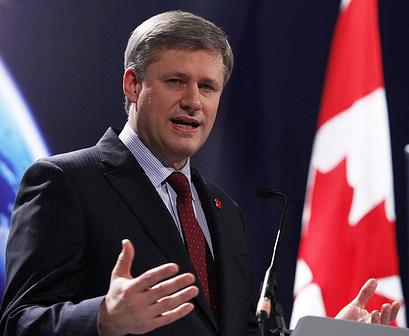
Prime Minister Stephen Harper

From Canoe.

Excerpt:

Finance Minister Jim Flaherty announced Sunday the government will scrap 70 tariff items to save Canadian businesses about $32 million a year.

“This builds on our government’s commitment in Budget 2010 to make Canada a tariff-free zone for industrial manufacturers,” Flaherty said in a statement. “By lowering costs for these businesses, we are enhancing their ability to compete in domestic and foreign markets and helping them invest and create jobs here at home.”

Various sectors — including food processing, apparel, electrical equipment and furniture — will benefit from the move.

The Conservatives had previously eliminated the duty on imported machinery and equipment in an attempt to make Canada a tariff-free zone for industrial manufacturers by 2015.

The Tories say that since 2009 they have eliminated more than 1,800 tariff items and have provided more than $435 million in annual tariff relief to Canadian businesses.

According to the leftist CTV news, Canada also has lower corporate taxes.

Excerpt:

The study released Wednesday by KPMG International found Canada’s corporate tax rate has dropped by more than 16 per cent over the last 11 years.

Canadian companies are actually paying less than their American counterparts.

On average, Canadian companies pay 28 per cent of their income in federal and provincial tax, well below the 40 per cent paid by American companies.

But Canada’s corporate tax rate is higher than Europe’s 20 per cent and the OECD average of 26 per cent.

Canadian corporate taxes fell three per cent in 2011, from 31 per cent in 2010.

“Canada’s corporate tax rate falls around the middle of the pack among the OECD countries,” said Elio Luongo, KPMG’s Canadian Managing Partner for Tax.

“But Canada’s general corporate tax rate is anticipated to continue to fall in 2012, when the federal tax rate will be 15 per cent, versus 16.5 per cent in 2011.”

I’ve written before about how Democrats oppose the job creation that would occur if the United States developed energy in Alaska, the Gulf of Mexico and the Ohio shale. Additionally, Obama has also opposed building the Keystone XL pipeline, which would have created 20,000 jobs paid for by a Canadian company. But Canada has no problems with developing their own energy resources, because their government operates independently of the environmentalist left.

Excerpt:

As world leaders gather in South Africa to discuss climate change this week and next, Canada’s environment minister says he plans to defend Alberta’s oilsands and is willing to argue they are an “ethical” and reliable energy source.

Heading into the 17th Conference of the Parties meeting, Environment Minister Peter Kent says he will not sign on to any deals that mandate some countries reduce greenhouse gas emissions while others don’t — as his government argues was the case under the Kyoto Protocol. He is also unequivocal in his defence of northern Alberta’s bitumen production, a position he expects will be supported by Alberta Environment Minister Diana McQueen when she joins him at the end of the week.

“We still need to — and the industry needs to and our provincial partners need to — be aggressive in ensuring international friends and neighbours and customers recognize Alberta’s heavy oil is no different from heavy oil produced in any number of other countries which don’t receive nearly the negative attention or criticism,” he says. “It is a legitimate resource.”

Kent has made headlines in the last year by arguing that Alberta’s oil is “ethical.”

“We talk about this on quite a regular basis,” Kent says. “I think it’s important we correct where we find … misunderstanding, misinformation or deliberate ignorance to demonize, to criticize and to attempt … to create a boycott.”

In January, on his second day as environment minister, Kent referred to Alberta’s oilsands product as “ethical oil” during an interview with a newspaper reporter.

Reports immediately linked Kent’s comments to the title of conservative activist Ezra Levant’s recent book, Ethical Oil: The Case for Canada’s Oil Sands.

The book essentially compares Canada’s human rights record to those of other oil-producing countries, and argues Canada’s “ethical oil” is preferable to “conflict oil” produced in countries with poor human rights records, such as Sudan, Venezuela, Saudi Arabia or Iran. The argument removes environmental issues, such as greenhouse gas emissions, from the equation, though Levant notes Alberta’s data on environmental issues is more transparent than information shared by other countries.

So in total I’ve presented three reasons why the Canadian economy is booming, while the American economy is stuck in neutral. Obama opposes free trade, lower corporate taxes and domestic energy production. When you elect a socialist lawyer, you get a Greece/Spain economy. When you elect a capitalist economist, you get Canada’s booming economy, and consequently, a lower unemployment rate. Recall that our recession began exactly when we elected Nancy Pelosi to the House leadership and Harry Reid to the Senate leadership in 2007. Democrats wreck economies. There is no reason why America cannot be more prosperous than Canada, but we have to not elect an abject buffoons as our leaders.