
Tag Archives: Stephen Harper

Should it be illegal to coerce a woman to have an abortion?

Rod Bruinooge
Rod Bruinooge

Story from Life Site News. (H/T Mary)

Excerpt:

The vote on the Canadian bill seeking to criminalize abortion coercion, which was initially pushed back to February, is now set for December 15th.

The bill, called “Roxanne’s Law,” is named after Roxanne Fernando, a Manitoba woman whose boyfriend attempted to coerce her to have an abortion after she became pregnant in 2007.  After refusing to have the unborn child killed, Roxanne was beaten and left to die in a snow bank.

It was introduced in April as a private members bill by Conservative MP Rod Bruinooge (Winnipeg South), who serves as chair of the parliamentary pro-life caucus.  It is opposed by Prime Minister Stephen Harper, who says he “will oppose any attempt to create a new abortion law.”

The bill, also known as C-510, received its first hour of debate on November 1st.  “No pregnant woman should ever have to choose between protecting herself and protecting her baby,” Bruinooge told the House of Commons.

It will receive a second hour of debate on December 13th.

The bill has gained wide support among religious and pro-life organizations, including the Evangelical Fellowship of Canada, the Canadian Bishops’ Catholic Organization for Life and Family, and Priests for Life, among numerous others.

Conservative prime minister (Stephen Harper) has committed to not changing abortion law at all while he has a minority government, probably because he feels he doesn’t have a mandate to do that since he never campaigned to do that. However, this law is so sensible and moderate, I have to think that he should allow a free vote on the issue, and let the social conservatives see that they have a home in the federal Conservative Party. This measure is so moderate that it would be difficult to see how anyone could be against it.

The latest poll has the Conservatives at 33.3% support, and the socialist Liberals at 27.1% support, and the communist NDP at 16.6%. To get a majority, the Conservatives have to be north of 40%. Canada is still a very liberal country.

UPDATE: Mary writes:

I agree that they should allow a free vote on the issue. It’s something that even the pro-choice side should support – provided they’re really pro-choice…

This is actually really important. There need to be repercussions to coercing a woman into abortion. It could save a lot of lives. Most abortions are not wanted and many are coerced. Read this to see just how bad it is: http://www.theunchoice.com/pdf/FactSheets/ForcedAbortions.pdf

And:

In the US context, listen to this recording of the testimony of a woman was coerced into an abortion by Planned Parenthood and hear how they try to shut her up when she wants to tell them why PP is not worthy of taxpayer funding:
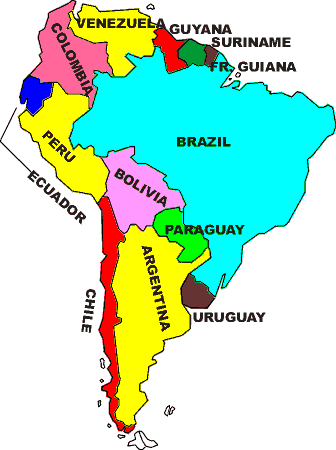
Colombia’s war on terrorism and Chile’s war on poverty

Map of South America

A magnificent column about Colombia’s war on FARC.

Excerpt:

When Juan Manuel Santos came into office as Colombia’s president and emphasized economic issues over the fight against terrorist guerrillas, he was suspected of going soft on those he had combated as minister of defense under the previous administration. Little did his critics know that he was planning the “coup de grace” against the Revolutionary Armed Forces of Colombia (FARC).

The devastating Sept. 22 attack on FARC headquarters in Colombia’s central Meta province all but signifies the end of the five-decade-old conflict. It will take a little while for the official end to be declared, but this war is pretty much over.

[…]For decades, politicians, academics, human rights activists and journalists on both sides of the Atlantic failed to see that there was nothing romantic, “bien-pensant” or Robin Hoodesque about an organization that killed, maimed, kidnapped and extorted for a totalitarian objective.

Colombia’s solitude was such that even the U.S. began to lose faith in its ally a couple of years ago, refusing to approve a free-trade agreement that Bogota had negotiated at a major political cost.

Colombians did not give up and continued to reclaim territory for civilian rule. Much like the defeat of Venezuela’s Cuba-inspired terrorist guerrillas in the 1960s, Colombia’s victory against FARC is the result of civilians awakening to the evil of totalitarian terror.

We get to hear about spectacular military feats, but how many outside Colombia realize that peasants, factory workers, teachers, students and others joined the struggle to defeat FARC, beautifully symbolized by the hundreds of thousands who took to the streets inside Colombia and around the world in 2008 to clamor for the end of terror?

There are still many challenges ahead. The lesson in courage and perseverance that Colombians have given us suggests they are ready to meet them.

I wish that we could sign a free trade deal with them like Canada’s conservative government. Canada is led by a conservative business-friendly economist, and they are very supportive of capitalist democracies like Colombia. Stephen Harper is Canada’s prime minister. He has economics degrees from the University of Calgary. Like Santos, he is very, very tough on terrorism – favoring increased defense spending to protect Canadian interests abroad. And guess what? Canada also has a free trade agreement with another South American country – Chile.

And Chile is also doing very well, even after the massive earthquake.

Excerpt:

Chile’s peso rose to a 27-month high after a report showed the country’s industrial growth accelerated to the fastest since 2006.

The peso appreciated 0.2 percent to 485.23 per U.S. dollar at 11:43 a.m. New York time, from 486.17 yesterday. The currency touched 483.61, the strongest since June 11, 2008. The peso has risen 13 percent during the quarter and 3.6 percent this month.

Chile’s economy is accelerating after the fifth-largest earthquake in a century struck in February, delaying its recovery from a 2009 recession.

“Retail sales grew and industrial production was better than expected,” said Roberto Melzi, a strategist at Barclays Capital in New York.

Retail sales expanded 13 percent in August from a year earlier, and industrial output grew 6.9 percent, the National Statistics Institute said in Santiago. That’s the most since January 2006. Industrial production shrank 17 percent after the 8.8-magnitude Feb. 27 earthquake and its accompanying tsunami, which caused damage worth more than a sixth of Chile’s gross domestic product.

Chile and Colombia are my two favorite South American countries. Both are led by conservative business-friendly economists. Chile’s president Sebastián Piñerahas a Masters and a Ph.D in economics from Harvard, and is successful in the private sector. The Colombian President Juan Manuel Santos specializes in business and economics, with graduate degrees from Harvard and the London School of Economics.

Canadian prime minister Stephen Harper vows to end long-gun registry

Canadian Prime Minister Stephen Harper

Here’s the story from the National Post.

Excerpt:

Prime Minister Stephen Harper vowed yesterday the Conservative party “will not rest” until the day it abolishes the long-gun registry.

[…]Mr. Harper predicted the “registry will someday be abolished” because it will continually be opposed by the people who understand it–whom he identified as “rural Canadians, hunters, outdoors men and women (and) police officers.”These people will never accept this registry because they know it is ineffective and wasteful. And the party I lead will not rest until the day it is abolished.”

See, the interesting thing is that this is exactly the kind of issue that Harper can use to drive rural voters, some of who vote Liberal or Socialist (NDP), towards the federal Conservative Party in the next federal election. Canadian rural voters tend to be further to the left than American rural voters.

Look at how the left-wing parties are squirming:

The Harper government has gone on the offensive this week in trying to draw attention to Liberal and NDP MPs who were once opponents of the long-gun registry but are now poised to vote in favour of it. Government House leader John Baird has said those MPs have been pressured by “Toronto elites” to switch their votes and will be held accountable by voters in the next election.

In Thunder Bay, NDP MPs John Rafferty and Bruce Hyer, on record as registry opponents, have yet to declare their intentions for next Wednesday’s vote on Conservative MP Candice Hoeppner’s bill to kill the registry.

The bill handily passed a preliminary vote last November, with the help of 12 New Democrats and eight Liberals. The margin this time is expected to be razor thin. The Liberals have been ordered to vote along party lines, while the New Democrats have said they have the six vote-changers they believe they need to save the registry.

And fiscal conservatives also hate the long-gun registry. It was supposed to cost 2 million dollars to implement, but it actually has cost over 2 billion dollars. What a waste! And with no demonstrable effect on crime rates, since law-abiding hunters don’t commit crimes.