Tag Archives: State

Is Obama telling the truth about U.S. oil reserves?

The Department of Energy's own figures

The Department of Energy’s own figures

Investors Business Daily explains. (H/T Master Resource)

Excerpt:

When he was running for the Oval Office four years ago amid $4-a-gallon gasoline prices, then-Sen. Barack Obama dismissed the idea of expanded oil production as a way to relieve the pain at the pump.

“Even if you opened up every square inch of our land and our coasts to drilling,” he said. “America still has only 3% of the world’s oil reserves.” Which meant, he said, that the U.S. couldn’t affect global oil prices.

It’s the same rhetoric President Obama is using now, as gas prices hit $4 again, except now he puts the figure at 2%.

“With only 2% of the world’s oil reserves, we can’t just drill our way to lower gas prices,” he said. “Not when we consume 20% of the world’s oil.”

The claim makes it appear as though the U.S. is an oil-barren nation, perpetually dependent on foreign oil and high prices unless we can cut our own use and develop alternative energy sources like algae.

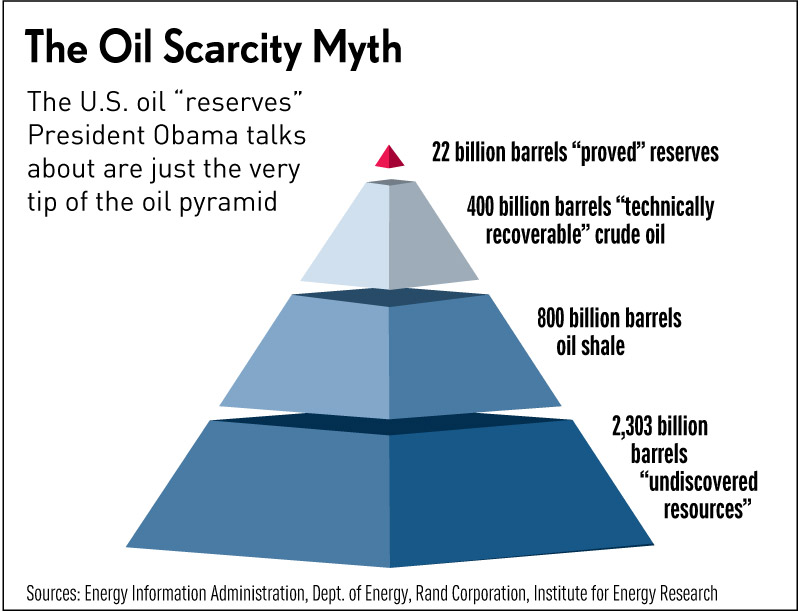
But the figure Obama uses — proved oil reserves — vastly undercounts how much oil the U.S. actually contains. In fact, far from being oil-poor, the country is awash in vast quantities — enough to meet all the country’s oil needs for hundreds of years.

The U.S. has 22.3 billion barrels of proved reserves, a little less than 2% of the entire world’s proved reserves, according to the Energy Information Administration. But as the EIA explains, proved reserves “are a small subset of recoverable resources,” because they only count oil that companies are currently drilling for in existing fields.

When you look at the whole picture, it turns out that there are vast supplies of oil in the U.S., according to various government reports. Among them:

At least 86 billion barrels of oil in the Outer Continental Shelf yet to be discovered, according to the government’s Bureau of Ocean Energy Management.

About 24 billion barrels in shale deposits in the lower 48 states, according to EIA.

Up to 2 billion barrels of oil in shale deposits in Alaska’s North Slope, says the U.S. Geological Survey.

Up to 12 billion barrels in ANWR, according to the USGS.

As much as 19 billion barrels in the Utah tar sands, according to the Bureau of Land Management.

Then, there’s the massive Green River Formation in Wyoming, which according to the USGS contains a stunning 1.4 trillion barrels of oil shale — a type of oil released from sedimentary rock after it’s heated.

[…]All told, the U.S. has access to 400 billion barrels of crude that could be recovered using existing drilling technologies, according to a 2006 Energy Department report.

When you include oil shale, the U.S. has 1.4 trillion barrels of technically recoverable oil, according to the Institute for Energy Research, enough to meet all U.S. oil needs for about the next 200 years, without any imports.

Please share this article, because it is unlikely that Obama’s Solyndra-supporting buddies in the mainstream media will report the facts on domestic energy production.

Production of oil, gas and coal on federal lands sinks to 9-year low

Obama claims that production of oil, gas and coal is up since he took office. It’s true that areas under state control are producing more, but what about energy production on federal lands? That’s the part of the country that Obama is responsible for.

Let’s see what two recent studies from the Energy Information Administration and the Institute for Energy Research found.

Excerpt:

The updated EIA report revealed a 12 percent decline in production for coal, oil, and natural gas on federal and Indian lands from fiscal 2003 through fiscal 2011.

During this same period, production on state and private lands has increased, boosting overall production numbers for the United States. That’s a point even President Obama will acknowledge: “Under my Administration, domestic oil and natural gas production is up,” he said upon announcing his rejection of the Keystone XL pipeline.

Obama is correct. He just can’t rightfully claim the credit, since the vast majority of America’s new oil and gas production is happening on private lands in states like North Dakota, Alaska and Texas.

The administration, meanwhile, has also taken several steps to limit production…

  • Withdrew areas offered for 77 oil and gas leases in Utah that could cost American taxpayers millions in lost lease bids, production royalties, new jobs and the energy needed to offset rising imports of oil and natural gas.
  • Cancelled lease sales in the Western Gulf of Mexico, the Atlantic coast and delayed exploration off the coast of Alaska and kept other resource-rich areas off-limits.
  • Finalized rules, first announced by Secretary Salazar on January 6, 2010, to establish more government hurdles to onshore oil and natural gas production on federal lands.
  • Withdrew 61 oil and natural gas leases in Montana as part of a lawsuit settlement over climate change.

“The big picture is clear that government policies undertaken by the Obama administration have produced a significant decline in offshore oil production on federal lands in fiscal year 2011,” the Institute for Energy Research said in response to last week’s updated EIA analysis. “That is certainly not a way to increase domestic production of oil and keep oil and thus gasoline prices in check.”

While it was waiting for EIA to update its numbers, the Institute for Energy Research conducted its own analysis of Department of Interior data in February. It came to the same conclusion: “Production on federal lands is down, while production on state and private lands is up.”

That’s the real story behind Obama’s claims about higher energy production. He’s doing his best to block energy production in the areas under his control. His energy plan is Solyndra, Solyndra, Solyndra – paying off his rich Democrat buddies with taxpayer money.

Mitt Romney’s pandering to Puerto Rico shows that he will say anything to win

From the Weekly Standard.

Excerpt:

CNN has projected that Mitt Romney will win Sunday’s primary in Puerto Rico, and Romney will most likely receive all 20 of Puerto Rico’s delegates. Romney had the support of Puerto Rico’s Republican governor, Luis Fortuño, and was expected to win handily.

But Robert G. de Posada, the former president of the conservative Latino Coalition, has an op-ed at the Daily Caller charging that Romney “sold out his conservative principles” in order to win big in the Caribbean territory. De Posada points out that Congress has often required territories with large non-English speaking populations to agree to use English officially within government and in schools before allowing those territories to achieve statehood. Romney, he says, pandered to pro-statehood sentiments in Puerto Rico while ignoring this precedent as well as his own position back on the mainland:

On Thursday, Romney called a radio station in San Juan (Noti-Uno) for an interview with a local reporter. When asked if he would support requiring that English became the principal language of government as part of a petition for statehood, Romney said no. When asked if he thought the legislature should have English as the principal language, once again Romney said no. He even opposed requiring English in the courts and public schools.

In Louisiana and Alabama, Mitt Romney is for English as the official language of the United States. In 2008, when Romney sought the GOP nomination, he was upfront about his opposition to bilingual education and his support for ending it in Massachusetts. But in Puerto Rico, he is a strong advocate of bilingualism and opposes requiring the state to make English the principal language of the legislature, courts and public schools. This only makes sense in the Romney World of Flip Flops.

But Romney took it a step further. He stated that a simple majority of 50% + 1 was enough for him to aggressively support statehood for Puerto Rico. As Rick Santorum said during his trip to Puerto Rico, “We need a significant majority supporting statehood before it’s considered. Why would we want a state where nearly half of its residents do not want to be part of the Union?”

Santorum should be commended for staying true to his conservative principles even when it was not politically convenient. Santorum could have pandered to the pro-statehood governor of Puerto Rico in order to get the 20 delegates at stake, but instead the former senator spoke the truth and told Puerto Rican voters a reality they needed to hear. Immediately after, Romney’s campaign started attacking Santorum and maliciously twisting his comments, telling voters that the former senator was advocating “English-only” and was against Spanish.

In contrast to what the Romney campaign said, Santorum Puerto Rico would have to stress English in addition to Spanish, before getting statehood.

Excerpt:

Rick Santorum Wednesday became the first Republican presidential hopeful in this election to visit Puerto Rico before the island commonwealth’s Sunday primary, taking a controversial stand on statehood that he was forced to defend this morning after losing a key supporter.

[…]“What I said is English has to be learned as a language and this has to be a country where English is widely spoken and used, yes,” Santorum told reporters, stating that the use of English should be a “condition” if Puerto Rico is to become a state. The island, he said, “needs to be a bilingual country, not just a Spanish speaking country.”

“I think English and Spanish – obviously Spanish is going to be spoken here on the island – but this needs to be a bilingual country, not just a Spanish-speaking country, and right now it is overwhelmingly just Spanish speaking. But it needs to have, in order to fully integrate into American society, English has to be a language that is spoken here also and spoken universally,” Santorum explained.

“I think that would be a condition. I think it’s important. And I think if you talk to most parents, they want their children to learn English. It is essential for children in America to be able to speak English to fully integrate and have full opportunities,” he added. “I don’t think we’re doing any more than, you know, people who come to America on the mainland. We’re not doing them any favors by not teaching them English.

There is a clear contrast between these two men: Mitt Romney is not a good man. He just says what people want to hear in order to win, and then when elected he will govern like a pro-abortion, pro-gay-marriage, tax-and-spend liberal – that’s what he did in Massachusetts.