Tag Archives: State Department

Hillary Clinton lied to CNN about not receiving a subpoena

What difference does national security make?

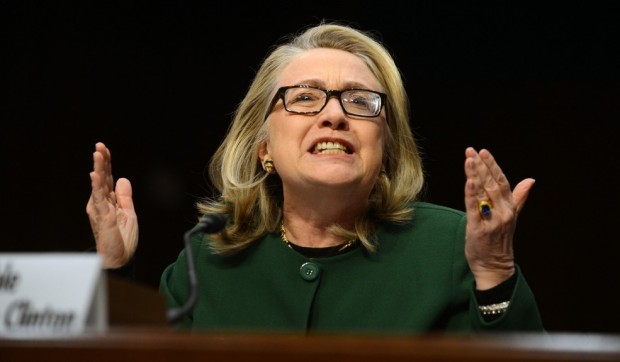
Hillary Clinton finally agreed to do an easy interview on CNN, but even though the questions were were easy, and the audience friendly, she still got caught in an obvious lie.

Here she is claiming she never was received a subpoena regarding her private, unsecure e-mail server:

Now here’s Trey Gowdy explaining to CNN that she in fact did receive a subpoena:

Former Congressman John Campbell interviewed Trey Gowdy on the Hugh Hewitt show – a national radio show. The audio and the transcript have been posted.

The MP3 file is here.

Here’s the interesting part of the transcript:

JC: We have with us on the line now Congressman Trey Gowdy and chairman of the House Select Committee on Benghazi. Hey, Trey, great to have you on the show.

TG: Congressman, we miss you, and thank you for having me on.

JC: Well, thank you so much for coming on. Now I’m going to play for you, I’m sure you expected this, the clip from Hillary Clinton yesterday when she was being interviewed on CNN by Brianna Keilar. So please play that clip.

BK: Facing a subpoena, deleted emails from them?

HRC: You know, you’re starting with so many assumptions that are, I’ve never had a subpoena.

JC: I’ve never had a subpoena, her words. Congressman Trey Gowdy, did Hillary Clinton lie yesterday?

TG: Well, she certainly had a subpoena. You know, when you lie, a lie suggests an intent to deceive. I can’t imagine whatever intent she could possibly have. I try not to use the word lie. I can certainly tell you this. It is a fact that there was a subpoena issued to her in March of 2015. But Congressman, it’s also a fact that there was a subpoena in existence from another Congressional committee far before that one. So there are two subpoenas. There are letters from Congress. And there’s a statutory obligation to her to preserve public records. So whether it’s a subpoena in place or whether it’s a statute in place, or whether it’s a Congressional investigation in place, you can’t delete and wipe out public records.

JC: Now Chairman Gowdy, I have the subpoena that your committee sent out, I have a copy of it, sitting in front of me from March of 2015. But you’re now telling me that there was another one prior to that?

TG: Oh, yes, sir. There was, think back right after Benghazi, Jason Chaffetz wrote a letter to Secretary Clinton, in fact, saying Congress has the right and the authority to investigate these attacks. That is tantamount to a ‘do not destroy’ request. And also keep in mind, Congress wrote her directly when she was Secretary of State and asked her specifically, do you ever use personal email. She never answered that question. She never said yes, she never said no. All right, fast forward. The Oversight Committee is looking into Benghazi. They issued a subpoena to the State Department to bring certain documents over to Congress so we can inspect them. It is that subpoena that ultimately led the State Department to give us the first eight emails we got from her.

JC: And when was that?

TG: We got them in August of…

JC: No, but when was that subpoena?

TG: 2013.

JC: 2013?

TG: Yes, sir.

JC: So she, all right, so, because she had this subpoena in March, 2015, and then you’re saying she had another one in 2013.

TG: There was another one to the State Department. In August of 2013, there were two subpoenas sent to the State Department, which are requests for documents. But as a result of that subpoena to the State Department, the State Department then produced to us her emails. So there is no way to claim that there was not some legal process directing that those emails be retained and ultimately produced, because they were.

JC: Yeah, because I’ve read that her trying to weasel out of this is, out of the lie, and I’m going to use that term, and I’m going to get back to it in a minute, but is that well, I thought that the question was whether I was under any subpoenas when the emails were deleted. And so obviously, she had subpoenas. I mean, there is no way that she didn’t have subpoenas. That’s without question. I’ve got them sitting in front of me. But you’re saying that also, there were subpoenas that covered the deletion of those emails?

TG: There are, there were subpoenas in place well before our committee ever existed.

CNN has also posted a story about this. As if there were not already enough Clinton scandals, here is another one to add to the heap.

Related posts

New study: how the mainstream media deleted Hillary Clinton’s e-mail scandal

Newsbusters has done some work to quantify it.

Excerpt:

Hillary Clinton’s official presidential announcement was a golden opportunity for networks to demand the former Secretary of State respond to unanswered questions about her e-mail scandal. Yet in the flurry of coverage since her official rollout (April 12 – April 20) the e-mail scandal garnered a total of just 7 minutes, 12 seconds on the Big Three (ABC, CBS, NBC) evening and morning shows.

Even a new angle on the e-mail scandal – the New York Times reported April 14 that Clinton never responded to a congressional inquiry [in December of 2012] that “directly asked” if she had used a private e-mail account – failed to re-ignite the interest networks initially showed when the scandal first broke in March.

Over the past five weeks, all three broadcast networks have essentially walked away from covering the ex-Secretary of State’s secret extra-governmental e-mail server and the possible loss of crucial documents needed by the House Select Committee investigating the 2012 Benghazi attacks, with coverage on ABC, CBS and NBC’s morning and evening news shows falling by more than 93 percent from the levels seen in early March.

When news first broke that Clinton improperly used her own private e-mail account, the Big Three networks actually jumped to cover the story, filling their evening and morning shows with a total of 124 minutes and 55 seconds of airtime (NBC: 53 minutes, 51 seconds; CBS: 36 minutes, 39 seconds; ABC: 34 minutes, 25 seconds) within the first two weeks (March 3-16) of coverage that encompassed Hillary Clinton’s March 10 press conference.

But despite pundits and journalists like NBC’s Chuck Todd insisting that Clinton’s press conference “didn’t satisfy her media critics” a look at the coverage in the ensuing weeks shows they lost a lot of their interest in the story.

In the third week, (March 17-23), the networks reduced their coverage of the latest Clinton controversy to just 1 minute and 59 seconds (NBC: 23 seconds; CBS 29 secondsl; ABC: 1 minute, 7 seconds).

In the fourth week (March 24-30), the stunning news that Clinton’s own attorney admitted her server had been wiped clean caused a brief spike in coverage — but even that development generated just 11 minutes and 14 seconds of airtime (ABC: 1 minute, 32 seconds; CBS: 4 minutes, 48 seconds; NBC: 4 minutes, 54 seconds).

By week 5 (March 31-April 6) the story was virtually non-existent drawing just 1 minute and 16 seconds total coverage. (ABC: 0; CBS: 29 seconds; NBC: 47 seconds).

[…]Even though unanswered questions still persist (Why was her private server wiped clean? Was there incriminating evidence in those e-mails regarding the Benghazi investigation or Clinton Foundation donations? Could a foreign nation, like Russia, have hacked her server?) the networks have essentially discarded the story, reducing their coverage to just a total of 2 minutes and 11 seconds (CBS: 14 seconds, ABC: 42 seconds, NBC: 1 minute, 15 seconds) by the seventh week.

Compare a few minutes here and there with the coverage of the VA scandal:

In nearly four and a half weeks, the ABC, CBS and NBC morning and evening news shows have offered 110 minutes to an evolving Obama administration scandal involving secret lists designed to keep veterans from receiving proper medical treatment. Back in January, it took those same network shows just four and a half days to churn that much coverage for Chris Christie’s Bridgegate.

Since the VA story broke on April 23 with the news that as many as 40 veterans seeking treatment at one Phoenix facility died while on secret waiting lists, CBS has provided the most coverage, 48 minutes and 46 seconds. NBC allowed 44 minutes and 53 seconds and ABC came in last with a scant 16 minutes and 44 seconds. None of the networks bothered covering the story until May 6, almost two weeks after it broke. (This is despite heavy investigative reporting by Fox News and CNN.)

An analysis last week by the Media Research Center found that through the morning of May 16, a mere five seconds of the coverage included criticism of Barack Obama’s handling of the VA hospital scandal. Only this week, as the pressure mounted and new details emerged, the storyline finally shifted to including criticisms of the President.

Oh, but if it’s a Republican scandal then clear the decks:

A 2014 Media Research Center study found that the broadcast networks of ABC, CBS, and NBC devoted a stunning 88 minutes of air time to the Bridgegate story in less that 48 hours after it broke on January 8 of that year.

And it didn’t fade, either:

In stark contrast, when a scandal involving the administration of New Jersey Governor Chris Christie (R) erupted in January, CNN provided wall-to-wall coverage. In the first full day of coverage on January 9, CNN spent a whopping eight hours and 35 minutes covering the Christie story.

I’m really not sure why so many Americans willingly indoctrinate themselves by watching the mainstream media and pretending that it’s unbiased news. If you’re looking for balance, then you’re better off reading something from a quality left-leaning source like National Journal or the Atlantic.

Is Obama’s nuclear deal with Iran good for our national security?

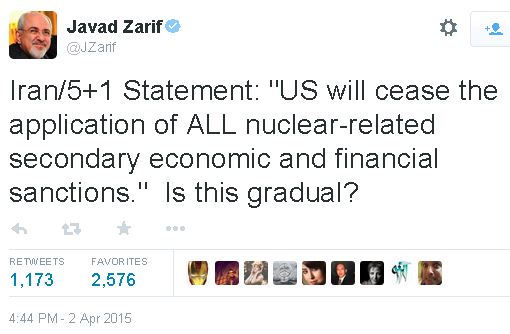
Iran chief negotiator: all sanctions will stop
Iran’s chief negotiator: all the sanctions cease immediately

This is the top article on the Wall Street Journal right now. It’s written by two former Secretaries of State, Henry Kissinger and George P. Shultz.

They are assessing the Iran deal:

While Iran treated the mere fact of its willingness to negotiate as a concession, the West has felt compelled to break every deadlock with a new proposal. In the process, the Iranian program has reached a point officially described as being within two to three months of building a nuclear weapon. Under the proposed agreement, for 10 years Iran will never be further than one year from a nuclear weapon and, after a decade, will be significantly closer.

[…]Progress has been made on shrinking the size of Iran’s enriched stockpile, confining the enrichment of uranium to one facility, and limiting aspects of the enrichment process. Still, the ultimate significance of the framework will depend on its verifiability and enforceability.

[…]Under the new approach, Iran permanently gives up none of its equipment, facilities or fissile product to achieve the proposed constraints. It only places them under temporary restriction and safeguard—amounting in many cases to a seal at the door of a depot or periodic visits by inspectors to declared sites. The physical magnitude of the effort is daunting. Is the International Atomic Energy Agency technically, and in terms of human resources, up to so complex and vast an assignment?

In a large country with multiple facilities and ample experience in nuclear concealment, violations will be inherently difficult to detect. Devising theoretical models of inspection is one thing. Enforcing compliance, week after week, despite competing international crises and domestic distractions, is another. Any report of a violation is likely to prompt debate over its significance—or even calls for new talks with Tehran to explore the issue. The experience of Iran’s work on a heavy-water reactor during the “interim agreement” period—when suspect activity was identified but played down in the interest of a positive negotiating atmosphere—is not encouraging.

Compounding the difficulty is the unlikelihood that breakout will be a clear-cut event. More likely it will occur, if it does, via the gradual accumulation of ambiguous evasions.

When inevitable disagreements arise over the scope and intrusiveness of inspections, on what criteria are we prepared to insist and up to what point? If evidence is imperfect, who bears the burden of proof? What process will be followed to resolve the matter swiftly?

The agreement’s primary enforcement mechanism, the threat of renewed sanctions, emphasizes a broad-based asymmetry, which provides Iran permanent relief from sanctions in exchange for temporary restraints on Iranian conduct. Undertaking the “snap-back” of sanctions is unlikely to be as clear or as automatic as the phrase implies. Iran is in a position to violate the agreement by executive decision. Restoring the most effective sanctions will require coordinated international action. In countries that had reluctantly joined in previous rounds, the demands of public and commercial opinion will militate against automatic or even prompt “snap-back.” If the follow-on process does not unambiguously define the term, an attempt to reimpose sanctions risks primarily isolating America, not Iran.

The gradual expiration of the framework agreement, beginning in a decade, will enable Iran to become a significant nuclear, industrial and military power after that time—in the scope and sophistication of its nuclear program and its latent capacity to weaponize at a time of its choosing. Limits on Iran’s research and development have not been publicly disclosed (or perhaps agreed). Therefore Iran will be in a position to bolster its advanced nuclear technology during the period of the agreement and rapidly deploy more advanced centrifuges—of at least five times the capacity of the current model—after the agreement expires or is broken.

That doesn’t sound like a good deal to me.

It sounds like we are trading permanent relief from sanctions. Those sanctions were built up over years of negotiations with the UN countries. Sanctions that are not easy to “snap back” if Iran breaks the deal, because they require negotiations with many different UN countries again – it won’t be automatic. That’s the “asymmetry” they are talking about in the article. Iran can break the agreement unilaterally, or just block the inspections, and the sanctions will stay off until we get agreement with the UN countries.

Here’s the former Democrat campaign worker, and now State Department spokeswoman Marie Harf:

She is confused by all the “big words” that these two Secretaries of State used in the article above.

But it gets worse!

Here’s the latest from the Times of Israel. (H/T Director Blue via ECM)

It says:

Iran will begin using its latest generation IR-8 centrifuges as soon as its nuclear deal with the world powers goes into effect, Iran’s foreign minister and nuclear chief told members of parliament on Tuesday, according to Iran’s semi-official FARS news agency.

If accurate, the report appears to make a mockery of the world powers’ much-hailed framework agreement with Iran, since such a move clearly breaches the US-published terms of the deal, and would dramatically accelerate Iran’s potential progress to the bomb.

Iran has said that its IR-8 centrifuges enrich uranium 20 times faster than the IR-1 centrifuges it currently uses.

According to the FARS report, “Iran’s foreign minister and nuclear chief both told a closed-door session of the parliament on Tuesday that the country would inject UF6 gas into the latest generation of its centrifuge machines as soon as a final nuclear deal goes into effect by Tehran and the six world powers.”

It said that Foreign Minister Mohammad Javad Zarif and Atomic Energy Organization of Iran (AEOI) head Ali Akbar Salehi made the promise when they briefed legislators on the framework agreement, and claimed the move was permitted under the terms of the deal.

Oh, I guess was wrong. This is a good deal! For Iran.

Sigh. I guess if you want to be even more horrified by the Iran deal, you can listen to an interview that Hugh Hewitt did with Wall Street Journal columnist Bret Stephens, and there’s a transcript as well for those who would rather read about the incompetence of the Obama administration rather than hear about the incompetence of the Obama administration.