
Tag Archives: Speech

Paul Ryan fact check: Was the GM plant in Janesville closed in 2008 or 2009?

CNS News sets the record straight.

Excerpt:

In his speech accepting the Republican nomination for vice president, Rep. Paul Ryan (R-Wisc.) told the story of a General Motors factory in his hometown of Janesville, Wisconsin, accusing President Obama of failing to keep a campaign promise to keep the plant open.

“My home state voted for President Obama. When he talked about change, many people liked the sound of it, especially in Janesville, where we were about to lose a major factory,” Ryan said Wednesday.

“Right there at that plant, candidate Obama said: ‘I believe that if our government is there to support you … this plant will be here for another hundred years.’ That’s what he said in 2008. Well, as it turned out, that plant didn’t last another year. It is locked up and empty to this day. And that’s how it is in so many towns today, where the recovery that was promised is nowhere in sight.”

Ryan’s claims received widespread criticism from the Obama campaign and many liberal media outlets.

“He even dishonestly attacked Barack Obama for the closing of a GM plant in his hometown of Janesville, Wisconsin — a plant that closed in December 2008 under George W. Bush,” Obama campaign manager Jim Messina said in an email to supporters Thursday.

The Washington Post official ‘fact-checker’ also attacked Ryan’s claims as false, using the same line about the plant closing in 2008:

“That’s not true. The plant was closed in December 2008, before Obama was sworn in,” Post fact-checker Glenn Kessler wrote Wednesday. “Obama gave his speech in February 2008, and he did say those words. But Ryan’s phrasing, referring to the fact the plant did not last another year, certainly suggests it closed in 2009, when Obama was president.”

But Ryan is in fact correct. The Janesville GM factory stopped production of SUVs in December 2008 and closed its doors for good in 2009 – less than one year after Obama promised to keep it open for another hundred years.

In his speech in Janesville, then-Sen. Obama said that if elected, he would support retooling the Janesville plant to make energy efficient vehicles. Despite his administration’s carefully shepherding of GM through bankruptcy, the Janesville plant has not been retooled to make anything.

[…]“Full-size sport utility vehicle production has ended at the local General Motors plant, but medium-duty truck production is continuing—not starting—in Janesville. And it likely will continue into May, when the lights finally go off in the facility that has been producing vehicles since 1923” the paper reported February 2, 2009.

In fact, a GM press release confirms that the automaker had placed the Janesville plant on “standby capacity” – an auto industry term for a factory no longer producing vehicles – in May of 2009.

“Janesville was placed on standby capacity in May 2009 and will remain in that status,” GM said in a June 26, 2009 press release.

In sum, the Janesville plant shut down the majority of its production in December 2008, laying off all but 50 of its approximately 1,200 employees. Those 50 employees remained at the plant making Isuzu trucks for several more months as the plant’s operations wound down.

As a candidate, President Obama promised to support re-tooling the factory to make more fuel-efficient vehicles and keep the plant open for a century. The plant, however, remains closed.

It’s amazing how the left-wing media just flat out lies in order to protect the incompetence of this community organizer President. Recall also that the economy started to decline when the massive spending started under the new Pelosi-Reid plan in January of 2007. Deficits went from $160 billion to about $600 billion as soon as the Democrats took over, and then well over a trillion in 2009 when Democrats controlled the House, Senate and Presidency.

More responses to criticisms of the speech at the liberal Washington Post.
Free speech hero Mark Steyn reflects on the demise of Section 13 fascism

Canada 2011 Federal Election Seats

Kathy Shaidle at Five Feet of Fury linked to this editorial which explains how the battle for free speech was won up in the frozen North.

Excerpt:

Justice Minister Rob Nicholson had voiced support for the legislation. So had the Prime Minister. The result, then, was never in doubt: at 9:35 p.m. on June 6, by a vote of 153-136,  Parliament got Canada’s human rights bureaucrats out of the business of policing speech on the Internet. There was a scattering of applause, and handshakes for Storseth (the bill requires the rubber stamp of Senate approval). “To be honest, it’s all a blur,” says the three-term MP, laughing. But if the passage of Bill C-304 represents a fundamental shift in Canadian culture, you’d never have known it that night. Members dealt with a few housekeeping matters, then waded through a supply bill. Finally, one by one, they trickled out into the cool Ottawa night.

The effect of killing Section 13 will be debated for years among anti-racist groups and civil libertarians. But it is undoubtedly a turning point. Since 1999, Canadians who felt aggrieved by material transmitted online have been encouraged to seek redress under federal human rights law, which targeted material “likely to expose a person or persons to hatred or contempt” based on grounds of discrimination like race, religion or sexual orientation. Storseth’s bill repeals the provision outright, leaving the Criminal Code as the primary bulwark against the dissemination of hate propaganda by electronic means.

With it will go one of the most divisive disputes to grip the country since the introduction of the Charter of Rights itself—a contest of values that over the past five years has pitted Canadians’ desire to protect minorities from discrimination against the bedrock principle of free speech. Mainstream media outlets, most notably Maclean’s, have been hauled before commissions to answer for their published content. The commissions themselves have come under fire for allowing their processes to be used as a bludgeon against legitimate expression, tailored as they are to encourage complainants to come forward. Meantime, a Saskatchewan law similar to Section 13 has become the subject of a Supreme Court challenge that could invalidate hate-speech provisions in most provincial human rights codes. By year’s end, it is conceivable that no human rights commission in the country will be in the business of adjudicating published material.

And here’s a must-read cri-de-coeur from free speech hero Mark Steyn in Maclean’s magazine. (H/T Binks the Web Elf)

Excerpt:

Operationally, Section 13 was stinkingly corrupt. There are some 34 million Canadians, yet just one individual citizen had his name on almost every Section 13 prosecution of the last decade. Just as Matthew Hopkins appointed himself England’s Witchfinder General in 1645 and went around the country turning in raven-tressed crones for the bounty of a pound per witch, so Richard Warman appointed himself Canada’s Hatefinder General and went around turning in shaven-headed tattooed losers in their mums’ basements for far more lucrative bounties of tens of thousands of dollars. He filed his complaints as a supposedly “offended” and “damaged” private citizen while an employee of Her Majesty’s Government. And, in fairness to Matthew Hopkins, he didn’t personally put on a pointy black hat and ride around on a broomstick. Whereas Mr. Warman joined Stormfront and other “white supremacist” websites and posted copious amounts of hate speech of his own, describing, for example, Jewish members of cabinet as “scum” and gays as a “cancer.” That’s how “hateful” Canada is: there’s so little “hate” out there that the country’s most famous Internet Nazi is a taxpayer-funded civil servant.

For Warman, there was little risk: you paid his costs, and the dice were loaded. After Hosni Mubarak was “re-elected” with 97.1 per cent of the vote, he was said to be furious with his officials for stealing too much of the election and making him look like one of those crude ham-fisted dictator-for-life types like Saddam and Kim Il-Sung. So next time round his officials arranged for him to “win” with a mere 96.3 per cent of the vote. Canada’s “human rights” commissars had no such squeamishness: until the tenacious Marc Lemire won his landmark victory in 2009, Section 13 prosecutions had a three-decade 100 per cent conviction rate even the Soviets might envy.

That wasn’t even the most basic affront. Until Maclean’s intervened in 2008, Lemire’s Section 13 trial was scheduled to be held in secret. I couldn’t quite believe this when I chanced to happen upon the “judge’s” rationale, and I suggested en passant that we should get Maclean’s estimable QC Julian Porter to file a whatchamacallit, a brief or motion or whatever, referencing precedents and other jurisprudential-type stuff, and put a rocket up these totalitarian buggers by treating their dank outhouse of pseudo-justice as a real courtroom subject to real law. Secret trials are for Beijing and Tehran, yet in the name of “human rights” they were introduced to Ottawa.

The line that sums up my objection to the racket was formulated by the Toronto blogger Kathy Shaidle: “You’re too stupid to tell me what to think.” In recent days, the last lonely defenders of the Canadian thought police have all volunteered to demonstrate Miss Shaidle’s proposition. The Opposition [NDP] critic for “public safety,” Randall Garrison, bemoaned the demise of the commissars’ “power to educate Canadians.” “We do have a serious problem,” said Garrison. “If you take away the power to take [websites] down, it’s not clear they have any mandate to even talk to people about it and educate them about it.”

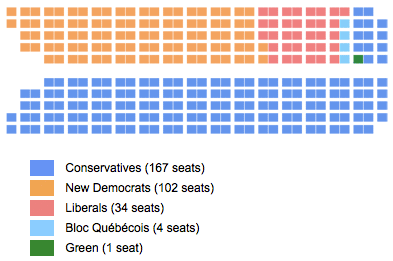
The Conservatives held up their end of the deal once they got their majority, didn’t they? Everyone who said they were not going to do anything with their majority should hang their heads in shame, now. They can’t do everything, but they can certainly do some things.

This is a lesson for us down here. If you love your country, then get out and vote in November! And make sure your friends vote, too – you should be convincing them to vote by giving them the facts about Obama’s catastrophic failures even now.

Related posts

Canadian conservatives pass bill to repeal Section 13 speech code

Canada 2011 Federal Election Seats

It’s the end of the Canadian speech code. (H/T Andrew)

Excerpt:

The federal Conservatives voted late Wednesday to repeal controversial sections of the Canadian Human Rights Act banning hate speech on the Internet, backing a bill they say promotes freedom of expression and would have the courts play a larger role in handling hate-crime cases.

In a free vote of 153 to 136, the Tory caucus supported a private member’s bill from Alberta Conservative MP Brian Storseth that would scrap Section 13 of the human rights code, which deals with complaints regarding “the communication of hate messages by telephone or on the Internet.”

Storseth argues the current human rights code fails to protect freedom of speech, which is guaranteed under the Charter of Rights and Freedoms, and believes Canadians are better off if the government repeals sections 13 and 54 — the latter section dealing with associated penalties.

“It’s a really important step for freedom of expression in our country,” Storseth said Thursday, the morning after the bill passed third and final reading in the House of Commons.

“There hasn’t been a tremendous pushback as you would have seen seven or eight years ago when this issue first really arose, and I think it’s because there has been a fruitful debate in our country.”

Senior cabinet ministers supported the bill and the results generated loud applause from Conservative MPs. Prime Minister Stephen Harper is overseas and wasn’t present for the vote. Most opposition politicians voted against the bill, although Newfoundland and Labrador Liberal MP Scott Simms supported it.

Storseth, a backbencher, said the current human rights code allows too many frivolous cases to proceed against citizens, when the Criminal Code already covers hate speech that could generate harm against an individual or group.

Acts of hate speech are serious crimes that should be investigated by police officers, not civil servants, he said, adding that the cases should be handled by “real judges and real lawyers,” instead of a quasi-judicial body such as the human rights commission.

The bill would effectively strip the human rights commission of its ability to rule on cases of hate speech over the phone and Internet, he said, and instead hand many of the powers to the courts.

Storseth said he has also been speaking with colleagues in the Conservative-dominated Senate in hopes the bill will pass through the upper chamber and receive royal assent by the end of the year. The bill contains a one-year implementation period.

For those who need a refresher course on how bad these secular leftist fascism panels really were, you can read this article about the punishment received by a Christian pastor who wrote an editorial critical of gay activism in the schools. He was put on trial for 5 years and had to pay over $100,000 in legal fees, including the legal fees of his accuser. His crime? Making his accuser feel offended.

Related posts