Tag Archives: Section 13

Canadian conservatives pass bill to repeal Section 13 speech code

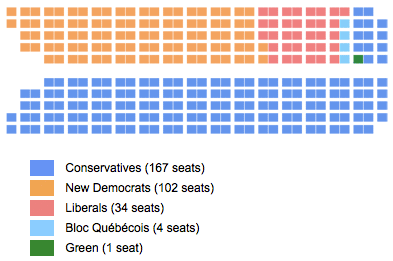
Canada 2011 Federal Election Seats

It’s the end of the Canadian speech code. (H/T Andrew)

Excerpt:

The federal Conservatives voted late Wednesday to repeal controversial sections of the Canadian Human Rights Act banning hate speech on the Internet, backing a bill they say promotes freedom of expression and would have the courts play a larger role in handling hate-crime cases.

In a free vote of 153 to 136, the Tory caucus supported a private member’s bill from Alberta Conservative MP Brian Storseth that would scrap Section 13 of the human rights code, which deals with complaints regarding “the communication of hate messages by telephone or on the Internet.”

Storseth argues the current human rights code fails to protect freedom of speech, which is guaranteed under the Charter of Rights and Freedoms, and believes Canadians are better off if the government repeals sections 13 and 54 — the latter section dealing with associated penalties.

“It’s a really important step for freedom of expression in our country,” Storseth said Thursday, the morning after the bill passed third and final reading in the House of Commons.

“There hasn’t been a tremendous pushback as you would have seen seven or eight years ago when this issue first really arose, and I think it’s because there has been a fruitful debate in our country.”

Senior cabinet ministers supported the bill and the results generated loud applause from Conservative MPs. Prime Minister Stephen Harper is overseas and wasn’t present for the vote. Most opposition politicians voted against the bill, although Newfoundland and Labrador Liberal MP Scott Simms supported it.

Storseth, a backbencher, said the current human rights code allows too many frivolous cases to proceed against citizens, when the Criminal Code already covers hate speech that could generate harm against an individual or group.

Acts of hate speech are serious crimes that should be investigated by police officers, not civil servants, he said, adding that the cases should be handled by “real judges and real lawyers,” instead of a quasi-judicial body such as the human rights commission.

The bill would effectively strip the human rights commission of its ability to rule on cases of hate speech over the phone and Internet, he said, and instead hand many of the powers to the courts.

Storseth said he has also been speaking with colleagues in the Conservative-dominated Senate in hopes the bill will pass through the upper chamber and receive royal assent by the end of the year. The bill contains a one-year implementation period.

For those who need a refresher course on how bad these secular leftist fascism panels really were, you can read this article about the punishment received by a Christian pastor who wrote an editorial critical of gay activism in the schools. He was put on trial for 5 years and had to pay over $100,000 in legal fees, including the legal fees of his accuser. His crime? Making his accuser feel offended.

Related posts

Conservative MP’s bill to repeal Section 13 moves to committee

Canada 2011 Federal Election Seats
Canada 2011 Federal Election Results

Andrew sent me this article from the Chronicle Herald.

Excerpt:

To protect freedom of expression in Canada, sometimes you need a majority government in Ottawa.

That’s the moral of the story of a Conservative backbencher’s private member’s bill — which has now cleared second reading in the House of Commons and gone to committee — seeking to repeal Section 13 of the Canadian Human Rights Act.

Let’s recall the exact wording of that infamous clause. Hate messages, according to Section 13 (1), are communications “likely to expose a person or persons to hatred or contempt by reason of the fact that that person or those persons are identifiable on the basis of a prohibited ground of discrimination.”

In other words, if I were to write something critical about Islam, for example, and someone reading my column felt it “likely” that my words could provoke “contempt” towards Muslims, they could lodge a complaint against me with one of Canada’s government-created human rights commissions.

Truth would not be a defence. Neither would my intent. And the person complaining wouldn’t even have to be a Muslim.

That’s because, on top of the appallingly loose wording of this section of federal human rights law — a clause echoed in its provincial counterparts — any complaints are adjudicated by government-appointed tribunals, where the standard protections afforded any accused in a court of law don’t necessarily apply.

When complainants’ cases go forward, taxpayers pick up the tab. Meanwhile, those accused must pay to defend themselves out of their own pockets.

It’s a system ripe for abuse. And that’s exactly what has happened. We’ve seen comics fined for insulting hecklers (B.C. human rights tribunal), former publishers spend $100,000 in legal fees over three years to defend themselves for printing “offensive” cartoons (Alberta human rights commission), and Maclean’s magazine investigated by three human rights bodies (federal, Ontario and B.C.) for running an article on Muslim demographics in Europe.

The Conservatives have long opposed Section 13, but didn’t feel they had the support they needed from the other parties, as a minority government, to push the issue legislatively.

They also were concerned, with good reason, that some opponents might twist the issue for political advantage, slamming the Tories for being soft on hate.

Yes, Bill C-304, which aims to repeal Sections 13 and 54 (dealing with penalties under S.13), was put forward by Alberta MP Brian Storseth (Westlock-St. Paul) and is a private member’s bill, but the legislation has the justice minister’s endorsement. So there’s a good chance the bill will be back in the Commons this spring for final reading, then on to the Senate and, hopefully, passage and royal assent.

The bill, if made law, would take effect a year after receiving royal assent.

Canada does not protect free speech right now. Repealing Section 13 would be good, but Canada is not a good place for families to raise children. Even if they get Section 13 repealed, there is still the recent unanimous Supreme Court decision affirming that the provincial governments have a right to decide what children will believe – not parents. The Supreme Court was mostly selected by the previous Liberal governments.

Conservative MP introduces bill to abolish Section 13 speech code

Here is the description for that video, posted by SDAMatt: (Note: Tory = Conservative)

Tory backbencher Brian Storseth wants to eliminate Section 13 of the Canadian Human Rights Act (CHRA). That is the provision in federal law that gives the Canadian Human Rights Commission authority to hear complaints of hate speech on the Internet. We wish Mr. Storseth, the MP from Westlock-St. Paul in Alberta, well in this campaign. Section 13 is a particularly pernicious infringement on free speech. Originally added to the CHRA in 2001 as a protection for vulnerable groups against racist or violence-promoting websites, the clause has more often been used by minority activists (or those purporting to act on behalf of minorities) to silence those who do not share their opinions.

The biggest problem with Sec. 13 is that its provisions make it far too easy for commissioners to find an alleged offender guilty. Unlike in a court of law – where the presumption of innocence, rules of evidence and bans on hearsay testimony protect defendants from wrongful prosecution – at a human rights tribunal complainants may remain anonymous and complaints may be filed by third parties with no direct interest in the case at hand. (Some folks even make a profitable hobby out of launching these complaints.) Hearsay evidence is perfectly acceptable, the onus to prove one’s innocence often falls on the accused, and tax dollars pay for the plaintiff’s lawyers while the accused is on his or her own to fund a defence.

A further flaw in Sec. 13 is that neither the truth nor the lack of intent to harm is permitted as a defence. It does not matter whether the offending Internet message was truthful or if adjudicators find it “likely to expose an identifiable group to hatred or contempt” (the standard employed under criminal law) – the owner of the website on which it appears and the person who posted it are guilty anyway.

In 2007, Sec. 13 was used against writer Mark Steyn for material he wrote in Maclean’s magazine that four Muslim students claimed had offended them. That same year, a similar provision in Alberta provincial human rights law was used to prosecute Ezra Levant for publishing the infamous Danish cartoons of the Prophet Muhammad in the now-defunct Western Standard magazine. In both cases, the clear intent of the complainants was to limit legitimate debate about religious extremism.

Fears that getting rid of Sec. 13 will lead to a flood of vicious anti-Semitism and the like are unfounded. Sections 318 through 320 of the Criminal Code already prohibit “hate propaganda” – including “any writing, sign or visible representation that advocates or promotes genocide.” And it has been used several times to prosecute true hatemongers, James Keegstra, most famously. Nothing in Mr. Storseth’s proposal would affect those laws.

The Conservatives have a majority in the House of Commons and the Senate, and they have Prime Minister Stephen Harper there to sign the bill. They need to do this right away, and then ban political contributions by large corporations and public sector unions.

But wait! There’s more! (H/T Andrew)

Excerpt:

The Supreme Court of Canada recently laid the smack down on Human Rights Tribunals across the country. In a recent decision, B.C. Workers’ Compensation Board v. Figliola, a five-judge majority dramatically reduced the discretion of human rights tribunals to rehear discrimination complaints already decided by other administrative bodies such as workers’ compensation boards.

According to lawyer Peter Gall, who is also representing Dr. Brian Day in a health care related case that the Canadian Constitution Foundation is also assisting in, “the practice of workers taking a second kick at the can in front of human rights tribunals after their discrimination complaints had already been dismissed by a labour board or other administrative decision-maker ‘was happening often enough that it was a real problem'”.
This Supreme Court decision applies to all human rights tribunals across Canada and is very important to the business community of British Columbia and Canada because it provides for finality and prevents “forum shopping” and the issue of multiple proceedings.

I know that there are  a lot of conservative voters who are disillusioned with the Canadian Tories over the abortion issue and the free speech issue. The Conservatives need to get something done on these issues, immediately.