
Tag Archives: SCOTUS

If there’s one thing that Trump is doing right, it’s nominating originalist judges

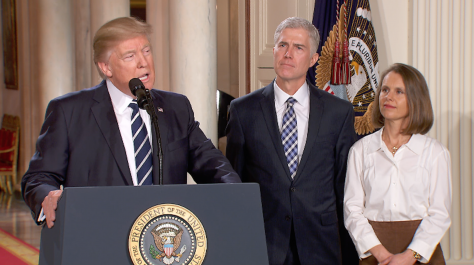
Trump picks a strict constructionist for Supreme Court vacancy

Well, so far Trump’s done many things right and many things wrong. Although I think more of the right things are actions (cleaning up regulations, energy development, etc. ) and the wrong things are just horribly damaging tweets. The best actions surely include his habit of nominating judges who will interpret the law as written, instead of pushing a political agenda.

Far-left ABC News reports on the most important judicial pick – Supreme Court Justice Neil Gorsuch.

Excerpt:

More than 2,000 conservatives in tuxedos and gowns recently filled Union Station’s main hall for a steak dinner and the chance to cheer the man who saved the Supreme Court from liberal control.

Justice Neil Gorsuch didn’t disappoint them, just as he hasn’t in his first seven months on the Supreme Court.

“Tonight I can report that a person can be both a publicly committed originalist and textualist and be confirmed to the Supreme Court,” Gorsuch said to sustained applause from members of the Federalist Society…

[…]The 50-year-old justice has been almost exactly what conservatives hoped for and liberals dreaded when he joined the court in April. He has consistently, even aggressively, lined up with the court’s most conservative justices. He has even split with Chief Justice John Roberts, viewed by some as insufficiently conservative because of his two opinions upholding President Barack Obama’s health law.

The article notes that liberal legal groups are very unhappy with Gorsuch’s constant focus on what the Constitution says. They don’t like him asking lawyers questions about the Constitution.

More:

Leonard Leo, the Federalist Society executive vice president who has advised Trump on judicial picks, also took issue with Gorsuch’s critics when he introduced the justice at the dinner. “They mischaracterize candor and a demand for rigorous analysis as polarizing,” Leo said.

Gorsuch and Leo embraced on the podium, in front of an adoring crowd of like-minded lawyers, judges and academics. The Federalist Society, which counted Scalia among its earliest backers, has helped Trump identify candidates for federal judgeships and has members in legal jobs across his administration.

Gorsuch made no apologies either for the substance of his questions and writing, or his style. He talked at length about the importance of seeking out the meaning of the Constitution and laws as they were understood when they written.

“Originalism has regained its place at the table of constitutional interpretation, and textualism in the reading of statutes has triumphed. And neither one is going anywhere on my watch,” Gorsuch said.

He went on to note that “some pundits have expressed bewilderment” about the questions he asks in court.

“But while I have you here tonight, I thought I might just settle the matter once and for all by taking a poll. … Should I just keep on asking about the text and original meaning of the Constitution?” he asked.

The response was predictably and overwhelmingly in favor.

Before Gorsuch was nominated and confirmed, I liked Justice Clarence Thomas best. He was the most faithful to the original meaning of the Constitution – better than Scalia.
Gorsuch and Thomas stick to the original meaning of the Constitution

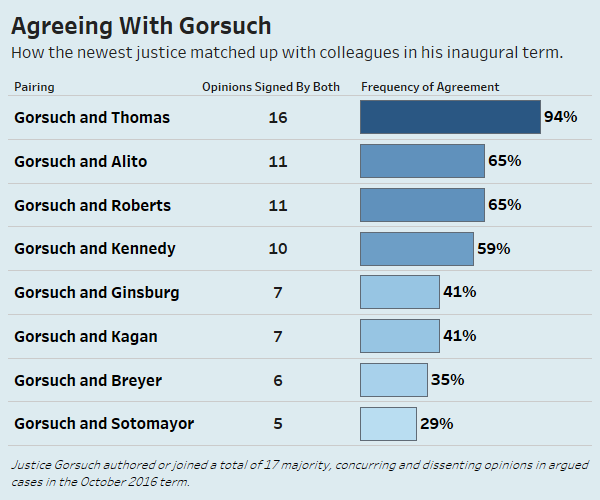
Now that Gorsuch is on the bench, he’s been tracking with Thomas. According to this article from Law 360, he votes with Thomas 94% of the time. Much higher than any of the centrist and liberal judges. The liberal writer of the Law 360 article is predictably horrified that Gorsuch is so good on religious liberty in particular:

As the most controversial rulings came down near the end of the term, however, Justice Gorsuch splintered off from most of his conservative colleagues and exclusively joined Justice Thomas in five separate opinions.

On Monday, for instance, Justice Gorsuch and Justice Thomas supported each other’s concurrences in the major religious freedom case, Trinity Lutheran v. Comer. The pair joined Chief Justice Roberts’ majority opinion holding that a Missouri playground-funding program closed to religious groups was unconstitutional, but they criticized the court for limiting the scope of its ruling.

In Trinity Lutheran, the court found that a widely available public program that discriminates on the basis of religious status violates the free exercise clause of the First Amendment. The court refused to say, however, whether a program that withholds public funds from groups that would use that money for religious purposes similarly violates the free exercise clause.

In doing so, Justice Roberts made an unworkable distinction, Justice Gorsuch said. “I don’t see why it should matter whether we describe that benefit, say, as closed to Lutherans (status) or closed to people who do Lutheran things (use),” he said. “It is free exercise either way.”

Justice Gorsuch’s desire for an expanded free exercise clause would likely come as a crushing blow to liberal groups and other advocates of church-state separation.

That’s the most important issue to me – my religious liberty. My right to live an authentic Christian life without being bullied by secular leftists in the government. I want people on the Supreme Court to defend my right to behave like a Christian in public.

The conservative Daily Signal had an article up describing even more good news about new judicial nominations.

Excerpt:

On Friday, President Donald Trump announced the addition of five individuals to his outstanding list of potential candidates for a future Supreme Court vacancy.

As was the case with the lists Trump put out during his presidential campaign, these new additions to the list are conservative men and women who are committed to interpreting the Constitution according to its original public meaning.

While there are currently no vacancies on the Supreme Court, rumors abound that Justice Anthony Kennedy may retire in the near future.

Whatever mess Trump makes with his Tweets, you have to love this judicial nominees. We would never have gotten nominees like this with Hillary Clinton. And what’s even better is that Trump will be making more judicial nominations in the next 12 months than Obama did in his entire 8 years in office, according to the radically leftist Washington Post. (H/T Curby)

Excerpt:

 Conservatives have a new court-packing plan, and in the spirit of the holiday, it’s a turducken of a scheme: a regulatory rollback hidden inside a civil rights reversal stuffed into a Trumpification of the courts. If conservatives get their way, President Trump will add twice as many lifetime members to the federal judiciary in the next 12 months (650) as Barack Obama named in eight years (325). American law will never be the same. 

That’s good news for liberty, bad news for big government coercion.
Supreme Court: Christians taxpayers are allowed access to social programs

The Supreme Court of the United States

Here is the latest Supreme Court decision news, and I’ll explain shortly why this is good news for a much more important religious liberty case.

David French posted this analysis in National Review:

While there are many threats to religious liberty, few are more consequential over the long term than the state’s ever-expanding role in private life. If the government is able to vacuum up tax dollars, create programs large and small for public benefit, and then exclude religious individuals or institutions from those programs, it has functionally created two tiers of citizenship. Secular individuals and institutions enjoy full access to the government they fund, while religious individuals and institutions find themselves funding a government that overtly discriminates against them.

That’s the issue the Supreme Court addressed today in Trinity Lutheran Church v. Comer. By a 7–2 margin, the Court held that when a state creates a neutral program for public benefit — in this case, a program that uses scrap tires to provide rubberized safety flooring for playgrounds — it can’t exclude a church from that program, even if that means state benefits flow directly to a house of worship.

Social conservative Maggie Gallagher writes this in The Stream:

The good news is the Trinity Lutheran victory shows us the current Court is more supportive of religious liberty than many of us feared.

Justice Elana Kagan joined the majority opinion without any reserve. Justice Breyer wrote his own concurring opinion limiting his judgement to playground resurfacing programs and not all government benefits.

Only Justices Sonia Sotomayor and Ruth Bader Ginbsurg dissented. In Justice Sotomayor’s dissent, she warned of almost apocalyptic consequences:

This ruling, “weakens this country’s longstanding commitment to a separation of church and state beneficial to both,” she wrote, “If this separation means anything, it means that the government cannot, or at the very least need not, tax its citizens and turn that money over to houses of worship. The court today blinds itself to the outcome this history requires and leads us instead to a place where separation of church and state is a constitutional slogan, not a constitutional commitment.”

If so, it’s a good thing.

You’ll remember that Sotomayor was the wise Latina nominated by Barack Obama, who many Christians-in-name-only voted for. And of course separation of church and state is nowhere in the Constitution. What Sotomayor and her ilk on the secular left want is for Christian taxpayers to channel their earnings into the coffers of their secular leftist overlords, who apparently know much better how to spend it than the fools who earned it.

This is good news, but it’s also a hopeful sign that the Supreme Court will come out in favor of religious liberty and conscience in another case, a case that pits powerful and wealthy gay rights activists and their government allies against Christian small business owners trying to follow Jesus in everything they do.

The other case is reported on in the Daily Signal:

By deciding to hear the appeal of a Colorado baker, the Supreme Court could make its first ruling next year on whether government may coerce some Christians, Jews, and Muslims to use their creative gifts to celebrate same-sex marriage.

The high court announced Monday that it would review the case of baker Jack Phillips, who cites his Christian faith in declining to make custom cakes for same-sex weddings.

The Supreme Court’s eventual ruling could be the first since its 2015 decision legalizing same-sex marriage to say whether bakers, photographers, florists, and others must be part of such celebrations through their creative expression.

Phillips, whose Masterpiece Cakeshop is in Lakewood, Colorado, stopped making all wedding cakes in 2014 rather than be compelled by the state to design and bake them for same-sex marriages—or be fined for not obeying.

State agency and court decisions said Phillips must make such cakes after a gay couple complained about him in July 2012.

“There’s just certain events, certain cakes I don’t make,” Phillips told The Daily Signal in a phone interview in August 2015. “That was one of them.”

He also won’t make cakes depicting witchcraft, ghosts, and demons or sexually suggestive images, Phillips said in the interview.

The Supreme Court previously delayed nine times on deciding to hear Phillips’ appeal in the case, first filed last July. But with the newest justice, Neil Gorsuch, settled into his seat to succeed the late Antonin Scalia, the high court announced Monday morning that it would do so in its next term, which begins in October.

You can find out more about the Masterpiece Cakes case by watching this short video from Alliance Defending Freedom:

Although today’s decision makes me more optimistic, David French is less optimistic, because of Justice Kennedy’s previous statements on the gay marriage decision.

He writes in National Review:

Third, if Justice Kennedy views this case primarily through the LGBT lens, then the First Amendment may well lose. Kennedy is obviously proud of his long line of LGBT-friendly precedents, and that pride has even led him to a relatively rare First Amendment misstep, so it will be critical to explain to him (and the other justices, of course) that this isn’t a case about “discrimination” but rather about forced speech. Framing matters, and the other side will wrongly frame the case as raising the specter of Jim Crow. The right framing is found in the First Amendment.

I’ll be watching this case closely.

Trump picks a scholarly originalist to replace Scalia on the Supreme Court

Trump picks a strict constructionist for Supreme Court vacancy
Trump picks a strict constructionist (originalist) for Supreme Court vacancy

There were three main candidates: Pryor had the most conservative record and a few red flags, Hardiman was the “stealth” candidate, and Gorsuch was the scholarly originalist.

Tump picked the scholarly originalist.

The Federalist explains:

Tonight, President Trump rewarded social conservatives and delivered on his campaign promise by nominating Neil Gorsuch, a Circuit Judge of the United States Court of Appeals for the 10th Circuit, to the United States Supreme Court.

[…]Gorsuch, 49, was appointed to the 10th Circuit in 2006 by George W. Bush. His nomination generated little controversy, and he was confirmed with a voice vote by the U.S. Senate. A graduate of Columbia, Harvard Law, and Oxford, he is praised for his eloquent legal prose, intellectual gifts, and is heralded by conservatives for his textualist and orginalist interpretations of the Constitution. It is no surprise that his appointment fills the vacuum left by Justice Antonin Scalia’s death.

Gorsuch has garnered significant praise from Robert P. George, the McCormick Professor of Jurisprudence at Princeton University and arguably the nation’s most influential social conservative intellectual. On Facebook, George issued the following praise for Gorsuch: “He would be a superb Supreme Court justice. He is intellectually extremely gifted and is deeply committed to the (actual) Constitution and the rule of law. He will not manufacture ‘rights’ or read things into the Constitution that aren’t there or read things out of the Constitution that are.” In social conservative circles, a Robert George endorsement is sufficient alone to merit support for Gorsuch.

This I really like – he’s a Protestant like me:

A member of the Anglican communion (who would become the only Protestant on the Supreme Court), Gorsuch studied under eminent legal philosopher, natural lawyer, and ethicist John Finnis at Oxford. Anyone familiar with Finnis’ work will understand the resounding alignment his work has with social conservative pillars, particularly around issues of human dignity and sexual ethics.

The only Protestant on the bench, in a majority Protestant country. It’s about time!

I’m not sure how to align SCOTUSBlog, but I think of them as center-left. Here’s what they think of the nominee:

With perhaps one notable area of disagreement, Judge Gorsuch’s prominent decisions bear the comparison out. For one thing, the great compliment that Gorsuch’s legal writing is in a class with Scalia’s is deserved: Gorsuch’s opinions are exceptionally clear and routinely entertaining; he is an unusual pleasure to read, and it is always plain exactly what he thinks and why. Like Scalia, Gorsuch also seems to have a set of judicial/ideological commitments apart from his personal policy preferences that drive his decision-making. He is an ardent textualist (like Scalia); he believes criminal laws should be clear and interpreted in favor of defendants even if that hurts government prosecutions (like Scalia); he is skeptical of efforts to purge religious expression from public spaces (like Scalia); he is highly dubious of legislative history (like Scalia); and he is less than enamored of the dormant commerce clause (like Scalia).

He’s like Scalia, and that’s what we want, (although Clarence Thomas is my favorite Supreme Court Justice).

Here’s Gorsuch’s view of legislating from the bench, in an article he wrote for National Review in 2005:

This overweening addiction to the courtroom as the place to debate social policy is bad for the country and bad for the judiciary. In the legislative arena, especially when the country is closely divided, compromises tend to be the rule the day. But when judges rule this or that policy unconstitutional, there’s little room for compromise: One side must win, the other must lose. In constitutional litigation, too, experiments and pilot programs–real-world laboratories in which ideas can be assessed on the results they produce–are not possible. Ideas are tested only in the abstract world of legal briefs and lawyers arguments. As a society, we lose the benefit of the give-and-take of the political process and the flexibility of social experimentation that only the elected branches can provide.

He doesn’t like judicial activism, he wants legislators to legislate. It’s about time we got a judge who believes in interpreting the Constitution instead of legislating from the bench. All we had for the last eight years was affirmative action picks who legislated from the bench, instead abiding by the plain meaning of the laws.

National Review also reports that religious liberty is an area of strength for him:

In two high-profile religious-liberty cases, Gorsuch voted to hold that the Obama administration had violated the Religious Freedom Restoration Act by refusing to exempt religious employers from a requirement to cover contraceptives in their insurance plans. In neither case, though, will it be easy for opponents to portray his decisions as evidence of social-conservative zealotry.

He concurred in a decision freeing the Hobby Lobby chain from the contraceptive mandate. Its evangelical owners considered some of the contraceptives they were forced to cover to be abortifacients, and objected to them for that reason. A narrow 5-4 majority of the Supreme Court affirmed that decision. Gorsuch joined a dissent arguing that the Little Sisters of the Poor, a group of Catholic nuns, had shown that the Obama administration’s fines for noncompliance with the mandate amounted to a substantial burden on the exercise of their faith — one of the preconditions for getting protection under the Religious Freedom Restoration Act. The Supreme Court unanimously vacated the decision from which Gorsuch had dissented.

Gorsuch’s solicitude for religious liberty has not been confined to cases involving abortion, contraception, or conservative Christians. In the less well-known Yellowbear v. Lampert, Gorsuch ruled that the Religious Land Use and Institutionalized Persons Act meant that a Native American prisoner had to have access to his prison’s sweat lodge.

Religious liberty is my core value – the thing I care the most about. It’s important to me that the nominee have a record on the issue I care about the most.

I think that next time we get a SCOTUS nominee, if we get 60 or more Republican senators in the Senate after the 2018 mid-terms, we’ll get the very conservative Pryor. Which would basically make Trump’s presidency great for conservatives. It’s very important to get these picks right. This was the right pick for 52 Republican senators in the Senate, and Pryor is the right pick when we have 60 Republican senators in the Senate. So get ready for 2018.

UPDATE: Ben Shapiro says that Pryor has some red flags, and that Gorsuch was the best pick. He calls it a home run, and even wore the red MAGA hat on his podcast, for being wrong. So Trump chose the best person.