Tag Archives: Science

George Ellis and Joe Silk attack untestable cosmological theories in Nature

I found this Evolution News post about it, thanks to a J. Warner Wallace tweet. The article they linked is by two well-known cosmologists.

EN writes:

Here’s what George Ellis and Joe Silk say in Nature (“Scientific Method: Defend the Integrity of Physics”):

This year, debates in physics circles took a worrying turn. Faced with difficulties in applying fundamental theories to the observed Universe, some researchers called for a change in how theoretical physics is done. They began to argue — explicitly — that if a theory is sufficiently elegant and explanatory, it need not be tested experimentally, breaking with centuries of philosophical tradition of defining scientific knowledge as empirical. We disagree. As the philosopher of science Karl Popper argued: a theory must be falsifiable to be scientific. (Emphasis added.)

In particular, they chide the string theorists, multiverse advocates, inflation theorists, and purveyors of the “many worlds” interpretation of quantum mechanics.

Their concern is that the requirement for testability is being relaxed for junky theories.

Whether Ellis and Silk’s definitions of science and the scientific method are adequate is beside the point (the definition of science is a vexed question, testability is vague, and falsifiability has its flaws). What worries them is something else:

The issue of testability has been lurking for a decade. String theory and multiverse theory have been criticized in popular books and articles, including some by one of us (G.E.). In March, theorist Paul Steinhardt wrote in this journal that the theory of inflationary cosmology is no longer scientific because it is so flexible that it can accommodate any observational result. Theorist and philosopher Richard Dawid and cosmologist Sean Carroll have countered those criticisms with a philosophical case to weaken the testability requirement for fundamental physics.

Interesting that Sean Carroll, a naturalist who proposes naturalistic alternatives to the standard (theism-friendly) cosmology model (creation out of nothing), wants to weaken the testability requirement. Why do you think that is? Well, if we go by which model is testable, rather than which model is acceptable to that old-time naturalistic religion, then then the standard model (creation out of nothing) wins. That’s because we have experimental evidence for the standard model, (light element abundances, cosmic microwave background radiation, second law of thermodynamics, etc.) Carroll’s model is falsified by observations (e.g. – humans exist, not Boltzmann brains), and that’s why why he weakens the criterion of testability. If testability is what makes science, then he’s really just engaged in creative writing.

And about the multiverse in particular:

Look what they say about multiverse theory:

The multiverse is motivated by a puzzle: why fundamental constants of nature, such as the fine-structure constant that characterizes the strength of electromagnetic interactions between particles and the cosmological constant associated with the acceleration of the expansion of the Universe, have values that lie in the small range that allows life to exist. Multiverse theory claims that there are billions of unobservable sister universes out there in which all possible values of these constants can occur. So somewhere there will be a bio-friendly universe like ours, however improbable that is.

That sounds like a lead-up to The Privileged Planet, or to Privileged Species. Ellis and Silk go on to describe how one of the constants, the cosmological constant, is 120 orders of magnitude off from the predicted theoretical value. So are they ready to consider scientific theories that embrace this evidence, like intelligent design? No, but one thing they do know: multiverse theory is not scientific.

Billions of universes — and of galaxies and copies of each of us — accumulate with no possibility of communication between them or of testing their reality. But if a duplicate self exists in every multiverse domain and there are infinitely many, which is the real ‘me’ that I experience now? Is any version of oneself preferred over any other? How could ‘I’ ever know what the ‘true’ nature of reality is if one self favours the multiverse and another does not?

That’s a logical statement, not an observational one. By this, we see that they are not against using logical inference to eliminate unworthy theories. Isn’t that what Meyer does in his books, using “inference to the best explanation”? Isn’t that what Dembski does to eliminate the chance hypothesis?

In the end, Ellis and Silk never explain cosmic fine-tuning. They just preach that science needs to stick to the old-time religion: respect for observable, testable evidence.

The article by Ellis and Silk takes a lot of shots at fundamentalist religion, but at least we fundamentalists are OK with following testable science wherever it goes. Unlike naturalists.
Is silicon-based life a possible alternative for carbon-based life?

In a recent debate, atheist philosopher Alex Rosenberg responded to the cosmic fine-tuning argument presented by William Lane Craig by asserting that complex life could be other than it is. He specifically mentioned silicon-based life.

Let’s see what scientists think of his speculation, using this article from Scientific American.

Excerpt:

Group IV of the Periodic Table of the Elements contains carbon (C), silicon (Si) and several heavy metals. Carbon, of course, is the building block of life as we know it. So is it possible that a planet exists in some other solar system where silicon substitutes for carbon? Several science fiction stories feature silicon-based life-forms–sentient crystals, gruesome golden grains of sand and even a creature whose spoor or scat was bricks of silica left behind. The novellas are good reading, but there are a few problems with the chemistry.

Indeed, carbon and silicon share many characteristics. Each has a so-called valence of four–meaning that individual atoms make four bonds with other elements in forming chemical compounds. Each element bonds to oxygen. Each forms long chains, called polymers, in which it alternates with oxygen. In the simplest case, carbon yields a polymer called poly-acetal, a plastic used in synthetic fibers and equipment. Silicon yields polymeric silicones, which we use to waterproof cloth or lubricate metal and plastic parts.

But when carbon oxidizes–or unites with oxygen say, during burning–it becomes the gas carbon dioxide; silicon oxidizes to the solid silicon dioxide, called silica. The fact that silicon oxidizes to a solid is one basic reason as to why it cannot support life. Silica, or sand is a solid because silicon likes oxygen all too well, and the silicon dioxide forms a lattice in which one silicon atom is surrounded by four oxygen atoms. Silicate compounds that have SiO4-4 units also exist in such minerals as feldspars, micas, zeolites or talcs. And these solid systems pose disposal problems for a living system.

So, first of all, it makes SAND. Second of all, it is so attracted to oxygen that it can’t easily join to make any other polymers that could be used in the chemistry of the minimal functions of a living system.

More:

Also consider that a life-form needs some way to collect, store and utilize energy. The energy must come from the environment. Once absorbed or ingested, the energy must be released exactly where and when it is needed. Otherwise, all of the energy might liberate its heat at once, incinerating the life-form. In a carbon-based world, the basic storage element is a carbohydrate having the formula Cx(HOH)y. This carbohydrate oxidizes to water and carbon dioxide, which are then exchanged with the air; the carbons are connected by single bonds into a chain, a process called catenation. A carbon-based life-form “burns” this fuel in controlled steps using speed regulators called enzymes.

These large, complicated molecules do their job with great precision only because they have a property called “handedness.” When any one enzyme “mates” with compounds it is helping to react, the two molecular shapes fit together like a lock and key, or a shake of hands. In fact, many carbon-based molecules take advantage of right and left-hand forms. For instance, nature chose the same stable six-carbon carbohydrate to store energy both in our livers (in the form of the polymer called glycogen) and in trees (in the form of the polymer cellulose).

Glycogen and cellulose differ mainly in the handedness of a single carbon atom, which forms when the carbohydrate polymerizes, or forms a chain. Cellulose has the most stable form of the two possibilities; glycogen is the next most stable. Because humans don’t have enzymes to break cellulose down into its basic carbohydrate, we cannot utilize it as food. But many lower life-forms, such as bacteria, can.

In short, handedness is the characteristic that provides a variety of biomolecules with their ability to recognize and regulate sundry biological processes. And silicon doesn’t form many compounds having handedness. Thus, it would be difficult for a silicon-based life-form to achieve all of the wonderful regulating and recognition functions that carbon-based enzymes perform for us.

The troubling thing I find about atheists is that they seem to be under the impression that an alternative speculative explanation is a refutation of an argument that is based in evidence.

So it goes like this:

  • origin of the universe? I can speculate about a naturalistic alternative cosmology which is falsified by observations
  • cosmic fine-tuning? I can speculate about an untestable multiverse
  • origin of life? I can speculate about unobservable aliens who seeded the Earth with life
  • Cambrian explosion? I can speculate about intermediary fossils that have not yet been discovered
  • habitability? I can speculate that habitable planets exist just outside the boundary of the observable universe
  • resurrection of Jesus? I can speculate that Jesus had an unknown, identical twin brother who showed up when he died and took his place

I think that if we are going to make a worldview, we should ground it in the evidence we have today. We should not have faith in speculative theories that we heard about on Star Trek. Seriously.

Jupiter deflects comets and asteroids that might otherwise hit Earth

Circumstellar Habitable Zone

This is an older article from Astrobiology magazine, but it shows how important Jupiter is for habitability.

Excerpt:

To a biologist, the ingredients needed to form life include water, heat and organic chemicals. But some in the astrophysics and astronomy community argue that life, at least advanced life, may require an additional component: a Jupiter-sized planet in the solar neighborhood.

“A long-period Jupiter may be a prerequisite for advanced life,” said Dr. Alan Boss, a researcher in planetary formation. Boss, who works at the Carnegie Institution of Washington, is a member of the NASA Astrobiology Institute (NAI).

In our own solar system, Jupiter, with its enormous gravitational field, plays an important protective role. By deflecting comets and asteroids that might otherwise hit Earth, Jupiter has helped to create a more stable environment for life to evolve here. It’s generally believed that a massive impact was responsible 65 million years ago for wiping out dinosaurs on Earth. If not for Jupiter, it’s possible that many other such impacts would have occurred throughout Earth’s history, preventing advanced life from ever gaining a foothold.

Jupiter is significant not only for its size but also for its location in our solar system, far from the Sun. Because it orbits at slightly more than 5 AU (astronomical units the distance between the Earth and the Sun is 1 AU), there is plenty of room in the inner part of our Solar System to accommodate a range of smaller planets.

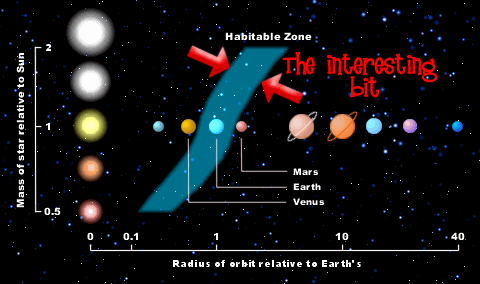
Within the inner solar system there exists a region, known as the habitable zone, where liquid water, and therefore life, can potentially exist on a planet’s surface. Without liquid water, life as we know it is not possible. The habitable zone around our Sun stretches roughly from the orbit of Venus to the orbit of Mars. Venus is generally believed to be too hot to support life. Earth, it appears, is just right. And the jury is still out on Mars.

Understanding the role that Jupiter plays in our own Solar System helps astronomers focus their search for habitable planets around other stars. “If,” Boss explains, “a Jupiter-mass planet on a stable, circular orbit [around another star at] around 4 to 5 AU was found, without any evidence for other gas giant planets with shorter period orbits, such a discovery would be like a neon light in the cosmos pointed toward that star, saying ‘Look here!’. That star would be a prime target for looking for a habitable, Earth-like planet.”

Previously, I blogged about how the circular orbit of Saturn and the mass of our star also play a role in making our planet habitable.

People who are not curious about science sort of take these blessings for granted and push away the God who is responsible for the clever life-permitting design of our habitat. In contrast, theists are curious and excited about what science tells us about the Creator. Theists care about science, but naturalists have to sort of keep experimental science at arm’s length – away from the presuppositions and assumptions that allow them to have autonomy to live life without respect, accountability and gratitude. Naturalists take refuge in the relief provided by speculative science and science fiction. They like to listen to their leaders speculate about speculative theories, and willingly buy up books by snarky speculators who think that nothing is really something (Krauss), or who think that the cosmic fine-tuning is not real (Stenger), or who think that silicon-based life is a viable scenario (Rosenberg), etc. But theists prefer actual science. Truth matters to us, and we willingly adjust our behavior to fit the scientific facts.

UPDATE: Rebuttal to me here at The Secular Outpost.