Tag Archives: Russia

Mitt Romney: Hillary’s Clinton Foundation Uranium One scandal “looks like bribery”

What looks like bribery? Well, read this story from the radically leftist New York Times, of all places. It should be the end of Hillary’s campaign.

Excerpt:

The headline in the website Pravda trumpeted President Vladimir V. Putin’s latest coup, its nationalistic fervor recalling an era when its precursor served as the official mouthpiece of the Kremlin: “Russian Nuclear Energy Conquers the World.”

The article, in January 2013, detailed how the Russian atomic energy agency, Rosatom, had taken over a Canadian company with uranium-mining stakes stretching from Central Asia to the American West. The deal made Rosatom one of the world’s largest uranium producers and brought Mr. Putin closer to his goal of controlling much of the global uranium supply chain.

But the untold story behind that story is one that involves not just the Russian president, but also a former American president and a woman who would like to be the next one.

At the heart of the tale are several men, leaders of the Canadian mining industry, who have been major donors to the charitable endeavors of former President Bill Clinton and his family. Members of that group built, financed and eventually sold off to the Russians a company that would become known as Uranium One.

Beyond mines in Kazakhstan that are among the most lucrative in the world, the sale gave the Russians control of one-fifth of all uranium production capacity in the United States. Since uranium is considered a strategic asset, with implications for national security, the deal had to be approved by a committee composed of representatives from a number of United States government agencies. Among the agencies that eventually signed off was the State Department, then headed by Mr. Clinton’s wife, Hillary Rodham Clinton.

As the Russians gradually assumed control of Uranium One in three separate transactions from 2009 to 2013, Canadian records show, a flow of cash made its way to the Clinton Foundation. Uranium One’s chairman used his family foundation to make four donations totaling $2.35 million. Those contributions were not publicly disclosed by the Clintons, despite an agreement Mrs. Clinton had struck with the Obama White House to publicly identify all donors. Other people with ties to the company made donations as well.

And shortly after the Russians announced their intention to acquire a majority stake in Uranium One, Mr. Clinton received $500,000 for a Moscow speech from a Russian investment bank with links to the Kremlin that was promoting Uranium One stock.

At the time, both Rosatom and the United States government made promises intended to ease concerns about ceding control of the company’s assets to the Russians. Those promises have been repeatedly broken, records show.

[…]The path to a Russian acquisition of American uranium deposits began in 2005 in Kazakhstan, where the Canadian mining financier Frank Giustra orchestrated his first big uranium deal, with Mr. Clinton at his side.

The two men had flown aboard Mr. Giustra’s private jet to Almaty, Kazakhstan, where they dined with the authoritarian president, Nursultan A. Nazarbayev. Mr. Clinton handed the Kazakh president a propaganda coup when he expressed support for Mr. Nazarbayev’s bid to head an international elections monitoring group, undercutting American foreign policy and criticism of Kazakhstan’s poor human rights record by, among others, his wife, then a senator.

Within days of the visit, Mr. Giustra’s fledgling company, UrAsia Energy Ltd., signed a preliminary deal giving it stakes in three uranium mines controlled by the state-run uranium agency Kazatomprom.

[…][T]he company’s story was hardly front-page news in the United States — until early 2008, in the midst of Mrs. Clinton’s failed presidential campaign, when The Times published an article revealing the 2005 trip’s link to Mr. Giustra’s Kazakhstan mining deal. It also reported that several months later, Mr. Giustra had donated $31.3 million to Mr. Clinton’s foundation.

[…][T]he ultimate authority to approve or reject the Russian acquisition rested with the cabinet officials on the foreign investment committee, including Mrs. Clinton — whose husband was collecting millions of dollars in donations from people associated with Uranium One.

Romney, in his interview with Hugh Hewitt, explained that because Bill and Hillary are married, their assets are co-mingled.

So what’s the problem with this deal?

The national security issue at stake in the Uranium One deal was not primarily about nuclear weapons proliferation; the United States and Russia had for years cooperated on that front, with Russia sending enriched fuel from decommissioned warheads to be used in American nuclear power plants in return for raw uranium. Instead, it concerned American dependence on foreign uranium sources. While the United States gets one-fifth of its electrical power from nuclear plants, it produces only around 20 percent of the uranium it needs, and most plants have only 18 to 36 months of reserves, according to Marin Katusa, author of “The Colder War: How the Global Energy Trade Slipped From America’s Grasp.”

“The Russians are easily winning the uranium war, and nobody’s talking about it,” said Mr. Katusa, who explores the implications of the Uranium One deal in his book. “It’s not just a domestic issue but a foreign policy issue, too.”

It’s a national security issue. We shouldn’t be selling uranium companies to countries like Russia who not only invade their neighbors, but also sell long-range missiles to Iran – and a host of other nasty things, too. This country is not friendly to us.
Hillary Clinton: secretive, entitled, hypoctritical

What was Hillary’s response? It’s a distraction invented by the vast right-wing conspiracy:

That’s some vast right-wing conspiracy that makes its way onto the nation’s most respected leftist national newspaper.

So, does this explain why Hillary Clinton deleted tens of thousands of e-mails and then wiped her private e-mail server clean? We’ll never know, because she destroyed all the evidence. But one thing is for sure – there is no reason to vote for this candidate for President, although some people will:

That’s the only “reason” that people will vote for her, because on the merits, she’s a stinker.

Related posts

Scott Walker discusses foreign policy and national security with Hugh Hewitt

Wisconsin Governor Scott Walker

Hugh Hewitt is a horrible RINO Republican establishment guy (backed Romney), but I sometimes listen to his show.

I got this audio and transcript from Hugh Hewitt’s blog.

The MP3 file is here. (19 minutes)

And here are the relevant parts of the transcript:

HH: You mentioned today, you called it “the safety issue,” not the “national security issue,” that sort of brings, explain to people why you use that terminology.

SW: I do, because I think it’s come to the forefront not so much because “national security,” that, to me, as I said [at lunch], is on page 6A of the newspaper where only a handful of us read into that. But when people see the videos, when they see the Jordanian burned alive in a cage, when they see the Egyptian Christians who were beheaded, when they see some of these other folks from around the world, including James Foley, who went to Marquette University where my son’s a junior, and suddenly, that becomes very real to everyday Americans.

HH: One of the beheaded Islamic State videos.

SW: Absolutely, whose parents are actually from New Hampshire, not far from where I was at a weekend ago, and you just realize, you can see it on your phone, you can see it on your iPad. You don’t need the filter of the network news or the daily newspaper to tell you how bad this is. It suddenly becomes an issue of safety, because that’s not something, national security, foreign policy is something over there. Safety is something you feel inside your chest, you feel in your heart. And I think increasingly, Americans feel a sense of concern that particularly if they have family members or loved ones that ever want to travel again, they see France, they see Canada, they see other places around the world, not just the Middle East, and it’s a safety issue. And they, and then I would just add to this, as they look at this more closely, they see a president whose drawn a line in the sand and crossed it, who called ISIS just a year ago the “jayvee squad,” who called Yemen last fall a success story, who calls Iran now a place where we can do business. Think about how screwed up that is. I remember the movie in the 80s, Trading Places…

HH: Right.

SW: …you know, with Dan Akroyd and Eddie Murphy, it’s like Iran and Israel are trading places in the sequel. In the eyes of this president, our ally is supposed to be Israel. Our adversary has been historically Iran. And yet this administration completely does it the other way around. We need to call radical Islamic terrorism for what it is, and a commander-in-chief who’s willing to act.

HH: Now I asked maybe one of your potential competitors yesterday, Senator Marco Rubio, who I know is a friend of yours.

SW: Good guy, yeah.

HH: I asked him yesterday would you disown and agreement that this president signs with Iran that leaves Iran uranium enrichment. What’s Scott Walker think about the deal, because that’s the outline, it appears?

SW: Absolutely.

HH: Would you reject that deal if you took the Oval Office?

SW: Absolutely, on Day One. I mean, to me, it is, the concept of a nuclear Iran is not only problematic for Iran, and certainly for Israel, but it opens the doors. I mean, the Saudis are next. You’re going to have plenty of others in the region. People forget that even amongst the Islamic world, there is no love lost between the Saudis and the Iranians. And so they’re going to want to have a nuclear weapon if the Iranians have a nuclear weapon. This is something that just escalates right before our eyes. And the fact that this administration began these discussions essentially conceding that they’re going to allow enrichment to go forward with the Iranians just shows you that they don’t have the same level of concern that I think I and Senator Rubio and many others out there have, that a nuclear Iran is a problem for the entire world, not just for Israel.

HH: Does the rising of these headlines, Saudi Arabia may be going to war with Yemen before this broadcast is over, if some of these Reuters reports are true.

SW: Right.

HH: And the Quds Force general is in Tikrit, right? So the world’s on fire. Does this hurt a governor’s claim to the presidency and elevate perhaps senators who have been there or other people who have been abroad and done that sort of thing? Or does it help you?

SW: Well, I think leadership is the fundamental ingredient that’s important in anything, particularly when it comes to foreign policy. And I won’t belittle any of the other would-be candidates. I would say, though, that my lifetime, the most significant president when it comes to foreign policy was a former governor, Ronald Reagan. The most faulty president, I would argue, when it comes to foreign policy and national security is a first term senator by the name of Barack Obama, who was on the Foreign Affairs Committee. And so, just those qualifications alone aren’t enough. Now again, I think Senator Rubio and I are very much aligned on these issues. I agree with a number of my other colleagues who might be prospective candidates should I and others get into the race in the future. What people need to look at is what do you bring to the table, who do you surround yourself with, what kind of leadership style do you have, and people, I think in this case in particularly, not just in the travels and the studies, need to know how you think. In this case, I think Americans more than anything want a commander-in-chief of the future who does a couple of things – 1) calls out radical Islamic terrorism for what it is, and says we will do whatever it takes to take the fight to them before they bring the fight to us, because unlike the Cold War, when containment was enough, when the Soviet Union and the United States could have leaders like Gorbachev and Reagan talking about containment, that’s not enough. When you have, not only with ISIS and al Qaeda, but you have an Iran, you have other places around the world groups that that want to not only annihilate Israel, but annihilate us in America, it’s like a virus. You’ve got to eradicate it. You can’t take out part of it, or it will come back.

HH: You also have people like Putin, Governor Walker…

SW: Absolutely.

HH: …who are pushing everywhere, and we’ve got Baltic allies. And people are wondering whether or not we’d actually come to their defense if Putin pushes into Estonia or Latvia or Lithuania. What do you think?

SW: We absolutely have to. I mean, NATO is the strongest military alliance we’ve had in history. It was part of, through Reagan’s leadership, but certainly part of the ingredient that allowed us to win the Cold War without firing a shot. If we don’t defend NATO members in a scenario like that, now I think we preempt that by showing strength in even dealing with Ukraine, which is not a NATO member, but is very much geographically aligned with what we’re talking about. Remember, Putin isn’t just aggressive for the sake of being aggressive. He’s a nationalist. He believes in the history of Russia and the old Soviet Union. Part of what you see here is the old Lenin adage that you probe with bayonets. If you find mush, you proceed. If you find steel, you withdraw. Well, in Ukraine, he’s found mush, and he’s found mush not only from the United States, but from others like, others and NATO partners out there. If it were to extend, and my belief is we need a president who’s going to act aggressively by giving lethal force to the Ukrainians and others to try to preempt that from happening. But a couple of weeks ago, I met with the president of Estonia. Certainly, we saw a week ago the Lithuanian leadership is literally giving out literature telling their own citizens what to do if Russians invade. Latvia, I just talked to someone the other day whose mother immigrated here from Latvia, and in each of those Baltic states, there are real serious concerns about what happens if we don’t deal with this in Ukraine. We need American leadership not just for America’s sake, but for the world.

If you find that interesting, listen to the whole thing or read the transcript. He also talks about education reform, if you’re into that. I am.

We don’t talk much about foreign policy as Christians, but it is important for us to understand it in order to promote the good, and achieve good results. We can’t just be led by our feelings, we have to do what works, and that requires understanding how the world works.

Obama administration giving away the store in nuclear deal with Iran

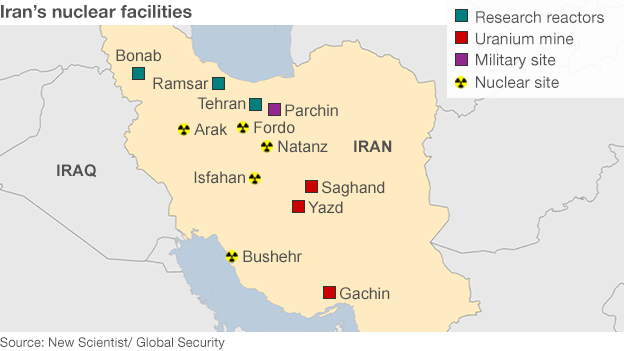
Map of Iran Nuclear Facilities

(Source: BBC)

The Wall Street Journal reports.

Excerpt:

Secretary of State John Kerry told Congress this week that no one should pre-judge a nuclear deal with Iran because only the negotiators know what’s in it. But the truth is that the framework of an accord has been emerging thanks to Administration leaks to friendly journalists. The leaks suggest the U.S. has already given away so much that any deal on current terms will put Iran on the cusp of nuclear-power status.

The latest startling detail is Monday’s leak that the U.S. has conceded to Iran’s demand that an agreement would last as little as a decade, perhaps with an additional five-year phase-out. After that Iran would be allowed to build its uranium enrichment capabilities to whatever size it wants. In theory it would be forbidden from building nuclear weapons, but by then all sanctions would have long ago been lifted and Iran would have the capability to enrich on an industrial scale.

Is Iran our friend? Not really:

That is some gamble on a regime that continues to sponsor terrorist groups around the world, prop up the Assad regime in Syria, use proxies to overthrow the Yemen government, jail U.S. reporter Jason Rezaian on trumped-up espionage charges, and this week blew up a mock U.S. aircraft carrier in naval exercises near the Strait of Hormuz.

Charles Krauthammer comments:

News leaked Monday of the “sunset clause.” President Obama had accepted the Iranian demand that any restrictions on its program be time-limited. After which, the mullahs can crank up their nuclear program at will and produce as much enriched uranium as they want.

Sanctions lifted. Restrictions gone. Nuclear development legitimized. Iran would re-enter the international community, as Obama suggested in an interview last December, as “a very successful regional power.” A few years — probably around 10 — of good behavior and Iran would be home free.

The agreement thus would provide a predictable path to an Iranian bomb. Indeed, a flourishing path, with trade resumed, oil pumping and foreign investment pouring into a restored economy.

Meanwhile, Iran’s intercontinental ballistic missile program is subject to no restrictions at all. It’s not even part of these negotiations.

Why is Iran building them? You don’t build ICBMs in order to deliver sticks of dynamite. Their only purpose is to carry nuclear warheads. Nor does Iran need an ICBM to hit Riyadh or Tel Aviv. Intercontinental missiles are for reaching, well, other continents. North America, for example.

[…]The deal now on offer to the ayatollah would confer legitimacy on the nuclearization of the most rogue of rogue regimes: radically anti-American, deeply jihadist, purveyor of terrorism from Argentina to Bulgaria, puppeteer of a Syrian regime that specializes in dropping barrel bombs on civilians.

Based on past deals, we shouldn’t be surprised by this news.

This Heritage Foundation article re-caps our negotiating blunders.

What makes these deals even worse is that they are all about constraining us, not the other guy. New START didn’t require Russia to destroy a single nuclear missile: it only reduced the size of the U.S. stockpile. The Arms Trade Treaty won’t stop the lawless and incompetent nations of the world from selling arms irresponsibly, but our lawyers will guarantee that it restrains us.

The essence of the Syrian deal was that it saved the U.S. from having to carry out Secretary of State John Kerry’s “unbelievably small” retaliatory strike on the Assad regime, which gets to remain in power. The Iran carve-up removes the lingering threat of any U.S. military action and makes Israeli action all but unthinkable, while the Iranians keep on enriching uranium and can zoom up to weapons-grade levels far faster than we can reimpose sanctions.

The administration is more afraid of having to respond to an Iranian nuclear breakout than it is of a breakout itself. The deal has bought only a six-month delay in the Iranian program, at the cost of easing UN sanctions the U.S. had carefully built up since 2006.

At the core of the accords is the belief that the U.S. is the nation that needs to be restrained. That is why they involve big concessions from us in exchange for far less from the other side. Since we are the problem, we are the ones who need to give things up to get a deal.

And what about the global warming deal with China?

We got fleeced there, too:

When the United States and China announced a surprise carbon-emissions deal, the environmental Left squealed in delight. Al Gore declared it “groundbreaking progress from the world’s largest polluter” (i.e., China), while John Kerry patted himself on the back in the New York Times, gushing about how “the world’s most consequential relationship has just produced something of great consequence in the fight against climate change.” Despite the extraordinary fanfare, there’s abundant reason for skepticism.

Though the announcement is politically expedient for both Barack Obama and Xi Jinping, China almost certainly won’t take significant steps to reduce carbon emissions.

[…]Beijing hasn’t actually agreed to much: It will try to “stop increasing” carbon emissions by 2030 — which is a slanted way of saying its emissions will continue to grow for another 16 years — and derive 20 percent of its energy from renewables by then, up from about 10 percent now. Though these goals may be codified into Chinese law, the CCP does not have a reputation for respecting the rule of law. And the United States and the international community won’t have any way of enforcing these goals. No wonder Reuters called it a “largely symbolic plan.”

[…]Critics of the president’s environmental policies have noted that even the most stringent emissions reductions from the First World won’t have much of an impact unless the developing world also cuts back. The environmental Left is marketing the new U.S.–China deal as a way to eliminate that objection and plow forward with the president’s hardline proposals for carbon regulations. “Now there is no longer an excuse for Congress to block action on climate change,” Senator Barbara Boxer said in today’s New York Times. “The biggest carbon polluter on our planet, China, has agreed to cut back on dangerous emissions, and now we should make sure all countries do their part because this is a threat to the people that we all represent.”

Boxer ignores the myriad other valid objections to the Obama administration’s proposed regulations, which seek to cut carbon emissions 30 percent from their 2005 levels by 2030. In reality, it’s bad policy because, despite enormous economic cost, it would yield very few environmental benefits.

And of course we have the complete surrender to Russia in the Arctic.

We are cutting deals with every bad actor on the planet that will undermine our interests at home and abroad for years to come. And why? Well, it’s because Democrats think that United States is more of a threat to world peace than a force for good, and so they think the best way to save the planet is to strengthen countries like Russia, Iran and China. I think in one way this plan will work – Democrats will feel as if they are doing something, and they will congratulate themselves on their moral superiority. But as far as actually achieving good results? It’s not going to happen.