Tag Archives: Ronald Reagan

How did the Reagan tax cuts and Bush tax cuts affect unemployment?

Consider this article by the Cato Institute, a libertarian think tank, which discusses how the Reagan tax cuts affected the unemployment rate.

Excerpt:

In 1980, President Carter and his supporters in the Congress and news media asked, “how can we afford” presidential candidate Ronald Reagan’s proposed tax cuts?

Mr. Reagan’s critics claimed the tax cuts would lead to more inflation and higher interest rates, while Mr. Reagan said tax cuts would lead to more economic growth and higher living standards. What happened? Inflation fell from 12.5 percent in 1980 to 3.9 percent in 1984, interest rates fell, and economic growth went from minus 0.2 percent in 1980 to plus 7.3 percent in 1984, and Mr. Reagan was re-elected in a landslide.

[…]Despite the fact that federal revenues have varied little (as a percentage of GDP) over the last 40 years, there has been an enormous variation in top tax rates. When Ronald Reagan took office, the top individual tax rate was 70 percent and by 1986 it was down to only 28 percent. All Americans received at least a 30 percent tax rate cut; yet federal tax revenues as a percent of GDP were almost unchanged during the Reagan presidency (from 18.9 percent in 1980 to 18.1 percent in 1988).

What did change, however, was the rate of economic growth, which was more than 50 percent higher for the seven years after the Reagan tax cuts compared with the previous seven years. This increase in economic growth, plus some reductions in tax credits and deductions, almost entirely offset the effect of the rate reductions. Rapid economic growth, unlike government spending programs, proved to be the most effective way to reduce unemployment and poverty, and create opportunity for the disadvantaged.

The conservative Heritage Foundation describes the effects of the Bush tax cuts.

Excerpt:

President Bush signed the first wave of tax cuts in 2001, cutting rates and providing tax relief for families by, for example, doubling of the child tax credit to $1,000.

At Congress’ insistence, the tax relief was initially phased in over many years, so the economy continued to lose jobs. In 2003, realizing its error, Congress made the earlier tax relief effective immediately. Congress also lowered tax rates on capital gains and dividends to encourage business investment, which had been lagging.

It was the then that the economy turned around. Within months of enactment, job growth shot up, eventually creating 8.1 million jobs through 2007. Tax revenues also increased after the Bush tax cuts, due to economic growth.

In 2003, capital gains tax rates were reduced. Rather than expand by 36% as the Congressional Budget Office projected before the tax cut, capital gains revenues more than doubled to $103 billion.

The CBO incorrectly calculated that the post-March 2003 tax cuts would lower 2006 revenues by $75 billion. Revenues for 2006 came in $47 billion above the pre-tax cut baseline.

Here’s what else happened after the 2003 tax cuts lowered the rates on income, capital gains and dividend taxes:

  • GDP grew at an annual rate of just 1.7% in the six quarters before the 2003 tax cuts. In the six quarters following the tax cuts, the growth rate was 4.1%.
  • The S&P 500 dropped 18% in the six quarters before the 2003 tax cuts but increased by 32% over the next six quarters.
  • The economy lost 267,000 jobs in the six quarters before the 2003 tax cuts. In the next six quarters, it added 307,000 jobs, followed by 5 million jobs in the next seven quarters.

The timing of the lower tax rates coincides almost exactly with the stark acceleration in the economy. Nor was this experience unique. The famous Clinton economic boom began when Congress passed legislation cutting spending and cutting the capital gains tax rate.

Those are the facts. That’s not what you hear in the media, but they are the facts.

Happy Independence Day 2012!

The Stars and Stripes

The Declaration of Independence

Here’s the complete text of the Declaration of Independence here.

The best book to read about the Revolutionary War is David McCullough’s “1776”, which I highly recommend. The audio book version is awesome.

George Washington and the American Revolution

Washington Crossing the Delaware

To really understand the founding of the United States, you should read about the story of Washington crossing the Delaware. At this point in the Revolutionary War, the British commanders had achieved a stunning series of victories against the Americans. They had even sent word home to the King that the war was over, and that the Americans would be forced to surrender. But Washington did not give up. He attacked the British forces and took them by surprise – and he won the Battle of Trenton! That was the turning point of the war. There almost never was a United States of America – that’s how close the revolution came to failing.

Ronald Reagan vision of America

Ronald Reagan
Ronald Reagan

Here is a portion of Ronald Reagan’s farewell speech:

Excerpt:

I’ve spoken of the shining city all my political life, but I don’t know if I ever quite communicated what I saw when I said it. But in my mind it was a tall proud city built on rocks stronger than oceans, wind-swept, God-blessed, and teeming with people of all kinds living in harmony and peace, a city with free ports that hummed with commerce and creativity, and if there had to be city walls, the walls had doors and the doors were open to anyone with the will and the heart to get here. That’s how I saw it, and see it still.

And how stand the city on this winter night? More prosperous, more secure, and happier than it was eight years ago. But more than that; after two hundred years, two centuries, she still stands strong and true on the granite ridge, and her glow has held steady no matter what storm. And she’s still a beacon, still a magnet for all who must have freedom, for all the pilgrims from all the lost places who are hurtling through the darkness, toward home.

This is no ordinary nation.

Songs of America

Whenever I drive on long trips, I always practice singing “The Star-Spangled Banner” and “America the Beautiful”.

Even if you are not an American, you can be an honorary American, just for today, if you sing the songs below. God knows that there are other people in the world that love freedom and look to the United States as the model.

If we fall now, then you other freedom-loving people abroad must be ready to pick up the torch!

United States Air Force

The Star Spangled Banner

Lyrics:

“Oh, say can you see by the dawn’s early light
What so proudly we hailed at the twilight’s last gleaming?
Whose broad stripes and bright stars thru the perilous fight,
O’er the ramparts we watched were so gallantly streaming?
And the rocket’s red glare, the bombs bursting in air,
Gave proof through the night that our flag was still there.
Oh, say does that star-spangled banner yet wave
O’er the land of the free and the home of the brave?

On the shore, dimly seen through the mists of the deep,
Where the foe’s haughty host in dread silence reposes,
What is that which the breeze, o’er the towering steep,
As it fitfully blows, half conceals, half discloses?
Now it catches the gleam of the morning’s first beam,
In full glory reflected now shines in the stream:
‘Tis the star-spangled banner! Oh long may it wave
O’er the land of the free and the home of the brave!

And where is that band who so vauntingly swore
That the havoc of war and the battle’s confusion,
A home and a country should leave us no more!
Their blood has washed out their foul footsteps’ pollution.
No refuge could save the hireling and slave
From the terror of flight, or the gloom of the grave:
And the star-spangled banner in triumph doth wave
O’er the land of the free and the home of the brave!

Oh! thus be it ever, when freemen shall stand
Between their loved home and the war’s desolation!
Blest with victory and peace, may the heav’n rescued land
Praise the Power that hath made and preserved us a nation.
Then conquer we must, when our cause it is just,
And this be our motto: “In God is our trust.”
And the star-spangled banner in triumph shall wave
O’er the land of the free and the home of the brave!”

America the Beautiful

Lyrics:

“O beautiful for spacious skies,
For amber waves of grain,
For purple mountain majesties
Above the fruited plain!
America! America!
God shed his grace on thee
And crown thy good with brotherhood
From sea to shining sea!

O beautiful for pilgrim feet
Whose stern impassioned stress
A thoroughfare of freedom beat
Across the wilderness!
America! America!
God mend thine every flaw,
Confirm thy soul in self-control,
Thy liberty in law!

O beautiful for heroes proved
In liberating strife.
Who more than self their country loved
And mercy more than life!
America! America!
May God thy gold refine
Till all success be nobleness
And every gain divine!

O beautiful for patriot dream
That sees beyond the years
Thine alabaster cities gleam
Undimmed by human tears!
America! America!
God shed his grace on thee
And crown thy good with brotherhood
From sea to shining sea!

O beautiful for halcyon skies,
For amber waves of grain,
For purple mountain majesties
Above the enameled plain!
America! America!
God shed his grace on thee
Till souls wax fair as earth and air
And music-hearted sea!

O beautiful for pilgrims feet,
Whose stem impassioned stress
A thoroughfare for freedom beat
Across the wilderness!
America! America!
God shed his grace on thee
Till paths be wrought through
wilds of thought
By pilgrim foot and knee!

O beautiful for glory-tale
Of liberating strife
When once and twice,
for man’s avail
Men lavished precious life!
America! America!
God shed his grace on thee
Till selfish gain no longer stain
The banner of the free!

O beautiful for patriot dream
That sees beyond the years
Thine alabaster cities gleam
Undimmed by human tears!
America! America!
God shed his grace on thee
Till nobler men keep once again
Thy whiter jubilee!”

Here is my favorite version of America the Beautiful, sung by Ray Charles. This is the same version you hear on the Mark Levin show on Friday. Perfection.

Remember to be grateful for the Founding Fathers, and other patriots, who risked everything for liberty in the Revolutionary war. Be grateful to those men and women still fighting abroad to keep those freedoms safe from evil. And most of all, be grateful to God that America is still the beacon of liberty.

Happy Independence Day!

Wow: Ezra Klein admits the real unemployment rate is 11 percent

From the left-leaning Washington Post, of all places.

Excerpt:

Typically, I try to tie the beginning of Wonkbook to the news. But today, the most important sentence isn’t a report on something that just happened, but a fresh look at something that’s been happening for the last three years. In particular, it’s this sentence by the Financial Times’ Ed Luce, who writes, “According to government statistics, if the same number of people were seeking work today as in 2007, the jobless rate would be 11 percent.”

Remember that the unemployment rate is not “how many people don’t have jobs?”, but “how many people don’t have jobs and are actively looking for them?” Let’s say you’ve been looking fruitlessly for five months and realize you’ve exhausted every job listing in your area. Discouraged, you stop looking, at least for the moment. According to the government, you’re no longer unemployed. Congratulations?

Since 2007, the percent of the population that either has a job or is actively looking for one has fallen from 62.7 percent to 58.5 percent. That’s millions of workers leaving the workforce, and it’s not because they’ve become sick or old or infirm. It’s because they can’t find a job, and so they’ve stopped trying. That’s where Luce’s calculation comes from. If 62.7 percent of the country was still counted as in the workforce, unemployment would be 11 percent. In that sense, the real unemployment rate — the apples-to-apples unemployment rate — is probably 11 percent. And the real un- and underemployed rate — the so-called “U6” — is near 20 percent.

There were some celebrations when the unemployment rate dropped last month. But much of that drop was people leaving the labor force. The surprising truth is that when the labor market really recovers, the unemployment rate will actually rise, albeit only temporarily, as discouraged workers start searching for jobs again.

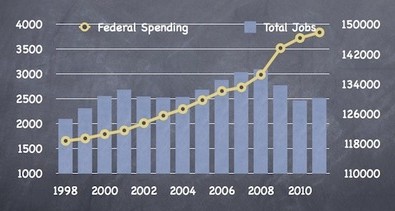
Yeah, because taking money away from private sector job creators costs jobs. That is straight out of Henry Hazlitt’s “Economics in One Lesson”: Public Works Means Taxes.

Look:

More stimulus spending means fewer jobs

From the Weekly Standard.

Excerpt:

When the Obama administration releases a report on the Friday before a long weekend, it’s clearly not trying to draw attention to the report’s contents. Sure enough, the “Seventh Quarterly Report” on the economic impact of the “stimulus,” released on Friday, July 1, provides further evidence that President Obama’s economic “stimulus” did very little, if anything, to stimulate the economy, and a whole lot to stimulate the debt.

The report was written by the White House’s Council of Economic Advisors, a group of three economists who were all handpicked by Obama, and it chronicles the alleged success of the “stimulus” in adding or saving jobs. The council reports that, using “mainstream estimates of economic multipliers for the effects of fiscal stimulus” (which it describes as a “natural way to estimate the effects of” the legislation), the “stimulus” has added or saved just under 2.4 million jobs — whether private or public — at a cost (to date) of $666 billion. That’s a cost to taxpayers of $278,000 per job.

In other words, the government could simply have cut a $100,000 check to everyone whose employment was allegedly made possible by the “stimulus,” and taxpayers would have come out $427 billion ahead.

When the government takes a dollar from a job creator, they take half of it for themselves, and then they often give the other half to some favored group, like a “green energy” company or Planned parenthood or a labor union.  Then they who turns around and give half of that handout right back to Obama as a campaign donation. The only way to stop them from doing more of this stimulus is to stop giving them money.

Do you know what has been proven to create jobs, though? TAX CUTS FOR THE RICH.

Consider this article by the Cato Institute, which discusses how the Reagan tax cuts affected the unemployment rate.

Excerpt:

In 1980, President Carter and his supporters in the Congress and news media asked, “how can we afford” presidential candidate Ronald Reagan’s proposed tax cuts?

Mr. Reagan’s critics claimed the tax cuts would lead to more inflation and higher interest rates, while Mr. Reagan said tax cuts would lead to more economic growth and higher living standards. What happened? Inflation fell from 12.5 percent in 1980 to 3.9 percent in 1984, interest rates fell, and economic growth went from minus 0.2 percent in 1980 to plus 7.3 percent in 1984, and Mr. Reagan was re-elected in a landslide.

[…]Despite the fact that federal revenues have varied little (as a percentage of GDP) over the last 40 years, there has been an enormous variation in top tax rates. When Ronald Reagan took office, the top individual tax rate was 70 percent and by 1986 it was down to only 28 percent. All Americans received at least a 30 percent tax rate cut; yet federal tax revenues as a percent of GDP were almost unchanged during the Reagan presidency (from 18.9 percent in 1980 to 18.1 percent in 1988).

What did change, however, was the rate of economic growth, which was more than 50 percent higher for the seven years after the Reagan tax cuts compared with the previous seven years. This increase in economic growth, plus some reductions in tax credits and deductions, almost entirely offset the effect of the rate reductions. Rapid economic growth, unlike government spending programs, proved to be the most effective way to reduce unemployment and poverty, and create opportunity for the disadvantaged.

The Heritage Foundation describes the effects of the Bush tax cuts.

Excerpt:

President Bush signed the first wave of tax cuts in 2001, cutting rates and providing tax relief for families by, for example, doubling of the child tax credit to $1,000.

At Congress’ insistence, the tax relief was initially phased in over many years, so the economy continued to lose jobs. In 2003, realizing its error, Congress made the earlier tax relief effective immediately. Congress also lowered tax rates on capital gains and dividends to encourage business investment, which had been lagging.

It was the then that the economy turned around. Within months of enactment, job growth shot up, eventually creating 8.1 million jobs through 2007. Tax revenues also increased after the Bush tax cuts, due to economic growth.

In 2003, capital gains tax rates were reduced. Rather than expand by 36% as the Congressional Budget Office projected before the tax cut, capital gains revenues more than doubled to $103 billion.

The CBO incorrectly calculated that the post-March 2003 tax cuts would lower 2006 revenues by $75 billion. Revenues for 2006 came in $47 billion above the pre-tax cut baseline.

Here’s what else happened after the 2003 tax cuts lowered the rates on income, capital gains and dividend taxes:

  • GDP grew at an annual rate of just 1.7% in the six quarters before the 2003 tax cuts. In the six quarters following the tax cuts, the growth rate was 4.1%.
  • The S&P 500 dropped 18% in the six quarters before the 2003 tax cuts but increased by 32% over the next six quarters.
  • The economy lost 267,000 jobs in the six quarters before the 2003 tax cuts. In the next six quarters, it added 307,000 jobs, followed by 5 million jobs in the next seven quarters.

The timing of the lower tax rates coincides almost exactly with the stark acceleration in the economy. Nor was this experience unique. The famous Clinton economic boom began when Congress passed legislation cutting spending and cutting the capital gains tax rate.

It worked for Reagan and it worked for Bush – they made unemployment go down, while Obama’s public works spending has made unemployment go up. Those are the facts. And we have to live in the world as it is. We may not like it, it may not be intuitive to us, it may not line up with our feelings, but that is the way the world is. When you let people with capital keep more of the money they earn, they hire more people and they try to make more money. When the rich risk their capital, they take the rest of us up with them – either by giving us jobs, or by offering us things that we are free to buy or not. Things like iPods, laptops and kitchen appliances. And the more competition there is among sellers in a free market, the lower the prices go, and the higher the quality gets.