Tag Archives: Revenue

Did George W. Bush’s tax cuts cause Obama’s trillion dollar budget deficits?

Let’s take a look at the budget deficits again, keeping in mind that the last Republican budget was the 2007 budget. In January of 2007, the Democrats took control of the House and Senate, and all spending was in Democrat control until January of 2011, when the Republicans took back the House.

Obama Budget Deficit 2011

Next, let’s see what impact the Bush tax cuts from 2001 and 2003 had on tax revenue:
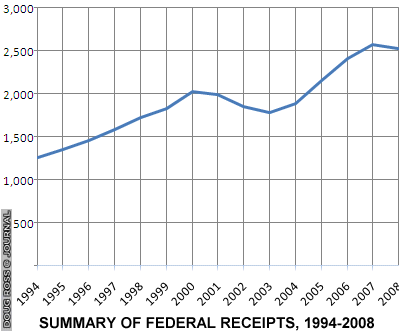
Federal receipts after Bush tax cuts
Federal receipts (1994-2008)

From the chart:

  • Revenue in 2001 was 2.0 trillion in the year of the first round of tax cuts
  • Revenue in 2003 was 1.8 trillion in the year of the second round of tax cuts
  • Revenue then rose in each subsequent year, ending at 2.6 trillion in 2007, when the Democrats took over the House and Senate
  • In 2007, Bush was only spending about 2.8 trillion – very close to what he was taking receiving in tax revenues
  • The budget deficit went down in each year after both tax cuts were in place (2004), until the Democrats took over the House and Senate
  • Obama is currently spending over 3.8 trillion per year, but he is only receiving about 2.2 trillion in revenue.
  • It’s a spending problem, not a revenue problem

Doug Ross explains:

According to the OMB’s own figures, the Bush tax cuts resulted in an explosion of revenue to the U.S. government.

That’s not to say Bush wasn’t a profligate spender — he was. But in virtually no cases were Democrats arguing that he spend less (unless you count national security).

In fact, fiscal conservatives opposed Bush’s absurd policies on spending, amnesty and the expansion of Medicare.

But no one in world history has ever spent money like Barack Obama.

These statements are indisputable.

Which is why they are certain to be rejected by the diminishing cadre of Obama-Democrat drones, who appear to be completely immune to facts, logic and reason.

And let’s just see what happened to the unemployment rate since the Democrats took over spending in January of 2007:
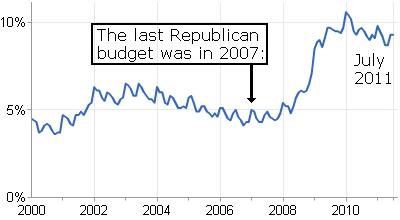
Unemployment Rate (Not seasonally adusted)

There are a lot of people who don’t know about these numbers because they watch Jon Stewart and Stephen Colbert on the Comedy Channel, or Rachel Maddow and Ed Schulz on MSNBC.

I actually spoke to someone who voted for Obama about these numbers. He said that 2.6 trillion in tax revenues was worse than 2.0 trillion in tax revenues. And he said that a 4.3% unemployment rate was WORSE than a 9.2% unemployment rate. And he also said that a $160 billion dollar deficit was WORSE than a $1650 billion dollar deficit. Ok I just made that up, but still. That’s how Democrats think. Tax and spend.

Do the Boehner and Reid plans address the concerns of credit agencies?

Obama Budget Deficit 2011

The Heritage Foundation assesses the new Boehner and Reid plans: can they stop us from getting our credit downgraded?

First, the credit agencies:

The second and even more crucial issue is whether Congress will take necessary action beyond the next year to bring our debt under control over the medium and long-term.  This is where the rating agencies really voice their strong concern. Again, Standard & Poor’s:

Congress and the Administration might also settle for a smaller increase in the debt ceiling, or they might agree to a plan that, while avoiding a near-term default, might not, in our view, materially improve our base case expectation for the future path of the net general government debt-to-GDP ratio.”

Moody’s response is similar:

The outlook assigned at that time to the government bond rating would very likely be changed to negative at the conclusion of the review unless substantial and credible agreement is achieved on a budget that includes long-term deficit reduction. To retain a stable outlook, such an agreement should include a deficit trajectory that leads to stabilization and then decline in the ratios of federal government debt to GDP and debt to revenue beginning within the next few years.

What the rating agencies are saying is that Congress and the President must pass legislation that immediately begins to rein in deficits and bring our debt down to more acceptable levels, and either keeps it there or continues to drive it down further.

Right now, there are two plans on the table, because the Senate rejected Boehner’s “Cut, Cap and Balance” plan. Do either of these plans address the concerns of the two credit agencies?

The Boehner proposal would cut $1.2 trillion in discretionary spending.  There is no assurance that these cuts will occur, but let’s assume they do.  Let’s even be generous and assume that they are – in the words of S&P– “enacted and maintained throughout the decade.”  This would cut debt held by the public from its projected $24.9 trillion in 2021 to $23.7 trillion, and when measured against the economy from 104% to 99.4%.  Certainly, this is an improvement, but it is hardly declining from today’s levels, nor would these cuts fundamentally restructure entitlements – the real driver of our deficits in the future.

Step two in the Boehner proposal would reduce deficits by an additional $1.8 trillion over ten years.  Even assuming these cuts all happen, and even assuming they were all spending cuts – a broad assumption given the President’s rhetoric surrounding tax hikes on the wealthy – this would bring publicly held debt down to 92% of GDP. Better, but not that much.  Even throwing in interest savings from deficit reduction would bring this down to 88%.  Again, not much improvement and far worse than today’s debt ratio.

The Reid proposal doesn’t move the ball forward enough either.  At best it falls somewhat short of Boehner’s $3 trillion by $800 billion ($1.2 trillion in discretionary and some confusing savings to be had from winding down operations in Iraq and Afghanistan of $1.0 trillion.)

Neither of this week’s dueling debt ceiling proposals would pass the test from Moody’s or Standard and Poor’s for a credible, firm and actionable plan that would turn the tide of our deficits to put our debt on a manageable track. And if that holds true, then a downgrade by the rating agencies could occur smack in the very election year the President is trying to scoot through.

[…]The fact is, the only plan that could likely pass muster with Moody’s and Standard and Poor’s is House passed, Cut, Cap and Balance.  Why?  They tackle spending with firm caps that are enforceable, and before the end of the decade bring spending down to 19.9% of GDP and keep it there.

My guess right now is that Obama is going to sign the Boehner plan into law. He has no choice, Boehner pwnd him in the deal negotiations. Obama is going to have to yield, or all the blame for the default will go on HIS shoulders. As much as I like the new Boehner plan, it doesn’t look like it’s going to stop our debt rating from being downgraded. We needed to pass the Cut, Cap and Balance plan, but the Democrats rejected it. Think of that when interest rates shoot up. A debt downgrade is going to cause WIDE-RANGING repercussions in the lives of ordinary working families.

The Gang of Six proposal: what’s in it and what do conservatives think of it?

A good analysis from Dan Mitchell of the libertarian Cato Institute. (With links removed – you have to click through for the links he included)

Excerpt:

The Good

  • Unlike President Obama, the Gang of Six is not consumed by class-warfare resentment. The plan envisions that the top personal income tax rate will fall to no higher than 29 percent.
  • The corporate income tax rate will fall to no higher than 29 percent as well, something that is long overdue since the average corporate tax rate in Europe is now down to 23 percent.
  • The alternative minimum tax (which should be called the mandatory maximum tax) will be repealed.
  • The plan would repeal the CLASS Act, a provision of Obamacare for long-term-care insurance that will significantly expand the burden of federal spending once implemented.
  • The plan targets some inefficient and distorting tax preference such as the health care exclusion.

The Bad

  • The much-heralded spending caps do not apply to entitlement programs. This is like going to the doctor because you have cancer and getting treated for a sprained wrist.
  • A net tax increase of more than $1 trillion (I expect that number to be much higher when further details are divulged).
  • The plan targets some provisions of the tax code – such as IRAs and 401(k)s) – that are not preferences, but instead exist to mitigate against the double taxation of saving and investment.
  • There is no Medicare reform, just tinkering and adjustments to the current system.
  • There in no Medicaid reform, just tinkering and adjustments to the current system.

The Ugly

  • The entire package is based on dishonest Washington budget math. Spending increases under the plan, but the politicians claim to be cutting spending because the budget didn’t grow even faster.
  • Speaking of spending, why is there no information, anywhere in the summary document, showing how big government will be five years from now? Ten years from now? The perhaps-all-too-convenient absence of this critical information should set off alarm bells.
  • There’s a back-door scheme to change the consumer price index in such a way as to reduce expenditures (i.e., smaller cost-of-living-adjustments) and increase tax revenue (i.e., smaller adjustments in tax brackets and personal exemptions). The current CPI may be flawed, but it would be far better to give the Bureau of Labor Statistics further authority, if necessary, to make changes. A politically imposed change seems like nothing more than a ruse to impose a hidden tax hike.
  • A requirement that the internal revenue code maintain the existing bias against investors, entrepreneurs, small business owners, and other upper-income taxpayers. This “progressivity” mandate implies very bad things for the double taxation of dividends and capital gains.

I’m more of a Heritage Foundation guy, myself, but this post is really very good.

Now let’s see Paul Ryan’s evaluation of it, courtesy of Jennifer Rubin in the Washington Post.

Excerpt:

Meanwhile, the president has heaped praise on the Gang of Six plan, which envisions more than $1.2 trillion in tax hikes and more than $880 billion in defense cuts. (So much for Obama making “sure that we’re cutting it in a way that recognizes we’re still in the middle of a war, we’re winding down another war, and we’ve got a whole bunch of veterans that we’ve got to care for as they come home.”) As Rep. Paul Ryan (R-Wis.) points out, the president’s new favorite plan includes just about every bad idea advanced so far in the debt debate:

Heavy Reliance on Revenues. The plan claims to increase revenues by $1.2 trillion relative to a “plausible baseline.” It also claims to provide $1.5 trillion in tax relief relative to the CBO March baseline. The CBO baseline assumes the expiration of tax relief, resulting in a $3.5 trillion revenue increase. As a result, the plan appears to include a $2 trillion revenue increase relative to a current policy baseline. If the $800 billion in tax increases from the new health care law are included, the plan appears to increase revenues by $2.8 trillion, without addressing unsustainable health care spending that is driving our debt problems.

Elusive Spending Restraint. It is unclear how much the plan achieves in spending savings. Based on released documents, it appears to primarily rely on cuts in the defense budget through $886 billion in reductions from the President’s budget for “security programs.”

Lack of Entitlement Reform. The plan does not address the $1.4 trillion in spending expansions in the new health care law. The health care law increases eligibility for the Medicaid program by one-third and creates a brand new health care entitlement. It does not appear to include reforms to the Medicare program. While it appears to pursue Social Security reform, it could end up creating barriers to enactment of these reforms.

Well, at least we know what Obama stands for: huge tax hikes, ephemeral domestic spending cuts, savaging the defense budget, and zero entitlement reform. I imagine that will come up in ads for the Republican presidential nominee next year.

Sounds like it’s not a good deal for conservatives.