
Tag Archives: Retreat

After a tough fight to take Ramadi, Obama hands it back to Islamic State

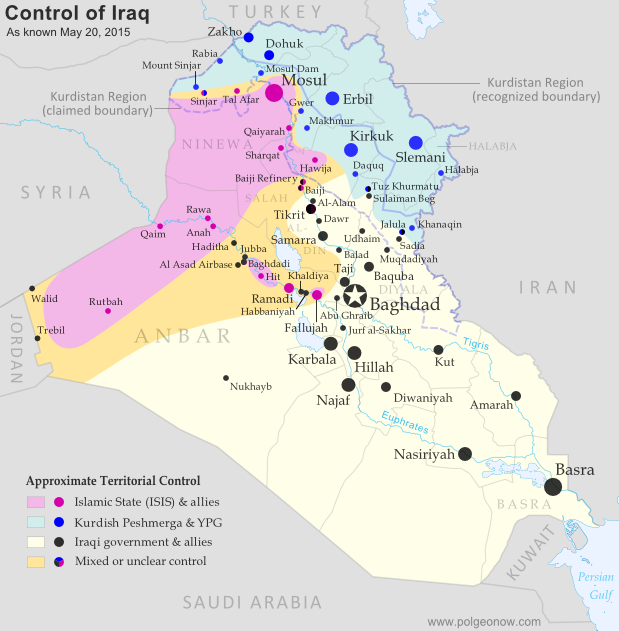
Control of Iraq (click for larger image)

(Source: Political Geography Now)

First, let’s start with and article from Breitbart News about Obama’s retreat from Iraq:

There is no commitment to America’s fighting men and women that President Barack Obama has not broken. When he ran for office in 2008, he promised to leave a residual force in Iraq to secure that country against external meddling and internal collapse. When he took office, President George W. Bush handed over a relatively stable and secure Iraq, thanks to the “surge” Obama opposed, and thanks to the sacrifices made by thousands of Americans, killed and wounded in battle.

Yet in 2011, Obama withdrew all combat troops–which is likely what he intended to do all along–and left Iraq before the job was done, allowing terrorists to regroup and sectarian rivalries to re-emerge. By pulling out troops, he also removed the only remaining strategic threat to the Iranian regime. Today, ISIS is running rampant across the region, and he and his sycophants assure the American people that they are winning the war against the “junior varsity” terrorist caliphate.

[…]“I don’t think we’re losing,” Obama says. That is because he has won, politically. But our troops paid the price.

Now an article from famous war journalist Michael Fumento, in Investors Business Daily.

He writes:

Ramadi is a city of vast importance, both strategic and symbolic. It’s the city that al-Qaida in Iraq chose as its headquarters, and it became the most fiercely contested area in the country. It’s why SEAL Team 3 of “American Sniper” fame was stationed there and became the most decorated SEAL unit since Vietnam.

Many experts consider the Battle of Ramadi and the “Anbar Awakening,” engineered by Capt. Travis Patriquin, the actual turning point of the war. Patriquin — who a few months after briefing me on his brilliant plan was killed in Ramadi — got the Sunni chieftains to join the Americans and Iraqi security forces to defeat al-Qaida.

Yet, bizarrely, the Obama administration wrote off Ramadi last month, declaring that defense of an oil refinery took precedence — as if we couldn’t do both. (Chairman of the Joint Chiefs of Staff Gen. Martin Dempsey claimed, “It has no symbolic meaning.” Now Dempsey says Islamic State “gains in Ramadi are a serious setback for its long-suffering inhabitants.”)

In any event, within days the refinery was out of danger. Yet, the administration still refused to defend Ramadi.

[…]…[O]n no day previously did the U.S. launch more than a handful of sorties in defense of Ramadi, and on many days it flew none.

Yet, area assets include hundreds of strike aircraft, most of which can fly several sorties a day. These comprise F-16s, F-15s, F-22s, A-10s, B-1 heavy bombers, helicopters, and Reaper and Predator drones among U.S. forces, plus aircraft of 11 other coalition nations.

A single Reaper can carry a mix of 14 bombs and missiles, meaning it’s capable of that many airstrikes. Cruise missiles are also in theater, and the U.S. can hit with heavy B-52 and B-2 bombers from anywhere in the world.

Yet with this massive armada and with assets on the ground to help identify targets, the administration seems unable to find and strike more than a handful of targets daily. A machine gun here, a truck there. By comparison, during the 1968 siege of Khe Sanh, American aircraft dropped roughly 1,300 tons of bombs daily — five tons each day for every North Vietnamese soldier besieging the base.

But it’s not just Ramadi that Obama has neglected. Fact is, the so-called air war against IS is a fraud. Rarely are more than a couple of dozen targets struck in a day throughout both Iraq and Syria.

Obama is simply keeping U.S. air power grounded.

[…]…[G]enerally, Obama seems simply clueless when it comes to prosecuting war, stuck at pre-school level. (Even grade-schoolers know that bombs are worthless unless you actually drop them.)

This is as bewildering as Obama’s trading the top five Taliban in captivity for one American deserter, as I wrote in these pages last June.

It’s time for Congress and the presidential candidates to make this an issue. Alas, for Ramadi it’s too late. IS has scored a huge coup and the slaughter of our allies already has begun.

This is why it’s important when you elect a President that you elect one who understands the value of projecting military force and the threat of military force abroad. The next time we get attacked by terrorists trained in Iraq, maybe then we will realize the cost of abandoning the crossroads of the Middle East to the enemy. You can’t just end a war by unilaterally backing out of it, because it sounds nice. That’s how you lose a war. To win a war, you have to be decisive, use overwhelming force, and stay on until the region is stabilized.

Left-wing media turning on Obama over his foreign policy failures

Dr. Stuart Schneiderman has read all the left-wing news sources and found some surprising views.

Excerpt:

The news hasn’t really reached the public, but Obama-supporting media outlets are starting to see the mess that the Obama/Clinton/Kerry foreign policy has produced.

It is so bad that columnists are not even trying to moderate their negative judgments.

From Frida Ghitis on the CNN site:

America’s foreign policy has gone into a tailspin. Almost every major initiative from the Obama administration has run into sharp, sometimes embarrassing, reverses. The U.S. looks weak and confused on the global stage.

This might come as happy news to some opponents of the administration who enjoy seeing Barack Obama fail, but it shouldn’t.

America’s failure in international strategy is a disaster-in-the-making for its allies and for the people who see the U.S. model of liberal democracy as one worth emulating in their own nations.

On Russia, she continues, the verdict is clear:

Relations with Russia have fallen off a cliff, making the theatrical “reset” of 2009 look, frankly, cringe-worthy.

Syria, of course, is even worse:

Obama dramatically warned Syrian dictator Bashar al-Assad, as he slaughtered his people by the thousands, that if he used chemical or biological weapons, he would cross a “red line.” The line was crossed and not much happened. Syria is crumbling, self-destructing in a civil war that I, for one, believe could have turned out quite differently if Washington had offered material and diplomatic support for moderates in the opposition. Fears that the opposition would be dominated by extremists became a self-fulfilling prophecy.

The centerpiece of the Obama/Clinton foreign policy initiative was Egypt. You know how that has worked out:

But it is Egypt where America’s foreign policy fiasco is most visible.

It was in Cairo in 2009, where the newly elected Obama, still reflecting the glow of sky-high expectations, launched his campaign to repair relations with the so-called “Muslim World.”…

Nobody knew what would happen in Cairo’s Tahrir Square a few years later. But today, the same people who yearned for democracy despise Washington. When Egyptians elected a Muslim Brotherhood president, Washington tried to act respectfully, but it showed a degree of deference to the Muslim Brotherhood that ignored the ways in which the group violated not only Egyptians’ but America’s own standards of decency and rule of law.

As tensions in Egypt grow between Islamists on one side and the military and anti-Islamists on the other, there is one sentiment shared by all: Both sides feel betrayed by Washington.

Egypt’s most powerful man, Gen. Abdel Fatah al-Sissi, said, “You [the U.S.] left the Egyptians; you turned your back on the Egyptians, and they won’t forget that.”

It’s not just CNN, though. He has quotations from articles in the radically, radically leftist New York Times and the left-wing extremist New Yorker, too. The New Yorker is disgusted with the way that Obama has handled Libya. It’s getting so bad that not even Obama’s biggest cheerleaders can ignore it.

Iraq plunges into chaos as U.S. troops withdraw

From the Heritage Foundation.

Excerpt:

The Obama Administration’s risky decision to seek the quickest possible exit from Iraq has contributed to a mushrooming political crisis there that is rapidly unraveling the hard-won gains of U.S. troops and threatens to plunge the country into a civil war that will greatly benefit Iran.

Shortly after the December 15 end-of-mission ceremony for U.S. troops, Iraqi Prime Minister Nouri al-Malikipurged many senior Sunni Arab political leaders from his fractious governing coalition. Maliki’s government, dominated by Shiite political parties of various stripes, also announced that it will prosecute Vice President Tareq al-Hashemi, a leader of the predominantly Sunni Arab Iraqiyah party, on terrorism charges. Hashemi, who denounced the allegations as propaganda cover for a political coup, has fled to the semi-autonomous Kurdish region in northern Iraq.

Iraq’s fragile unity is now dissolving in growing political tensions between the leaders of the Shiite majority and Sunni minority and between the Shiite-dominated central government and the non-Arab Kurdish minority. But the Obama Administration, blindsided by simmering tensions that it had downplayed in its rush for the exit, appears to be on auto-pilot.

The Administration gave a higher priority to domestic political considerations than to Iraq’s long-term security needs when it neglected to negotiate an extension of the U.S. troop presence past the end-of-year deadline set by the 2008 Status of Forces Agreement. Although the Bush Administration had envisioned a follow-on agreement to extend the military presence, and the Obama Administration had initially planned for a smaller residual force of military trainers and advisers, in the end politics trumped security in the White House’s deliberations.

Pulling troops out of the Middle East will make it harder for us to gather intelligence and support our allies against Islamic aggression. This decision to pull troops out ahead of the 2012 election is very similar to the decision to delay the Keystone XL pipeline until after the election.

Excerpt:

In November, the White House announced it would delay deciding on the project until after next year’s election. Administration officials claim they need more time to evaluate the potential environmental impacts of the $7 billion, 2,100-mile project to transport crude oil from Alberta, Canada, to major American refineries in the Gulf Coast.

Not content to wait until 2013, Republicans inserted a Keystone approval provision into the payroll tax extension. The result of that move is still in flux, as House Republicans have rejected the Senate’s measure.

Regardless of the outcome, President Obama’s desire to delay the pipeline is just the latest example of his pernicious proclivity for putting politics over sound policy when it comes to energy regulations.

The president simply doesn’t want to bear the political costs of deciding either way on Keystone until after his re-election bid. He’s wants to remain non-committal.

[…]Shambling on Keystone might be smart politics — but there’s no good policy reason to delay approval. And there is a huge cost of delay, which can be captured in just four letters: J-O-B-S.

Keystone XL requires miles of pipe to be welded and installed, and at least 30 new pumping facilities to be constructed. American workers would staff many of those operations.

Indeed, if Keystone XL were allowed to proceed as planned, oil sands development and related operations would directly create thousands of new jobs. Tens of thousands additional positions would be created indirectly at businesses along the pipeline’s pathway.

That same political strategizing driving the Keystone delay also undergirds the White House’s stance on hydraulic fracturing.

Colloquially know as “fracking,” this technique has proven invaluable in extracting natural gas buried under the earth’s surface. It involves pumping a high-pressure mixture of water and sand into the rock surrounding deposits to free up gas for collection.

In the Marcellus shale — a massive reserve running from Ohio and Pennsylvania into New York — fracking is the only way for developers to get access to gas located deep underground. Unfortunately, policymakers high and low have succumbed to environmentalist alarmism on fracking.

New York — with the tacit support of the White House — has instituted a fracking moratorium and effectively prohibited exploration of the parts of the Marcellus that run under the state.

Again, the cost of currying favor with environmentalists? Jobs. According to the Department of Environmental Conservation, Marcellus development in New York could generate up to 80,000 new local positions.

The more we decline to develop our own energy resources here at home, the worse it is for our economy. But it’s also bad for our national security to continue to buy oil from people who don’t like us very much. If we could develop our own energy resources at home – and buy from Canada – then we could use the money we save to keep our commitments in the Middle East. It’s not good for our economy or our national security to make short-sighted decisions that are going to hurt us in the long-run.