
Tag Archives: Results

Does the Bible teach that all judging of other people is wrong?

Policeman investigates crime scene for evidence

Today, most people seem to think that the most wonderful thing is to not judge anyone else. We’re told that morality is like personal preference… you just choose what you like. There is no standard of morality that exists objectively, in the same way as mathematics or logic exists. And besides, even if there were, the only reason to judge someone else would be to hurt them. Right?

I found an interesting article about judging from Christian apologist Timothy Fox, on the Freethinking Ministries web site. He starts out right away with one very good reason for judging – judging allows people who have experience and demonstrated ability to help those who are making mistakes to get better.

Timothy writes:

When you study to be an educator, you have to spend a certain number of hours as a student teacher, under the guidance of a veteran teacher. I remember my cooperating teacher telling me one of my strengths was that I took criticism well and was very open to it. I was shocked to hear this! I wanted to tell him he was crazy and that I hate criticism! But I was also well aware that he was the master and I was the apprentice and that it was his responsibility to help me to be the best teacher I could be. So I needed his criticism. (And I received a lot of it!) Whenever he gave me feedback, positive or negative, it wasn’t intended to stroke my ego or hurt my feelings. It was so I can learn and improve, to keep doing the good and to change the bad.

The same goes for many other things, such as sports. Athletes have coaches that train and guide. But what about normal, everyday life? That’s when we want people to leave us alone. Don’t tell me how to live. Don’t judge me.

In my life, I’ve been able to have success at a few things. Education for sure – I have a BS and MS in computer science which has allowed me to earn a good living. Finances… well, I’ve made a lot of mistakes with investing, but I was able to succeed (eventually!) just by maxing out my 401K and Roth IRA contributions every year. And I’m just coming up on my 21st year of full time work. So when I give people advice, it’s usually in those areas, or maybe in apologetics.

But that advice is not always well-received. Usually, the people I’m advising just find themselves some nice yes-men and yes-women who will agree with them that having fun “in the moment” won’t close any doors down the road. It doesn’t work, but that’s how judging is received. Cut off the judge, and find yourself some yes-men and yes-women. And when your plan doesn’t work, just say that it wasn’t your fault.

People often cite a passage in the Bible about not making judgments, Matthew 7:1-6. But does it really say that?

1“Do not judge so that you will not be judged.

For in the way you judge, you will be judged; and by your standard of measure, it will be measured to you.

Why do you look at the speck that is in your brother’s eye, but do not notice the log that is in your own eye?

Or how can you say to your brother, ‘Let me take the speck out of your eye,’ and behold, the log is in your own eye?

You hypocrite, first take the log out of your own eye, and then you will see clearly to take the speck out of your brother’s eye.

“Do not give what is holy to dogs, and do not throw your pearls before swine, or they will trample them under their feet, and turn and tear you to pieces.

Here’s what Timothy Fox had to say about those verses:

Jesus’ point is not not to judge (note the double negative). It’s “Don’t be a hypocrite!” Verse 5 commands us to clean up our own junk, then to help clean up your friends’. He’s stating the obvious, that when you criticize people, they will turn around and criticize you back. So make sure your closet is clean first! And how do you know who the “dogs” and “pigs” are (v. 6)? Wouldn’t you have to judge them?

And then there is John 7:24: “Do not judge by appearances, but judge with right judgment.” Here Jesus is differentiating between proper and improper judgement. But he still commands to judge!

The reason for many of Paul’s letters is to correct some kind of nonsense going on in a church. In 1 Corinthians 5, he writes angrily that the church is not judging sin in their midst (and it’s quite the sin – go read it!). In verse 12, he rhetorically asks “Are you not to judge those inside [the church]?” And in the following verse, he plainly states to remove the “wicked person” from their midst. Here Paul is criticizing the church for not judging when they should have, even to the extent of excommunicating an unrepentant church member.

He concludes:

More often than not, the ones who cry “Don’t judge me!” the loudest are the ones who need it the most, whether it’s due to insecurity, pride, or flat-out rebellion. But let us not forget that Jesus was full of truth and grace. We desperately need both in our dealings with our brothers and sisters in Christ, when we give correction as well as when we receive it. It’s never pleasant to hear some hard (but loving) truth, but remember the first half of Proverbs 27:6: “Faithful are the wounds of a friend.” Do we like it? Of course not. But we need it. And more than that, the Bible commands it.

Obviously, it doesn’t feel good to admit you’re wrong, but if you want to achieve results, then the quickest way to do that is to listen to people who have already achieved results. The world isn’t as “random” as many people want to believe. You get to make choices, and there are best practices. When you see someone failing to achieve their goals, it doesn’t do them any good to tell them to follow their hearts and it’s not their fault when they fail. The best thing to do is to show them what to do differently, and help them to do it.

American Spectator praises Australia’s bold new conservative leader

Tony Abbott, Prime Minister of Australia

Well, I think we can get some encouragement from this article from the American Spectator.

Let’s take a look at his policies and appointments:

On economic policy, his government has moved in the opposite direction of those who favor Dodd-Frank-like behemoth approaches to the financial industry. Instead it’s opted to simplify regulation. As the minister responsible for the reform bluntly pointed out, “no amount of legislation will ever be a guarantee against another Storm Financial.” Indeed it’s often excessive regulation that creates opportunities for financial shenanigans by industry insiders.

Regarding the welfare state, Abbott’s minister for Social Security, Kevin Andrews (another conservative politician-thinker), has announced a major overhaul of a welfare system that was starting to drift in a distinctly European-direction. Predictably the left are up in arms. But so too are those rent-seeking Australian businesses who now find themselves dealing with a government uninterested in subsidizing them. That’s nothing, however, to the fury that greeted Abbott’s disbanding of the climate-change bureaucracy established by the preceding Labor government.

[…]The first sign of Abbott’s seriousness about obstructing the left’s long march through the institutions was his government’s appointment of the policy-director of the center-right Institute of Public Affairs to the nation’s Human Rights Commission. This was widely seen as the beginning of an effort to re-balance an organization long criticized as monolithically left-wing. Since then Abbott has indicated that major changes are coming to the ABC: Australia’s government-funded institutional — and ideological — equivalent of the BBC.

[…]Along the same lines, Abbott’s education minister, Christopher Pyne, has initiated a review of the national curriculum implemented by the previous government. A moment’s glance at the curriculum’s treatment of history soon illustrates the extent to which it seeks to downplay Australia’s indisputably Western heritage. In the words of Sydney’s Cardinal George Pell, “Europe, Britain and the United States are mentioned 76 times, while Asia is referred to on more than 200 occasions.” This disparity is odd because although Australia is certainly in Asia, no objective observer could say that Australia is “of” Asia. Moreover, while Australian students learn about “Gaia” and other deep-green fantasies in grade 9, many Australian universities find they need to put the same students through remedial English classes once they begin college.

Then there are Abbott’s initial steps on the international stage. Take, for instance, his recent remarks at Davos. Much of the address was devoted to pushing a strong free trade agenda and insisting that governments should let business do what it does best: promote lasting economic growth. “After all,” Abbott said, “government doesn’t create wealth; people do, when they run profitable businesses.”

In the same speech, however, Abbott made the conservative point that economic prosperity and freedom can’t be sustained in a value-neutral world. Nor did Abbott shy away from relentlessly pressing one of the most important moral arguments for free trade articulated long ago by Adam Smith: that economic freedom, combined with the right institutions, radically reduces poverty faster than any other approach. “No country,” Abbott added, “has ever taxed or subsidized its way to prosperity.”

All in all, the address added up to a solid integration of sound economics with conservative principles. That’s what makes Abbott different from, say, Canada’s Stephen Harper or Spain’s Mariano Rajoy. Abbott happily engages in the indispensable task of moral suasion in favor of conservative positions. What’s more, he’s quite good at it. With his rare combination of plain-speaking and intellectual substance, Abbott makes conservative ideas sound, well, reasonable to the average voter.

Now, I personally thought that prime minister Stephen Harper of Canada was the best leader of any nation out there, but I had not been following Australian politics as much as I should be, and now I think I’ll give the crown to Abbott. He seems to have a good fusionist view that integrates economic policy and social policy, and that makes him better than Harper, in my view. I would like to see Abbott flex his muscles on foreign policy, as well. Something to look forward to.

Wisconsin judge defends free speech rights of conservative groups against Democrat fascists

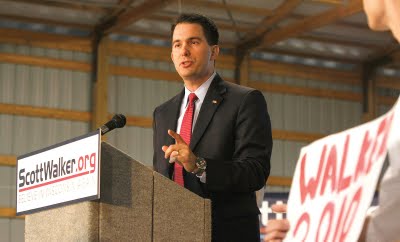
Wisconsin Governor Scott Walker

From the Wall Street Journal.

Excerpt:

Chalk up a big victory for the First Amendment. On Friday a Wisconsin judge struck a major blow for free political speech when he quashed subpoenas to conservative groups and ordered the return of property to the targets of a so-called John Doe campaign-finance probe.

John Doe probes operate much like grand juries, allowing prosecutors to issue subpoenas and conduct searches while gag orders require the targets to keep quiet. We wrote about the kitchen-sink subpoenas and morning raids by special prosecutor Francis Schmitz that targeted dozens of conservative groups that participated in the battle to recall Republican Governor Scott Walker (“Wisconsin Political Speech Raid,” Nov. 16, 2013).

Now we learn that Judge Gregory A. Peterson ruled on Friday that at least some of those subpoenas were improper. They “do not show probable cause that the moving parties committed any violations of the campaign finance laws,” he wrote. His opinion remains under seal but we obtained a copy.

The quashed subpoenas were sent to Friends of Scott Walker, Wisconsin Manufacturers & Commerce Inc., the Wisconsin Club for Growth, and Citizens for a Strong America, as well as their officers and directors. Judge Peterson’s order doesn’t apply to other subpoena targets, but they can presumably get the same result if they file a motion with the judge and have a similar factual basis.

[…]“There is no evidence of express advocacy” and therefore “the subpoenas fail to show probable cause that a crime was committed,” Judge Peterson wrote. Even “the State is not claiming that any of the independent organizations expressly advocated” for the election of Mr. Walker or his opponent, he added. Instead they did “issue advocacy,” which focuses on specific political issues.

This means that prosecutors essentially invented without evidence the possibility of criminal behavior to justify the subpoenas and their thuggish tactics. At least three targets had their homes raided at dawn, with police turning over belongings, seizing computers and files, and even barring phone calls.

The judge’s order vindicates our suspicion that the John Doe probe is a political operation intended to shut up Mr. Walker’s allies as he seeks re-election this year. No one has taken public credit for appointing the special prosecutor, but we know the probe began in the office of Milwaukee County Assistant District Attorney Bruce Landgraf.

Charlie Sykes, the famous Wisconsin-based radio talk show host, had more to say about it on Right Wisconsin.

He writes:

The IRS scandal — which is ongoing — is not that Tea Party groups may have engaged in political activities; it is the abuse of government power to target, harass, and intimidate political opponents. It involves singling out conservative Tea Party groups for special scrutiny and harassment if they sought tax exempt status. 

But that pales next to the Doe, which targeted dozens of conservative groups and individuals and subjected them to criminal investigations. Prosecutors cast a breathtakingly wide net –- 29 separate groups, including Wisconsin Club for Growth, Wisconsin Manufacturers and Commerce (WMC), the League of American Voters, Wisconsin Family Action, Americans for Prosperity, American Crossroads, and the Republican Governors Association, along with other innocent bystanders.

In the IRS scandal, Tea Party groups were threatened with the denial of tax exempt status and subject to legal and financial inconvenience. In Wisconsin, conservatives were threatened with imprisonment.

[…]The anti-Walker probe included raiding the homes of targeted activists, seizing their private correspondence, phones, and computers – including the computers, phones, and emails of their spouses and other family members. Under the Doe’s draconian gag orders, conservatives subjected to such raids were threatened with imprisonment if they spoke about it. And because the probe was secret, the prosecutors could not be held accountable for their conduct. 

[…]So, what is the motivation/agenda behind the witch-hunt?  The office of Milwaukee Democrat district attorney, John Chisolm, presided over a three-year-old long John Doe aimed at Scott Walker that resulted in charges only against a handful of functionaries. Dozens of members of Chisholm’s office signed Walker recall petitions; the chief investigator had a recall sign in his front yard, and some of Chisolm’s aides reportedly were panting at the prospect of charging Walker himself.  Their disappointment has been palpable.

Sources describe deputies Bruce Landgraf and David Robles as particularly vindictive and aggressive in pursuing the new probe.

I just finished reading Governor Scott Walker’s new book about his effort to limit public sector unions in Wisconsin, and their (failed) effort to recall him. I believe this man has what it takes to be President one day. I believe in experience, and Walker is getting a lot of experience passing bold, innovative reforms as governor of Wisconsin. He could. Go. All. The. Way.

Related posts