Tag Archives: Republican Party

James Inhofe says that the Fairness Doctrine will affect Christian radio

On his official blog, Senator James Inhofe links to an article from the Culture and Media Institute.  The article states that the Fairness Doctrine could affect Christian radio as well as conservative radio.

But, the return would also harm religious speech according to a senior Republican senator, James Inhofe, Okla., and the senior vice president of the National Religious Broadcasters (NRB), Craig Parshall. Both are warning religious broadcasting is facing a threat.

According to Parshall, there are about 2400 full power radio stations with a Christian format in the United States. About 40 percent of people who regularly listen do so specifically so they can listen to “teaching, preaching and talk” formats, he said. Christian radio and television have a total reach of 75 million he claimed.

Inhofe is quoted in the article as follows:

Those warning shots from the left have raised the possibility of the Fairness Doctrine’s reinstitution, one that Sen. James Inhofe, R-Okla., says Christian radio isn’t immune to. According to the senior senator from Oklahoma, if the federal government had to enforce a “Fairness Doctrine,” in whatever form it may take in the legislative process, it could open the door to lawsuits by advocacy groups, like the American Civil Liberties Union (ACLU).

“Religious messages are, often times, inherently political,” Inhofe said to the Culture & Media Institute. “Even when they are not, they could be considered controversial, and under the Fairness Doctrine as it once existed, controversial issues of public importance must be presented in an equitable and balanced manner. I am concerned that the ACLU and other liberal organizations will use this logic to file lawsuits against anyone who presents a message that they deem to be controversial. Though I believe these lawsuits would ultimately fail on First Amendment grounds, the chilling effect that the mere threat of a lawsuit will have on religious broadcasters could be substantial.”

Another concerned Republican is Cathy McMorris Rodgers. She is cited as follows:

“Over the last 20 years, conservative talk radio has done such an incredible job as far as getting out the message,” McMorris Rodgers said. “And although, ‘Fairness Doctrine’ may sound good, it’s just a clever title to say, ‘We’re going to shutdown conservative talk radio, and we’re going to potentially really hammer Christian radio, Christian television, and it’s very important to not allow this to move forward.”

Congressman Mike Pence also weights in:

“The American people cherish freedom, that’s why President Reagan repealed the so-called ‘Fairness Doctrine’ back in 1987,” Pence said. “This Depression-era government regulation would actually regulate the content of America’s airwaves and represents an existential threat to talk radio—and in particular—Christian talk radio.”

The article ends by discussing a legal case in which a Christian radio station was actually shut down by the FCC, because of the Fairness Doctrine. This happened in 1969, but the Fairness Doctrine was repealed in 1987.
Jim Demint’s Broadcaster Freedom Act of 2009 is co-sponsored by some of my favorite conservatives, like Tom Coburn and James Inhofe.

Jim Demint presses Democrats to vote on free speech

Senator Jim Demint
Senator Jim Demint

James “Jim” Demint is my favorite senator, (although he’s nearly tied with James Inhofe). Demint introduced the Broadcaster Freedom Act to protect free political speech in January, and he’s trying to force the Democrats to vote on the so called “Fairness Doctrine” so that their views on free speech over the radio can be made clear. If the Fairness Doctrine passed, free political speech on the radio would be effectively abolished. This is dangerous because talk radio is predominantly conservative just as the news media is predominantly leftist.

This NewsMax.com article notes that Senator Debbie Stabenow, House Speaker Nancy Pelosi and Senator Tom Harkin all support reintroducing the Fairness Doctrine. Their article explains what would likely follow from passing the bill.

Since talk radio is overwhelmingly dominated by conservative hosts, and progressive talk radio draws few listeners, the “equal time” provision would likely force many radio stations to pull popular conservative hosts from the air rather than air low-rated liberal hosts.

If they do go ahead and ban political speech on the radio, I wonder what they will call the bill?

Remember that his Freedom of Choice Act abolishes the right of medical personnel to choose not to performing abortions.

The Family Research Council says:

If FOCA is passed, it would automatically overturn:

  • Forty-six states’ conscience protection laws for individual health care providers
  • Twenty-seven states’ conscience protection laws for institutions

And remember his Employee Free Choice Act abolishes the right of workers to choose not to join a union.

The Heritage Foundation says:

Abolishing elections deprives workers of a fun­damental democratic right. Elections guarantee that all workers can express their views on whether they want to belong to a union. Under card check, how­ever, workers who have not been contacted by union organizers have no say in whether their workplace organizes. If organizers collect cards from a majority of workers, all workers must join the union without a vote.

Maybe the bill to ban free speech on the radio will be called called the Happiness, Ice Cream, Apple Pie, Sunshine and Nothing To See Here Act?

Michele Bachmann explains why we need to cut corporate tax rates

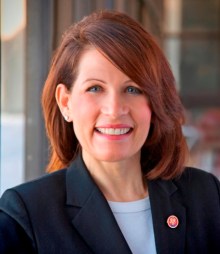
Representative Michele Bachmann

Michele Bachmann is by far my favorite House Representative. In a post dated 2/17/2009, she draws attention to the little-known fact that the combined corporate tax rate of the United States is the fourth highest in the world. This is important because the higher to corporate tax rate, the more likely it is that a corporation will move overseas and lay off all of its American workers. Also, a lower corporate tax rate attracts the best and brightest from abroad to move here to start their businesses, powered by American workers.

This might come as a surprise to you, but the United States is near the top of the list of industrialized countries with the highest corporate tax rates.

You may be asking yourself “so what,” or “who cares,” but it’s important to recognize that lower corporate tax rates result in attracting more investment capital. A reduction of the federal corporate tax rate would increase firms’ productivity and investment incentives, and ultimately stimulate our nation’s long-term competitiveness by enhancing economic freedom.  The end result would be a boon to your family budget.

The problem gets even worse when you realize that many eastern European nations are slashing their corporate tax rates and even imposing flat taxes, leading to astonishing economic growth. This growth attracts foreign investments away from the USA, because investors can get a better return wherever there are lower corporate tax rates.

Bachmann post cites a study from KPMG showing just how bad the USA is compared to other nations.

“U.S. corporate income tax rate is higher than all other global regions—14 percentage points higher than the global average and nearly 17 percentage points higher than the average among European Union nations. Of the 106 countries surveyed, only the United Arab Emirates, Kuwait, and Japan impose a higher corporate tax rate than the combined rate of 40 percent. The United Arab Emirates and Kuwait each have a staggering tax rate of 55 percent; Japan’s rate is 40.69 percent.”

She also cites alarming figures from Heritage Foundation.

“Even Europe’s old welfare states have joined the aggressive tax cut parade: Sweden has cut its corporate tax rate to 28 percent from 60 percent; Norway’s rate has dropped over 50 percent to 28 percent; and Denmark’s corporate tax rate is now 25 percent.”

Is it any wonder that American firms are laying off workers and shipping jobs overseas? Cutting corporate tax rates creates jobs, increases economic growth and, eventually, increases consumer spending. If you don’t believe me, believe the 69-page research paper published by the Congressional Budget Office. The Tax Foundation summarizes their findings here.

A new study from three prominent economists finds that employees suffer most when their corporate employers must pay high corporate taxes. That contradicts the theory that has prevailed for decades — that corporate taxes mainly hurt investors — but it supports a recent CBO study by Randolph that found workers bearing 70 percent of the burden of corporate income taxes.

They find that the workers’ share of the corporate tax burden ranges from 45 to 75 percent.

The Tax Foundation has a complete study of corporate tax rates across the world. We are not winning. We are losing. Badly.

On a positive note, I find it charming and delightful when women speak passionately about how fiscal conservatism supports marriage, family and charity. Bachmann and her husband Markus run their own business. She’s worked as a tax lawyer and an elected legislator, but she still found time for a period of home-schooling. And not only did she raise her own 5 children, but also 23 foster children.

In her speech at the Republican National Convention in 2008, (video, transcript), Bachmann makes the connection between fiscal conservatism, small government, a strong family and private charity.

As Republicans, we recognize that service is an innately personal characteristic. It is best achieved by individuals and community groups, faith-based organizations and charities. And, service thrives best in an environment of freedom. Government fosters service best when government binds it least.

As Republicans, we recognize that when you keep more of your hard-earned dollars, you are free to spend it as you choose on the charities that touch your heart and make a difference in your community.

Bachmann believes in marriage, family and charity. My favorite quote from her is from her profile in World Magazine.

Bachmann says for her one thread ties all the day’s obligations together: “radical abandonment to God’s call.”

For more on big-government socialism and its conflict with marriage, family and charity, see this video lecture, by the eminent economist Jennifer Roback Morse.