
Tag Archives: Republican Party

When all else failed, Republicans will try conservative ideas

Jennifer Rubin over at Pajamas Media writes that the GOP has had enough with the Democrats’ big-spending socialist agenda, and they are ready to try something completely different: small government conservatism. Instead of just being the party of “NO”, the GOP intends to market a series of common sense conservative policies directly to Americans.

Rubin writes:

Minority Leader John Boehner has a new video out listing a number of Republican themes and promising a Republican alternative budget from reformer Rep. Paul Ryan. The themes are simple: lower taxes, restrain the growth of government, a market-based health care plan, domestic energy development, and ending bailout mania. Boehner’s video does not have many details, but its core message is clear: Republicans are tired of being the punching bag for an administration that wishes to paint itself as the only source of ideas capable of solving the country’s problems.

But I didn’t like John Boehner’s video as much as this one from Rep. Paul Ryan:

He can make the case in the House of Representatives:

And look, he can take on the leftist news media, too:

Fun! Rubin continues with some links to wonderful policy ideas:

Truth be told, for months, Republicans inside and outside of government have been throwing out ideas on how to revive the economy.  Americans for Tax Reform has ten ideas to help small business. Newt Gingrich has twelve ideas to promote job growth and recovery. And budget draftsman Paul Ryan has had “A Road Map for America’s Future” for some time. But the mainstream media is uninterested in reading through all of this, much of the conservative blogosphere is too invested in carping about the shortcomings of elected leaders and in fighting among themselves, and the president, of course, has made a habit of disparaging his opposition’s lack of creative ideas.

the task here is to capture the public’s dissatisfaction with the Democrats’ bailout and pork-laden approach to governance and remind voters that Republicans in fact do have ideas — ones that favor lower taxes and less spending.

As soon as I read this, I rushed over to the Cato Institute to see their take on Ryan’s plan, and I found an article by Michael D. Tanner.

He likes Ryan’s plan:

Health Care: Ryan would reform our employment-based insurance system by replacing the current tax exclusion for employer-provided insurance with a refundable tax credit of $2,500 for individuals, and $5,000 for families. This would encourage employers to take the money they currently spend providing health insurance and give it directly to workers, who could then use it to purchase competitive, personally owned insurance plans. That would be insurance that met their needs, not those of their bosses, and people wouldn’t lose it if they lost their jobs.

Ryan would also allow workers to shop for insurance across state lines. That would mean residents of states like New Jersey and New York, where regulation has made insurance too expensive for many people, could buy their insurance in states where it cost less. And increased competition would help bring insurance costs down for all of us.

Since I am a clean-living, never-married single guy, this would basically add a bunch of money to my take home pay. More money for donations to Reasonable Faith and the Discovery Institute! So far so good!

Tanner continues:

Social Security: Like Medicare, Social Security is hurtling toward insolvency. Rep. Ryan would preserve the program unchanged for current recipients and workers older than age 55, but he would allow younger workers to invest part of their Social Security taxes privately through personal accounts. Unlike the present system, workers would own the funds in their accounts, and when they died, they could pass any remaining funds on to their heirs.

Taxes: Rep. Ryan would radically simplify today’s hopelessly complex, cumbersome and bureaucratic tax code. He would give filers a choice: They could pay their taxes under existing law, or they could choose a new simplified code, with just two tax rates (10 percent on the first $100,000 for joint filers; $50,000 for individuals, and 25 percent above that).

Human Events has some more details on the tax policy:

The tax reform aspect of the bill is appealing, offering a simplified tax system that has only two rates and eliminates the alternative minimum tax (AMT) and the death tax. The bill also abolishes taxes on interest, capital gains and dividends among other aggressive tactics that will make a noticeable, long term change.

And this interesting quotation from Ryan:

“Our fate is not inevitable…we can change it,” he said. “I want to be the Paul Revere of fiscal policy in this country.”

Now, that two-tier tax plan was one of the reasons why I preferred for Fred Thompson in the primaries… but the rest of my party wanted style, instead of substance. You blithering toadies! Who cares how warm his belly is? He opposes taxes and abortion, you hamster-brains! Oh, well. There’s always 2012, where we can try to run Mark Sanford, Bobby Jindal or maybe even Michele Bachmann!

For more on Ryan’s plan, here is an article in the Wall Street Journaltat he wrote. (H/T Western Standard Shotgun Blog)
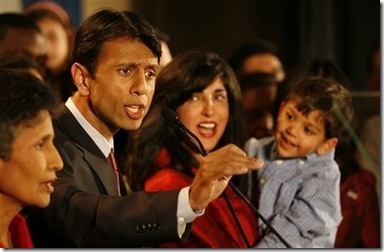
Bobby Jindal cuts spending in Lousiana and imposes accountability

Bobby and Supriya Jindal
Bobby and Supriya Jindal: no teleprompter needed

UPDATE: Welcome visitors from the Anchoress! Thanks for the link! New visitors, please take a look around. My blog is 50% news and policy analysis, 50% defending Christianity in practical ways.

Found this recent blog post over at Governor Bobby Jindal’s blog. (H/T The Maritime Sentry).

Previously, I had blogged about his refusal to take bailout funds, his defense of Rush Limbaugh on CNN, and his plans for education reform in Louisiana.

In the new post, he talks about cutting spending and imposing more reporting and accountability on the government departments:

Our budget will decrease by 9.8 percent compared to last year’s budget, including a 12.7 percent decrease in state funds… We have asked agencies and departments across state government to provide meaningful performance data, so that we can target underperforming and out-of-date programs while protecting high performing programs from severe reductions.

He outlines specific measures to deal with the economic downturn:

School funding based on performance

First, are calling on the Board of Regents to implement a new funding formula that will reform higher education spending. While the current formula too often rewards enrollment alone and results in duplication, a new formula should reward performance, and, for example, encourage schools to target specific programs that will provide degrees in high demand professions – aligning funding with our state’s economic needs.

Eliminate unnecessary government departments

Next, we will create a Commission on Streamlining Government, whose mission will be to examine agencies and departments throughout state government to ensure that their roles and missions are still relevant today.

Improve efficiency of civil service

Third, we will work to reduce the size of state government by implementing civil service reforms that encourage state workers to do their jobs well – not just to reach tenure.

Facilitate future spending cuts

Dedicated funds will have to be just as transparent as discretionary funds, and will sunset every four years beginning in 2010. We will change the current laws so that discretionary funds can be cut up to 10 percent, whereas currently they can only be cut 5 percent, and to remove the two year limit on cutting these funds.

Improve transparency and accountability in education spending

Finally, we will reform the current MFP funding process for our state’s K-12 schools. As the MFP funds are given to school district as a block grant, there is not enough accountability for how the funds are spent. We will require that beginning in FY11 districts must fully account for how these dollars are spent, and the Department of Education will develop an easy to use website allowing taxpayers to see how their hard-earned dollars are being spent.

The post goes on to discuss other initiatives, such as increasing economic growth. And that is when you read this startling statement:

The retention and expansion of jobs has been a top priority of this administration, and we will continue working to expand our economy in the coming months and years. In December, we were the only state in the nation to add jobs, and in January, we were the only state in the nation whose unemployment rate when down and not up.

Sigh. Shouldn’t we have elected Bobby Jindal instead of Mr. Teleprompter-Reader?

To find out more about Bobby Jindal, check out these links:

Interview with Rush Limbaugh (PDF)
The American Spectator: Hope Floats on the Bayou
RedState.com: Bobby Jindal Saves Louisiana
Townhall.com: The Future of Conservatism (Isn’t Running for President)
The Weekly Standard: Another Winner from Winn Parish
The National Review: The Governor Is Right
The Wall Street Journal: Bayou Boy Wonder
Townhall.com: Want real hope and change? Try Louisiana

Mark Sanford and Bobby Jindal refuse bailout funds

Governor Mark Sanford

I noticed some posts at the Maritime Sentry about Governor Mark Sanford. If Bobby Jindal can’t save us in 2012, then Mark Sanford is my second choice. Everybody knows that Jindal is turning down bailout funds. Here is Bobby Jindal on the Hugh Hewitt show explaining why he is refusing the bailout funds, on how he intends to deal with the economic downturn in his state budget. Dynamite!

But Maritime Sentry has the story on Mark Sanford’s refusal to take bailout funds. Here, they link to this Forbes article, entitled “Why Mark Sanford Matters: Small-government conservatives have found their champion.”

Here is an excerpt from the article:

Sanford’s opposition to President Obama’s American Recovery and Reinvestment Act, and in particular his insistence on using up to a fourth of his state’s stimulus funds to pay down debt or refusing it outright, has fast made him a folk hero to conservatives.

I am a little concerned by his opposition to the Iraq war, because I feel that it was a successful action against terrorism with strategic gains that far outweighed the costs. I approve of his small government stand, though. The National Taxpayer’s Union also approves:

The 362,000-member National Taxpayers Union (NTU) has applauded South Carolina Gov. Mark Sanford (R) and Texas Gov. Rick Perry (R) for their decisions this week to refuse part of the federal stimulus package earmarked for their respective states. Sanford will accept $700 million only if the President allows him to use it to pay down debts rather than create new spending obligations. Perry has refused outright $555 million for expansion of state unemployment benefits.

Maritime Sentry also links to this 5-minute video, in which Sanford explains why he is turning down the bailout money. He doesn’t want Obama to be able to impose taxes on his state later, if he takes the bailout money today.

The Democrats doesn’t like federalism much. The DNC is even running ads in South Carolina against Sanford for refusing to take the money, and the attached strings. I found a statement about these DNC ads over at his blog. Jindal is also taking heat from unions and other economically-illiterate left-wing groups in his state.

UPDATE 1: Here is the transcript of Bobby Jindal’s interview on the Hugh Hewitt show. (H/T Binky @ Free Canuckistan!)

UPDATE 2: Here is the first part of an interview with Mark Sanford conducted by the Acton Institute, which specializes in free market capitalism and its relationship to religious liberty. (H/T Binky @ Free Canuckistan!)