Tag Archives: Redistribution

Venezuela solves hunger by banning bread lines, and solves crime by banning self-defense

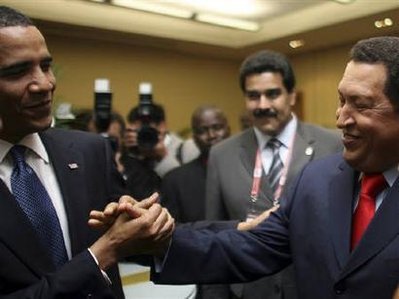
Two socialists shake hands: Barack Obama and Hugo Chavez

First, let’s review who has been running Venezuela, and what they’ve been doing in the last few decades.

Here is an article from March 2013 from the radically leftist Slate. The headline is “Hugo Chavez’s economic miracle: The Venezuelan leader was often marginalized as a radical. But his brand of socialism achieved real economic gains”. The author is “a senior writer for the International Business Times”.

He writes:

Chavez became the bugaboo of American politics because his full-throated advocacy of socialism and redistributionism at once represented a fundamental critique of neoliberal economics, and also delivered some indisputably positive results. Indeed, as shown by some of the most significant indicators, Chavez racked up an economic record that a legacy-obsessed American president could only dream of achieving.

What did Chavez do, precisely, that caused the Venezuelan economic to boom? Well, he nationalized private industry and redistributed wealth from job creators and entrepreneurs to the poor.

As The Week correctly put it, while “Chavez’s policies of redistribution and nationalization of oil assets endeared him to Venezuela’s working class” and produced many laudable results, the country’s “oil-centric economy has taken away resources from other areas that are badly in need of development.”

It’s a miracle! Yay for socialism! Well, that’s what leftists thought – this time, for sure, the laws of economics would be suspended and unicorns would fly.

Reason.com reports on what happened next:

The tragedy of Venezuela continues unabated, but that doesn’t mean the government of President Nicolás Maduro has stopped trying to fix problems like the devastating scarcity of food which has led to malnutrition, riots, food truck hijackings, vigilante lynchings of petty thieves, and the starvation of zoo animals.

No, Maduro hasn’t admitted the failure of Chavismo — the brand of Bolivarian socialism imposed on the oil-rich country by his late predecessor Hugo Chavez — instead, Venezuela’s embattled leader has launched a war on “anxiety.”

The National Superintendency of Fair Prices has reportedly instituted a policy of fining bakeries that allow lines to stretch out their front doors, according to PanAmPost. The head of this particular bureaucracy, William Contreras, claims the lines aren’t a true indicator of a severe shortage of bread, but rather, a political “strategy of generating anxiety.”

[…][T]his is indicative of the magical thinking of Venezuela’s socialist government: the breakdown of the economy couldn’t possibly because of failed economic policy, and scarcity must be the result of a greater conspiracy.

Fine, so they solved the problem of not enough bread by banning line-ups for bread. Great. But what about Venezuela’s astronomically high murder rate? What will they ban to solve that?

Easy, peasy: by seizing the guns of law-abiding people, just like Hillary Clinton wants to do.

Daily Wire reports:

Venezuela is descending further into the misery of socialism, as their government confiscated 2,000 pistols, shotguns and other firearms on Wednesday.

Reuters reports that the firearms were “crushed and chopped up” at a square in Caracas and ammunition was registered through laser technology as part of Interior Minister Nestor Reverol’s recent initiatives to further disarm the Venezuelan citizenry.

“We are going to bring disarmament and peace,” Reverol declared.

Venezuela currently has the second highest murder rate in the world, and Caracas is the most violent city in the world. In 2012, dictator Hugo Chavez completely banned private gun ownership, and yet crime rose.

Naturally, taking away the guns of law abiding people increases the rate of violent crime. In the UK, where the ban on handguns resulted in the doubling of violent crime in the four years after the ban. This is known by anyone who has spent more than two minutes studying the history of these laws in other times or places.

In my last post, I reported about how Venezuela had resorted to forced labor (slavery) to grow more food.

Here’s what CNBC reported:

The government of Venezuela has issued a decree that “effectively amounts to forced labor” in an attempt to fix a spiraling food crisis, according to a new report from Amnesty International.

A Venezuelan ministry last week announced Resolution No. 9855, which calls for the establishment of a “transitory labor regime” in order to relaunch the agricultural and food sector. The decree says that the government must do what is “necessary to achieve strategic levels of self-sufficiency,” and states that workers can be forcefully moved from their jobs to work in farm fields or elsewhere in the agricultural sector for periods of 60 days.

It’s so bad that Venezuelans are breaking into zoos to kill and eat the animals. Now that’s real progressive animal rights for you. But they can solve this by banning the eating of meat.

Slavery, food lines, lousy health care, crime sprees, confiscating guns from law abiding citizens. All to be expected when Democrat party policies go into effect. If Democrats wins the House, Senate and Presidency, we’ll see the same here – we’re not any better than any other country. Nothing magic about the United States, if we get away from our Constitution.

Related posts

What is the difference between capitalism and socialism?

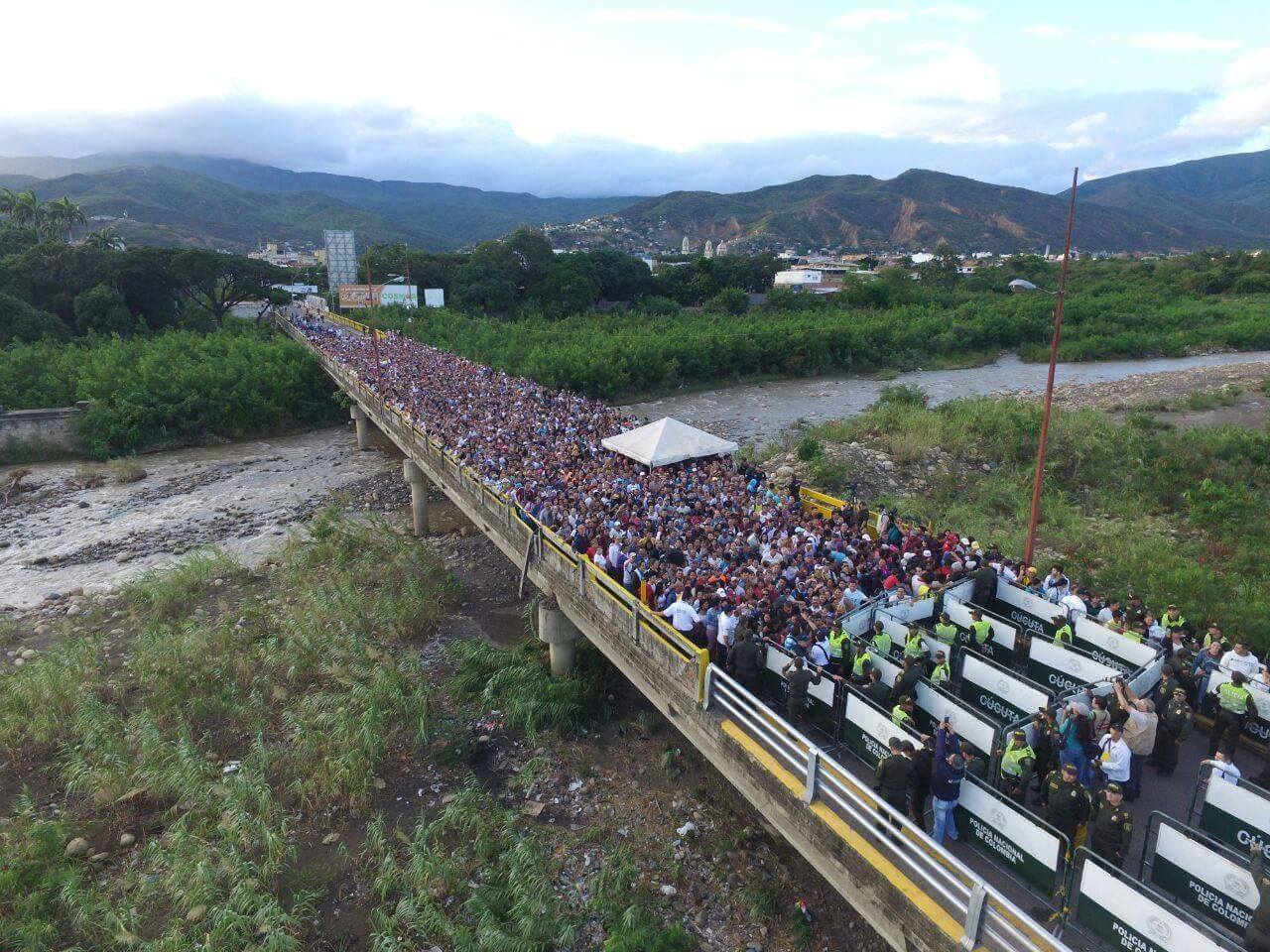
Over 100,000 Venezuelans pouring into Colombia from the Venezuela in order to buy food
Over 100,000 Venezuelans cross into Colombia in order to buy food

(This photo H/T Prager University)

One country that has done a good job of implementing socialism is Venezuela.

Here is an article from March 2013 from Slate, a web site that strongly favors socialism. The headline is “Hugo Chavez’s economic miracle: The Venezuelan leader was often marginalized as a radical. But his brand of socialism achieved real economic gains”. The author is “a senior writer for the International Business Times”.

He writes:

Chavez became the bugaboo of American politics because his full-throated advocacy of socialism and redistributionism at once represented a fundamental critique of neoliberal economics, and also delivered some indisputably positive results. Indeed, as shown by some of the most significant indicators, Chavez racked up an economic record that a legacy-obsessed American president could only dream of achieving.

What did Chavez do, precisely, that caused the Venezuelan economic to boom? Well, he nationalized private industry and redistributed wealth from job creators and entrepreneurs to the poor.

As The Week correctly put it, while “Chavez’s policies of redistribution and nationalization of oil assets endeared him to Venezuela’s working class” and produced many laudable results, the country’s “oil-centric economy has taken away resources from other areas that are badly in need of development.”

OK, so that’s pretty much what the Democrat party wants to do in the United States as well. Nationalize the energy sector, nationalize health care, etc. Let the government take over the private sector industries in order to eliminate “inequalities”. Raise taxes, and redistribute the money to the low income people via social programs, also known as welfare.

So, how does it work? Is socialism really an “economic miracle”?

Here is the latest from Venezuela, as reported by CNN Money. (H/T William)

Excerpt:

Venezuelans cried at the sight of fully-stocked supermarket shelves in Colombia.

Pregnant women, children and even elderly Venezuelans crossed into Colombia on Sunday after the border was temporarily reopened, allowing them to buy basic foods and toiletries — rare commodities in their home country.

Tearful Venezuelans had gone weeks without basic food items like milk, flour and toilet paper. It’s a sad but common part of daily life today in crisis-ridden Venezuela, a country that has the world’s largest proven reserves of oil. Colombian officials estimate that about 100,000 Venezuelans crossed the border.

Venezuela is expected to dive deeper into the abyss this year, according to new projections published Wednesday by the International Monetary Fund.

The IMF forecasts Venezuela’s economy will shrink 10% this year, worse than its previous estimate of 8%. It also estimates that inflation in Venezuela will catapult to 700% this year, up from the earlier guess of about 480%.

“Venezuela’s economic condition continues to deteriorate,” says Alejandro Werner, chief Latin America economist at the IMF. The estimates for growth and inflation are the worst worldwide.

The numbers are just the tip of the iceberg. Venezuela is deep into a humanitarian crisis — people are dying in ill-equipped hospitals and many live without basic food items. Venezuela can’t pay to import goods because its government is desperately strapped for cash after years of mismanagement of its funds, heavy spending on poorly-run government programs, and lack of investment on its oil fields.

[…]It’s all even more tragic given that despite Venezuela’s oil abundance, its state-run oil company, PDVSA, is broke. Venezuela’s oil production fell to a 13-year low in June, according to OPEC, of which it’s a member.

That’s what you get when you let the government take over the free enterprise system, or even when you just stifle the free market with burdensome regulations and high taxes. That’s what socialists in Venezuela did. That’s what the Democrat party would do. They’re  two sides of the same coin.

Dennis Prager

Dennis Prager put out a good video recently explaining the problems with socialism:

Why would anyone prefer a system that encourages some people to feel entitled to what other people create and earn? We want a system that is focused on serving your neighbor – not stealing from them.

Arthur Brooks

If you would like a very brief introduction to capitalism, also known as the free enterprise system or the free market system, then you can watch the videos below, featuring Arthur Brooks, president of the American Enterprise Institute.

Here is the first one, which explains the myths that most Americans are taught about capitalism in school and in the culture:

An important advantage of capitalism is that it lifts people out of poverty. The poorest people in America live much better than the wealthy in Venezuela.

And the second video explains what capitalism offers to individuals for their fulfillment, which socialism does not:

Earned success makes people happier, which is at least as important as the wealth benefit.

We can compare the results of each system by looking at where it’s been tried. Capitalism lifts people out of poverty – all the people in the society who are willing to work are lifted out of poverty. Even the people who can’t work in a capitalist society enjoy the benefits of charity from their neighbors – when people do well, they give more money away. Socialism drives those who work and those who don’t work into poverty, and eliminates charity. No one has anything to share when everyone is poor.

Related posts

New study: Taxing top earners will not reduce wealth inequality

Lets take a closer look at a puzzle

New study! Here’s a report on it from Real Clear Markets:

The top 10% of Americans control roughly three-quarters of the nation’s wealth, and the minority of Haves are continuing to accumulate more than the majority of Have-Nots.

This is wealth inequality in the United States. And though it doesn’t attract as much attention as income inequality, it’s arguably far more important, imposing economic instabilities and social strife.

To decrease wealth inequality, pundits, politicians, and economists often suggest raising income tax rates on top earners to as high as 50, 70, or even 90 percent.

The idea sounds plausible, but according to a new study published to PLoS ONE it probably won’t work in practice.

[…]In their model, income inequality was tied to a metric called the Gini index, a statistical measure of inequality used for decades. They found that altering income inequality to a Gini index of 0.1 (very low inequality) resulted in the top 10% controlling 78.6% of wealth in 2030, while raising income inequality to a Gini index of 0.9 (very high inequality) resulted in the top 10% controlling 79.3% of wealth in 2030, hardly a significant difference.

Do you know what does work to help people – growing the economy so that everyone can find work. It’s actually been done before.

The conservative Heritage Foundation describes the effects of the Bush tax cuts from 2001 and 2003.

Excerpt:

President Bush signed the first wave of tax cuts in 2001, cutting rates and providing tax relief for families by, for example, doubling of the child tax credit to $1,000.

At Congress’ insistence, the tax relief was initially phased in over many years, so the economy continued to lose jobs. In 2003, realizing its error, Congress made the earlier tax relief effective immediately. Congress also lowered tax rates on capital gains and dividends to encourage business investment, which had been lagging.

It was the then that the economy turned around. Within months of enactment, job growth shot up, eventually creating 8.1 million jobs through 2007. Tax revenues also increased after the Bush tax cuts, due to economic growth.

In 2003, capital gains tax rates were reduced. Rather than expand by 36% as the Congressional Budget Office projected before the tax cut, capital gains revenues more than doubled to $103 billion.

The CBO incorrectly calculated that the post-March 2003 tax cuts would lower 2006 revenues by $75 billion. Revenues for 2006 came in $47 billion above the pre-tax cut baseline.

Here’s what else happened after the 2003 tax cuts lowered the rates on income, capital gains and dividend taxes:

  • GDP grew at an annual rate of just 1.7% in the six quarters before the 2003 tax cuts. In the six quarters following the tax cuts, the growth rate was 4.1%.
  • The S&P 500 dropped 18% in the six quarters before the 2003 tax cuts but increased by 32% over the next six quarters.
  • The economy lost 267,000 jobs in the six quarters before the 2003 tax cuts. In the next six quarters, it added 307,000 jobs, followed by 5 million jobs in the next seven quarters.

The timing of the lower tax rates coincides almost exactly with the stark acceleration in the economy.

Please note: revenues actually went up as a result of the tax cuts, because more economic growth means more taxes are collected on the income that is generated.

Whenever people with savings take risks to grow their wealth, there will be jobs created. The solution to helping the poor isn’t giving them someone else’s money. The solution to helping the poor is to let productive job creators keep their own earnings, so that they use their money to create more jobs. That way, people who want to work have multiple job offers and can pick the best one. Productive people are not the enemy. Productive people give you money to work for them. That’s good for you.