Tag Archives: Primary

Cruz wins primaries that are “closed” for Republican voters only

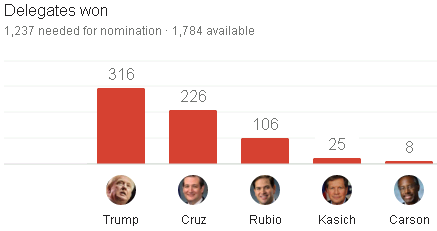
GOP primary delegate count after Super Tuesday

I have some great news. I found out why Cruz unexpectedly lost South Carolina. It turns out that in states that have “open” primaries, that anyone can vote – including Democrats! Cruz is losing some states because Democrats are declining to vote in their own primary, and instead voting in the Republican primary. They are voting for the Republican who is the easiest to beat in head-to-head polls: Donald Trump.

Here’s what the Boston Herald reported:

Nearly 20,000 Bay State Democrats have fled the party this winter, with thousands doing so to join the Republican ranks, according to the state’s top elections official.

Secretary of State William Galvin said more than 16,300 Democrats have shed their party affiliation and become independent voters since Jan. 1, while nearly 3,500 more shifted to the MassGOP ahead of tomorrow’s “Super Tuesday” presidential primary.

So that explains why Cruz is not winning everything. Cruz wins primaries that are closed, so that only people who register as Republicans can vote – not registered Democrats.

But some states allow Democrats to vote in Republican primaries without any change in registration.

Look at how it’s explained in the leftist Washington Post:

Following the South Carolina primary, an interesting article by Michael Harrington went around Facebook that speculated that Donald Trump’s victory in the South Carolina primary was attributable to Democrats voting in the Republican (open) primary. One of the good things about Harrington’s article is that he put out a testable hypothesis — that turnout in the Democratic primary a few days later would be less than 390,000. In fact, it was 367,000. Harrington concludes that had South Carolina had a closed primary, Ted Cruz would have won the primary there. I don’t know him and the author seems to be anti-Trump based on other things he has written — but the fact that his prediction was borne out adds some independent verification to his thesis. So that got me to thinking.

[…][S]o far the primary calendar has been heavily tilted toward open primaries. But there have been four closed elections: the Iowa caucus, the Nevada caucus, and Super Tuesday’s Oklahoma primary and Alaska caucus. Ted Cruz won three of those four closed elections.

[…][T]here are four Republican primaries/caucuses: Kansas, Kentucky, Louisiana and Maine. All are closed.

Then, once the winner-takes-all states begin, a large number of those are closed primaries and caucuses as well (including Florida, for what it’s worth).

[…]First, the fact that South Carolina and most of the SEC primaries were open primaries may very well explain why those states did not turn out to be Ted Cruz’s firewall or launch states as he had predicted. Oklahoma did perform as expected, being a fairly comfortable win for Cruz.

This is something that the Republican National Committee really needs to fix, along with requiring photo identification and proof of residency in order to vote. We can’t allow a bunch of Democrats to come in and pick a raving con man as our candidate, in order to make it easier on their candidate in November. No wonder we haven’t been winning elections!

Anyway, there is more good news. Shane Vander Hart has it up on his Caffeinated Thoughts blog.

He writes:

The next few contests on March 5 are ones where Cruz could do well Kansas and Kentucky which are both caucus states that rely upon organization. Cruz could also do well in Louisiana which is a closed primary. On March 8th you have Idaho Primary which is a closed primary that doesn’t favor Trump. Mississippi has an open primary, but I suspect Cruz will be competitive. Michigan on March 8th is an open primary which favors Trump.

So not only are there more upcoming closed primaries, but some of the states are caucus states, where having a good ground game makes a difference. We should be optimistic about Cruz’s chances in the next week.

Which candidate is best at working with Democrats to get things done?

The Jesus Seminar and their pre-suppositions
Republican voters need to go beyond the surface level in assessing candidates

I have a few friends who I know are supporting either Donald Trump or Marco Rubio in the election. I have asked them specifically what policies, accomplishments and past battles they like best about their candidate.

Donald Trump supporters say this:

  • he’s leading in the polls (vs Republicans)
  • he tells it like it is
  • he’s going to build a fence  and make Mexico pay for it
  • he’s a businessman

Marco Rubio supporters say this:

  • he’s leading in the polls (vs Democrats)
  • he’s handsome
  • I like the way he talks
  • his wife was a Miami Dolphins cheerleader, so she is prettier and funner than nerdy workaholic Harvard MBA Heidi Cruz

My candidate is Ted Cruz, and the Trump supporters tend to have no problem with him. But the Rubio supporters don’t like Cruz. So I made a list of their objections to Cruz.

The Rubio supporters say this:

  • (quoting Donald Trump) not one of his colleagues in the Senate has endorsed him
  • he won’t be able to convince other people to get things done
  • I don’t like the way he talks
  • he has a pickle nose
  • he said he wanted to make Marco Rubio’s amnesty bill “better” but  his amendment actually killed the amnesty bill – that means he’s a liar because his amendment didn’t make the bill better

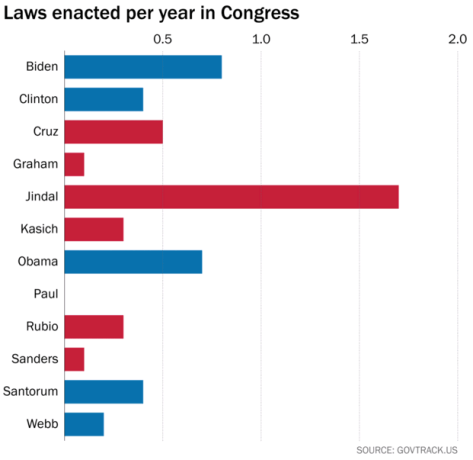
Regarding the point about Ted Cruz not being able to get along with his colleagues in the Senate, that’s actually false. First, Cruz and Rubio came into the Senate at the same time, and Cruz has passed more legislation than Rubio. That might be because Rubio has the worst attendance record in the Senate.

When Rubio works together with people, he authors an amnesty bill, he supports the failed Libya invasion, he gives in-state tuition to illegal immigrants, he weakens border security, he authors a bill to remove the due process rights of men falsely accused of rape on campus, he skips votes to defund Planned Parenthood, he is liberal on the issue of gay marriage, his deputy campaign manager is a gay activist, and so on. In short, he works with liberals on liberal priorities – that’s why he is likable to them.

Ted Cruz gets into trouble with his colleagues, because he tries to stop the spending, stop amnesty, stop the military interventions in Syria, Libya and Egypt, etc. That’s why he is not likable to them.

What about the point that Cruz would not be persuasive to Democrats, and so would not be able to get anything done? Well, we already saw that Cruz has passed more legislation than Rubio, despite having a pickle nose. But he’s also shown the ability to pull Democrats towards his point of view.

Here’s an article from PJ Media to explain:

Now that Cruz regularly polls toward the top of an ever-shrinking field, his early tenure bears closer scrutiny. Cruz has gained fame as a social conservative and an unwavering opponent of Obamacare. In his first major leadership role, however, he developed economic policy as the director of the Federal Trade Commission’s Office of Policy Planning.

At the FTC, Cruz’s agenda could have been written by Milton Friedman.

Cruz promoted economic liberty and fought government efforts to rig the marketplace in favor of special interests. Most notably, Cruz launched an initiative to study the government’s role in conspiring with established businesses to suppress e-commerce. This initiative ultimately led the U.S. Supreme Court to open up an entire industry to small e-tailers. Based on his early support of disruptive online companies, Cruz has some grounds to call himself the “Uber of American politics.”

Moreover, and perhaps surprising to some, Cruz sought and secured a broad, bipartisan consensus for his agenda. Almost all of Cruz’s initiatives received unanimous support among both Republicans and Democrats.

Ted Cruz a consensus-builder? He was, at the FTC.

[…]Beyond the e-commerce initiative, Cruz also reoriented the FTC’s use of antitrust laws.

[…]Cruz also sent dozens of letters to states to fight new efforts to enshrine crony capitalism.

[…]Perhaps surprisingly, Cruz secured a high degree of consensus in pursuing his agenda.

As an independent agency, the FTC has five commissioners, and during Cruz’s tenure, two of them had served in President Clinton’s administration. All five commissioners voted to support almost all of Cruz’s proposals.

Cruz achieved this consensus by listening to policy experts and political opponents. He listened to the FTC’s economic experts and marshaled empirical economic analysis to support his policy objectives. He solicited input from prominent Democrats, including the late Senator Howard Metzenbaum, who spoke at the e-commerce conference. In addition, Cruz worked to develop personal relationships across the aisle. He regularly met with Democratic commissioners and incorporated their ideas into his policy proposals.

The article explains Cruz’s conservative agenda in detail; increasing competition, protecting consumers, and so on. But he wasn’t likable in the way that Marco Rubio was likable – by pushing a Democrat agenda. He was likable by convincing Democrats to push a conservative agenda. He did it by gathering evidence and making his case. And that’s what you expect from a lawyer who wins cases for conservatives at the Supreme  Court.

Bush, Rubio and Christie spent $70 million in NH – Cruz beat them and spent $580 thousand

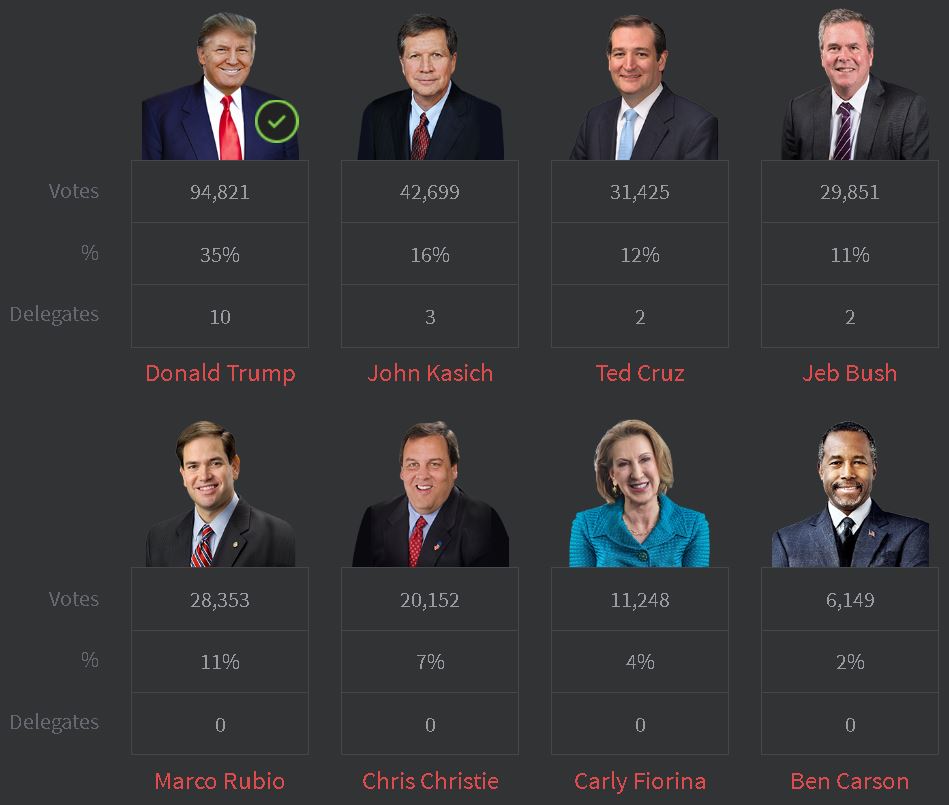
NH primary results early Wednesday morning with 95% counted

(Source: Fox News)

According to this tweet from the Weekly Standard’s Stephen F. Hayes, here are the totals of combined candidate/Super PAC spending in the New Hampshire primary:

  • $36 Million Jeb Bush
  • $18.5 Million Chris Christie
  • $15.2 Million Marco Rubio
  • $12.1 Million John Kasich
  • $3.7 Million Donald Trump
  • $1.8 Million Carly Fiorina
  • $580 Thousand Ted Cruz

Here are the results of the election with 95% counted:

  • Trump 94,821 (35%)
  • Kasich 42,699 (16%)
  • Cruz 31,425 (12%)
  • Bush 29,851 (11%)
  • Rubio 28,353 (11%)
  • Christie 20,152 (7%)
  • Fiorina 11,248 (4%)

And this is how much each candidate spent per vote:

  • Bush: $1206 per vote
  • Christie: $918 per vote
  • Rubio: $536 per vote
  • Kasich: $283 per vote
  • Fiorina: $160 per vote
  • Trump: $39 per vote
  • Cruz: $18 per vote

Here are the most recent “cash on hand” numbers for the campaigns:

Cash on Hand (12/31/2015)

  1. Ted Cruz $18,734,794.46
  2. Marco Rubio $10,398,592.91
  3. Jeb Bush $7,589,858.03
  4. Donald Trump $6,964,324.88
  5. Ben Carson $6,567,647.25
  6. Carly Fiorina $4,484,307.21
  7. John Kasich $2,537,300.60
  8. Chris Christie $1,126,158.09

Cruz is backed primarily by individual small donors.

So what does it mean?

It means that you can tell a lot about a candidate from the way they spend money that is entrusted to them. You can tell a lot about a candidate by how much they can get done with the least possible expense. These are useful skills.

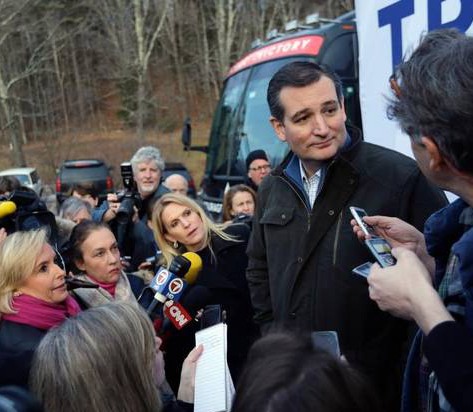
Ted Cruz meets voters at a campaign event

Ted Cruz’s record of conservative achievements

Ted Cruz is also the most qualified candidate running.

Young Conservatives explains his achievements:

  • Graduated valedictorian in 1988 from Second Baptist High School
  • Graduated cum laude from Princeton University in 1992
  • Graduated magna cum laude from Harvard Law School in 1995
  • 1992 U.S. National Debate Champion representing Princeton
  • 1995 World Debating Championship semi-finalist representing Harvard
  • Served a law clerk to Chief Justice William Rehnquist, making him the first Hispanic ever to clerk for a Chief Justice of the United States
  • Served as Solicitor General of Texas from 2003 to 2008, making him the first Hispanic Solicitor General in Texas, the youngest Solicitor General in the entire country and the longest tenure in Texas history
  • Partner at the law firm Morgan, Lewis & Bockius, where he led the firm’s U.S. Supreme Court and national appellate litigation practice
  • Authored over 80 SCOTUS briefs and presented over 40 oral arguments before The Court
  • Adjunct Professor of Law at the University of Texas School of Law in Austin, where he taught U.S. Supreme Court litigation

Smart guy.

Here are the specifically conservative achievements:

  • In the landmark case of District of Columbia v. Heller, Cruz assembled a coalition of 31 states in defense of the principle that the 2nd Amendment guarantees an individual right to keep and bear arms
  • Presented oral arguments before the United States Court of Appeals for the District of Columbia Circuit
  • Defended the Ten Commandments monument on the Texas State Capitol grounds,
  • Defended the recitation of the Pledge of Allegiance in public schools
  • Defended the State of Texas against an attempt by the International Court of Justice to re-open the criminal convictions of 51 murderers on death row throughout the United States

He’s 5 for 9 arguing cases before the Supreme Court. Cruz knows how to convince liberal scholars to come over to his side. That’s what he enjoys – persuading people who disagree with him.

Here’s some of the legislation he introduced:

  • ObamaCare Repeal Act
  • Disarm Criminals and Protect Communities Act
  • Defund Obamacare Act of 2013
  • A bill to amend the National Voter Registration Act of 1993 to permit States to require proof of citizenship for registration to vote in elections for Federal office
  • State Marriage Defense Act of 2014
  • A bill to amend title 18, United States Code, to prohibit the intentional discrimination of a person or organization by an employee of the Internal Revenue Service
  • A bill to prohibit the Department of the Treasury from assigning tax statuses to organizations based on their political beliefs and activities
  • American Energy Renaissance Act of 2014
  • A bill to deny admission to the United States to any representative to the United Nations who has been found to have been engaged in espionage activities or a terrorist activity against the United States and poses a threat to United States national security interests
  • SuperPAC Elimination Act of 2014
  • Free All Speech Act of 2014
  • A bill to prevent the expansion of the Deferred Action for Childhood Arrivals program unlawfully created by Executive memorandum on August 15, 2012
  • Sanction Iran, Safeguard America Act of 2014

And he has gotten more legislation passed than Marco Rubio in the Senate:

Laws enacted per year in Congress

He has done something to address so many of the things I’ve been writing about on this blog – voter fraud, IRS discriminating against conservatives, etc. I am a Cruz supporter because I like Cruz, not because I oppose Trump and Rubio.