Tag Archives: Positions

Getting to know the real Ted Cruz, an account from his close friend Jay Nordlinger

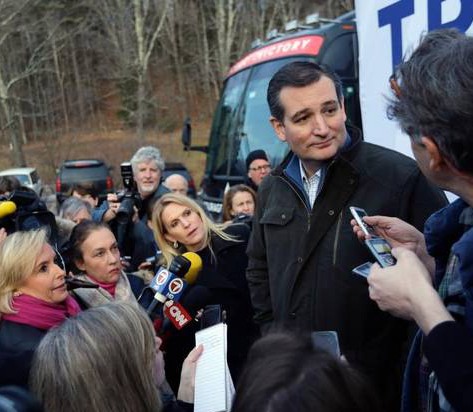
Ted Cruz meets voters at a campaign event

There was a three-part series in National Review which I found just fascinating, and a good antidote to the hit pieces you see from the Republican establishment, which they attack Cruz for “likability”. As regular readers of National Review know, Jay Nordlinger is more of an establishment type. But he backed Cruz from the beginning in the GOP primary, because he has known Cruz personally for a long time.

Here are the three parts:

From part 1:

I met Ted Cruz on the presidential campaign of George W. Bush in 2000. I had taken a leave of absence from NR to assist that campaign. This was in mid-September, for the last six or seven weeks of the campaign. […]Ted was a domestic-policy advisor on the campaign.

We bonded, as they say. We had many a late-night discussion at Earl Campbell’s barbecue joint and other choice spots.

On judges:

Ted had a fancy education. He went to Princeton University, where he was a debate champion, and to Harvard Law School, where he was an editor on several publications, including the Law Review.

But I noticed something on the campaign — the campaign in 2000: He had a scrappy, outsider’s heart.

More on his background: He clerked for Judge Mike Luttig, on the Fourth Circuit. In fact, Ted made me aware of Luttig, and I came to admire this judge almost as much as Ted did. Then Ted clerked for the chief justice of the United States: William Rehnquist.

In fact, I think Ted learned to play tennis just to play with the chief. I’ll have to check with Ted on that.

An additional note on Mike Luttig: When a Supreme Court seat came open in 2005, Ted pushed for Luttig’s nomination. So did I, in my capacity as an opinion journalist (not that I had great pull). When John Roberts got the nod, we supported this nomination, of course, as all conservatives did. But our heart was with Luttig.

I back Edith Hollan Jones and Janice Rogers Brown for Supreme Court picks, but J. Michael Luttig is on my list, further down.

On school choice:

Tell you a story. Ted was, and is, an impassioned advocate of school choice. He thinks it’s shocking — immoral — that poor kids are trapped in hopeless, violent schools. One day, he was telling me about lawyers in the opposite camp: the camp of the education establishment. (For once, I think the word “establishment” is appropriate. Or Bill Bennett’s word: “Blob.”)

“You could practically smell the sulfur coming off them,” said Ted.

I don’t have permission to tell that story. But what the hell. It’s done. (Ted can sue me!)

Promoting school choice is the civil rights issue of our time. We have to get the money out of the government, and back into the hands of parents, so that they are free to choose schools that serve their children, instead of indoctrinating their children. We need kids who can get private sector jobs, not recite global warming dogma and put condoms on cucumbers.

On the free enterprise system:

Ted was exceptionally versatile. He knew a lot about the law, of course. And about domestic policy, of course. He was a domestic-policy adviser. He had Medicare Part B and all that jazz down pat. I am still a little hazy about these things, never being able to get through a white paper. Even the abstract …

He knew a lot about economics, and was a big free-marketeer. When he was in high school, he took part in something called the Free Enterprise Institute. They read Hayek, Friedman, Bastiat, everything. Ted imbibed. And saw the reason of.

He knew a lot about foreign policy, and was a hawk. Also, he was a “social conservative.” That term is weak, but it will have to do. Ted opposed abortion, for example — and knew why.

This is important: Ted was amazingly free of cynicism. What do I mean by that? I mean, he reallybelieved in America, free enterprise, and all that rah-rah stuff. Other people feel the need to roll their eyes a bit. Not Ted.

Here’s something from part two, now:

Ted worked at the Justice Department and at the Federal Trade Commission. Then he was solicitor general of Texas (under the attorney general, Greg Abbott, who would become governor). Frankly, I didn’t know that states had solicitors general until Ted became one.

I blogged before about Ted’s experience pushing for free-market policies at the Federal Trade Commission, and for gun rights and religious liberty as Solicitor General of Texas. Everywhere he has gone, he has pushed conservative positions. If you were hiring a candidate and went strictly off of resume, this would be the guy you would hire. Trump would not get an interview – he has no resume.

Cruz’s record in the Senate:

Ted has a wider libertarian streak than I do. (Bill Buckley: “Within every conservative is a streak of libertarianism.”) Also, he has less patience for the “establishment” than I do. But, you know? He was the one who got elected, and you know what else? He kept his promises to the voters.

Some may not have liked those promises. But, by golly, he kept them. Which is refreshing in a politician.

And he did not sit around. Oh, no. He did not mark time. A senator observed, “Ted has done more in a couple of years here than some of our colleagues have done in decades.”

Cruz got a lot of legislation passed, more than Rubio.

And from the third part:

Obviously, the Cruz style is not for everyone. But I can say this, to conservatives (and to anyone else, for that matter): If he is president, he will do everything humanly possible to repeal Obamacare. And to prevent Iran from going nuclear. And to do other hard, vital things. I don’t know if these things can be done. But I feel sure that, if they can, Ted will do them. He will go the last mile, and beyond.

Like everyone else, he likes popularity more than unpopularity. But if popularity clashes with the right course of action, popularity will have to go. Ted is used to opposition and scorn. And he would do anything — walk through fire, chew on glass — to keep this country free.

You can read more about Cruz’s achievements in this post.

Related posts

On the issues: assessing the 2016 Republican presidential candidates

Latest Republican presidential primary polls
Latest Republican presidential primary polls (click for larger image)

The PDF is here. (50 pages, but you only have to read about the candidates you might consider voting for)

Unfortunately, radically leftist Politico is the only one with a write-up on it, so here goes:

The hard-line conservative arm of the Heritage Foundation has tough criticism for much of the 2016 field, but high praise for the Texas senator.

The political arm of The Heritage Foundation has released a detailed assessment of the 2016 Republican presidential field — and it offers harsh words for many candidates. But not for Sen. Ted Cruz.

Cruz receives almost exclusively praise for his stances in the 50-page 2016 presidential policy scorecard, the first of its kind produced by Heritage Action. The report grades the candidates across six categories: growth, opportunity, civil society, limited government, favoritism and national security.

Many of the lines in the scorecard appear destined for future attack ads.

Jeb Bush, for instance, is accused of having “kowtowed to the state’s environmental lobby” in Florida. Chris Christie “has shown favoritism toward well-connected real estate developers.” Rand Paul’s “views at times veer outside the conservative mainstream.” And Donald Trump backs “massive tariffs that would damage the American economy.”

Cruz, by contrast, manages to emerge with barely a blemish, receiving only softly worded critiques of his adopting “sound policies advanced by others” rather than crafting his own.

[…]“Cruz has been willing to pay a political price for taking on government favoritism,” the report reads.

The group even forgives Cruz for one of the few trespasses he has made against its positions, voting for a bill that served “as a bargaining chip for [Export-Import Bank] allies to secure reauthorization.” The report credits him for later switching his vote and then publicly attacking Republican Senate Majority Leader Mitch McConnell for allegedly lying about his plans.

Bobby Jindal, who is running hard to the right in Iowa, receives among the more glowing reviews. So does Marco Rubio, who angered the right with his pursuit of a comprehensive immigration plan after first being elected with tea party support.

The two current front-runners in the polls, Ben Carson and Trump, were dinged for their lack of a record on conservative causes and a lack of specifics in their visions. “His unconventional foreign policy prescriptions raise more questions of significant consequence than they answer,” Heritage writes of Trump.

Bush was singled out for some of the most biting critiques. “Has shown favoritism toward Florida special interests and supports amnesty” for undocumented immigrants, reads one bullet point.

In its 2016 assessment, Heritage dings Bush for not supporting recent efforts to defund Planned Parenthood this fall because he said he opposed precipitating a government shutdown. The report accuses him of “playing to President [Barack] Obama’s talking points rather than reinforcing conservatives.”

No, everyone knows that my list of candidates favors governors who have a history of putting in place actual policies that actually affected real people in the real world and got real conservative results. So on that score, Cruz and Rubio way down the list because they have achieved very little:

  1. Scott Walker
  2. Bobby Jindal
  3. Rick Perry
  4. Ted Cruz
  5. Marco Rubio

Ted Cruz’s Twitter feed and his overall feel to me is that all he does is talk, talk, talk. He just doesn’t have the record of Bobby Jindal at putting policies into place. For example, as governor, Jindal actually cut spending. He actually put in place pro-life measures that actually saved lives. He actually put in place a school choice program that helped low-income students get out of failing schools. He actually cut off funding for Planned Parenthood. He actually defended religious liberty. Cruz is just a senator, so he hasn’t got that proven record. I believe he would be conservative, but I feel safer trusting someone with experience.

Having said that, the more I read reports like this Heritage Action Scorecard report, I am finding out that Cruz has been willing to at least pay a price politically for doing the right thing at various times. So, although he does not have the accomplishments that the governors have, he has been willing to push conservative values when it was not to his advantage, politically. I have to admit, there is some value to this in one sense – we know that he would do what he says no matter what. But there is a problem with Cruz. We don’t know whether he is able to create clever policies that will draw the votes of independents and even moderate Democrats. That’s what Walker and Jindal were able to do. So, although I respect what the Heritage Action team have written, I am not changing my rankings.

Tonight’s debate

Be sure and tune in to both debates tonight on Fox Business, as I am expecting Jindal and Cruz to outperform their competitors in their respective debates:

Republican debate – Fox Business/Wall Street Journal

Time – Primary: 9 p.m. ET. Secondary: 7 p.m. ET

Location – Milwaukee Theater, Milwaukee, Wisconsin

Moderators – Gerard Baker, Neil Cavuto, Maria Bartiromo

Primary: All candidates averaging at least 2.5 percent in four most recent national polls by Nov. 4.

Secondary: Remaining candidates averaging at least 1 percent in one of the four most recent polls.

Primary: Donald Trump, Ben Carson, Marco Rubio, Ted Cruz, Jeb Bush, Carly Fiorina, John Kasich, Rand Paul.

Secondary: Chris Christie, Mike Huckabee, Bobby Jindal, Rick Santorum.

Candidates on my list are in bold. The debate will be live-streamed, so you have no excuses for missing it. This one promises to be a good one. The moderators will not be amateurs as with the Democrat-biased CNBC debate.

Scott Walker’s new budget: tax cuts, spending cuts, school choice, smaller government

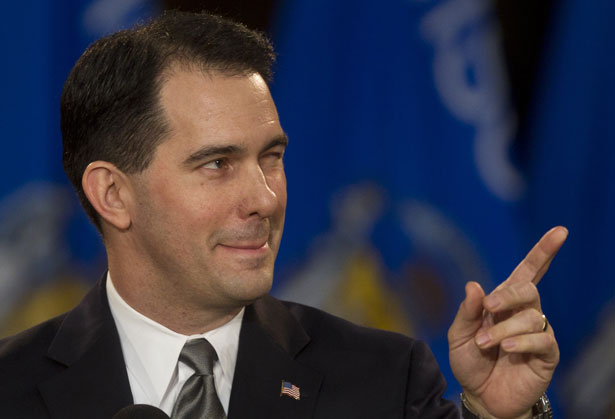
Wisconsin Governor Scott Walker

Scott Walker announces some of the items in his new Wisconsin budget.

The Daily Signal reports:

Gov. Scott Walker unveiled his proposal for Wisconsin’s state budget on Tuesday night, and he did not shy away from offering bold ideas.

The second-term Republican governor has proposed a budget for 2015-17 that would cut property taxes again, eliminate the cap on the state’s school choice program, and reform government by merging agencies.

Walker’s budget would also spin off the public University of Wisconsin System as a separate state entity and require those receiving government benefits to take a drug test.

Tax cuts, expanding school choice, smaller government.

Here are the details on the school choice expansion:

The governor also talked about expanding the state’s school choice program.

“I am excited to announce our plans to lift the cap on vouchers so more families … can have the choice to find the best school for their children,” Walker said. “Every child deserves the chance to succeed.”

If passed by the GOP-led legislature, all students living under 185 percent of the federal poverty level and currently attending a public school would have access to a voucher to attend a private school.

This expansion is on top of school choice programs already in place in the cities of Milwaukee and Racine.

Walker’s budget also expands public school choice in the form of independent charter schools. Wisconsin currently authorizes these schools in the city of Milwaukee, but nowhere else in the state. Independent charter schools are public schools, but do not operate under the auspice of the local school board or teachers’ union.

The governor has proposed a statewide board, which would authorize new charter schools statewide. In Milwaukee, the independent charter schools have repeatedly outperformed their traditional public school peers.

Oh no! What will the leftist public schools do when parents can choose not to give them money? WHO CARES!

And welfare reform:

Walker also introduced a plan recently that would build on his previous entitlement reforms.

“Our budget expands the requirement for able-bodied adults to be enrolled in an employment and training program in order to receive food stamps,” Walker announced. “Now, some might claim that we’re making it harder to get government assistance. We’re not. We’re making it easier to get a job.”

He is mean. Mean to lazy people!

The leftist New York Times reports that the streamlining of government will result in 400 public sector positions (some of which are vacant) being eliminated.

The article also reminds us why conservatives love Scott Walker:

Mr. Walker came to national prominence in 2011 largely because of his first statewide budget proposal, which relied on cuts to collective bargaining rights and increased health and pension costs for most public workers to help solve an expected budget gap.

That got rid of the massive $3.6 billion deficit he inherited from his Democrat predecessor.

But there is more. What do you think the deepest, darkest place is in the United States? I think it’s the university.

The NYT article continues:

Mr. Walker’s proposal calls for cutting about $300 million, or 13 percent, in state funds from the University of Wisconsin System, which includes 13 four-year universities and enrolls some 180,000 students. Mr. Walker’s plan would also take the unusual step of removing the university system from direct state control to a “quasi-governmental” authority that could act autonomously on issues of personnel, procurement, capital projects and tuition.

As word spread in recent days that proposed cuts were coming, some in the university system expressed deep concern, likening the focus on the universities to Mr. Walker’s earlier clashes with public-sector labor unions. At the University of Wisconsin-Madison, the Faculty Senate this week condemned the proposal. Students said they intended to organize opposition.

He went after the leftist public sector unions, and now the bloated leftist public universities. He is so mean to them! Oh well. (Fake cry)

Just ask yourself – what if the guy we chose as the Republican candidate for president actually knew what he was doing? Wouldn’t that be interesting? What if our candidate for President could do more than just play golf and read a teleprompter? What if our candidate for President could actually tell the truth instead of saying “let me be clear”, then lying, then saying “period” after the lie?

When the Green Bay Packers play NFL MVP Aaron Rodgers at quarterback, the Green Bay fans understand that he actually knows how to play football – and he is actually good at it, based on past experiences playing football. What if we chose a candidate who could actually do the job? And talk about past experiences doing the job? Wouldn’t that be something? Picking Scott Walker to be president would be like picking William Lane Craig to debate in favor of Christianity.