
Tag Archives: Peace

In California, students protest the results of their own liberal voting

Victor Davis Hanson writes about it National Review.

Excerpt:

Here in California, students just marched on Sacramento in outrage that state-subsidized tuition at the UC and CSU campuses keeps climbing. It is true that per-unit tuition costs are rising, despite even greater exploitation of poorly paid part-time teachers and graduate-student TAs. But the protests are sort of surreal. The California legislature is overwhelmingly Democratic. The governor is a Democrat. The faculties and administrative classes are largely Democratic. Who then, in the students’ minds, have established these supposedly unfair budget priorities?

Sales, income, and gas taxes are still among the highest in the nation (and are proposed to rise even higher) — prompting one of the largest out-of-state exoduses of upper-income brackets in the nation. The state budget is pretty much entirely committed to K–12 education (whose state-by-state comparative test scores in math and science hover between 45th and 49th in the nation), prisons, social services, and public-employee salaries and pensions. Whom, then, can the students be angry at?

Are students angry at public-union salaries and pensions that are among the highest in the nation? Do they think the many highly compensated retired Highway patrol officers have shorted students at UC Davis? Are they mad at the 50,000 illegal aliens in the California prison system that might have siphoned off scholarship funds from CSU Monterey Bay? Or is the rub the influx of hundreds of thousands of children of illegal aliens who require all sorts of language remediation and extra instruction in the public schools, and so might in theory divert library funds from UC Santa Cruz?

Perhaps the students don’t want billions to be committed to high-speed rail that might rob Berkeley of needed funding, or environmental efforts to introduce salmon into the San Joaquin River, in which the $70 million spent so far in studies and surveys might have come from nearby CSU Fresno? Are they mad at state social services, whose medical expenses have skyrocketed to address the health-care needs of millions of illegal aliens, and thus in theory could curb the choice of classes at CSU Stanislaus? Are they angry that some $10–15 billion a year probably leaves the state as remittances to Mexico?

If one cannot blame the wealthy for “not paying their fair share” (the top 1 percent of Californians now pay about 37 percent of all income-tax revenue — and their numbers have decreased by one-third in recent years, as the state has come to rely on the income tax for half its revenue), or Republican majorities in government, who, then, is left to blame?

Not only are their tuition costs going UP but their likely salary is going DOWN.
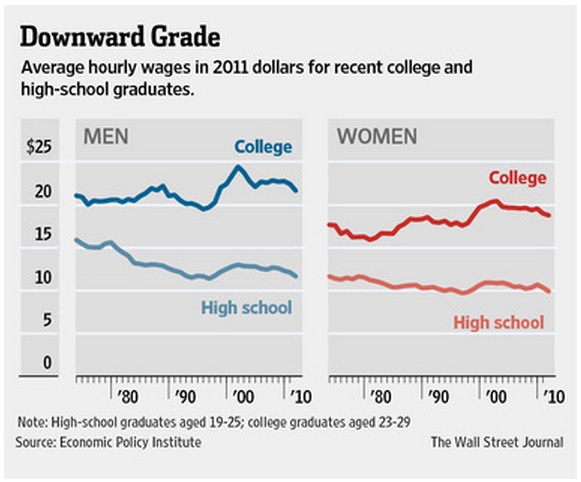
Students majoring in booze and hook-up sex
How's that hopey-changey stuff workin' for ya?

I got that image from a post at the American Enterprise Institute.

Excerpt:

  • Only 35 percent of students starting a four-year degree program will graduate within four years, and less than 60 percent will graduate within six years.
  • The U.S. college dropout rate is about 40 percent, the highest college dropout rate in the industrialized world.
  • Over the past 25 years, the total number of students in college has increased by about 50 percent. But the number of students graduating with degrees in STEM subjects has remained more or less constant.
  • In 2009, the United States graduated 37,994 students with bachelor’s degrees in computer and information science. That’s not bad, but we graduated more students with computer-science degrees 25 years ago!
  • Few disciplines have changed as much in recent years as microbiology, but in 2009 we graduated just 2,480 students with bachelor’s degrees in microbiology—about the same number as 25 years ago. Who will solve the problem of antibiotic resistance?
  • If students aren’t studying science, technology, engineering, and math, what are they studying?
  • In 2009, the United States graduated 89,140 students in the visual and performing arts, more than in computer science, math, and chemical engineering combined and more than double the number of visual-and-performing-arts graduates in 1985.
  • Moreover, more than half of all humanities graduates end up in jobs that don’t require college degrees, and those graduates don’t get a big income boost from having gone to college.

I think this is interesting. What exactly are these students paying for?

If there is one thing I learned from my love of Shakespeare, it’s that it is tragic to be the cause of your own downfall because of your own tragic flaw. Right now, there are a bunch of young people who have been totally brainwashed by the unionized public school teachers and professors to have views on economics that are completely opposite to what works in the real world. They keep voting for bigger and bigger government, which creates more and more debt in order to provide their parents with bigger and bigger benefits. They have lots of self-esteem, but very few marketable skills. Eventually, the bill for all the government spending on “helping the poor”, (e.g. – food stamps for millionaires and bailouts for bankrupt green energy firms), comes due, and it’s the students who will be paying the bill. I wonder if they will look as favorably on socialism and global warming alarmism then?

UPDATE: I noticed that in Quebec, the most liberal province in Canada, students are doing the same thing.

Iran launches Spanish-language TV channel in Venezuela

Political Map of South America

From the NY Daily News.

Excerpt:

As tensions with the United States continue to heat up, Iran is looking for some new allies — with Spanish speakers.

Iranian President Mahmoud Ahmadinejad announced on Tuesday that the country had launched a Spanish-language TV network meant to deal a blow to “dominance seekers” — which apparently means the U.S. and other Western countries, the Associated Press reported.

The Spanish-language channel, Hispan TV, will run 24 hours a day with Iranian movies, news and documentaries.

The channel is most likely targeted at countries that are friendly with Iran in Latin America, including Venezuela, Nicaragua and Cuba.

Ahmadinejad said the channel had already been on the air on a trial basis since October.

“The new channel will limit the ground for supremacy of dominance seekers,” Ahmadinejad said during a Tehran ceremony marking the inauguration, according to the AP. “It will be a means for better ties between people and governments of Iran and Spanish-speaking nations.”

This is the kind of thing that we should have been doing in Iraq and Afghanistan instead of pulling our forces out and handing Egypt and Libya to the Islamofascists. You don’t have to fight a war to project power and influence, you just have to have ideas and convictions.

Ron Paul’s isolationist foreign policy views echo Neville Chamberlain

From Doug Ross at Director Blue, 10 fun facts about Ron Paul.

Here’s fact #7:

And so I asked Congressman Paul: if he were President of the United States during World War II, and as president he knew what we now know about the Holocaust, but the Third Reich presented no threat to the U.S., would he have sent American troops to Nazi Germany purely as a moral imperative to save the Jews?

And the Congressman answered:

“No, I wouldn’t. I wouldn’t risk American lives to do that. If someone wants to do that on their own because they want to do that, well, that’s fine, but I wouldn’t do that.”

Paul then looked at me, and I politely thanked him for his time. He smiled at me again and nodded his head, and many of his young followers were also smiling, and nodding their heads in agreement. Clearly, I was the only one in the room who was disturbed by his response.

When I first presented the story of Paul’s comments about the Holocaust to major news media outlets two years ago, they were so stunned they were afraid to publish my story, and as a result it has remained unpublished until now.

I went to great lengths afterwards to learn more about the basis for Paul’s comments. I spoke to Eric Dondero, a former senior aide for Paul, in February 2010. Dondero is quoted in a Weekly Standard article today about Paul’s isolationist beliefs.

When I called Dondero again this morning, and told him I was finally going forward with the story, he told me that Paul had made similar comments to him.

“He told me numerous times it was not worth it to intervene to save the Jews in World War II,” Dondero said. “I don’t think that’s because he’s an antisemite. It’s because he’s an extreme isolationist and he’s trying to be 100% principled–he doesn’t think there’s any reason to intervene for human rights or any other reason anywhere on the planet.”

Calls to Rep. Paul’s congressional office and campaign office last week and this morning were not returned.

It’s not just the Holocaust, either. It’s the wholesale abandonment of the United Kingdom to conquest by Nazi Germany. And it’s not just the United Kingdom. It’s the complete takeover of the Asia-Pacific theater, and Australia, and New Zealand, by Imperial Japan. That’s what Ron Paul would have let happen.

Historians will tell you that Hitler could have been contained if Western leaders had responded militarily when he broke the Locarno treaties by remilitarizing the Rhineland in 1936. Do you think that Ron Paul would have gone to war in 1936 to stop Hitler – when he was still relatively weak? The Polyanna isolationism of Ron Paul is exactly what causes world wars. People like Ron Paul ignore aggressors when they make small invasions and then in a few years we have a world war on our hands. Ron Paul is a warmonger – his naive isolationism gets us into world wars by emboldening and coddling tyrants with a naive stick-your-head-in-the-sand foreign policy. Ron Paul doesn’t know anything about the threat of terrorism – his foreign policy is based on economics theories authored by people who died before nuclear weapons were invented. You can’t trust someone who makes foreign policy using theories, but who is ignorant of the real dangers we face.

“Those who do not learn from history are doomed to repeat it”
– George Santayana 

It’s not a surprise to me that Ron Paul is popular with young people who don’t understand military history and the threat of terrorism. They don’t know who Neville Chamberlain was, or they would recognize Ron Paul as the second coming of Neville Chamberlain.

Thomas Sowell explains what causes wars

Let’s take a look at the lessons of history and find out what really causes wars.

Here’s an article from Townhall.

Excerpt:

On the international scene, trying to assuage aggressors’ feelings and look at the world from their point of view has had an even more catastrophic track record. A typical sample of this kind of thinking can be found in a speech to the British Parliament by Prime Minister Neville Chamberlain in 1938: “It has always seemed to me that in dealing with foreign countries we do not give ourselves a chance of success unless we try to understand their mentality, which is not always the same as our own, and it really is astonishing to contemplate how the identically same facts are regarded from two different angles.”

Like our former ambassador from the Carter era, Chamberlain sought to “remove the causes of strife or war.” He wanted “a general settlement of the grievances of the world without war.” In other words, the British prime minister approached Hitler with the attitude of someone negotiating a labor contract, where each side gives a little and everything gets worked out in the end. What Chamberlain did not understand was that all his concessions simply led to new demands from Hitler — and contempt for him by Hitler.

What Winston Churchill understood at the time, and Chamberlain did not, was that Hitler was driven by what Churchill called “currents of hatred so intense as to sear the souls of those who swim upon them.” That was also what drove the men who drove the planes into the World Trade Center.

Pacifists of the 20th century had a lot of blood on their hands for weakening the Western democracies in the face of rising belligerence and military might in aggressor nations like Nazi Germany and imperial Japan. In Britain during the 1930s, Labor Party members of Parliament voted repeatedly against military spending, while Hitler built up the most powerful military machine in Europe. Students at leading British universities signed pledges to refuse to fight in the event of war.

All of this encouraged the Nazis and the Japanese toward war against countries that they knew had greater military potential than their own. Military potential only counts when there is the will to develop it and use it, and the fortitude to continue with a bloody war when it comes. This is what they did not believe the West had. And it was Western pacifists who led them to that belief.

Then as now, pacifism was a “statement” about one’s ideals that paid little attention to actual consequences. At a Labor Party rally where Britain was being urged to disarm “as an example to others,” economist Roy Harrod asked one of the pacifists: “You think our example will cause Hitler and Mussolini to disarm?”

The reply was: “Oh, Roy, have you lost all your idealism?” In other words, the issue was about making a “statement” — that is, posturing on the edge of a volcano, with World War II threatening to erupt at any time. When disarmament advocate George Bernard Shaw was asked what Britons should do if the Nazis crossed the channel into Britain, the playwright replied, “Welcome them as tourists.”

Most people think that Thomas Sowell is a libertarian, but he isn’t a full libertarian. He just reports the evidence. If the evidence is pro-war, then he’s pro-war. Ronald Reagan and Margaret Thatcher called this view “peace through strength”. There is only one reason why evil people do not attack – because they think that good people have the firepower to make them pay dearly for their aggression, and – and this is very important – the will to use it. We need to be wary of people like Ron Paul who minimize patriotism and heroism, and charge proponents of military power with “imperialism”.

Here’s an article that explains it more.

Excerpt:

In France, after the First World War, the teachers’ unions launched a systematic purge of textbooks, in order to promote internationalism and pacifism.

Books that depicted the courage and self-sacrifice of soldiers who had defended France against the German invaders were called “bellicose” books to be banished from the schools.

Textbook publishers caved in to the power of the teachers’ unions, rather than lose a large market for their books. History books were sharply revised to conform to internationalism and pacifism.

The once epic story of the French soldiers’ heroic defense against the German invaders at Verdun, despite the massive casualties suffered by the French, was now transformed into a story of horrible suffering by all soldiers at Verdun— French and German alike.

In short, soldiers once depicted as national heroes were now depicted as victims— and just like victims in other nations’ armies.

[…]France, where pacifism and internationalism were strongest, became a classic example of how much it can matter.

During the First World War, France fought on against the German invaders for four long years, despite having more of its soldiers killed than all the American soldiers killed in all the wars in the history of the United States, put together.

But during the Second World War, France collapsed after just six weeks of fighting and surrendered to Nazi Germany.

At the bitter moment of defeat the head of the French teachers’ union was told, “You are partially responsible for the defeat.”

Charles de Gaulle, Francois Mauriac, and other Frenchmen blamed a lack of national will or general moral decay, for the sudden and humiliating collapse of France in 1940.

At the outset of the invasion, both German and French generals assessed French military forces as more likely to gain victory, and virtually no one expected France to collapse like a house of cards — except Adolf Hitler, who had studied French society instead of French military forces.

Did patriotism matter? It mattered more than superior French tanks and planes.

Everybody wants peace. Everyone – on both sides of the issue. But it is not weakness but strength that deters wars. Strength, and the will to defeat evil.