Tag Archives: Peace Through Strength

Are snowflakes and libertarians right to worry that killing Iranian terrorists will start a war?

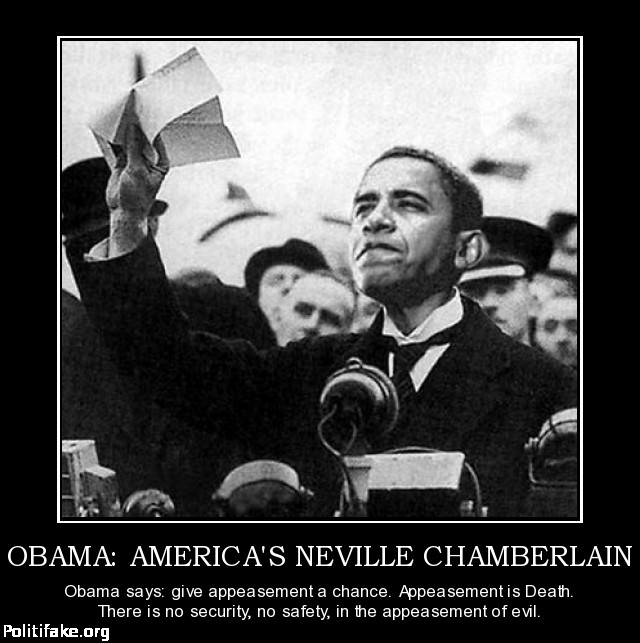
Neville Chamberlain Obama: peace in our time

I talked to a few progressives and libertarians on the weekend. They seemed to think that Trump’s decision to sanction two Iranian generals would lead to war. Now, I asked the libertarians and progressives a bit about how World War 2 started. They didn’t know anything about how it started. Let’s see what Trump did in Iran, and then look at WW2 history to see if it is likely to stop or start a war.

Before I start, I just want to say that someone shared a post by far-left filmmaker Michael Moore claiming that Americans had ever heard of Soleimani or the Quds Force. Here are my previous 134 posts on Iran, my previous 9 posts on the Quds Force, and my previous post on Soleimani. Speak for yourself, Michael Moore.

First, who is Solemani, and what is the Quds Force? The New York Times explains:

More than any other American military operation since the invasion of Iraq, the assassination yesterday of Maj. Gen. Qassim Suleimani, the head of Iran’s Qods Force of its Islamic Revolutionary Guards Corps, is a seismic event. The killings of Osama bin Laden and Abu Bakr al-Baghdadi, the leaders of al-Qaeda and the Islamic State, were certainly meaningful, but they were also largely symbolic, because their organizations had been mostly destroyed. Taking out the architect of the Islamic Republic’s decades-long active campaign of violence against the United States and its allies, especially Israel, represents a tectonic shift in Middle Eastern politics.

[…]In Lebanon, Mr. Suleimani built Lebanese Hezbollah into the powerful state within a state that we know today. A terrorist organization receiving its funds, arms and marching orders from Tehran, Hezbollah has a missile arsenal larger than that of most countries in the region. The group’s success has been astounding, helping to cement Iran’s influence not just in Lebanon but farther around the Arab world.

Building up on this successful experience, Mr. Suleimani spent the last decade replicating the Hezbollah model in Iraq, Syria and Yemen, propping up local militias with precision weapons and tactical know-how. In Syria, his forces have allied with Russia to prop up the regime of Bashar al-Assad, a project that, in practice, has meant driving over 10 million people from their homes and killing well over half a million. In Iraq, as we have seen in recent days, Mr. Suleimani’s militias ride roughshod over the legitimate state institutions. They rose to power, of course, after participating in an insurgency, of which he was the architect, against American and coalition forces. Hundreds of American soldiers lost their lives to the weapons that the Qods Force provided to its Iraqi proxies.

I think this part is worth emphasizing – Solemani was the aggressor in the Iraq embassy attack, and he has a record of attacking American armed forces:

Soleimani, who was designated and sanctioned by the U.N., E.U., and U.S. alike, directly approved Tuesday’s U.S. embassy storming in Baghdad by Iranian proxy militia Kataib Hezbollah, and was credibly assessed by Secretary of State Mike Pompeo as actively planning more “imminent” attacks against hard American assets in the Middle East, has been directly active in the mass murder of Americans. He personally oversaw the mass arming of Shiite Iraqi insurgents and it is estimated that the IRGC-QF targeted and killed over 600 Americans in Iraq from 2003–2011. The State Department asserts that this personally amounts to a whopping 17% of all deaths of U.S. military personnel during the Iraq War.

So, far from Trump’s response being disproportionate, this was actually a long-overdue response. It was even overdue from Trump.

The message that Iran got after 8 years of Obama was clear: acts of aggression committed by Iran against the United States and her allies would be rewarded, including the $1.7 BILLION payoff from the Obama administration. The Obama administration’s policy was isolationism and appeasement. And this was fine with Democrat voters, because not a single Democrat voter (or libertarian ) knew anything about Iran, the Iran deal, Soleimani, or the Quds Force. They are low-information voters.

Now let’s see how World War 2 started.

Here is a helpful lecture by military historian Victor Davis Hanson.

Germany re-armed in 1936. Austria was annexed in 1938. The Rhineland was re-occupied in 1938. Czechoslovakia was invaded in 1939. And the allied democracies did nothing to stop Hitler. Similarly, Japan also re-armed, broke treaties and invaded neighbors. And the allied democracies did nothing to stop them, despite having superior planes, tanks, and ships. This allowed the Axis powers time to research better weapons, re-arm, and gain a strategic advantage. The Axis powers could have been stopped early on, at a much lower cost in blood and treasure. It was the libertarians and the progressives with their policies of isolationism and appeasement that made World War 2 much worse than it needed to be.

VDH explains:

Hitler assumed the United States either could not or would not offer much military help to his intended European targets.

Why, then, did a relatively weak Nazi Germany between 1939 and 1941 believe that it could take on much of the world, and inspire Axis partners such as Italy and Japan to follow its suicidal lead?

The answer is obvious. British and French appeasement, Soviet collaboration and American isolation had together convinced Hitler and his Axis allies that the victors of World War I were more eager to grant concessions at any cost than were the defeated.

In the lecture, VDH explains that we know from the writings of the leaders of Germany and Japan that they interpreted the isolationist / appeasement policies of the libertarian progressives as weakness, and this is what caused them to re-arm and attack their neighbors. Prior to the historical start of WW2, the Western nations had better tanks, planes and ships than the Axis powers. But they refused to use them to deter the Axis powers. And that’s why World War 2 was much more costly and bloody than it needed to be.

Finally, I should quickly note that America pursued a different strategy in the Cold War, under Ronald Reagan. Reagan was villified by the libertarians and progressives for taking a strong stand against communism. Instead of appeasing and isolating, he put America on a war footing, making aggression costly to the Soviet Union. This approach worked to avoid an actual World War 3. Although his critics attacked him for being pro-war, his tough approach was exactly what was needed to cause the bully to back down.

Si Vis Pacem, Para Bellum
Ronald Reagan’s 40th anniversary D-Day speech: the boys of Pointe du Hoc

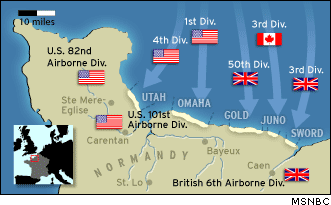
June 6, 1944 D-Day Normandy Invasion Map

It’s June 6th, today, and it’s the anniversary of D-Day: the Allied invasion of northern France – the beginning of the end of World War 2. One of the most pivotal events of that day was the assault on German gun emplacements by members of the Army Rangers at a fortified position called “Pointe du Hoc”.

President Ronald Reagan recognized the soldiers who attacked Pointe du Hoc back in 1984:

You can read the full transcript of that speech here.

Ronald Reagan also made the case for gratitude and vigilance:

Here’s the hymn that starts to play at the end:

The Boys of Pointe du Hoc

Here’s a summary of the Pointe du Hoc mission:

[Lt. Col. James Earl] Rudder took part in the D-Day landings as Commanding Officer of the United States Army’s 2nd Ranger Battalion. His U.S. Army Rangers stormed the beach at Pointe du Hoc and, under constant enemy fire, scaled 100-foot (30 meter) cliffs to reach and destroy German gun batteries. The battalion’s casualty rate for this perilous mission was greater than 50 percent. Rudder himself was wounded twice during the course of the fighting. In spite of this, they dug in and fought off German counter-attacks for two days until relieved. He and his men helped to successfully establish a beachhead for the Allied forces.

You can watch a three-clip documentary on it, too: part 1, part 2, part 3.

Although initially, the Rangers did not find the guns where they had expected them, they did find them further back behind the cliffs and destroyed them there, removing a threat to the forces that would be landing later.

What does D-Day mean to Christians in particular?

A Christian friend asked me what she should be thinking about when I sent her one of the videos above, and so I wrote her this to explain why I sent her the video:

To make you close your eyes and think in a more practical way about what it means for someone to sacrifice their lives to save you, of course. What it means to look up cliffs at machine guns, barbed wire and mortars raining death on you and to take a rope in your hands and to climb up a sheer cliff, under heavy fire, in order to save generations yet unborn and freedom itself.

To think about a concrete example helps us to be able to appreciate what Christ did for us in giving his life for us so that we could be free of sin, as well.

This is the insight that drives my entire interest in war and military history, in fact.

What does this mean: “Greater love has no man than this, that a man lay down his life for his friends.”

The more you know about D-Day, the more fearful what Jesus did appears, and the more you can be grateful.

Bullets and shrapnel are scary… and so are nails and lashes. Why on Earth would anyone endure either for me? And what should my response be to it?

I think it is helpful to explain Christianity to those who are not yet Christian, and for Christians to fully appreciate what Christianity is all about.

We were in peril. And now we have been saved. But at a cost.

I think that it’s important for Christians to look to history, art, poetry and music to help them to reflect and comprehend the sacrifice that Christ made for us in dying on the cross to protect us from peril. What must the cross have looked like to Jesus? It must have been something like what the Omaha beach looked like to the Americans landing in Normandy. Jesus saw whips, thorns and nails, and the heroes of Normandy saw 88 mm AT guns, 81 mm mortars and MG42 machine guns. How should you feel about people who face death on your behalf? Think about it.

Scott Walker discusses foreign policy and national security with Hugh Hewitt

Wisconsin Governor Scott Walker

Hugh Hewitt is a horrible RINO Republican establishment guy (backed Romney), but I sometimes listen to his show.

I got this audio and transcript from Hugh Hewitt’s blog.

The MP3 file is here. (19 minutes)

And here are the relevant parts of the transcript:

HH: You mentioned today, you called it “the safety issue,” not the “national security issue,” that sort of brings, explain to people why you use that terminology.

SW: I do, because I think it’s come to the forefront not so much because “national security,” that, to me, as I said [at lunch], is on page 6A of the newspaper where only a handful of us read into that. But when people see the videos, when they see the Jordanian burned alive in a cage, when they see the Egyptian Christians who were beheaded, when they see some of these other folks from around the world, including James Foley, who went to Marquette University where my son’s a junior, and suddenly, that becomes very real to everyday Americans.

HH: One of the beheaded Islamic State videos.

SW: Absolutely, whose parents are actually from New Hampshire, not far from where I was at a weekend ago, and you just realize, you can see it on your phone, you can see it on your iPad. You don’t need the filter of the network news or the daily newspaper to tell you how bad this is. It suddenly becomes an issue of safety, because that’s not something, national security, foreign policy is something over there. Safety is something you feel inside your chest, you feel in your heart. And I think increasingly, Americans feel a sense of concern that particularly if they have family members or loved ones that ever want to travel again, they see France, they see Canada, they see other places around the world, not just the Middle East, and it’s a safety issue. And they, and then I would just add to this, as they look at this more closely, they see a president whose drawn a line in the sand and crossed it, who called ISIS just a year ago the “jayvee squad,” who called Yemen last fall a success story, who calls Iran now a place where we can do business. Think about how screwed up that is. I remember the movie in the 80s, Trading Places…

HH: Right.

SW: …you know, with Dan Akroyd and Eddie Murphy, it’s like Iran and Israel are trading places in the sequel. In the eyes of this president, our ally is supposed to be Israel. Our adversary has been historically Iran. And yet this administration completely does it the other way around. We need to call radical Islamic terrorism for what it is, and a commander-in-chief who’s willing to act.

HH: Now I asked maybe one of your potential competitors yesterday, Senator Marco Rubio, who I know is a friend of yours.

SW: Good guy, yeah.

HH: I asked him yesterday would you disown and agreement that this president signs with Iran that leaves Iran uranium enrichment. What’s Scott Walker think about the deal, because that’s the outline, it appears?

SW: Absolutely.

HH: Would you reject that deal if you took the Oval Office?

SW: Absolutely, on Day One. I mean, to me, it is, the concept of a nuclear Iran is not only problematic for Iran, and certainly for Israel, but it opens the doors. I mean, the Saudis are next. You’re going to have plenty of others in the region. People forget that even amongst the Islamic world, there is no love lost between the Saudis and the Iranians. And so they’re going to want to have a nuclear weapon if the Iranians have a nuclear weapon. This is something that just escalates right before our eyes. And the fact that this administration began these discussions essentially conceding that they’re going to allow enrichment to go forward with the Iranians just shows you that they don’t have the same level of concern that I think I and Senator Rubio and many others out there have, that a nuclear Iran is a problem for the entire world, not just for Israel.

HH: Does the rising of these headlines, Saudi Arabia may be going to war with Yemen before this broadcast is over, if some of these Reuters reports are true.

SW: Right.

HH: And the Quds Force general is in Tikrit, right? So the world’s on fire. Does this hurt a governor’s claim to the presidency and elevate perhaps senators who have been there or other people who have been abroad and done that sort of thing? Or does it help you?

SW: Well, I think leadership is the fundamental ingredient that’s important in anything, particularly when it comes to foreign policy. And I won’t belittle any of the other would-be candidates. I would say, though, that my lifetime, the most significant president when it comes to foreign policy was a former governor, Ronald Reagan. The most faulty president, I would argue, when it comes to foreign policy and national security is a first term senator by the name of Barack Obama, who was on the Foreign Affairs Committee. And so, just those qualifications alone aren’t enough. Now again, I think Senator Rubio and I are very much aligned on these issues. I agree with a number of my other colleagues who might be prospective candidates should I and others get into the race in the future. What people need to look at is what do you bring to the table, who do you surround yourself with, what kind of leadership style do you have, and people, I think in this case in particularly, not just in the travels and the studies, need to know how you think. In this case, I think Americans more than anything want a commander-in-chief of the future who does a couple of things – 1) calls out radical Islamic terrorism for what it is, and says we will do whatever it takes to take the fight to them before they bring the fight to us, because unlike the Cold War, when containment was enough, when the Soviet Union and the United States could have leaders like Gorbachev and Reagan talking about containment, that’s not enough. When you have, not only with ISIS and al Qaeda, but you have an Iran, you have other places around the world groups that that want to not only annihilate Israel, but annihilate us in America, it’s like a virus. You’ve got to eradicate it. You can’t take out part of it, or it will come back.

HH: You also have people like Putin, Governor Walker…

SW: Absolutely.

HH: …who are pushing everywhere, and we’ve got Baltic allies. And people are wondering whether or not we’d actually come to their defense if Putin pushes into Estonia or Latvia or Lithuania. What do you think?

SW: We absolutely have to. I mean, NATO is the strongest military alliance we’ve had in history. It was part of, through Reagan’s leadership, but certainly part of the ingredient that allowed us to win the Cold War without firing a shot. If we don’t defend NATO members in a scenario like that, now I think we preempt that by showing strength in even dealing with Ukraine, which is not a NATO member, but is very much geographically aligned with what we’re talking about. Remember, Putin isn’t just aggressive for the sake of being aggressive. He’s a nationalist. He believes in the history of Russia and the old Soviet Union. Part of what you see here is the old Lenin adage that you probe with bayonets. If you find mush, you proceed. If you find steel, you withdraw. Well, in Ukraine, he’s found mush, and he’s found mush not only from the United States, but from others like, others and NATO partners out there. If it were to extend, and my belief is we need a president who’s going to act aggressively by giving lethal force to the Ukrainians and others to try to preempt that from happening. But a couple of weeks ago, I met with the president of Estonia. Certainly, we saw a week ago the Lithuanian leadership is literally giving out literature telling their own citizens what to do if Russians invade. Latvia, I just talked to someone the other day whose mother immigrated here from Latvia, and in each of those Baltic states, there are real serious concerns about what happens if we don’t deal with this in Ukraine. We need American leadership not just for America’s sake, but for the world.

If you find that interesting, listen to the whole thing or read the transcript. He also talks about education reform, if you’re into that. I am.

We don’t talk much about foreign policy as Christians, but it is important for us to understand it in order to promote the good, and achieve good results. We can’t just be led by our feelings, we have to do what works, and that requires understanding how the world works.