Leslie Sabo was killed during the Vietnam War’s 1970 Cambodian Campaign. He was nominated for the Medal of Honor, but the records were lost until a veteran rediscovered them in 1999. In 2012, Sabo’s widow received the nation’s highest military award on his behalf, the 249th for Vietnam.
Sabo’s platoon and another had been ambushed from all sides by a large and well-entrenched force of communist soldiers.
He repeatedly attacked and killed enemy soldiers, was wounded by a grenade as he shielded a comrade, and then was fatally shot as he provided covering fire for a medevac helicopter.
“His indomitable courage and complete disregard for his own safety saved the lives of many of his platoon members,” said the Medal of Honor citation. “Spc. 4 Sabo’s extraordinary heroism and selflessness, above and beyond the call of duty, at the cost of his life, are in keeping with the highest traditions of military service and reflect great credit upon himself, Company B, 3rd Battalion, 506th Infantry, 101st Airborne Division, and the United States Army.”
Leslie Jr. was born in 1948 in Kufstein, Austria, where his well-to-do family had moved after the Soviet occupation of Hungary at the end of World War II, leaving almost everything behind.
They moved to America when he was 2. They lived in Youngstown, Ohio, and then Ellwood City, Pa.
Leslie Sr., a lawyer in Hungary, retrained as an engineer, and both parents taught their two remaining sons (another was killed by a bomb during the war) patriotism for their adopted country.
Here are some more details from the Army web site:
4 Leslie H. Sabo Jr. distinguished himself, May 10, 1970, in Se San, Cambodia, while serving as a rifleman in Company B, 3d Battalion, 506th Infantry, 101st Airborne Division.
Members of B. Co. were ambushed by a large enemy force. While conducting a reconnaissance patrol, 22-year-old Sabo, charged an enemy position, killing several enemy soldiers. Immediately thereafter, he assaulted an enemy flanking force, successfully drawing their fire away from friendly soldiers and ultimately forcing the enemy to retreat.
When a grenade landed nearby a wounded comrade, Sabo picked up the grenade threw it away while shielding his buddy with his own body, thus absorbing the brunt of the blast and saving the man’s life.
Seriously wounded by the blast, Sabo, nonetheless, retained the initiative and single- handedly charged an enemy bunker that had inflicted severe damage on the platoon. He received several serious wounds from withering automatic weapons fire in the process. Despite being mortally injured, he crawled towards the enemy emplacement and, when in position, threw a grenade into the bunker. The resulting explosion silenced the enemy fire, but also ended Spc. 4 Sabo’s life.
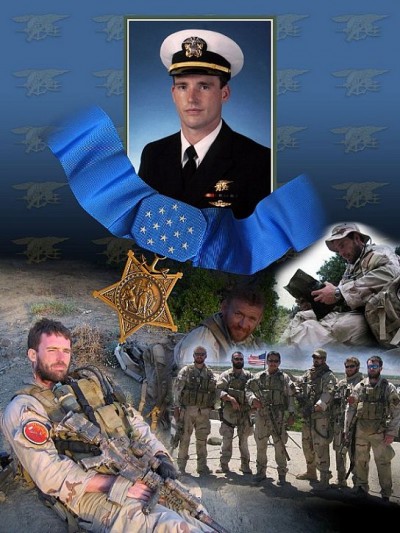
Engaged in a frenzied firefight and outnumbered by the Taliban, Navy Lt. Michael Murphy made a desperate decision as he and three fellow SEALs fought for their lives on a rocky mountainside in Afghanistan’s Kunar Province in 2005.
In a last-ditch effort to save his team, Murphy pulled out his satellite phone, walked into a clearing to get reception and called for reinforcements as a fusillade of bullets ricocheted around him. One of the bullets hit him, but he finished the call and even signed off, “Thank you.”
Then he continued the battle.
Dan Murphy, the sailor’s father, said it didn’t surprise him that his slain son nicknamed “The Protector” put himself in harm’s way. Nor was he surprised that in the heat of combat his son was courteous.
“That was Michael. He was cool under fire. He had the ability to process information, even under the most difficult of circumstances. That’s what made him such a good SEAL officer,” Murphy said.
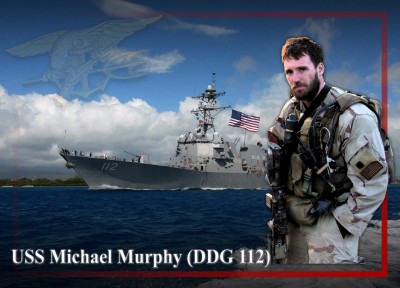
A warship bearing the name of the Medal of Honor recipient will be christened Saturday — on what would have been Murphy’s 35th birthday — at Bath Iron Works, where the destroyer is being built.
Murphy, who was 29 when he died, graduated from Pennsylvania State University and was accepted to multiple law schools, but decided he could do more for his country as one of the Navy’s elite SEALS — special forces trained to fight on sea, air and land — the same forces that killed Osama bin Laden this week in Pakistan.
[…]Murphy, of Patchogue, N.Y., earned his nickname after getting suspended in elementary school for fighting with bullies who tried to stuff a special-needs child into a locker and for intervening when some youths were picking on a homeless man, said Dan Murphy, a lawyer, former prosecutor and Army veteran who served in Vietnam.
Maureen Murphy said he thought he was too young to take a desk job as a lawyer. Instead, he went to officer candidate school, the first step on his journey to become a SEAL officer. He was in training during the Sept. 11 attacks, which shaped his views.
His view was that there are “bullies in the world and people who’re oppressed in the world. And he said, ‘Sometimes they have to be taken care of,'” she said.
On June 28, 2005, the day he was killed, Murphy was leading a SEAL team in northeastern Afghanistan looking for the commander of a group of insurgents known as the Mountain Tigers.
What happened to Murphy?
The Operation Red Wings reconnaissance team rappelled down from a helicopter at night and climbed through rain to a spot 10,000 feet high overlooking a village to keep a lookout. But the mission was compromised the following morning when three local goat herders happened upon their hiding spot.
High in the Hindu Kush mountains, Murphy and Petty Officers Marcus Luttrell of Huntsville, Texas; Matthew Axelson of Cupertino, Calif.; and Danny Dietz of Littleton, Colo.; held a tense discussion of the rules of engagement and the fate of the three goat herders, who were being held at gunpoint.
If they were Taliban sympathizers, then letting the herders go would allow them to alert the Taliban forces lurking in the area; killing them might ensure the team’s safety, but there were issues of possible military charges and a media backlash, according to Luttrell, the lone survivor.
Murphy, who favored letting the goat herders go, guided a discussion of military, political, safety and moral implications. A majority agreed with him.
An hour after the herders were released, more than 100 Taliban armed with AK-47 assault rifles and rocket-propelled grenades opened fire, attacking from higher elevation, and maneuvering to outflank the SEALs, said Gary Williams, author of “Seal of Honor,” a biography of Murphy.
[…]As the only survivor, Luttrell has pangs of regret for voting to go along with Murphy, his best friend; he now believes the team could’ve survived if the goat herders were killed.
He wasn’t willing to kill unarmed civilians. That’s the difference between the United States and the Muslim terrorists. It’s a moral difference. Michael Murphy was a good man. He used guns and violence to protect others, and he was not willing to kill unarmed civilians.
The Medal of Honor is awarded by the President in the name of Congress to a person who, while a member of the Army, distinguishes himself or herself conspicuously by gallantry and intrepidity at the risk of his or her life above and beyond the call of duty while engaged in an action against an enemy of the United States; while engaged in military operations involving conflict with an opposing foreign force; or while serving with friendly foreign forces engaged in an armed conflict against an opposing armed force in which the United States is not a belligerent party. The deed performed must have been one of personal bravery or self-sacrifice so conspicuous as to clearly distinguish the individual above his comrades and must have involved risk of life. Incontestable proof of the performance of the service will be exacted and each recommendation for the award of this decoration will be considered on the standard of extraordinary merit.
I once read an entire book on Medal of Honor award winners in World War II. It’s hard to read those stories, because these people who won the award did amazing acts of bravery, courage and self-sacrifice, but then most of them DIED. The stories almost always end in sadness and grief. Here’s the one that really stuck with me as an example.
On a happier note, what kind of ship do you think would suit Michael Murphy?
The Arleigh Burke Class destroyers are equipped with the Aegis combat system which integrates the ship’s sensors and weapons systems to engage anti-ship missile threats.
The Aegis system has a federated architecture with four subsystems – AN/SPY-1 multifunction radar, command and decision system (CDS), Aegis display system (ADS) and the weapon control system (WCS). The CDS receives data from ship and external sensors via satellite communications and provides command, control and threat assessment. The WCS receives engagement instruction from the CDS, selects weapons and interfaces with the weapon fire control systems.
[…]Lockheed Martin is developing the Aegis ballistic missile defence (BMD) capability for the Aegis combat system to engage ballistic missiles with the SM-3 missile. 15 Arleigh Burke destroyers have been fitted with the Aegis BMD system, which provides the capability for long-range surveillance, tracking and engagement of short and medium-range ballistic missiles. The system received US Navy certification for full deployment in September 2006. Work was completed on the 15 destroyers at the end of 2008 and the vessels, with three Ticonderoga cruisers, form the Aegis BMD fleet. On 30 July 2009 the Aegis BMD system was successfully tested by the US Navy on the USS Hopper (DDG 70).Aegis BMD is the main sea-based component of the US ballistic missile defence system.
The weapons control systems include a SWG-1A for Harpoon, SWG-3 for Tomahawk, mk99 mod 3 missile fire control system, GWS34 mod 0 gun fire control system and mk116 mod 7 fire control system for anti-submarine systems.
Only two classes of warships that I know of have the AEGIS system. The DDG Arleigh Burke and the CG Ticonderoga.
Michael Murphy was a real hero. It makes me sad that he is gone. But his spirit will live on in the new warship that bears his name.
During the Allied Bombing offensive of World War II the public was often informed that “A raid took place last night over …, One (or often more) of Our Aircraft Is Missing”. Behind these sombre words hid tales of death, destruction and derring-do. This is the story of one such bomber crew who were shot down and the brave Dutch patriots who helped them home.
The bomber in the movie that they start with is called a Vickers Wellington. It’s not very good, but the four-engine Avro Lancaster they get at the end of the movie is as good or better than the B-17 bomber used by the Americans during the war. Most people think that the Avro Lancaster was the best bomber of World War 2 on either side. My Canadian readers will be thrilled to know that Avro Canada constructed many Avro Lancasters to help with the war effort. You can still see an intact Lancaster in Alberta, Canada.


 WINTERY KNIGHT