Tag Archives: Oil Shale

GAO: Green River Formation has more oil than the rest of the world combined

Remember when Obama said that we have “2 percent of the world’s oil reserves”?

This is an excerpt from his own speech:

As a country that has 2 percent of the world’s oil reserves, but uses 20 percent of the world’s oil — I’m going to repeat that — we’ve got 2 percent of the world oil reserves; we use 20 percent.  What that means is, as much as we’re doing to increase oil production, we’re not going to be able to just drill our way out of the problem of high gas prices.  Anybody who tells you otherwise either doesn’t know what they’re talking about or they aren’t telling you the truth.

Now let’s find out who doesn’t know what they’re talking about and who isn’t telling the truth.

The Government Accountability Office – a department of the federal government – tells us the facts.

Excerpt:

The Green River Formation, a largely vacant area of mostly federal land that covers the territory where Colorado, Utah and Wyoming come together, contains about as much recoverable oil as all the rest the world’s proven reserves combined, an auditor from the Government Accountability Office told Congress on Thursday.

The GAO testimony said that the federal government was in “a unique position to influence the development of oil shale” because the Green River deposits were mostly beneath federal land.

[…]It also noted that developing the oil would have an environmental impact and pose “socioeconomic challenges,” that included bringing “a sizable influx of workers who along with their families put additional stress on local infrastructure” and “making planning for growth difficult for local governments.”

“The Green River Formation–an assemblage of over 1,000 feet of sedimentary rocks that lie beneath parts of Colorado, Utah, and Wyoming–contains the world’s largest deposits of oil shale,”Anu K. Mittal, the GAO’s director of natural resources and environment said in written testimony submitted to the House Science Subcommittee on Energy and Environment.

“USGS estimates that the Green River Formation contains about 3 trillion barrels of oil, and about half of this may be recoverable, depending on available technology and economic conditions,” Mittal testified.

“The Rand Corporation, a nonprofit research organization, estimates that 30 to 60 percent of the oil shale in the Green River Formation can be recovered,” Mittal told the subcommittee. “At the midpoint of this estimate, almost half of the 3 trillion barrels of oil would be recoverable. This is an amount about equal to the entire world’s proven oil reserves.”

In her oral statement before the subcommittee, Mittal said that developing the shale oil would create wealth and jobs for the country, but also challenges for government.

“Being able to tap this vast amount of oil locked within this formation will go a long way to help to meet our future demands for oil. The U.S. Geological Survey, as you noted, estimates that the formation contains about 3 trillion barrels of oil of which half may be recoverable,” she said.

“As you can imagine having the technology to develop this vast energy resource will lead to a number of important socioeconomic benefits including the creation of jobs, increases in wealth and increases in tax and royalty payments for federal and state governments,” she said.

[…]In her written testimony, Mittal noted that three-fourths of the Green River shale oil is under federal land.

Is Barack Obama a good President? Does he know how to be President? Does he understand economics?

Let’s look at the national debt and the labor force participation rates in Obama’s first term. Recall that the Republicans lost the House and Senate in January of 2007. At the time of the Pelosi/Reid takeover, the national debt was $8 trillion. It is now almost double that at $16 trillion.
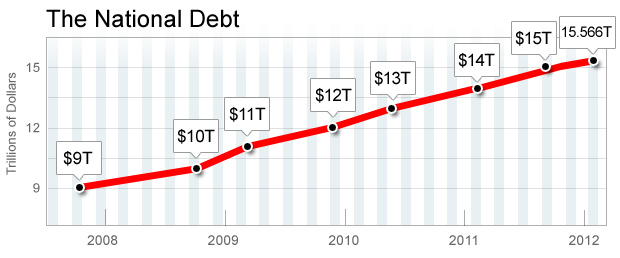
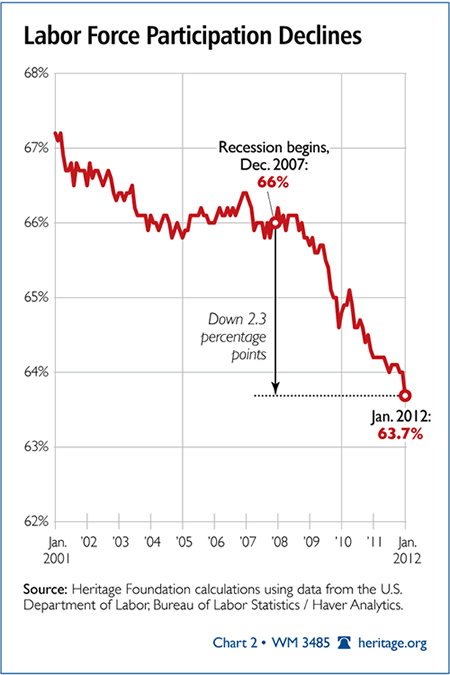
Obama added 5 trillion dollars to the debt since he took office
US Labor Force Participation down 4.9 million people

If these numbers seem bad to you, then I don’t think you should vote for Obama.
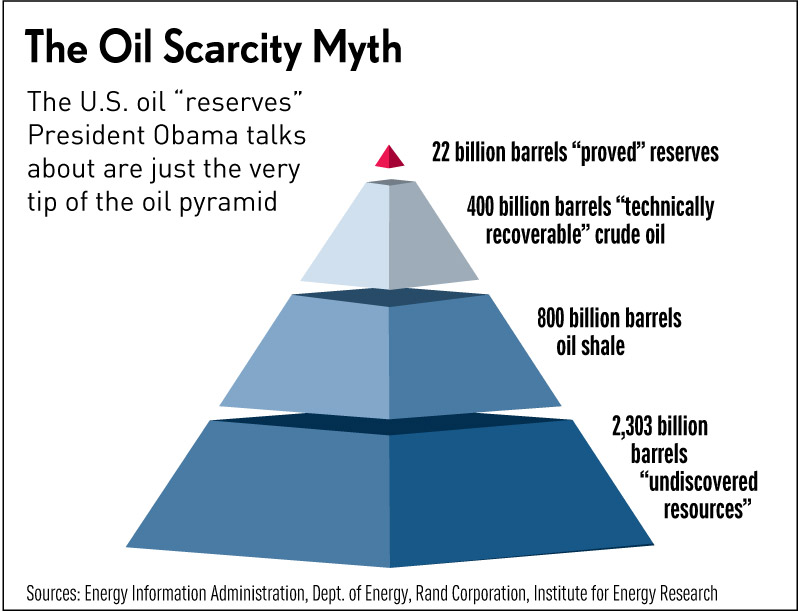
Is Obama telling the truth about U.S. oil reserves?

The Department of Energy's own figures

The Department of Energy’s own figures

Investors Business Daily explains. (H/T Master Resource)

Excerpt:

When he was running for the Oval Office four years ago amid $4-a-gallon gasoline prices, then-Sen. Barack Obama dismissed the idea of expanded oil production as a way to relieve the pain at the pump.

“Even if you opened up every square inch of our land and our coasts to drilling,” he said. “America still has only 3% of the world’s oil reserves.” Which meant, he said, that the U.S. couldn’t affect global oil prices.

It’s the same rhetoric President Obama is using now, as gas prices hit $4 again, except now he puts the figure at 2%.

“With only 2% of the world’s oil reserves, we can’t just drill our way to lower gas prices,” he said. “Not when we consume 20% of the world’s oil.”

The claim makes it appear as though the U.S. is an oil-barren nation, perpetually dependent on foreign oil and high prices unless we can cut our own use and develop alternative energy sources like algae.

But the figure Obama uses — proved oil reserves — vastly undercounts how much oil the U.S. actually contains. In fact, far from being oil-poor, the country is awash in vast quantities — enough to meet all the country’s oil needs for hundreds of years.

The U.S. has 22.3 billion barrels of proved reserves, a little less than 2% of the entire world’s proved reserves, according to the Energy Information Administration. But as the EIA explains, proved reserves “are a small subset of recoverable resources,” because they only count oil that companies are currently drilling for in existing fields.

When you look at the whole picture, it turns out that there are vast supplies of oil in the U.S., according to various government reports. Among them:

At least 86 billion barrels of oil in the Outer Continental Shelf yet to be discovered, according to the government’s Bureau of Ocean Energy Management.

About 24 billion barrels in shale deposits in the lower 48 states, according to EIA.

Up to 2 billion barrels of oil in shale deposits in Alaska’s North Slope, says the U.S. Geological Survey.

Up to 12 billion barrels in ANWR, according to the USGS.

As much as 19 billion barrels in the Utah tar sands, according to the Bureau of Land Management.

Then, there’s the massive Green River Formation in Wyoming, which according to the USGS contains a stunning 1.4 trillion barrels of oil shale — a type of oil released from sedimentary rock after it’s heated.

[…]All told, the U.S. has access to 400 billion barrels of crude that could be recovered using existing drilling technologies, according to a 2006 Energy Department report.

When you include oil shale, the U.S. has 1.4 trillion barrels of technically recoverable oil, according to the Institute for Energy Research, enough to meet all U.S. oil needs for about the next 200 years, without any imports.

Please share this article, because it is unlikely that Obama’s Solyndra-supporting buddies in the mainstream media will report the facts on domestic energy production.

Production of oil, gas and coal on federal lands sinks to 9-year low

Obama claims that production of oil, gas and coal is up since he took office. It’s true that areas under state control are producing more, but what about energy production on federal lands? That’s the part of the country that Obama is responsible for.

Let’s see what two recent studies from the Energy Information Administration and the Institute for Energy Research found.

Excerpt:

The updated EIA report revealed a 12 percent decline in production for coal, oil, and natural gas on federal and Indian lands from fiscal 2003 through fiscal 2011.

During this same period, production on state and private lands has increased, boosting overall production numbers for the United States. That’s a point even President Obama will acknowledge: “Under my Administration, domestic oil and natural gas production is up,” he said upon announcing his rejection of the Keystone XL pipeline.

Obama is correct. He just can’t rightfully claim the credit, since the vast majority of America’s new oil and gas production is happening on private lands in states like North Dakota, Alaska and Texas.

The administration, meanwhile, has also taken several steps to limit production…

  • Withdrew areas offered for 77 oil and gas leases in Utah that could cost American taxpayers millions in lost lease bids, production royalties, new jobs and the energy needed to offset rising imports of oil and natural gas.
  • Cancelled lease sales in the Western Gulf of Mexico, the Atlantic coast and delayed exploration off the coast of Alaska and kept other resource-rich areas off-limits.
  • Finalized rules, first announced by Secretary Salazar on January 6, 2010, to establish more government hurdles to onshore oil and natural gas production on federal lands.
  • Withdrew 61 oil and natural gas leases in Montana as part of a lawsuit settlement over climate change.

“The big picture is clear that government policies undertaken by the Obama administration have produced a significant decline in offshore oil production on federal lands in fiscal year 2011,” the Institute for Energy Research said in response to last week’s updated EIA analysis. “That is certainly not a way to increase domestic production of oil and keep oil and thus gasoline prices in check.”

While it was waiting for EIA to update its numbers, the Institute for Energy Research conducted its own analysis of Department of Interior data in February. It came to the same conclusion: “Production on federal lands is down, while production on state and private lands is up.”

That’s the real story behind Obama’s claims about higher energy production. He’s doing his best to block energy production in the areas under his control. His energy plan is Solyndra, Solyndra, Solyndra – paying off his rich Democrat buddies with taxpayer money.