Tag Archives: Obamacare

Obamacare will increase average individual-market premiums by 99% for men

% Increase in health insurance premium before and after Obamacare
Percent increase in average health insurance premium after Obamacare

What will you be paying for the privilege of electing a socialist who made you feel good about yourself?

Avik Roy counts the cost in Forbes magazine.

Excerpt:

For months now, we’ve been waiting to hear how much Obamacare will drive up the cost of health insurance for people who purchase coverage on their own. Last night, the U.S. Department of Health and Human Services finally began to provide some data on how Americans will fare on Obamacare’s federally-sponsored insurance exchanges. HHS’ press release is full of happy talk about how premiums will be “lower than originally expected.” But the reality is starkly different.

Based on a Manhattan Institute analysis of the HHS numbers, Obamacare will increase underlying insurance rates for younger men by an average of 97 to 99 percent, and for younger women by an average of 55 to 62 percent. Worst off is North Carolina, which will see individual-market rates triple for women, and quadruple for men.

[…][M]any 27-year-olds will face steep increases in the underlying cost of individually-purchased insurance under Obamacare. For the states where we have data—the 36 reported by HHS, plus nine others that we had compiled for our map that HHS didn’t report—rates will go up for men by an average of 97 percent; for women, 55 percent. (In the few cases where HHS reported on states that our map includes, we went with HHS’ numbers.)

Worst off was Nebraska, where the difference between the cheapest plan under the old system and under Obamacare was 279 percent for men, and 227 percent for women: more than triple the old rate. Faring best was Colorado, where rates will decline for both 27-year-old men and women by 36 percent. The only other state to see a rate decline in this analysis was New Hampshire: 8 percent for both men and women.

(Still missing are data from Hawaii, Kentucky, Massachusetts, Maryland, Minnesota, and Nevada. The data from New York and New Jersey should be taken with a grain of salt, as their individual insurance markets are not like those of other states.)

[…]40-year-olds, surprisingly, will face a similar picture. The cheapest exchange plan for the average enrollee, compared to what a 40-year-old would pay today, will cost an average of 99 percent more for men, and 62 percent for women.

You might be asking why men have to pay more than women for Obamacare premiums, and the answer is simple. Even though women use a lot more health care, companies are now forbidden from making women pay more because they use more. Women will be paying less because men will be picking up the cost. That’s called “equality”. The same thing happened with the stimulus, which also favored women, because they are more likely than men to support big government Democrats at election time.

What about the subsidies that are being offered by the government to ease the transition to government-controlled health care?

However, the overall results make clear that most people will not receive enough in subsidies to counteract the degree to which Obamacare drives premiums upward. Remember that nearly two-thirds of the uninsured are under the age of 40. And that young and healthy people are essential to Obamacare; unless these individuals are willing to pay more for health insurance to subsidize everyone else, the exchanges will not serve the goal of providing coverage to the uninsured.

Democrats like to make much of the subsidies that they are offering to offset these skyrocketing premiums, but that money is being borrowed from the children of today. They are the ones who will have to pay the money back. In effect, we are borrowing money from the next generation of workers to pay off the health care of the retirees of today. Obamacare is a massive transfer of wealth from young people to older people. Young people are still very much under the influence of the brainwashing they got from their teachers in government-run public schools. They have been taught that in order to be good people, they need to vote for socialism. And they do. It’s only much later that the bill comes due – for now they are blissfully unaware of what they are doing to themselves.

Health insurance premiums have been going up since 2008

Remember, premium shave already gone up $3,000 on average since Obamacare was passed, despite Obama promising they would drop by $2,500. That’s a $5,500 difference.

From Investors Business Daily.

Excerpt:

During his first run for president, Barack Obama made one very specific promise to voters: He would cut health insurance premiums for families by $2,500, and do so in his first term.

But it turns out that family premiums have increased by more than $3,000 since Obama’s vow, according to the latest annual Kaiser Family Foundation employee health benefits survey.

Premiums for employer-provided family coverage rose $3,065 — 24% — from 2008 to 2012, the Kaiser survey found. Even if you start counting in 2009, premiums have climbed $2,370.

What’s more, premiums climbed faster in Obama’s four years than they did in the previous four under President Bush, the survey data show.

There’s no question about what Obama was promising the country, since he repeated it constantly during his 2008 campaign.

In a debate with Sen. John McCain, for example, Obama said “the only thing we’re going to try to do is lower costs so that those cost savings are passed onto you. And we estimate we can cut the average family’s premium by about $2,500 per year.”

At a campaign stop in Columbus, Ohio, in February 2008, Obama promised that “We are going to work with you to lower your premiums by $2,500. We will not wait 20 years from now to do it, or 10 years from now to do it. We will do it by the end of my first term as president.”

A $5,500 difference doesn’t mean a lot to Obama. But maybe it means a lot to you. We’re going to find out exactly what we voted for very soon now.
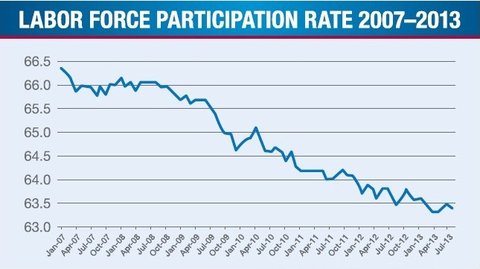
Which policies have caused our low labor force participation rate?

Labor Force Participation Rate from 2007 (Pelosi/Reid) to 2013

Jay Richards tweeted this article from the Wall Street Journal. The article is an interview with a business owner named Bob Funk whose job it is to match job seekers to job creators.

Hiring is down because of increased regulation of employers and fear of interventionism:

Here’s something you don’t often see in Washington: a businessman trying to repeal a law that helps his company. That’s Bob Funk’s latest mission in life. He’s the president and founder of Express Employment Services, the fifth-largest employment agency in America, with annual sales of $2.5 billion and more than 600 franchises across the country. This year he will place nearly half a million workers in jobs.

“ObamaCare has been an absolute boon for my business,” he says as we sit in his new office headquarters near downtown Oklahoma City. “I’m making a lot of money thanks to that law. We’re up 8% this year. But it’s just terrible for the country. I see that firsthand every day.”

Why is the health-care law good for Express but bad for the country? “Firms are just very reluctant to hire full-time workers,” Mr. Funk says. “So they are taking on more temporary help, which is what we do.” ObamaCare imposes new mandates and penalties on companies with more than 50 full-time employees—and even those working 30 hours a week are considered full-time.

He quickly adds: “The problem isn’t just ObamaCare, though. It’s the entire regulatory assault on employers coming out of Washington—everything from the EEOC”—the Equal Employment Opportunity Commission hits companies hard when employees claim age, race or sex discrimination—”to the Dodd-Frank monstrosity. Employers are living in a state of fear.”

So let’s take a look at what is causing a record low labor force participation rate.

The younger generation does not have a good work ethic:

The primary jobs problem today, Mr. Funk says, is that too many workers are functionally unemployable because of attitude, behavior or lack of the most basic work skills. One discouraging statistic is that only about one of six workers who comes to Express seeking employment makes the cut. He recites a company statistic that about one in four applicants can’t even pass a drug test.

“In my 40-some years in this business, the biggest change I’ve witnessed is the erosion of the American work ethic. It just isn’t there today like it used to be,” Mr. Funk says. Asked to define “work ethic,” he replies that it’s fairly simple but vital on-the-job behavior, such as showing up on time, being conscientious and productive in every task, showing a willingness to get your hands dirty and at times working extra hours. These attributes are essential, he says, because if low-level employees show a willingness to work hard, “most employers will gladly train them with the skills to fill higher-paying jobs.”

He fears that too many of the young millennials who come knocking on his door view a paycheck as a kind of entitlement, not something to be earned. He is also concerned that the trendy concept of “life-balancing” is putting work second behind leisure.

Welfare spending discourages people from working:

When pressed to explain what Washington can do to get Americans back on the job, Mr. Funk says the first step would be to start shrinking the “vast social welfare state programs that have become a substitute for work. There’s a prevalent attitude of a lot of this generation of workers that the government will always be there to take care of them. It’s hard to get people to take entry-level jobs when they can get unemployment benefits, health care, food stamps and the rest.”

This week during the food-stamp debate in Congress, Democrats voted unanimously against work requirements and ridiculed Republicans who suggested that the expansion of food stamps to 47 million Americans has discouraged working. The Democrats are living in a fantasy world, according to Mr. Funk. He points to Congress’s decision in 2009 to increase unemployment-insurance benefits to 90 weeks or more as “a policy that held a lot of people out of the workforce until the checks stopped coming. We saw that here very clearly.”

Disability makes people less inclined to get a job:

The most abused government program, he says, is disability insurance and the 14 million Americans who now collect these benefits. Express has found that over half of the disability claims brought by its workers have turned out to be fraudulent. “We win 90% of the disability cases that we challenge in court,” Mr. Funk says.

Skills deficit makes people less employable:

Another big hurdle is the widening skills deficit. At any given time, Mr. Funk says, Express has as many as 20,000 jobs the company can’t fill because workers don’t have the skills required. His advice to young people who are looking for a solid career is to get training in accounting (thanks to Dodd-Frank’s huge expansion of paperwork), information technology, manufacturing-robotics programming, welding and engineering. He’s mystified why Express has so much trouble filling thousands of information-technology jobs when so many young, working-age adults are computer literate.

Public schools and universities don’t prepare people for work:

He blames public schools and universities for the skills mismatch. Young people looking for a financially secure future might want to heed one of his favorite pieces of cautionary advice: “If you’ve got a college degree in psych, poly-sci or sociology, sorry, I can’t help you find a job.” He urges greater emphasis on vocational and practical skills training in schools, universities and junior colleges.

With so many ideas about how to help get the country on track, Mr. Funk might seem ripe to enter politics, but he already made one electoral foray—he was a local school-board member for 11 years—and found it an exercise in pure frustration. Bringing his pay-for-performance values to the board, he spent years futilely trying to get rid of bad teachers and to reward “the 30% that are really good.”

He says “teacher tenure is by far the most corrupt social institution in our time, because it doesn’t reward excellence or weed out bad teachers.” The teachers union had operational control of the school board, and Mr. Funk couldn’t get them to budge. He says the union celebrated when he left the board.

I think that this shows the important of having private sector experience in a President. When you are looking to hire a President, you want to hire someone who has already done what he claims he wants to do, at a smaller level. If you want someone to fix health care, pick someone like Bobby Jindal who has already done it in his state. If you want someone to make schools accountable, pick Scott Walker. If you want someone to cut spending, pick Rick Scott. If you want someone to create jobs, pick Rick Perry. If you want someone to balance the budget, pick John Kasich. Pick a candidate who can do the work. Not someone who passionately speaks about how he wants to do the work. Pick someone who has been fabulously successful at actually doing what he says he wants to do.

Our current President knew nothing about running a business or how jobs are created when he was elected. He was just a community organizer. Never did a thing in the private sector. Maybe he could get lucky at making policies that would create jobs, but “lucky” our best option? Next time, let’s not take chances. Pick someone who has proved that he can do the work based on past performance. Not speeches.

Obamacare in action: 301 employers cut employee hours and/or jobs

Investors Business Daily reports on the job creator response to Obamacare mandates.

Excerpt:

More than 300 employers have cut work hours or jobs, or otherwise shifted away from full-time staff, to limit liability under ObamaCare, according to a newly updated IBD analysis.

The ObamaCare Employer Mandate: A List Of Cuts To Work Hours, Jobs now includes 62 private employers and 239 public-sector employers. The list includes 80 school districts that have cited Affordable Care Act costs as a reason for cutting work hours — or in several cases outsourcing functions — of part-time instructional aides, cafeteria workers, custodians and bus drivers.

It also includes 46 universities and colleges — in some cases college systems — that have reduced teaching loads for adjunct faculty.

The 43 entries added to the list in the past two weeks reflect numerous actions taken before the Obama administration announced a one-year delay ofObamaCare employer mandate penalties on July 2. But the list also includes actions taken more recently, such as SeaWorld Entertainment’s decision to limit part-time workers to 28 hours per week, down from 32 hours previously.

Although the mandate won’t take effect until January 2015, fines will be based on employment levels beginning in the second half of 2014 — or earlier.

[…]In addition to SeaWorld (SEAS), 10 other private employers just added to the list include a group home for disabled adults; a YMCA; two private universities; the K-VA-T Food Stores regional supermarket; the Bealls regional department store ; and four restaurant operations.

[…]Workers in low-wage industries clocked the shortest average workweek on record in July, just 27.4 hours, an IBD analysis of the latest available Bureau of Labor Statistics industry data shows.

This low-wage segment covers 29 million private-sector workers, 25% of the total, in about 40 industry groups where nonsupervisors make up to about $14.50 an hour.

While the IBD list of private-sector hour-cutters is quite small to prove otherwise, it does offer clues that can be of help in interpreting official industry data on hours worked.

For example, the workweek at general merchandise stores tumbled from 31.1 hours in December to 29.8 hours in July. The inclusion of Wal-Mart (WMT) and Bealls on IBD’s list point to ObamaCare’s employer mandate as a significant contributing factor.

The average workweek in the hotel and accommodations industry hit a record low in July — lower than in the aftermath of 9/11 or at the bottom of the Great Recession.

In July, the workweek for nonsupervisors fell to 28.8 hours, down from 30.7 hours in March 2010, when ObamaCare was signed into law.

I’m looking forward to the 2014 elections, when we will get to vote again on this after we’ve seen “what’s in the bill”. I don’t think that the media’s blatherings are going to be able to convince people who are working under 30 hours a week that Obamacare was the right way to reform health care policy.