
Canada’s opposition parties decided not to support Stephen Harper’s Conservative Party, so Canada will hold a federal election in early May 2011. But should the opposition parties have called an election? Not according to the latest poll.
From the liberal Ottawa Citizen.
Excerpt:
Prime Minister Stephen Harper’s Conservatives begin an election campaign this weekend far ahead of their political rivals in public favour and would be poised to win a “comfortable” majority if Canadians cast their votes now, a new poll has found.
The national survey, conducted exclusively for Postmedia News and Global National, reveals that voter support is declining for the opposition Liberals who have put forward a non-confidence motion that will lead to the defeat of the Conservative government in the House of Commons Friday afternoon.
The March 22-23 poll by Ipsos Reid found that public support remains solid for the Tories despite recent opposition attempts to draw attention to such controversies as the government’s treatment of Parliament and revelations that an ex-senior aide to Harper lobbied a department to get funds for his fiance, a former escort.
The Conservatives are now supported by 43 per cent of decided voters — up by three points from two weeks ago.
Just as important, the Tories now have a widening 19-point lead over the Liberals led by Michael Ignatieff.
[…]”The Tories are starting this election campaign in a better place than they have started the last three campaigns,” Ipsos Reid president Darrell Bricker said in an interview Thursday. “With 43 per cent, they’re probably quite comfortably in majority territory.”At dissolution of Parliament, the Tories will have 143 seats. They need to win just 12 more — to reach the 155-seat mark — to get a majority government.Bricker said the problem for the Liberals is that their efforts to discredit the Tories on ethics are going nowhere.[…]According to the poll, the Tories have opened up a commanding lead in vote-rich Ontario. In that key battleground, the Conservatives stand at 46 per cent, compared to 30 per cent for the Liberals, 16 per cent for the NDP and eight per cent for the Greens.
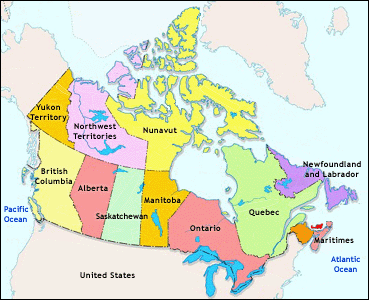
In Quebec, the Tories appear poised to easily hang on to their seats. While the Bloc would receive 41 per cent of the vote, the Conservatives (25 per cent) have moved into second position, followed by the Liberals (18 per cent), the NDP (13 per cent) and the Greens (three per cent).
In another key battleground — British Columbia — the Conservatives (50 per cent) hold a solid lead over the Liberals (22 per cent), with the NDP (20 per cent) not far behind. The Greens (seven per cent) trail.
[…]In Alberta, the Tories stand at 54 per cent support, while the Liberals have 23 per cent, the NDP have 17 per cent and the Green party has five per cent.In Saskatchewan/Manitoba, the Tories are ahead at 66 per cent, while the Liberals have 18 per cent and NDP has 13 per cent.
In the Atlantic region, the Tories are at 41 per cent, followed by the Liberals at 28 per cent, the NDP at 20 per cent, and the Greens at 11 per cent.
Just to refresh you, the Liberals are the socialist party, and the NDP are the communist party, and the Bloc is the French communist party. The conservatives are strong on defense and fiscal issues, and they do have some good social conservatives like Maurice Vellacott and Rob Anders. The Conservatives do understand the need for strong families, low unemployment rates and low taxes as a support for social conservatism, but there is not much they can do about that while they are still a minority party. That could all change with this election, and you might see some common sense reforms to strengthen marriage (reform divorce laws and custody laws), and have some restrictions on abortion, like the kind that the state Republican parties pass.
For example, you might finally see moderate reforms like parental consent or born alive infant protection or a bill to make coerced abortion a prosecutable offense or more ultrasounds in hospitals or tax deductions for adoptions. This would be in addition to all the wonderful military and economic laws they could pass if they were a majority: a helicopter carrier, new guided-missile frigates, new safe nuclear reactors, lower minimum wage rates to raise the employment rate, free trade deals (e.g. – with Singapore, India, South Korea, Ukraine, Georgia and the Baltic nations), employer payroll tax cuts to encourage hiring of more employees, vouchers for school choice so parents could choose schools, lower corporate tax rates to encourage businesses to move to Canada, a national right-to-work law so workers wouldn’t have to join a union, dismantle the long gun registry to encourage self-defense of homes and property, abolish all Human Rights Commissions and Human Rights Tribunals, privatize CBC, Canada Post and other Crown corporations to make them more balanced politically and more responsive to consumers, double the child tax credit for married couples to encourage married couples to have children, and put in income splitting for married couples to allow mothers to stay home for a couple of years with new kids, etc. At least they could ask the Canadian people what they want and try to put in common sense reforms that support working families.
The election is set for May 2011. I cannot believe that the Conservatives are more popular in Saskatchewan than in Alberta. Alberta used to be the conservative headquarters of Canada, with Calgary at the center. Now I am not so sure what to think.

 WINTERY KNIGHT