Tag Archives: Natural Gas

A closer look at Obama’s three-point plan to create American jobs

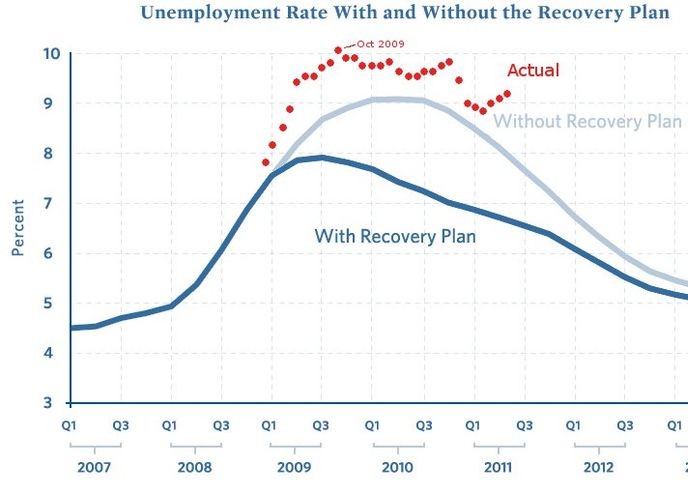
Unemployment rate chart 2011
Democrats take over the House and Senate in January 2007

The Heritage Foundation outlines three of Obama’s job creation plans.

Excerpt:

This week, President Obama is again set to make a pitch for his latest plan to stimulate the economy, but meanwhile he is turning his back on projects that would put tens or even hundreds of thousands of Americans to work. And he’s doing it all to appease his left-wing, environmentalist base at the expense of domestic energy production.

Heritage’s Rob Bluey reported last week on a new finding by a New Orleans-based group that the Obama administration is approving just 35 percent of the oil drilling plans for the Gulf of Mexico so far this year. It is also taking an average of 115 days — nearly four months — to secure approval from the Bureau of Ocean Energy Management, Regulation and Enforcement. Those numbers are a sharp drop from previous years, well below the historical average 73.4 percent approval rate and 61 days it takes to approve plans. And for plans that require drilling activity, the numbers are even worse with an average approval time of 222 days.

That’s bad news for job creation. One deepwater rig alone can create 700 jobs locally. But slowing down oil drilling in the Gulf isn’t the only way the President is blocking jobs. Earlier this month, the Obama Administration announced it would delay the construction of the $7 billion Keystone XL pipeline that would bring in more than 700,000 barrels of oil per day from Alberta, Canada, to the Texas Gulf coast–and could have produced upwards of 20,000 jobs. Heritage’s Nicolas Loris explains the impact:

What this delay really means is that President Obama is putting off an important election year decision in which two of his largest supporters–labor unions and environmentalists–are split on the issue. This tactic allows the decision to be delayed until after the 2012 elections.

More importantly, this means a delay in access to easy imports from our northern neighbor, the creation of thousands of jobs, and the generation of revenue for the states where the pipeline passes. Montana, South Dakota, Kansas, Oklahoma, Nebraska, and Texas are collectively projected to collect $5.2 billion in property tax revenue as a result of building the pipeline.

As if that weren’t enough, the White House made another decision blocking energy-related jobs in the United States. In mid-November, the Obama Administration delayed a mineral lease sale in Ohio’s Wayne National Forest for oil and gas drilling. Apart for providing Americans access to affordable energy, the project could have had a tremendous impact in the state, including the creation of an estimated 200,000 jobs, an overall wage and personal-income boost of $12 billion by 2015, and a billion-dollar boon to Ohio landowners, schools, businesses, and communities.

So Obama has three plans to create more American jobs:

  1. Block drilling in the Gulf of Mexico
  2. Block the construction of the Keystone XL pipeline
  3. Block drilling for oil and gas in Ohio

I don’t think Obama’s three job creation plans are working.

Maybe he just just do the opposite: 1) more drilling in the Gulf, 2) build the Keystone XL pipeline, and 3) allow development of the Ohio oil shale. And while he’s at it, 4) drill for oil in Alaska. That would create real jobs.

Senate Republicans fight to block Democrats from imposing energy tax

From the Wall Street Journal. (H/T Marathon Pundit)

Excerpt:

The Environmental Protection Agency debate lands in the Senate this week, amid the makings of a left-right coalition to mitigate the agency’s abuses. Few other votes this year could do more to help the private economy—but only if enough Democrats are willing to buck the White House.

This moment arrived unexpectedly, with Majority Leader Harry Reid opening a small business bill to amendments. Republican leader Mitch McConnell promptly introduced a rider to strip the EPA of the carbon regulation authority that the Obama Administration has given itself. Two weeks ago, Mr. Reid pulled the bill from the floor once it became clear Mr. McConnell might have the 13 Democrats he needs to clear 60.

[…]A vote to overrule the EPA is also needed to remove the regulatory uncertainty hanging over the economy. This harm is already apparent in energy, where the EPA is trying to drive coal-fired power out of existence. The core electricity generation that the country needs to meet future demand is not being built, and it won’t be until the EPA is bridled. This same dynamic is also chilling the natural gas boom in the Northeast, and it is making U.S. energy-intensive industries less competitive world-wide.

As the EPA screws tighten, the costs will be passed along to consumers, with the same damage as a tax increase but none of the revenues. Eventually, the EPA plan will appreciably lower the U.S. standard of living. Hardest hit will be the middle-American regions that rely on coal or heavy industry, though the EPA bulldozer will run over small businesses too. The Clean Air Act, once the carbon doomsday machine has been activated, won’t merely apply to “major” sources of emissions like power plants or factories. Its reach will include schools, farms, hospitals, restaurants, basically any large building.

It’s not enough that the Democrats caused the recession through their affirmative action mortgage lending to unqualified borrowers, now they have to go and pass an energy tax, too. Not to mention their efforts to block domestic energy development, which only makes prices go higher. When will they learn?

Government report: US has world’s largest supply of oil, natural gas and coal

Here’s the press release. (H/T Canada Free Press)

Abstract:

Sen. James M. Inhofe (R-Okla.), Ranking Member of the Senate Committee on Environment and Public Works, and Sen. Lisa Murkowski (R-Alaska), Ranking Member of the Senate Energy and Natural Resources Committee, today released an updated government report from the Congressional Research Service (CRS) showing America’s combined recoverable oil, natural gas, and coal endowment is the largest on Earth. America’s recoverable resources are far larger than those of Saudi Arabia (3rd), China (4th), and Canada (6th) combined.  And that’s not including America’s immense oil shale and methane hydrates deposits.

Details:

Oil

CRS offers a more accurate reflection of America’s substantial oil resources.  While America is often depicted as possessing just 2 or 3 percent of the world’s oil – a figure which narrowly relies on America’s proven reserves of just 28 billion barrels – CRS has compiled US government estimates which show that America, the world’s third-largest oil producer, is endowed with 163 billion barrels of recoverable oil. That’s enough oil to maintain America’s current rates of production and replace imports from the Persian Gulf for more than 50 years.

Natural Gas

Further, CRS notes the 2009 assessment from the Potential Gas Committee, which estimates America’s future supply of natural gas is 2,047 trillion cubic feet (TCF) – an increase of more than 25 percent just since the Committee’s 2006 estimate.  At today’s rate of use, this is enough natural gas to meet American demand for 90 years.

Coal

The report also shows that America is number one in coal resources, accounting for more than 28 percent of the world’s coal. Russia, China, and India are in a distant 2nd, 3rd, and 5th, respectively. In fact, CRS cites America’s recoverable coal reserves to be 262 billion short tons. For perspective, the US consumes just 1.2 billion short tons of coal per year.  And though portions of this resource may not be accessible or economically recoverable today, these estimates could ultimately prove to be conservative.  As CRS states: “…U.S. coal resource estimates do not include some potentially massive deposits of coal that exist in northwestern Alaska.  These currently inaccessible coal deposits have been estimated to be more than 3,200 billion short tons of coal.”

Oil Shale

While several pilot projects are underway to prove oil shale’s future commercial viability, the Green River Formation located within Colorado, Wyoming, and Utah contains the equivalent of 6 trillion barrels of oil.  The Department of Energy estimates that, of this 6 trillion, approximately 1.38 trillion barrels are potentially recoverable.  That’s equivalent to more than five times the conventional oil reserves of Saudi Arabia.

Methane Hydrates

Although not yet commercially feasible, methane hydrates, according to the Department of Energy, possess energy content that is “immense … possibly exceeding the combined energy content of all other known fossil fuels.” While estimates vary significantly, the United States Geological Survey (USGS) recently testified that: “the mean in-place gas hydrate resource for the entire United States is estimated to be 320,000 TCF of gas.” For perspective, if just 3% of this resource can be commercialized in the years ahead, at current rates of consumption, that level of supply would be enough to provide America’s natural gas for more than 400 years.

The press release has lots of informative graphs.

The PDF of the full report is here.

Obama keeps blocking energy production at home, and sending taxpayer money (and jobs) to countries in the Middle East, some of who don’t like us very much. What would possess a president to undermine the national security and economy of his own country that way? Why does he want to raise the cost of living for his fellow citizens and send jobs overseas to the Middle East?