
Tag Archives: National Debt

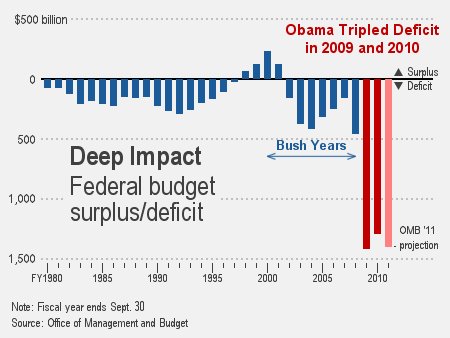
Debt has increased 5 trillion since Pelosi became Speaker of the House

Nancy Pelosi becomes House Speaker in Jan 2007

Debt has increased 5 trillion since Nancy Pelosi became Speaker of the House in January 2007.

Excerpt:

When Rep. Nancy Pelosi (D-Calif.) gave her inaugural address as speaker of the House in 2007, she vowed there would be “no new deficit spending.” Since that day, the national debt has increased by $5 trillion, according to the U.S. Treasury Department.

“After years of historic deficits, this 110th Congress will commit itself to a higher standard: Pay as you go, no new deficit spending,” Pelosi said in her speech from the speaker’s podium. “Our new America will provide unlimited opportunity for future generations, not burden them with mountains of debt.”

Pelosi has served as speaker in the 110th and 111th Congresses.

At the close of business on Jan. 4, 2007, Pelosi’s first day as speaker, the national debt was $8,670,596,242,973.04 (8.67 trillion), according to the Bureau of the Public Debt, a division of the U.S. Treasury Department.  At the close of business on Oct. 22, it stood at $13,667,983,325,978.31 (13.67 trillion), an increase of 4,997,387,083,005.27 (or approximately $5 trillion).

Pelosi, the 60th speaker of the U.S. House of Representatives, has added more to the national debt than the first 57 House speakers combined.

The $4.997-trillion increase in the national debt since she took the gavel is more debt than the federal government amassed from the speakership of Rep. Frederick Muhlenberg of Pennsylvania, who became the first speaker of the House on April 1, 1789, to the start of the speakership of Rep. Newt Gingrich of Georgia, the 58th speaker, who took up the gavel on Jan. 4, 1995.

The national debt first topped $5 trillion on Feb. 23, 1996, more than a year into Gingrich’s speakership.

FIVE TRILLION since January 2007.

UPDATE: More from Hans Bader at the Competitive Enterprise Institute on the unemployment rate.

Excerpt:

As noted earlier, the stimulus package contained wasteful “green jobs” funding, 79 percent of which went to foreign firms, effectively sending American jobs overseas.  A recent biofuel program actually wiped out jobs rather than creating them as intended, while costing taxpayers a lot of money.  New EPA rules are expected to wipe out at least 800,000 jobs, and the EPA is considering new ozone rules that could wipe out 7.3 million jobs. The stimulus package contained provisions that wiped out thousands of jobs in America’s export sector.  New laws backed by Obama, and Obama Administration regulations governing employers, have discouraged employers from hiring new employees.

Businesses understand that more spending means inflation or taxes or both – so they stop hiring and stop expanding.

Obama says “there’s no such thing as shovel-ready projects”

From the radically-leftist New York Times.

Excerpt:

While proud of his record, Obama has already begun thinking about what went wrong — and what he needs to do to change course for the next two years. He has spent what one aide called “a lot of time talking about Obama 2.0” with his new interim chief of staff, Pete Rouse, and his deputy chief of staff, Jim Messina. During our hour together, Obama told me he had no regrets about the broad direction of his presidency. But he did identify what he called “tactical lessons.” He let himself look too much like “the same old tax-and-spend liberal Democrat.” He realized too late that “there’s no such thing as shovel-ready projects” when it comes to public works. Perhaps he should not have proposed tax breaks as part of his stimulus and instead “let the Republicans insist on the tax cuts” so it could be seen as a bipartisan compromise.

It would have been nice to know that 2.7 trillion dollars and 8 million jobs ago.

Economics in One Lesson

Perhaps it is time to review Henry Hazlitt’s Economics in One Lesson, chapter 4, entitled “Public Works Mean Taxes”.

Excerpt:

Therefore, for every public job created by the bridge project a private job has been destroyed somewhere else. We can see the men employed on the bridge. We can watch them at work. The employment argument of the government spenders becomes vivid, and probably for most people convincing. But there are other things that we do not see, because, alas, they have never been permitted to come into existence. They are the jobs destroyed by the $10 million taken from the taxpayers. All that has happened, at best, is that there has been a diversion of jobs because of the project. More bridge builders; fewer automobile workers, television technicians, clothing workers, farmers.

Excerpt that the government, lacking a profit motive, is never as efficient as private business is in spending money – government wastes money that it never earned in the first place.

And consider Chapter 5 as well, entitled “Taxes Discourage Production”.

In our modern world there is never the same percentage of income tax levied on everybody. The great burden of income taxes is imposed on a minor percentage of the nation’s income; and these income taxes have to be supplemented by taxes of other kinds. These taxes inevitably affect the actions and incentives of those from whom they are taken. When a corporation loses a hundred cents of every dollar it loses, and is permitted to keep only fifty-two cents of every dollar it gains, and when it cannot adequately offset its years of losses against its years of gains, its policies are affected. It does not expand its operations, or it expands only those attended with a minimum of risk. People who recognize this situation are deterred from starting new enterprises. Thus old employers do not give more employment, or not as much more as they might have; and others decide not to become employers at all. Improved machinery and better-equipped factories come into existence much more slowly than they otherwise would. The result in the long run is that consumers are prevented from getting better and cheaper products to the extent that they otherwise would, and that real wages are held down, compared with what they might have been.

There is a similar effect when personal incomes are taxed 50, 60 or 70 percent. People begin to ask themselves why they should work six, eight or nine months of the entire year for the government, and only six, four or three months for themselves and their families. If they lose the whole dollar when they lose, but can keep only a fraction of it when they win, they decide that it is foolish to take risks with their capital. In addition, the capital available for risk-taking itself shrinks enormously. It is being taxed away before it can be accumulated. In brief, capital to provide new private jobs is first prevented from coming into existence, and the part that does come into existence is then discouraged from starting new enterprises. The government spenders create the very problem of unemployment that they profess to solve.

George W. Bush cut taxes in his first term and created 1 million NEW JOBS. Government spending is a job killer. Companies understand that government spending has to be paid for eventually, so they stop hiring people now to save the money for later tax increases.

Is Obama correct to think that Republicans don’t know what to cut?

From David Freddoso, in the Washington Examiner.(H/T Nice Deb)

Excerpt:

He finished speaking in Cleveland by urging his audience to “choose the future over the past.” A good thing — we should move on to 2011 instead of repeating the year 2009. Anyway, here were his “they-have-no-ideas” remarks, in part:

Just this year, these same Republicans voted against a bipartisan fiscal commission that they themselves proposed.  And when you ask them what programs they’d actually cut, they usually don’t have an answer.

House Minority Whip Eric Cantor, R-Va., replies:

“President Obama must have misspoken today, because I have personally sat across the table from him and suggested specific ways to cut spending. Furthermore, House Republican Leader John Boehner and I urged President Obama to work with Republicans to cut spending by using his authority to send Congress a “rescissions” package.  In fact, we sent President Obama a letter twice pledging to work together with him on that effort. We still have not heard back – seven months later. It doesn’t end there, through the YouCut program House Republicans have offered over $120 billion in spending cuts, only to be voted down by Democrats in the House. Finally, House Republicans Jeb Hensarling and Paul Ryan have introduced a “Cut Spending Now” package of specific cuts that would save taxpayers $1.3 trillion.

“President Obama is entitled to his opinion, but he’s not entitled to his own facts, and with that in mind I am asking him to either clarify or withdraw the accusation that he made earlier today.”

If you want to cut spending, you vote for Republicans. If you want 3 trillion in deficits over two years, vote Democrat.