
Tag Archives: Muslim

Christmas not so merry for Christians living under Islamic rule

I found that video on Right Scoop via Director Blue.

Gates of Vienna has more news coverage, and they are claiming that the death toll in Nigeria is at least 60 people from 5 separate bombings.

Here’s a longer essay about the problem from Dave Warren. (H/T ECM)

Excerpt:

The “Arab Spring,” which was welcomed this year as an expression of “democracy” by the West’s political, media, and chattering classes, has brought social convulsion to one Arab state after another. Against the background of what is to my view instead a large catastrophe, Christian communities that have existed in each state since centuries before the arrival of Islam, are being eliminated.

…[W]ith the Americans gone, Iraq now slips the rest of the way off the world media map. It may crawl back on with full-scale civil war. And perhaps, eventually, notice will be taken that Iran’s revolutionary regime, already represented within Maliki’s entourage, is using the disorder to attach Iraq as a satellite. This is not something even Shia Iraqis could want; but they will have it as a consequence of disintegrative war between Sunni and Shia, Arab and Kurd, abetted by an utterly corrupt and dysfunctional “democratic” political class.

Meanwhile, tonight’s Midnight Mass has been cancelled, so far as I can see through the Internet, at Christian churches throughout the country. Estimates of the number of Christians who have fled Iraq now approach or exceed one million; and the reason for their leaving may be read in graffiti sprayed over their empty and assaulted churches. This persistently reminds worshippers of past massacres, and promises they will be next.

The collapse of once-peaceful Egypt into disorder has had similar effects, as the old secular military establishment bids to retain some semblance of its former power and pomposity, while the Islamist parties sweep parliamentary elections.

In the first moments of Egypt’s “Arab Spring,” triggered by the country’s relatively tiny and secular middle class, Coptic Christians were already feeling the rise in heat. But there were several fine displays of solidarity, in which leading Muslims attended church services in defiance of Islamist terror threats.

As ever, in revolutionary situations, the heroic phase ended quickly. We’re advancing now through the squalid phases. For the safety of their parishioners, night church services are already switched to broad daylight, and as in Iraq, there are ever-more-cumbersome security measures to pass through, to get into a church at all.

Nothing can be done, or more certainly, nothing will be done by our own “progressive” governing classes, even to anticipate the coming fallout.

Something to keep in your prayers. And when you get the chance to vote, keep in mind Christians living in other countries where there is no religious liberty. I find it interesting to note that the two situations Warren raised have different solutions. In Iraq, the right thing to do was to keep our forces in there to stabilize the region. In Egypt, the solution was not to get involved at all.
Islamic extremists dominate Egypt’s parliamentary elections

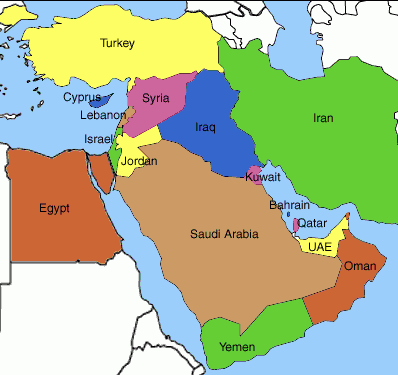
Map of the Middle East

From the Wall Street Journal.

Excerpt:

Unofficial initial results from the first two days of Egypt’s parliamentary elections pointed to a dominant showing for Islamist candidates, fulfilling most analysts’ expectations that conservative religious politicians could have the upper hand in next year’s drafting of a new Egyptian constitution.

Initial tallies put the powerful Muslim Brotherhood’s political arm, the Freedom and Justice Party, or FJP, in a leading position, followed by the Nour Party, which represents the ultraconservative Salafi school of Islam, FJP said.

An FJP official said the party’s vote-counting observers expect the group to win as much as 50% of the vote. A Nour Party spokesman said the early returns point to a Salafi capture of about 10% to 15% of seats in the incoming Parliament.

The Egyptian Bloc, a list of liberal parties dominated by the left-leaning Social Democrat Party and the pro-market Free Egyptians Party, appeared to be in third place. Official early results are expected to be announced on Thursday, the High Elections Commission said.

The results are far from final—a second and third round of elections covering two-thirds of Egypt’s 27 governorates are scheduled to take place in December and January. Individual candidate races that didn’t secure at least 51% will face runoffs beginning next week.

But the early results indicate that Egypt—the largest Arab country and under former President Hosni Mubarak one of the region’s staunchest defenders of secular governance—is set to pivot toward political Islam. The next voting rounds include mostly smaller Egyptian cities and villages, where Islamist rule is popular.

Such an outcome would surprise few Egyptians or political observers. Egypt’s deeply religious population grated under the ousted regime’s secular policies, and Tunisia and Morocco have recently awarded pluralities to moderate Islamist parties.

[…]Both Salafi and Brotherhood representatives said it was too early to say whether the two groups would form a coalition in Parliament—an alliance that would give Islamists a powerful majority.

This is what Obama bought us by taking his eye off the ball in Iraq, Afghanistan, Syria, Pakistan and Iran. We had no business firing a shot in Libya and Egypt. There was no strategic reason for us to be there.

Top ten foreign policy and national security issues for 2012

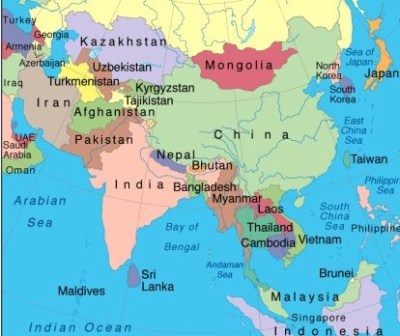
Map of Asia
Map of Asia

From the American Enterprise Institute.

Here’s the list:

  1. Iran, and the American retreat from Iraq
  2. Dealing with Islam and China in South Asia
  3. America’s strategy for Pakistan
  4. Defense spending priorities
  5. American support for Israel
  6. The Islamization of Turkey
  7. Collapse of the European economies
  8. Demographic crisis in Europe
  9. Demographic crisis in Russia
  10. Strategy for the Middle East

They have one article linked for each topic, so I chose the Islamization of Turkey.

Full text:

Turkey was a key American ally throughout the Cold War. As one of only two NATO countries to share a border with the Soviet Union, Turkey proved pivotal not only to the defense of Europe but also for American interests in Asia. The Turkish army fought alongside U.S. troops in Korea. Americans embraced Turkey not only for its strategic role, but also for its values. The Turkish government was decidedly Western-leaning. Turkey may have been majority Muslim, but most Turks saw their future tied more to the West than the Middle East.

Over the past nine years, however, Turkey has changed. No longer can Turkey be called a democracy. The Pew Global Attitudes Project now ranks Turkey as the most anti-American country it surveys. Reporters Without Frontiers ranks Turkish press freedom below even Zimbabwe and Venezuela. Turkey has imprisoned more journalists than even China and Iran. As Prime Minister Recep Tayyip Erdoğan has sought to Islamize society, Turkish women have lost both their equality and safety: The murder rate of women has increased 1,400 percent since Erdoğan’s Justice and Development Party took power.

Erdoğan has reoriented Turkey’s foreign policy as well. Turkey now not only embraces the Arab world, but it allies itself with its more radical factions: Turkey endorses Hamas, Hezbollah, Sudan’s genocidal dictator Omar al-Bashir, and the Islamic Republic of Iran. Whereas a decade ago, the alliance between Turkey and Israel stabilized the Eastern Mediterranean, today diplomats worry that Turkey’s antagonism toward both Israel and Cyprus could lead to military conflict in the region. In September 2010, Turkey raised eyebrows at the Pentagon when it held secret war games with the Chinese air force without first alerting Washington. Because Turkey increasingly is the obstacle to NATO consensus, its future in the defensive alliance may now be open to question.

Any new president will be faced with serious decisions regarding Turkey. Should Turkey remain in NATO? If so, should the United States share its next generation F-35 Joint Strike Fighters, Predators, and AWACS aircraft with Turkey? Lastly, if Erdoğan fulfills his promise to use the Turkish navy to challenge Israel’s blockade of Gaza, leading to a fight between two traditional American allies, on whose side will the White House be, and what actions would the new president take?

This is a primer, so the articles are fairly short. Just enough to give you background information on the hot spots that the next President will have to deal with. Can you think of any issues they left out? I think that we should also be concerned with the drug cartels in Mexico, the continuous sabre-rattling from Venezuela, threats to our Asian allies from China, and whether we still need to have so many troops in Europe and South Korea.

It’s good for Christians to have some awareness of national security and foreign policy issues. It only takes an hour to read a few articles and to have some understanding of the issues we are facing, so that we can discuss them with others and vote properly. There’s going to be a foreign policy debate for the GOP primary on November 22, 2011, so it would be good for us to study up so we can understand what they are talking about.