Tag Archives: Military

Is the Obama administration deliberately weakening our military?

Who needs air superiority? Not Obama

Consider this article from the Weekly Standard. (H/T ECM)

Excerpt:

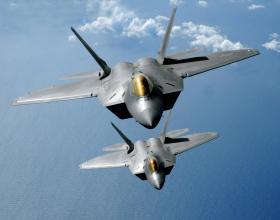
When Secretary of Defense Robert Gates went to Chicago last summer to make the case for killing the F-22 — the world’s premier air supremacy fighter and the only “fifth generation fighter” currently in production anywhere — he argued that the F-35 Joint Strike Fighter would be a more cost-effective alternative. Though the JSF “has had development problems to be sure,” Gates said, “It is a versatile aircraft, less than half the total cost of the F-22, and can be produced in quantity with all the advantages produced by economies of scale – some 500 will be bought over the next five years.”

[…]But the oddest thing about Gates’s speech last summer was his assertion that competitors to the United States, specifically China, would be unable to produce their own fifth-gen fighters any time soon. “Consider that by 2020, the United States is projected to have nearly 2,500 manned combat aircraft of all kinds,” Gates said, while “China, by contrast, is projected to have no fifth generation aircraft by 2020.”

[…]We know now that Gates’s estimate of U.S. procurement last summer was bogus. We will be nowhere near 2,500 fifth-gen aircraft (F-35s and F-22s) by 2020. And now Gates has conceded that China will, in fact, have produced a fifth-generation stealth fighter by 2020. How many will they have produced? How many will we have produced? We can only be sure of two things: Gates doesn’t know, and he killed the F-22 based on a faulty assumption that the number of Chinese stealth fighters in 2020 would be zero.

I am a HUGE fan of the F-22 and I hate the F-35.
China should not be underestimated

And what about this article from Investors Business Daily?

Excerpt:

From the Battle of Midway to President Reagan’s 600-ship fleet that helped win the Cold War, naval supremacy has been critical to the protection and survival of our nation.

Which is why we find the recent remarks of Defense Secretary Robert Gates to the Navy League at the Sea-Air-Space expo so disturbing. He seems to think naval supremacy is a luxury we can’t afford and that, like every other aspect of our military, an already shrunken U.S. Navy needs to downsize.

“As we learned last year, you don’t necessarily need a billion-dollar guided missile destroyer to chase down and deal with a bunch of teenage pirates wielding AK-47s and RPGs (rocket-propelled grenades),” Gates quipped.

We are not laughing.

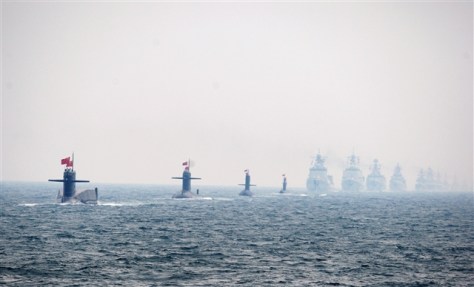
Pubescent pirates aren’t the only threat we face. Last month, a Chinese naval task force from the East Sea Fleet — including the imposing Sovremenny-class guided missile destroyers, frigates and submarines — passed through the Miyako Strait near Okinawa, a move that sent shock waves through Japan.

Sovermenny vessels are DDGs not DDs. That means that they have guided-missile capability via the SS-N-22 surface-to-surface platform. That missile has a range of 160 nautical miles, flies at Mach 3, and is fairly dangerous. Fire enough of them and one is bound to get through. What if these weapons were sold to our enemies and used to menace commercial and civilian shipping? It’s the next level of piracy.

We need more carrier battle groups, not less. Carrier battle groups are the most visible way of projecting American power abroad in theaters where we face dangerous repressive regimes like North Korea and Iran. It’s good that countries like India are stepping up by building two new conventionally-powered aircraft carriers and support vessels, but we have to pull our own weight, too.
Democrats favor terrorist rights over national security in latest intelligence bill

Story here from National Review. (H/T ECM)

Excerpt:

While the country and the Congress have their eyes on today’s dog-and-pony show on socialized medicine, House Democrats last night stashed a new provision in the intelligence bill which is to be voted on today.  It is an attack on the CIA: the enactment of a criminal statute that would ban “cruel, inhuman and degrading treatment.” (See here, scoll to p. 32.)

The provision is impossibly vague — who knows what “degrading” means? Proponents will say that they have itemized conduct that would trigger the statute (I’ll get to that in a second), but it is not true. The proposal says the conduct reached by the statute “includes but is not limited to” the itemized conduct. (My italics.) That means any interrogation tactic that a prosecutor subjectively believes is “degrading” (e.g., subjecting a Muslim detainee to interrogation by a female CIA officer) could be the basis for indicting a CIA interrogator.

The act goes on to make it a crime to use tactics that have been shown to be effective in obtaining life saving information and that are far removed from torture.

[…]What’s more, the proposed bill is directed at “any officer or employee of the intelligence community” conducting a “covered interrogation.” The definition of “covered interrogation” is sweeping — including any interrogation done outside the U.S., in the course of a person’s official duties on behalf of the government.

[…]Here is the fact: Democrats are saying they would prefer to see tens of thousands of Americans die than to see a KSM subjected to sleep-deprivation or to have his “phobias exploited.” I doubt that this reflects the values of most Americans.

They would rather put us all at risk of a terrorist attack than upset the terrorists. National security, Democrat style.

Related posts

Should we be proud of our victory in Iraq?

Here’s a blog post from David Bellavia. (H/T Curby Graham)

Excerpt:

Another page in the scrapbook has a clear acetate pouch. Stuffed inside is a thick, folded sheet of blue paper. An Iraqi ballot I stole on January 30th 2005.

The sound of mortar fire fills my ears. The desk dissolves. Suddenly, I’m kneeling on a road, a palm grove to my front. Iraq. Election Day 2005.

The bullets are flying.

My squad runs through the searing heat and forms a wall of flesh and Kevlar between the incoming fire and the citizens standing in line behind us. They’ve turned out in their finest clothes to wait for the opportunity to cast a vote. For most, this moment is a defining one in their lives. They’ve never had a voice before. This means something to them, and they have used the moment as an object lesson for their children. They appear nervous and take photos. The kids stand with them in line, viewing first hand this revolution in Iraqi civics.

As they came to line up earlier that morning, the men thanked us and clasped their hands over their heads, striking a triumphant pose. Some of the women cried. The kids were on their best behavior.

The gunfire began that afternoon. Insurgents started to shoot them. My unit ran to the road and formed a protective position between the killers and the citizens going to the polls. As we scanned the palm grove in front of us, bullets cracked and whined, then mortars start thumping around us. My squad pushed into the palm grove. I stayed on the road, overseeing their movement and coordinating the heavy fire from the Bradleys.

The firefight ebbs. The mortar fire ceases. A few last stray rounds streak past. A cry from behind causes me to turn. Lying in the road is a young Iraqi woman. I run over to help. She’s caught a round just below her temple. Her stunning beauty has been ruined forever.

She cries, “Paper! Paper” over and over until the ambulance arrives to take her away. An old lady emerges from the schoolhouse-turned voting site, sheets of blue paper in hand. She gives one to the wounded girl, who clutches it to her like a prized possession even as the ambulance carries her away.

The ballot was her voice. All she wanted was a chance to exercise it, just once, before she died.

Read the whole thing. We all have to do something to try to understand what our men and women in uniform sacrifice to give us our freedoms. Whether that involves reading books, reading military blogs, (like Blackfive, This Ain’t Hell and Michael Yon), sending donations to Soldier’s Angels, or thanking a returning veteran for his service. We have to talk to them and listen to their stories.