
Tag Archives: Michael Ignatieff

Conservatives lead Liberals by 19 points in latest 2011 election poll

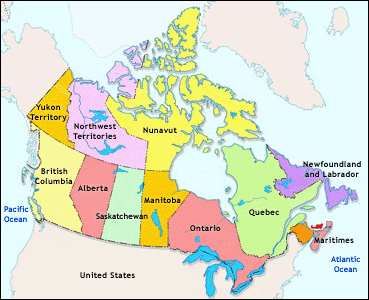
Map of Canada
Map of Canada

Canada’s opposition parties decided not to support Stephen Harper’s Conservative Party, so Canada will hold a federal election in early May 2011. But should the opposition parties have called an election? Not according to the latest poll.

From the liberal Ottawa Citizen.

Excerpt:

Prime Minister Stephen Harper’s Conservatives begin an election campaign this weekend far ahead of their political rivals in public favour and would be poised to win a “comfortable” majority if Canadians cast their votes now, a new poll has found.

The national survey, conducted exclusively for Postmedia News and Global National, reveals that voter support is declining for the opposition Liberals who have put forward a non-confidence motion that will lead to the defeat of the Conservative government in the House of Commons Friday afternoon.

The March 22-23 poll by Ipsos Reid found that public support remains solid for the Tories despite recent opposition attempts to draw attention to such controversies as the government’s treatment of Parliament and revelations that an ex-senior aide to Harper lobbied a department to get funds for his fiance, a former escort.

The Conservatives are now supported by 43 per cent of decided voters — up by three points from two weeks ago.

Just as important, the Tories now have a widening 19-point lead over the Liberals led by Michael Ignatieff.

[…]”The Tories are starting this election campaign in a better place than they have started the last three campaigns,” Ipsos Reid president Darrell Bricker said in an interview Thursday. “With 43 per cent, they’re probably quite comfortably in majority territory.”At dissolution of Parliament, the Tories will have 143 seats. They need to win just 12 more — to reach the 155-seat mark — to get a majority government.Bricker said the problem for the Liberals is that their efforts to discredit the Tories on ethics are going nowhere. 

[…]According to the poll, the Tories have opened up a commanding lead in vote-rich Ontario. In that key battleground, the Conservatives stand at 46 per cent, compared to 30 per cent for the Liberals, 16 per cent for the NDP and eight per cent for the Greens.

In Quebec, the Tories appear poised to easily hang on to their seats. While the Bloc would receive 41 per cent of the vote, the Conservatives (25 per cent) have moved into second position, followed by the Liberals (18 per cent), the NDP (13 per cent) and the Greens (three per cent).

In another key battleground — British Columbia — the Conservatives (50 per cent) hold a solid lead over the Liberals (22 per cent), with the NDP (20 per cent) not far behind. The Greens (seven per cent) trail.

[…]In Alberta, the Tories stand at 54 per cent support, while the Liberals have 23 per cent, the NDP have 17 per cent and the Green party has five per cent.In Saskatchewan/Manitoba, the Tories are ahead at 66 per cent, while the Liberals have 18 per cent and NDP has 13 per cent.

In the Atlantic region, the Tories are at 41 per cent, followed by the Liberals at 28 per cent, the NDP at 20 per cent, and the Greens at 11 per cent.

Just to refresh you, the Liberals are the socialist party, and the NDP are the communist party, and the Bloc is the French communist party. The conservatives are strong on defense and fiscal issues, and they do have some good social conservatives like Maurice Vellacott and Rob Anders. The Conservatives do understand the need for strong families, low unemployment rates and low taxes as a support for social conservatism, but there is not much they can do about that while they are still a minority party. That could all change with this election, and you might see some common sense reforms to strengthen marriage (reform divorce laws and custody laws), and have some restrictions on abortion, like the kind that the state Republican parties pass.

For example, you might finally see moderate reforms like parental consent or born alive infant protection or a bill to make coerced abortion a prosecutable offense or more ultrasounds in hospitals or tax deductions for adoptions. This would be in addition to all the wonderful military and economic laws they could pass if they were a majority: a helicopter carrier, new guided-missile frigates, new safe nuclear reactors, lower minimum wage rates to raise the employment rate, free trade deals (e.g. – with Singapore, India, South Korea, Ukraine, Georgia and the Baltic nations), employer payroll tax cuts to encourage hiring of more employees, vouchers for school choice so parents could choose schools, lower corporate tax rates to encourage businesses to move to Canada, a national right-to-work law so workers wouldn’t have to join a union, dismantle the long gun registry to encourage self-defense of homes and property, abolish all Human Rights Commissions and Human Rights Tribunals, privatize CBC, Canada Post and other Crown corporations to make them more balanced politically and more responsive to consumers, double the child tax credit for married couples to encourage married couples to have children, and put in income splitting for married couples to allow mothers to stay home for a couple of years with new kids, etc. At least they could ask the Canadian people what they want and try to put in common sense reforms that support working families.

The election is set for May 2011. I cannot believe that the Conservatives are more popular in Saskatchewan than in Alberta. Alberta used to be the conservative headquarters of Canada, with Calgary at the center. Now I am not so sure what to think.
Canadians brace themselves for a federal election

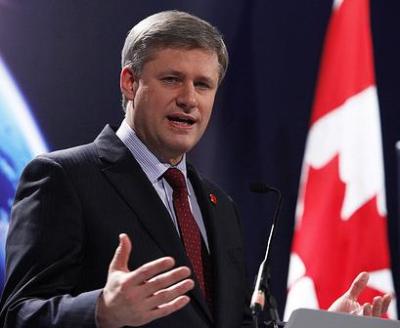
Prime Minister Stephen Harper

This just in! The Conservatives are going to take a shot at winning a majority.

Excerpt:

Canadians may face their fourth federal election in seven years as early as May, after opposition parties said they wouldn’t back Conservative Prime Minister Stephen Harper’s fiscal plan.

Leaders of all three opposition parties said that C$7.6 billion ($7.7 billion) in new measures announced yesterday by Finance Minister Jim Flaherty weren’t enough to warrant their support. Harper will face a Liberal motion of non-confidence on March 25.

Opposition lawmakers are seeking to benefit from what they say have been ethics violations by Harper’s administration, including accusations by Liberal Leader Michael Ignatieff that former Harper aide Bruce Carson was peddling influence with companies seeking state contracts, as well as charges that ministers have misled Parliament. Harper has said he doesn’t want an election that could undermine the country’s recovery.

“The opposition parties are going to talk about contempt of Parliament and ethics” to weaken the government’s position, said Robert Drummond, a political scientist at York University in Toronto. The Conservatives “are going to want to talk about their economic record.”

I don’t know why the opposition parties would focus on ethics – according to the latest poll, the Conservatives have them beat solidly on ethics.

Excerpt:

In the poll, Canadians were given two choices for what they think is the most important issue in the election.

Sixty-three per cent said that “electing a party and leader that will provide honest, open and trustworthy government” is more important.

By comparison, 37% believe that “electing a party and leader that will make sure that our economic recovery continues” is more important.

Those findings, on their surface, should be good news for the Liberals. But in an ironic twist, the very issue the Liberals are trumpeting could backfire on them in a campaign.

Here’s why:

• 28% of Canadians believe the Conservatives, if re-elected, would do the best job of “providing honest, open and trustworthy government.”

• 22% believe the NDP would do the best job of this.

• Just 15% say the Liberals would be best at providing honest, open and trustworthy government.

And more:

When it comes to the party that can do the best job at “making sure our economic recovery continues,” 37% chose the Tories, while significantly fewer believe the Liberals (20%), NDP (14%) or Bloc (6%) are best positioned to do this.

Nearly one-quarter (23%) don’t believe any of these parties would do the best job at this.

Thinking about which party would “keep taxes under control,” 36% believe the Conservatives are best able to do this, while fewer believe the Liberals (17%), NDP (16%) or Bloc (6%) are best positioned to do this. Twenty-five per cent think that some other party would do a better job with this.

One in three (33%) believe the Conservatives would do the best job at “spending taxpayers money wisely,” while others believe the NDP (18%), Liberals (16%) or Bloc (6%) would do the best job of this. Another 27% don’t believe any of these parties would do the best job at spending taxpayers money wisely.

The Conservatives currently have 143 seats, with 155 needed for a majority. The latest poll puts them just shy of a majority.

UPDATE: An even later poll puts Harper at 43% support.

Related posts

Stephen Harper’s Conservatives up to 43% in latest federal election poll

Canadian Prime Minister Stephen Harper

For my Canadian readers, especially Tory Ninja. (H/T Ben)

Excerpt:

Prime Minister Stephen Harper’s Conservatives have opened up a wide lead against their political rivals in public favour and would be close to winning a majority if an election occurred now, a new poll has found.

The national survey, conducted exclusively for Postmedia News and Global National, found that the Tories are now supported by 43% of decided voters — up by four points from early February.

That finding by pollster Ipsos Reid is significant, as the level of support is near the threshold that experts believe the Tories need to win their long-coveted majority.

The Conservatives haven’t been this popular since they enjoyed a brief spike in the polls in December 2008 when Canadians were opposed to the opposition parties’ efforts to create a coalition government.

The new survey shows the Tories have a 16-point lead over the Liberals, led by Michael Ignatieff. The Grits, who have been trying to stoke voter anger over the government’s performance, have the support of 27% of voters, up by two points.

Jack Layton’s NDP appears to be in political decline as it makes demands to the government over what should be in the budget. The New Democrats would receive 13% of the vote, down by five points.

Similarly, the Green party, led by Elizabeth May, is in trouble. It would receive five per cent of the vote, down by five points.

Gilles Duceppe’s Bloc Quebecois has 10%of the vote nationally and still has a commanding lead in Quebec.

“What you’re seeing in the numbers is a continuation of a trend that started over the past two months,” said Ipsos Reid president Darrell Bricker on Tuesday.

“And one could say that with these types of numbers, the Tories are well poised to potentially form a majority.”

Bricker said that two major factors are at work: Canadians are generally optimistic about the economy and are giving credit to the Harper government, and the negative Conservative TV ads which take aim at Ignatieff’s political ambitions and patriotism are working.

[…]Bricker said another trend is occurring which works in the Tories’ favour: They are increasingly attracting support beyond their traditional base.

The new poll finds the Tories receiving more support from middle-income Canadians, women, university-educated voters and foreign-born Canadians.

“They’re flattening out those demographic differences and becoming more mainstream,” said Bricker.

[…]The federal political parties are preparing for the possibility of an election that could be precipitated by a budget in late March.

[…]In every region but Quebec, the Tories are leading in public opinion.

This poll puts them in majority territory, because last time they only won by 37.65% to 26.26% but they won 143 seats. 155 seats are needed for a majority, so 43% would definitely do the job. Anything over 40% is good.

Stephen Harper has a BA and MA in Economics, and is cutting the corporate tax rate to HALF of the US corporate tax rate. In Canada, voters are concerned about JOBS, not about Harper’s skin color, happy-talk or handsomeness. Canadians understand that if you woo corporations and businesses with low taxes and fewe regulations, you get the jobs. Harper also supports free trade, so that Canadians can sell their goods to foreign markets, and buy good from abroad for a cheaper price, either for consumption of manufacturing. This results in even MORE jobs.

Related posts