Tag Archives: Meaning

Are Christians responsible for making plans and making good decisions?

Here’s a wonderful post on decision making and the will of God posted on Neil’s blog. Neil links to another post where someone is trying to figure out what God wants him to do.

Excerpt:

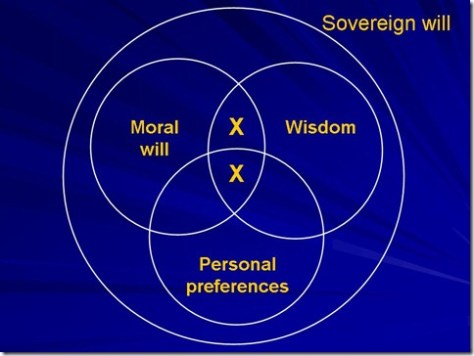
Really short version: Aside from direct and clear personal revelation from God, you don’t have access to his sovereign will when making decisions.  Therefore you must look at other factors.  If it isn’t moral, don’t do it.  If it is moral but not wise, don’t do it.  If it is moral and wise, then use your personal preferences.

Using this model you can end up with a wise and biblical decision, but you have avoided the traps of the “God told me to ____” routine.  People who run around saying that God told them this and that convey a super-spirituality that can leave less mature believers wondering if they really have a relationship with God (i.e., “God doesn’t tell me every little thing to do, so maybe I don’t really know him.”).

He has a helpful picture posted as well:

This is actually a very important topic for me, because I like making plans and making good decisions. I like being the quarterback or squad leader of my own life. I like to pick objectives and then make plans to achieve them. (Nothing too exotic, just simple stuff like saving money or reading more books)

Actually, I really oppose the idea that God has a magical fairy tale will for each person that will make them happy and fulfilled. For me, life isn’t like that. I don’t expect God to lead me along like a child at a scavenger hunt. I expect to survey the battlefield where I am and then do something to make a difference. There are lots of things you can do that will please God. Should you focus on your career and sponsor apologetics conferences? Or should you use your spare time preparing Sunday school lessons? There are lots of good things you could do to please God. Your job is to pick the one that will be the most effective. It doesn’t matter if it makes you happy, it only matters if it’s effective and if you are good at it.

Who is Rifleman Dodd?

A while back, I was busily working my way through the U.S. Marine Corps Official Reading List, and I came across a book by C.S. Forester called Rifleman Dodd, or alternatively titled Death to the French. It’s a work of historical fiction that takes place during the Napoleonic wars. The story is about a British marksman named Dodd, who is cut off from his own lines during a withdrawal maneuver. He is subsequently left to fend for himself behind enemy lines. An ordinary man might be full of despair and forget about his mission entirely. But Dodd is no ordinary man. Not only does he find a way to survive by finding food to eat, water to drink and places to sleep, but he also tries to remember his orders and to think about what he can do to advance the cause of his General, the Duke of Wellington.

Here’s an excerpt from a gritty book review:

It’s about a green-coated British infantry rifleman in the Napoleonic Wars, an age when rifles were a novelty and most of the army was red-coated and carried muskets. Private Matthew Dodd gets separated from his regiment during a retreat and finds himself stranded behind enemy (French) lines in Portugal. With the occasional aid of some natives, but mostly on his own, he harasses the French with his rifle and tries to prevent them from building a bridge across the Tagus River. It’s a remarkable tale of survival and solitary achievement, of a rank-and-file soldier who lives by his wits and slowly learns to make plans without orders, and shows leadership qualities and a knowledge of warfare.

I think we’re in the same situation as Dodd.

There is no point in us looking for breadcrumb trails to happiness at this point. That’s not the point of Christianity. The point of Christianity is friendship with God, imitation of Christ, honoring moral obligations, self-sacrificial love for your neighbor (and even your enemies!), and dedication to the truth – whether anyone else likes you or not. It’s not supposed to make you happy, and it’s not necessarily going to be a normal life like everyone else has. Things may not work out the way you’d like them to.

We seem to be making such a big deal about compassion and forgiveness in the Christian life these days – such a big emphasis on our feelings. Almost like we have forgotten that we have obligations to our friend – and his objectives. A relationship doesn’t mean that one person completely disregards the character and goals of the other person and then is automatically granted forgiveness whenever they want it. That’s not a friendship – that’s using someone else for your own ends. Maybe it’s time to remember what this is all about.

Finding God’s will for our lives

I’m stealing from Amy Hall, who blogged at Stand to Reason.

Excerpt:

Chandler Vannoy wrote about “What We Get Wrong about ‘Finding God’s Will,’” and it’s always a good time to be reminded of this:

The phrase we have all heard…is we need to find God’s will for our life. And for the past 21 years, I thought I had to keep praying for God to open my eyes to the will he had laid out for me. That if I just kept searching long enough and hard enough, I would know exactly what I was supposed to do in the future.

But Kevin DeYoung blew up this idea for me while I was reading his book Just Do Something….

In the beginning of the book, DeYoung says, “We should stop thinking of God’s will like a corn maze, or a tight-rope, or a bull’s eye, or a choose-your-own-adventure novel.” This rocked my world. I always thought that if I made a wrong decision or took a wrong turn, I would be removed from God’s plan.

But what he is saying here is that we are free from the burden of trying to discover God’s will ahead of time. It is not a maze for us to perfectly navigate in order to reach our end goal, but instead, God desires for us to trust Him with all of the twists and turns.

Yes, God is sovereign over my life. Yes, He has specific plans for my future, but He does not expect me to find out the details of His plan before I get there. So this whole idea of finding God’s will for my life has been me searching for something God does not want to reveal.

The answer for making good decisions is to learn wisdom from the words God has already given us, and to rest in the knowledge that God has guaranteed that all things work together for the good of making us more like Christ (Romans 8:28-29). Even if a wise decision leads to unforeseen difficulties, that doesn’t mean it was the “wrong” one. In fact, difficulties are the most powerful tool God regularly uses to shape us.

I think this is good advice for everyone.

Here’s a wonderful post on decision making and the will of God posted on Neil’s blog. Neil links to another post where someone is trying to figure out what God wants him to do.

Excerpt:

Really short version: Aside from direct and clear personal revelation from God, you don’t have access to his sovereign will when making decisions.  Therefore you must look at other factors.  If it isn’t moral, don’t do it.  If it is moral but not wise, don’t do it.  If it is moral and wise, then use your personal preferences.

Using this model you can end up with a wise and biblical decision, but you have avoided the traps of the “God told me to ____” routine.  People who run around saying that God told them this and that convey a super-spirituality that can leave less mature believers wondering if they really have a relationship with God (i.e., “God doesn’t tell me every little thing to do, so maybe I don’t really know him.”).

He has a helpful picture posted as well:

This is actually a very important topic for me, because I like making plans and making good decisions. I like being the quarterback or squad leader of my own life. I like to pick objectives and then make plans to achieve them. (Nothing too exotic, just simple stuff like saving money or reading more books)

Actually, I really oppose the idea that God has a magical fairy tale will for each person that will make them happy and fulfilled. For me, life isn’t like that. I don’t expect God to lead me along like a child at a scavenger hunt. I expect to survey the battlefield where I am and then do something to make a difference. There are lots of things you can do that will please God. Should you focus on your career and sponsor apologetics conferences? Or should you use your spare time preparing Sunday school lessons? There are lots of good things you could do to please God. Your job is to pick the one that will be the most effective. It doesn’t matter if it makes you happy, it only matters if it’s effective and if you are good at it.

Who is Rifleman Dodd?

A while back, I was busily working my way through the U.S. Marine Corps Official Reading List, and I came across a book by C.S. Forester called Rifleman Dodd, or alternatively titled Death to the French. It’s a work of historical fiction that takes place during the Napoleonic wars. The story is about a British marksman named Dodd, who is cut off from his own lines during a withdrawal maneuver. He is subsequently left to fend for himself behind enemy lines. An ordinary man might be full of despair and forget about his mission entirely. But Dodd is no ordinary man. Not only does he find a way to survive by finding food to eat, water to drink and places to sleep, but he also tries to remember his orders and to think about what he can do to advance the cause of his General, the Duke of Wellington.

Here’s an excerpt from a gritty book review:

It’s about a green-coated British infantry rifleman in the Napoleonic Wars, an age when rifles were a novelty and most of the army was red-coated and carried muskets. Private Matthew Dodd gets separated from his regiment during a retreat and finds himself stranded behind enemy (French) lines in Portugal. With the occasional aid of some natives, but mostly on his own, he harasses the French with his rifle and tries to prevent them from building a bridge across the Tagus River. It’s a remarkable tale of survival and solitary achievement, of a rank-and-file soldier who lives by his wits and slowly learns to make plans without orders, and shows leadership qualities and a knowledge of warfare.

I think we’re in the same situation as Dodd.

There is no point in us looking for breadcrumb trails to happiness at this point. That’s not the point of Christianity. The point of Christianity is friendship with God, imitation of Christ, honoring moral obligations, self-sacrificial love for your neighbor (and even your enemies!), and dedication to the truth – whether anyone else likes you or not. It’s not supposed to make you happy, and it’s not necessarily going to be a normal life like everyone else has. Things may not work out the way you’d like them to.

We seem to be making such a big deal about compassion and forgiveness in the Christian life these days – such a big emphasis on our feelings. Almost like we have forgotten that we have obligations to our friend – and his objectives. A relationship doesn’t mean that one person completely disregards the character and goals of the other person and then is automatically granted forgiveness whenever they want it. That’s not a friendship – that’s using someone else for your own ends. Maybe it’s time to remember what this is all about.

Three thoughts on forgiveness and reconciliation in Luke 15

For the final post in the series of five on Bible study / theology that I’ve been writing for the lady I am mentoring in apologetics, I decided to focus on a very interesting, distinctive feature of Christian theology. The Bible passage for this post is in Luke 15.

Luke 15:1-10:

1 Now all the tax collectors and the sinners were coming near Him to listen to Him.

Both the Pharisees and the scribes began to grumble, saying, “This man receives sinners and eats with them.”

So He told them this parable, saying,

“What man among you, if he has a hundred sheep and has lost one of them, does not leave the ninety-nine in the open pasture and go after the one which is lost until he finds it?

When he has found it, he lays it on his shoulders, rejoicing.

And when he comes home, he calls together his friends and his neighbors, saying to them, ‘Rejoice with me, for I have found my sheep which was lost!’

I tell you that in the same way, there will be more joy in heaven over one sinner who repents than over ninety-nine righteous persons who need no repentance.

“Or what woman, if she has ten silver coins and loses one coin, does not light a lamp and sweep the house and search carefully until she finds it?

When she has found it, she calls together her friends and neighbors, saying, ‘Rejoice with me, for I have found the coin which I had lost!’

10 In the same way, I tell you, there is joy in the presence of the angels of God over one sinner who repents.”

And now we go to C.S. Lewis for this quote:

“It may be possible for each [person] to think too much of his own potential glory hereafter; it is hardly possible for him to think too often or too deeply about that of his neighbor. The load, or weight, or burden of my neighbor’s glory should be laid daily on my back, a load so heavy that only humility can carry it, and the backs of the proud will be broken. It is a serious thing to live in a society of possible gods and goddesses, to remember that the dullest and most uninteresting person you talk to may one day be a creature which, if you saw it now, you would strongly be tempted to worship, or else a horror and a corruption such as you now meet, if at all, only in a nightmare. All day long we are, in some degree, helping each other to one or other of these destinations. It is in the light of these overwhelming possibilities, it is with the awe and the circumspection proper to them, that we should conduct all our dealings with one another…. There are no ordinary people. You have never talked to a mere mortal…. This does not mean that we are to be perpetually solemn. We must play. But our merriment must be of that kind (and it is, in fact, the merriest kind) which exists between people who have, from the outset, taken each other seriously—no flippancy, no superiority, no presumption.”

— C.S. Lewis “The Weight of Glory”

And then there is this from the biography of J. Warner Wallace:

J. Warner Wallace was an atheist for 35 years. He was passionate in his opposition to Christianity, and he enjoyed debating his Christian friends. In debating his friends, J. Warner seldom found them prepared to defend what they believed. He became a Police Officer and eventually advanced to Detective. Along the way, he developed a healthy respect for the role of evidence in discerning truth, and his profession gave him ample opportunity to press into action what he had learned about the nature and power of evidence. Throughout all of this, he remained an “angry atheist”, hostile to Christianity and largely dismissive of Christians.

When J. Warner took time to be honest with himself, he had to admit that he never took the time to examine the evidence for the Christian Worldview without the bias and presupposition of naturalism. He never gave the case for Christianity a fair shake. When he finally examined the evidence fairly, he found it difficult to deny, especially if he hoped to retain his respect for the way evidence is utilized to determine truth. J. Warner found the evidence for Christianity to be convincing.

J. Warner founded PleaseConvinceMe.com as a transparent resource that tracks his own spiritual journey. From angry atheist, to skeptic, to believer, to seminarian, to pastor, to author and podcaster, his journey has been assisted by his experience as a Detective. J. Warner wrote, “Cold-Case Christianity” with a desire to share those experiences with you, It’s J. Warner’s hope that his own efforts to detect and articulate the truth will help you to become a better Christian Case Maker.

In a recent podcast, I heard Wallace mention that he is now an adjunct professor in the apologetics program at Biola University. Adjunct professor.

And this from the biography of the fighting pastor, Pastor Matt Rawlings:

Matt Rawlings is a Teaching Pastor at Christ’s Community Church in Portsmouth, OH and State Director of Development for a Christian legal ministry.

Matt has been married since 1998 to Emily Bennington and they have a son, Jackson who was born in 2003.

Matt is a prodigal preacher’s kid who ran away from home at 15, ended up in Hollywood at 17 where, among other things, he directed music videos for Latin MTV. He returned to his home town of Portsmouth, OH in 1991 and after a wasted year of college, he entered politics (which is just Hollywood for ugly people). Matt worked for 2 Congressional campaigns and spent 2 years working on Capitol Hill as a legislative aide during the “Gingrich Years” of 1995-1997.

It was during this time that Matt was diagnosed with cancer and was saved. After graduating from Shawnee State University in 1998 with a B.A. in History, Matt studied New Testament Greek at Kentucky Christian University and then the Graduate School of Theology at Abilene Christian University where he earned a Master of Divinity.

Matt then graduated from Cornell Law School in 2004 while pastoring a small church in Ithaca, New York. After a few years working in a large corporate law firm in West Virginia while serving as an interim pastor for small churches, Matt became a Teaching Pastor at Christ’s Community Church in 2006. He then helped launch and lead Revolution, a Gen-X & Gen-Y ministry from 2008 to 2013.

Matt earned a certificate in apologetics from BIOLA University. He also launched Free Seminary to train lay Christians to become disciple makers. When Matt isn’t preaching or teaching, he is hanging out with his family or reading theology or detective novels, watching old movies or listening to really loud music.

Pastor Matt spent a period of time as an atheist, and he wrote about it candidly in several posts on his blog. But look at him now.

So here’s what I want to say about all this.

The first point I want to make is that it’s important to understand what human beings are in Christianity. We are not just lumps of meat who evolved by accident in an eternal, undesigned universe. Every single one of us is made in the image of God. We are embodied minds. When we die, our body stops working, but the mind/soul survives. God loves each of us equally and wants us all to come to know him and to have eternal life with him. Those who resist his loving but non-coercive drawing of us to him will spend eternity separated from him. Our lives do not end at the grave. Every single person you speak to was made to live on beyond the grave. And every moment you spend with them, (as a Christian operator, working as God’s ambassador), is leading them to one eternal destination or another. It’s part of God’s plan for your santification that you participate in leading other people to Christ, and building them up once they’ve been led to Christ.

The second point I want to make is that you can know precisely nothing about what a person can accomplish for God from their present state of rebellion against God. Wallace and Rawlings were bold and determined atheists. To every prim and proper church Christian looking on then, they must have looked as if they would never come to faith in Christ, and certainly that they would never make contributions to the Kingdom like the ones they have. It would have been exactly the wrong thing to do, at that time, to count them out and to refuse to engage them. I meet Christians all the time who are regular church-attenders and Bible-readers who I ask to engage with me to grow some of these lost-sheep or newly-found sheep, and I am so surprised to hear the pride in their voice as they dismiss these people as lost causes. Don’t do that! You are not in a position to know what these people are capable of. And I can guarantee you that God hasn’t given you so many people to mentor that you can just be cavalier about throwing some of them out that you deem to be unworthy of your time. Be careful about having your sins forgiven and then refusing to forgive someone else’s sins. If someone needs your mentoring, you better put in the same effort that God put into rescuing you. God uses people to save other people, and God help the “Christian” who makes excuses for not being faithful when they are called. This is not optional.

The third point I want to make is that in the real world, we have to understand what works in order to convince someone to become a Christian or to return to the faith. Christianity is a truth-centered faith. It has certain propositions that must be affirmed as true. In order for those propositions to be affirmed as true, they have to be demonstrated to be true. The way the founder of the religion did this is by providing miracles to authenticate his claims, (just read the gospel of John). Jesus offered these miracles to unbelievers as evidence for them to then freely choose to believe his statements about himself. Here in this time and place, it falls to us to use logical arguments and evidence from nature and history to prove out these same propositions to unbelievers. If you want to be the one who is able to leave the 99 found sheep and save the 1 lost sheep, then you study apologetics and invest in relationships with people. If you want to be the one who is able to leave the 9 silver coins and save the 1 lost silver coin, then you study apologetics and invest in relationships with people. Christianity is an evidential faith. If you want to share your faith with the lost, you have to study the evidence for it.