Tag Archives: Marriage

New study: a good credit score is a key performance indicator for marriage success

Financial responsibility is a key performance indicator for marriage success

Story from the leftist Washington Post.

Excerpt:

When people are looking for a significant other, they often try to find someone whose values, education, earnings, hobbies and even height match their own. But new research suggests there’s one promising measure for finding a committed partner that most daters overlook — credit scores.

A credit score is a number that is supposed to reflect the risk of lending money to someone, based mostly on their past history of borrowing, repaying and defaulting on debt. Banks have long used credit scores to evaluate customers, but these days potential employers, landlords, insurance companies, cellphone companies and many other businesses do, too.

A new working paper from the Federal Reserve Board that looks at what role credit scores play in committed relationships suggests that daters might want to start using the metric as well. The researchers found that credit scores — or whatever personal qualities credit scores might represent — actually play a pretty big role in whether people form and stay in committed relationships. People with higher credit scores are more likely to form committed relationships and marriages and then stay in them. In addition, how well matched the couple’s credit scores are initially is a good predictor of whether they stay together in the long term.

The paper analyzed a large proprietary data set of 12 million randomly selected U.S. consumers from the credit reporting agency Equifax over a period of about 15 years. Researchers used an algorithm to find a swathe of committed couples, including some who live together and are not legally married.

They found that people with higher (i.e. better) credit scores are more likely to form a committed relationship, as the chart below shows. This was true even after controlling for other differences between partners, like education level, race or income.

The researchers also found that having higher credit scores when they started the relationship meant that couples were less likely to separate over the next few years… In fact, for every extra 100 points in the couple’s average credit score when beginning the relationship, their odds of splitting in the second year fell by around 30 percent.

So what do I want to say about this story? I want to tell you that marriage is not something that you just jump into when you feel like it, without any preparation. Relationships work well when both people have trained their character to be ready to do the most important thing in a relationship: to commit. And your credit score is a good measure of your ability to do that.

A high credit score is an excellent measure of a person’s ability to be responsible with money, and to take their obligation to pay their money back seriously. Marriage is all about whether two people are comfortable with being responsible, and whether two people can put aside their desire for fun and thrills and meet their obligations, even when they don’t feel like it. If a person is uncomfortable with marriage obligations, because it is too “transactional” and they want to be feelings-led, that’s a clear sign they are not ready for a commitment through thick and thin. The credit score is a measure of one’s ability to be responsible to others regardless of feelings and desires, and that’s what you need to commit.

When I meet someone I am interested in for marriage, if they have problems with their education, career or finances, the first thing I do is to try to push them to study for a degree with a good employment rate, and good starting salaries. I push them to get good jobs with reputable companies, and to work in the summer if they are students. I push them to pay off their debts and start investing. I do this because I am trying to make them marriage-ready. That is, I am trying to get them to be comfortable with responsibilities, expectations and obligations.

One girl I used to mentor just got married. She started out living with her parents, doing degrees in English, and working minimum wage service jobs. Then something happened. She moved out of her parents house, got a real job, cut expenses, and married a non-student who works and saves. They are both paying down debt like crazy, and she has a plan to invest soon. Most of what she did was self-directed, all I did was cheer, make suggestions and send the occasional gift. But she never viewed this advising and rewarding as “manipulative”. She was happy to get the opinion of someone with qualifications in those areas. She didn’t rebel against people who were leading her upward, she embraced it. Now she’s committed to a man for life and they are executing a sound plan to have an influence as Christians. It has not been easy for her. She is punching well above her weight now, though.

If you want to get married, you need to develop the ability to commit. That means that you need to get comfortable with self-sacrifice and self-denial. You need to change your character through studying hard things, working boring jobs, saving instead of spending, and investing early. These are the life experiences that change your character so that you are able to commit to another person for life.

Should fascist Democrats allow Christians to work for a living in America?

Young people seem to like gay marriage more than they like individual liberties

The story is from the Daily Signal.

Excerpt:

Former Atlanta Fire Chief Kelvin Cochran lived the American dream. That is, until he was fired from his childhood dream job for writing a book during his own private time.

Cochran’s book, published in 2013 and called “Who Told You That You Were Naked?,” expresses a biblical view on marriage and addresses homosexuality from his Christian perspective.

An active member in his church, he led a men’s small group Bible study and, after discussion with his group on Adam’s sin in the Book of Genesis, researched the words “naked” and “clothed” from the perspective of what the Bible says. He decided to write 162 pages about the topic in a men’s devotional book.

Cochran was reported to have asked the city’s ethics officer for permission before publishing the book and gave a copy of the book to Atlanta Mayor Kasim Reed in January of 2014.

Fast-forward a few months, and Cochran received a 30-day suspension without pay, after an LGBT activist group started to protest the book.

“LGBT citizens deserve the right to express their beliefs regarding sexual orientation, and deserve to be respected for their positions without hate and discrimination,” Cochran said, according to a January article from The Atlanta-Journal Constitution. “But Christians also have the right to express their beliefs regarding sexual orientation and be respected for their position without hate and without discrimination.”

After 34 years as a firefighter, Cochran’s fairy-tale career came to a halt in January due to his personal views on gay marriage.

“I profoundly disagree with and am deeply disturbed by the sentiments expressed in the paperback regarding the LGBT community,” Mayor Reed said in a statement. “I will not tolerate discrimination of any kind within my administration.”

[…]“I want to be clear that the material in Chief Cochran’s book is not representative of my personal beliefs and is inconsistent with the administration’s work to make Atlanta a more welcoming city for all citizens,” Reed stated after he had given Cochran a suspension.

Irony! And I’m sure that the Democrat Reed would say that he is as much a Christian as Cochran, even though he’s not a Christian in any way shape or form. Many Democrats claim to be Christians and even attend churches where they sing and jump around waving their arms. But they’re not authentic Christians.

More:

Cochran had worked his way up, and out from the poverty he grew up in, to be named Atlanta fire chief in 2008. In 2009, he was appointed administrator of the United States Fire Administration under President Barack Obama. Less than a year later, he was back to his position as chief in Atlanta.

Investigation into Cochran found that he did not show discrimination against anyone during employment, yet he was terminated anyway.

[…]“The part that got me in trouble was the fact that in the book I dealt with sexual challenges that Christian men have and spoke of biblical marriage and biblical sexuality,” Cochran said in August while speaking at a religious libertyrally in Iowa.

There is something funny about sin. Not only do the people who do it want to be free to do it, but they also don’t want you to disapprove of it. So, if they have to use government power to force you to approve of it, they will.

It never occurs to me to use the government to force people to approve of what I am doing with my life. I’m chaste, I don’t believe in premarital sex. There is no support for this anywhere in the society, certainly not in the government, the education system, the mainstream media, Hollywood, and so on. There is not even support for this in the church. Yet, I don’t insist that people celebrate me – I don’t even feel ashamed of what I’m doing. It’s not easy, but not hurting women and being able to look at them as people instead of objects is a pretty good balance to the social disapproval I get. I’m just not interested in promiscuity, Tinder, Grindr, hooking up, monogamish, domestic violence, drug addiction, no-fault divorce, suicide, depression, sexually-transmitted diseases, abortions, and all the other things that the sexual revolutionaries push on me. Not interested.

So, that’s the difference between sin and not sin. Sin requires you to get people to agree with you. You feel so bad inside that you want everyone to affirm you, hoping that the shame and guilt you feel because of what you are doing will go away. Hoping that if all the humans agree with you, and support you, then God will have to overlook what you are doing. Hoping that if everyone is as sinful as you, then all of you will get into Heaven somehow.

Here are two more things about me. First, I wouldn’t be writing a thing about sexual issues unless I was using an alias. The champions of the sexual revolution occupy the commanding heights, and they are very happy to punish dissenters. Second, one of the big reasons why I am so picky about marriage is because I would rather save my money and make a difference by writing than get married and have kids and be forced to go silent for fear of becoming unable to support my family. The scarier these restrictions on open Christianity become, the more difficult the choice between making a difference and marrying becomes. Seems like I have to choose between speaking up and defending myself, or going silent and providing for a family.

New study: adopted kids struggle, even with well-educated, wealthy parents

I’ll explain why I am posting this below, but for now, let’s take a look at the study, which is discussed at Family Studies. (H/T Brad Wilcox tweet)

Excerpt:

To expand what we know about adopted students, for this Institute for Family Studies research brief, I carried out a fresh analysis of data from a large longitudinal study of 19,000 kindergarten students that was conducted by the National Center for Education Statistics beginning in 1998.

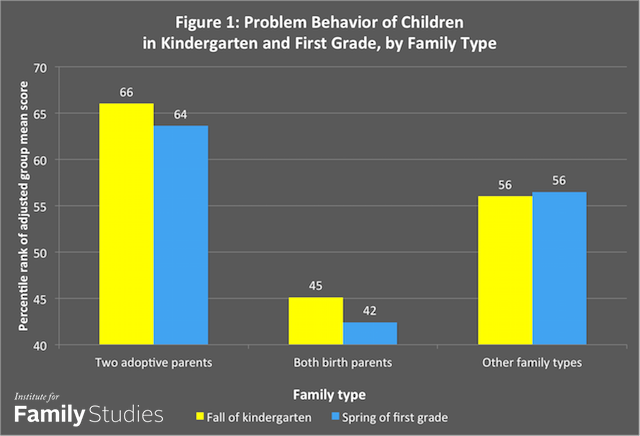
[…]Kindergarten and first-grade teachers were asked to rate the classroom behavior of children in the ECLS-K sample—how well they got along with other children in a group situation. In both the fall of kindergarten and the spring of first grade, adopted children were more likely than biological ones to be reported to get angry easily and often argue or fight with other students.

Here’s the first chart:

Adopted kids struggle in school
Adopted kids more likely to engage in problem behaviors

And more results:

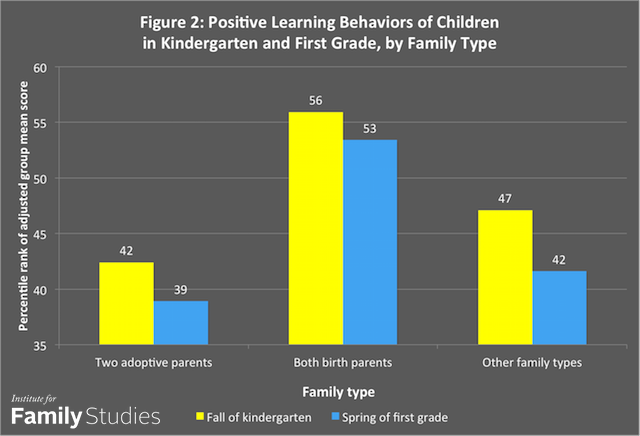
Children in the ECLS-K were also rated by their teachers on how well they paid attention in class, whether they seemed eager to learn new things, and whether they persisted at challenging learning tasks. Scores on these measures have proven to be predictive of later academic performance and career success beyond elementary school.5 Adopted children were rated less highly with respect to such positive approaches to learning than were children being raised by both birth parents.

Here’s the second chart:

Adopted kids struggle to pay attention in class

And even more results:

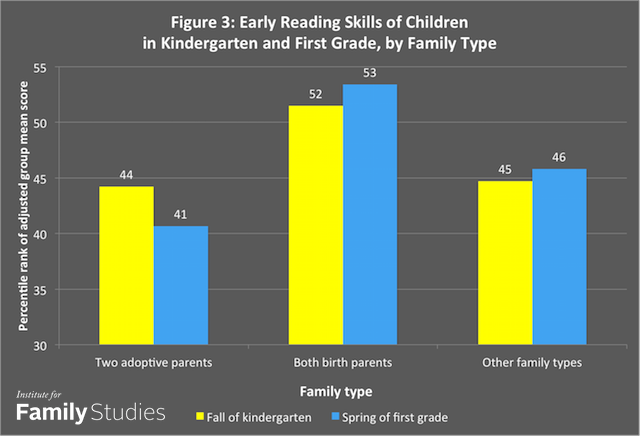
As the participating children began kindergarten, the ECLS-K assessed their pre-reading skills, such as recognizing letters by name, associating sounds with letters, identifying simple words by sight.

Here’s the third chart:

Adopted kids struggle with reading skills

And now math results:

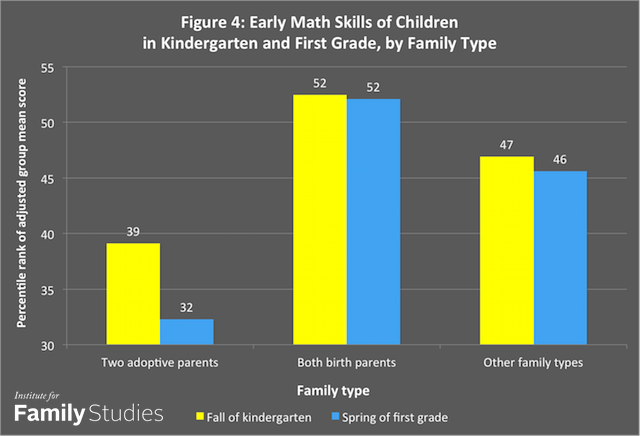
In the fall of their kindergarten year, the ECLS-K assessed children’s pre-arithmetic skills like counting by rote, recognizing written numerals, and understanding greater, lesser, and equal relationships.

Here’s the fourth chart:

Adopted kids struggle with math skills

The article concludes:

Attachment theory holds that a warm, intimate, and continuous relationship with at least one adult, usually the mother, is essential for the mental health of infants and young children. Children who do not develop a stable and secure bond during early childhood, or have the bond disrupted, are subject to both short-term distress reactions and longer-term abnormalities in their feelings and behavior toward other people. Not having a stable maternal bond is apt to produce long-lasting deficits in the child’s social development, deficiencies that are not easily remedied by a new home environment, no matter how favorable.

Some adopted children experienced neglect, abuse, or other stressful events prior to their adoption. According to traumatic stress theory, the likelihood of long-term emotional scars depends on the intensity and duration of the stress. Severe or prolonged early stress can have long-lasting effects on a child’s development, effects that a supportive adoptive family may only partly ameliorate.

So what do I want to say about this? I want to warn young women, especially young Christian women, that children work best when grown-ups plan their lives in such a way that they can provide for what the children need, at the time they need it. And if you miss the window of opportunity to have your own kids and raise them yourself, then you can’t just fix it at the last minute with ad hoc alternatives.

But for some reason, I get a lot of kickback from young women when I tell them what studies say about things like marriage, premarital sex, cohabitation, infertility, day care, and on and on and on. The Christian women in particular dismiss all the facts with stuff like:

God is leading me to choose fun and thrills now. That’s what my feelings say (and all my friends and family tell me that my feelings are God speaking to me). Tingles and peer-approval rationalize my choice to delay marriage and child-bearing. Who cares about stuff evidence? I don’t like to hear about constraints and deadlines. So I’ll just keep up this plan to run up debts, go on missionary trips, and have fun traveling till I’m 90 years old. God always calls people to do what feels good. I’m going on an adventure! And it will be easy to find a good husband and raise happy and effective kids later – whenever I feel like it. Er, I mean when God leads me to feel like it. Yeah.

So even though all of these studies show the need for timings, pre-conditions, best practices, and so on, that can all be dismissed because the feelings are God speaking to her, and God can somehow magically make all the data not apply to her. One of my married friends once wrote to a young, single fun-seeking feminist telling her about the risks of delaying marriage and child-bearing for too long, and the fun-seeker came back to me dismissing the whole letter because “I don’t like the feeling that I am being constrained”. So, the advice of old Christian women (Titus 2:4) can be dismissed because the young adventurous feminist didn’t like the feeling of being confronted by reality by someone who had more wisdom and experience than she did.

What young children need is their mom, and a Dad who can provide for her to stay home during the crucial first 5 years of their lives. That is more important than pursuing fun and thrills, then grabbing for children as if they were handbags at the last second after natural child-bearing becomes impossible. The right thing to do is to use your 20s preparing financially and otherwise to have kids when you are young, and to be financially set up to stay home with them during the critical years. Choosing a man who can provide, and who understands the best practices for having and raising children is vital, if you want your children to be effective and influential for Christ and his kingdom.

I do think that if a couple is intentionally adopting because they want the challenge and want to help a child who really needs it, then it’s praiseworthy to do that. I just don’t want someone who isn’t ready for the challenge thinking that adoption is the same, so they can delay marriage and children.I know that I am lazy, and I always want to do things the easy way. E.g. – I buy new cars, not used cars. I will buy hand-fed birds, not rescue birds. I would buy a new house, not a fixer-upper. I’m just not cut out for doing things that are hard. I have no ability to struggle through when there is resistance. When I face rejection or resistance to trying to grow or lead someone, I just give up. I think what I was saying to young women was – don’t delay marriage and child-bearing, you’ll get better results with less work.

Related posts