After gunman Muhammad Youssef Abdulazeez, a Muslim immigrant from Kuwait, allegedly shot and killed four Marines in Chattanooga, Tennessee, former NYPD detective Harry Houck said the military’s “gun-free zone” mindset has to change.
Speaking to CNN Newsroom, Houck said, “I’m a Marine. And this really is hitting me a little harder here than normal that [these Marines] weren’t able to protect themselves at the time this occurred.”
“We need people that are armed,” he added. He also said that even if that means getting armed guards, then so be it; something has to change.
[…]Ironically, one of the earliest post-attack photos of the recruiting center shows shattered glass and bullet holes by the very sign that designated the office a gun free zone.
You can see the photo above, with the gun-free zone sticker.
So, let me make two points about this.
First, the shooter was not some poor person who just needed to be given a job, as the State Department spokeswomen, e.g. Marie Harf, are always trying to tell us.
Authorities identified the gunman as Muhammad Youssef Abdulazeez of Hixson, Tenn., though the spelling of his first name was in dispute, with federal officials and records giving at least four variations.
[…]The shooting suspect’s family lived there about 15 years and did not bring attention to themselves, according to neighbor Dean McDaniel.
[…]It was unclear whether Abdulazeez was a U.S. or Kuwaiti citizen.
University of Tennessee at Chattanooga officials confirmed that Abdulazeez graduated in 2012 with a degree in electrical engineering. He also interned at the Tennessee Valley Authority, the agency confirmed.
Second, this was not an episode of “senseless violence” or “workplace violence”, as politically correct leftists might like to say. This guy was a Muslim and he was “very religious”.
Ryan Smith told the Times Free Press that he wrestled with Abdulazeez at Red Bank High School.
Smith said that Abdulazeez was very religious and that he would argue “back and forth” with the boys’ high school wrestling coach during fasting rituals.
This was not a random attack.
Recall the Fort Hood attack, another gun-free zone. That time, it was Major Nidal Hasan, a devout Muslim, and Obama called that attack “workplace violence”. Not terrorism! It’s “workplace violence”.
The problem with not taking domestic terrorism seriously is that instead of fixing the gun-free zones that enable these attacks, we keep going as before, and invite more attacks. Obama learned nothing from Fort Hood, and now four more U.S. Marines are dead because of his difficulty at accepting reality.
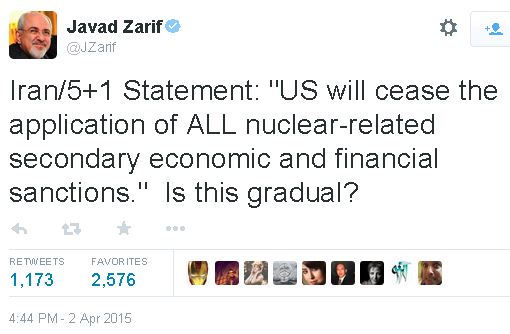
Iran’s chief negotiator: all the sanctions cease immediately
This is the top article on the Wall Street Journal right now. It’s written by two former Secretaries of State, Henry Kissinger and George P. Shultz.
They are assessing the Iran deal:
While Iran treated the mere fact of its willingness to negotiate as a concession, the West has felt compelled to break every deadlock with a new proposal. In the process, the Iranian program has reached a point officially described as being within two to three months of building a nuclear weapon. Under the proposed agreement, for 10 years Iran will never be further than one year from a nuclear weapon and, after a decade, will be significantly closer.
[…]Progress has been made on shrinking the size of Iran’s enriched stockpile, confining the enrichment of uranium to one facility, and limiting aspects of the enrichment process. Still, the ultimate significance of the framework will depend on its verifiability and enforceability.
[…]Under the new approach, Iran permanently gives up none of its equipment, facilities or fissile product to achieve the proposed constraints. It only places them under temporary restriction and safeguard—amounting in many cases to a seal at the door of a depot or periodic visits by inspectors to declared sites. The physical magnitude of the effort is daunting. Is the International Atomic Energy Agency technically, and in terms of human resources, up to so complex and vast an assignment?
In a large country with multiple facilities and ample experience in nuclear concealment, violations will be inherently difficult to detect. Devising theoretical models of inspection is one thing. Enforcing compliance, week after week, despite competing international crises and domestic distractions, is another. Any report of a violation is likely to prompt debate over its significance—or even calls for new talks with Tehran to explore the issue. The experience of Iran’s work on a heavy-water reactor during the “interim agreement” period—when suspect activity was identified but played down in the interest of a positive negotiating atmosphere—is not encouraging.
Compounding the difficulty is the unlikelihood that breakout will be a clear-cut event. More likely it will occur, if it does, via the gradual accumulation of ambiguous evasions.
When inevitable disagreements arise over the scope and intrusiveness of inspections, on what criteria are we prepared to insist and up to what point? If evidence is imperfect, who bears the burden of proof? What process will be followed to resolve the matter swiftly?
The agreement’s primary enforcement mechanism, the threat of renewed sanctions, emphasizes a broad-based asymmetry, which provides Iran permanent relief from sanctions in exchange for temporary restraints on Iranian conduct. Undertaking the “snap-back” of sanctions is unlikely to be as clear or as automatic as the phrase implies. Iran is in a position to violate the agreement by executive decision. Restoring the most effective sanctions will require coordinated international action. In countries that had reluctantly joined in previous rounds, the demands of public and commercial opinion will militate against automatic or even prompt “snap-back.” If the follow-on process does not unambiguously define the term, an attempt to reimpose sanctions risks primarily isolating America, not Iran.
The gradual expiration of the framework agreement, beginning in a decade, will enable Iran to become a significant nuclear, industrial and military power after that time—in the scope and sophistication of its nuclear program and its latent capacity to weaponize at a time of its choosing. Limits on Iran’s research and development have not been publicly disclosed (or perhaps agreed). Therefore Iran will be in a position to bolster its advanced nuclear technology during the period of the agreement and rapidly deploy more advanced centrifuges—of at least five times the capacity of the current model—after the agreement expires or is broken.
That doesn’t sound like a good deal to me.
It sounds like we are trading permanent relief from sanctions. Those sanctions were built up over years of negotiations with the UN countries. Sanctions that are not easy to “snap back” if Iran breaks the deal, because they require negotiations with many different UN countries again – it won’t be automatic. That’s the “asymmetry” they are talking about in the article. Iran can break the agreement unilaterally, or just block the inspections, and the sanctions will stay off until we get agreement with the UN countries.
Here’s the former Democrat campaign worker, and now State Department spokeswoman Marie Harf:
She is confused by all the “big words” that these two Secretaries of State used in the article above.
Iran will begin using its latest generation IR-8 centrifuges as soon as its nuclear deal with the world powers goes into effect, Iran’s foreign minister and nuclear chief told members of parliament on Tuesday, according to Iran’s semi-official FARS news agency.
If accurate, the report appears to make a mockery of the world powers’ much-hailed framework agreement with Iran, since such a move clearly breaches the US-published terms of the deal, and would dramatically accelerate Iran’s potential progress to the bomb.
Iran has said that its IR-8 centrifuges enrich uranium 20 times faster than the IR-1 centrifuges it currently uses.
According to the FARS report, “Iran’s foreign minister and nuclear chief both told a closed-door session of the parliament on Tuesday that the country would inject UF6 gas into the latest generation of its centrifuge machines as soon as a final nuclear deal goes into effect by Tehran and the six world powers.”
It said that Foreign Minister Mohammad Javad Zarif and Atomic Energy Organization of Iran (AEOI) head Ali Akbar Salehi made the promise when they briefed legislators on the framework agreement, and claimed the move was permitted under the terms of the deal.
Oh, I guess was wrong. This is a good deal! For Iran.
Sigh. I guess if you want to be even more horrified by the Iran deal, you can listen to an interview that Hugh Hewitt did with Wall Street Journal columnist Bret Stephens, and there’s a transcript as well for those who would rather read about the incompetence of the Obama administration rather than hear about the incompetence of the Obama administration.
Remember last week when the Obama administration told us that terrorism is caused by poverty and joblessness?
Let’s take a look at the research and see if this is true.
Here’s the working paper, authored by a Harvard University scholar from the John F. Kennedy School of Government.
And here’s the abstract:
This article provides an empirical investigation of the determinants of terrorism at the country level. In contrast with the previous literature on this subject, which focuses on transnational terrorism only, I use a new measure of terrorism that encompasses both domestic and transnational terrorism. In line with the results of some recent studies, this article shows that terrorist risk is not significantly higher for poorer countries, once the effects of other country-specific characteristics such as the level of political freedom are taken into account. Political freedom is shown to explain terrorism, but it does so in a non-monotonic way: countries in some intermediate range of political freedom are shown to be more prone to terrorism than countries with high levels of political freedom or countries with highly authoritarian regimes. This result suggests that, as experienced recently in Iraq and previously in Spain and Russia, transitions from an authoritarian regime to a democracy may be accompanied by temporary increases in terrorism. Finally, the results suggest that geographic factors are important to sustain terrorist activities.
More from the body:
However, recent empirical studies have challenged the view that poverty creates terrorism. Using U.S. State Department data on transnational terrorist attacks, Krueger and Laitin (2003) and Piazza (2004) find no evidence suggesting that poverty may generate terrorism. In particular, the results in Krueger and Laitin (2003) suggest that among countries with similar levels of civil liberties, poor countries do not generate more terrorism than rich countries. Conversely, among countries with similar levels of civil liberties, richer countries seem to be preferred targets for transnational terrorist attacks.
I know this is shocking – this the same administration that told us that insuring more people for more stuff would lower health care premiums… and that anyone who though that Russia was a threat was crazy… and that pulling out of Iraq would stabilize the region… could they be wrong about this Jobs for Terrorists program, too? The study seems to say they are wrong again.
But wait, there’s more. We actually know about some terrorists from their terrorist attacks, and we can see if they were as poor and uneducated as the Obama administration tells us they are.
According to scholar Scott Atran, a research director in Paris who is part of a NATO group studying suicide terrorism, there is no link between poverty and terrorism. Forensic psychiatrist and former foreign service officer Marc Sageman studied 172 participants in jihad for his book, Understanding Terror Networks, and came to the same conclusion. Princeton economist Claude Berrebi found that members of Palestinian terrorist organizations were frequently better educated and better off economically than the Palestinian Arab population as a whole.
Islamic terrorists tend to come from cosmopolitan backgrounds, are fluent in multiple languages and have advanced computer skills. Their privileged status enables them to accomplish such horrific acts undercover, often without being detected.
Osama bin Laden was the son of a billionaire construction magnate, who had close ties to the Saudi royal family. The younger bin Laden inherited $25–30 million of his family’s wealth. He studied economics and business administration at King Abdulaziz University.
Bin Laden’s top deputy, Ayman al-Zawahiri, who replaced him as the leader of al Qaeda, came from wealthy Egyptian parents. His father was a surgeon and medical professor, and his mother came from a politically active, financially successful clan. Al-Zawahiri also became a surgeon, even obtaining a master’s degree in surgery.
The leader of the 9/11 terrorist attacks, Mohammad Atta, studied architecture in Cairo, Egypt, then entered an urban planning graduate program at the Technical University of Hamburg-Harburg in Germany. His father was a lawyer and his mother came from a wealthy farming and trading family.
The “underwear bomber,” Umar Farouk Abdulmutallab, is the son of a wealthy Nigerian banker and businessman. His father was the chairman of First Bank of Nigeria and has been described by the UK paperThe Times as “one of the richest men in Africa.” Umar studied at several universities, including University College London, where he studied Engineering and Business Finance and earned a degree in mechanical engineering.
One of the 2005 London bombers left an estate valued at over $150,000. Dawood Ibrahim, who coordinated the 1993 Mumbai bombings, is worth somewhere between $6 and $20 billion. Ibrahim despised his father’s successful banking profession, condemning it as “immoral” and “un-Islamic” for charging interest, and urged him to quit.
Now, my understanding is that when we elect politicians to run the economy, foreign affairs, etc. that we are picking people who understand the issues – not merely people who give speeches that sound nice. If I am hiring someone to fix my car, I don’t want to hear his pet theory about how gremlins are causing the leak. I want people who can see the world clearly, apart from any political correctness or anti-American bias, so that the problems get solved. I want the problems solved effectively and cheaply – that’s what I am used to in the private sector, where competence matters. It seems to me that the next time we have an election, we ought to elect someone who can do the work – not someone who just talks a lot of counter-factual nonsense.


 WINTERY KNIGHT