
Tag Archives: Love

Can relationships succeed independently of the efforts of the people involved?

Man helping a woman with proper handgun marksmanship

A few years ago, I blogged about the soul mate / fairy tale view of marriage, which I think is the dominant view of marriage among young people today – even among Christians. This view of marriage basically says that there is a person in the world out there who will match up so perfectly with each one of us that we will have to expend no effort and perform no actions and take responsibility for nothing in order for the relationship to work. it will just work on its own!

I’ve decided to link to this recent article by Matt Walsh which is on that same topic.

He writes:

The disease is the fanciful, unrealistic, fictionalized perceptions that both males and females harbor about marriage.

For example, think of the glamorization of the “mysterious” and “damaged” guy from the “wrong side of the tracks.” Hollywood makes him seem alluring and sexy, but forgets to mention that most of the time, in the real world, that dude probably has herpes, a coke habit, and a criminal record.

Still, that bit of propaganda is nothing compared to the underlying misconception that so many of us carry around consciously or subconsciously, because we’ve seen it on TV and in the movies, and read it in books a million times since childhood: namely, that there is just one person out there for us. Our soul mate. Our Mr. or Mrs. Right. The person we are “meant to be with.”

Matt thinks this view of relationships is not realistic:

I didn’t marry my wife because she’s The One, she’s The One because I married her. Until we were married, she was one, I was one, and we were both one of many. I didn’t marry The One, I married this one, and the two of us became one. I didn’t marry her because I was “meant to be with her,” I married her because that was my choice, and it was her choice, and the Sacrament of marriage is that choice. I married her because I love her — I chose to love her — and I chose to live the rest of my life in service to her. We were not following a script, we chose to write our own, and it’s a story that contains more love and happiness than any romantic fable ever conjured up by Hollywood.

Indeed, marriage is a decision, not the inevitable result of unseen forces outside of our control. When we got married, the pastor asked us if we had “come here freely.” If I had said, “well, not really, you see destiny drew us together,” that would have brought the evening to an abrupt and unpleasant end. Marriage has to be a free choice or it is not a marriage. That’s a beautiful thing, really.

God gave us Free Will. It is His greatest gift to us because without it, nothing is possible. Love is not possible without Will. If we cannot choose to love, then we cannot love. God did not program us like robots to be compatible with only one other machine. He created us as individuals, endowed with the incredible, unprecedented power to choose. And with that choice, we are to go out and find a partner, and make that partner our soul mate.

That’s what we do. We make our spouses into our soul mates by marrying them. We don’t simply recognize that they are soul mates and then just sort of symbolically consecrate that recognition through what would then be an effectively meaningless marriage sacrament. Instead, we find another unique, dynamic, wholly individualized human being, and we make the monumental, supernatural decision to bind ourselves to them for eternity.

It’s a bold and risky move, no matter how you look at it. It’s important to recognize this, not so that you can run away like a petrified little puppy and never tie the knot with anyone, but so that you can go into marriage knowing, at least to some extent, what you’re really doing. This person wasn’t made for you. It wasn’t “designed” to be. There will be some parts of your relationship that are incongruous and conflicting. It won’t all click together like a set of Legos, as you might expect if you think this coupling was fated in the stars.

It’s funny that people get divorced and often cite “irreconcilable differences.” Well what did they think was going to happen? Did they think every difference would be reconcilable? Did they think every bit of contention between them could be perfectly and permanently solved?

Finally, regarding his own marriage:

There were literally millions of things that either of us could have done. An innumerable multitude of possible outcomes, but this was our outcome because we chose it. Not because we were destined or predetermined, not because it was “meant to happen,” but because we chose it. That, to me, is much more romantic than getting pulled along by fate until the two of us inevitably collide and all that was written in our horoscopes passively comes to unavoidable fruition.

We are the protagonists of our love story, not the spectators.

I see this problem everywhere, even with Christian women who have been raised as Disney princesses. I was just told by one last week that she will marry when she meets “the right man” – the man who will require her to do nothing. This magical relationship will require no communication, no working through disagreements, no problem solving, no compromise, no effort, no self-sacrifice of any kind. it will just “work”, without any growing up by anyone. Two unemployed people with degrees in English can have a fine marriage, I suppose, traveling the world and skydiving every Tuesday.

I think that when problems arise between two people who are largely compatible, the right thing to do is to engage and solve the problems. Yes, work isn’t required in pop culture notions of romance, but those things don’t reflect the real world anyway. In the real world, actions to solve a problem count for more than words that avoid the problem. Engineering principles and self-sacrificial attitude are infinitely more useful in a relationship than all the pop culture descriptions of ideal men and ideal women and ideal relationships combined.

By the way, the best book on this problem is Dr. Laura’s “The Proper Care and Feeding of Husbands”, which clearly sets out how a woman’s choices influence her husband’s ability to perform well. The myth of the mind-reading “right man” is also debunked.

The downside of the soul mate / fairy tale view of relationships


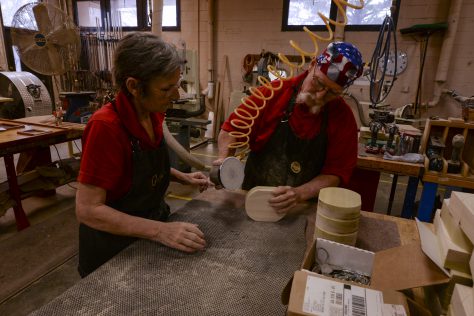
Husband and wife doing some woodworking together

(Image: Husband and wife doing some woodworking together)

Astonishing article from the leftist Huffington Post, of all places. (links removed)

Excerpt:

As millennial women, we were groomed for a white knight fantasy. From childhood favorites such as Snow White to adult rom-com staples such as How to Lose a Guy in Ten Days or Sleepless in Seattle, the media perpetuates a romantic storyline in which compatibility and lasting romance is something effortless, built on chance, sustained by good looks, fun dates and electric sexual chemistry. These story lines shape our expectations for romantic happiness. It is not enough to find someone with whom we are mostly compatible, who would make a good parent, with whom we could learn and grow wrinkly; now, we expect a perfect fit and an easy, instantaneous “connection.” In short, we want a soul mate. But it is this desire for a soul mate that is actually the undoing of our happy ending.

A “soul mate” is defined as one who is ideally suited to us, perfectly completes us, one with whom the relationship feels easy and natural. With them, a relationship is just “meant to be”… A survey of young adults conducted by the National Marriage Project found that while 84% of young adults report finding a marriage partner “very important,” a full 94% of young adults say they would like to marry a soul mate, and 73% of people ages 18 – 29 believe that there is a soul mate out there for them.

Wow. That doesn’t sound like a good approach to me. My approach has always been to pick the girl who was most willing to learn new things. And then to explain to her my vision for marriage and see if I could get her to work independently on that plan before I married her. I don’t favor this soul mate approach at all.

Does the “soul mate” approach work?

We heard that those who get married later and possess a college degree have fewer divorces and more stable marriages. So we spend our twenties trying to find ourselves through travel, accumulating degrees and building a career. Marriage will be the capstone of our achievements, and nothing less than tying the knot with a soul mate will suffice. But the tragic irony is that soul mate thinking makes us increasingly likely to divorce. A study of 1,400 married men and women shows that people who hold soul mate orientations are 150% more likely to end up divorced than those who do not.

The widespread cultural belief in “soul mate ideology” undermines our chances at happiness because it makes us passive receivers of idyllic romantic expectations. Further, it fosters self-centeredness; one rarely longs to be a soul mate for someone else, which would require effort. For this reason, believing in soul mates is one of the most dis-empowering belief systems we can adopt. As millennials, we pride ourselves on actively pursuing the life we want to live, rather than simply accepting whatever hand we are dealt. We are innovative, passionate, proactive and not afraid to take risks. Yet, there is a disconnect when it comes to our desire for lasting love. Though there are prospects around us, we forgo taking the concrete steps needed to build happy compatible relationships because we do not “feel a spark.” We are passively waiting on the sidelines for love to “happen,” and then wonder why it is so difficult.

I’ve always felt that the soul mate approach was like the evil villain in opposition to my noble plan-based approach. My approach is to pick a woman who wants to learn and work hard. Explain your marriage plan to her, and how your marriage plan serves God. My marriage plan accomplishes four goals, for example. 1) Influence the university with apologetics, 2) influence the church with apologetics, 3) provide a model of a good marriage to people in the community, including co-workers, college students and neighbors, and 4) raise effective, influential children who will have an impact for God. Now if you are a Christian woman raised in a church that affirms the soul mate / fairy tale view of marriage with this “God has a wonderful plan for your life” stuff, then a specific, non-emotional plan from a man is the last thing you want to hear about.

Their solution is for people to work at compatibility:

Compatibility is something co-created through intentionality and conscious choice. It involves mutual sacrifice, effort and commitment for the sake of the other’s benefit. A recent study found that of the couples who demonstrate above average daily generosity, 50% of them report being “very happy” in marriage; among the low generosity scores, only 14% can say the same. As studies indicate, selflessness is required to create mutual compatibility. It is not instantaneous, nor does it usually begin with true love’s kiss.

We both know from experience that there are some you naturally connect with and others you do not. This is not a call towards forced attraction or companionship. But, our romantic futures should not be placed in the hands of blind chance. It is time we roll up our sleeves and shift our expectations from unattainable perfection to realistic romance, one that accounts for imperfection. We must understand that work in a relationship is a necessary key to success, rather than an indication of imminent failure. We will be letting go of a tired plot line that sets us up for disappointment and embracing an active role in our own unique story.

How refreshing to know that we do not have to be perfect to be lovable, and that our romantic success is not solely dependent on finding the “right” fit, but instead built through cultivating daily moments of generosity, sacrifice and conscious coupling.

So in my case, I am looking for a woman who listens to the plan, develops the skills for the plan and then independently engages in activities to achieve the goals of the plan. In the past, I have had women listen to the plan carefully, including my motivations and experiences that caused me to choose this plan. And they have been willing to read books, listen to lectures, watch debates, to gain the skills needed to make a difference. And they have even engaged independently with activities like public speaking, teaching classes, and so forth. But none of the women who had done that accepted the soul mate / fairy tale view of marriage. They all wanted to hear a good plan, learn useful skills and then get to work. Big difference.

How chastity orders your relationships and liberates you for love

Time for examples of real, self-sacrificial love

I really recommend chastity to men especially. As long as they are chaste, they free themselves to love others unselfishly. That’s not for every woman, but it’s very useful to do with the right women.

In Salvo magazine, Terrell Clemmons has a good summary of what chastity allows you to do in this post, where she looks at the ideas of Dawn Eden.

She writes:

Contrary to the pervasive bad press it’s gotten from libertines, chastity isn’t about “not having sex.” In fact, it’s about a lot more than just sex. Dawn defines it beautifully: “Chastity is the virtue that enables us to love fully and completely in every relationship, in the manner that is appropriate to the relationship.” Of course, this raises the question of what determines appropriateness, but from both a scriptural and natural law standpoint, this is an easy question to answer. Sexual expression is appropriate to the marriage relationship and inappropriate to all others. Whether or not it’s easy to follow is certainly another matter, and Dawn gives excellent counsel on that and other related matters, but the point here is that the categories are discrete and clearly discernible.

More important, chaste living is grounded in something larger and more permanent than the individual. Whereas in modern singlehood, love is based on feelings, which are apt to change with the wind or even last night’s dinner, chaste love is defined by and grounded in God himself. Love of God—love for God and love from God—becomes the love that orders all other loves. “For each of those whom divine providence places in your life,” Dawn writes, “friends, family, the stranger on the street—you ask yourself, how can I love God through loving this person?”

Whereas the modern single is driven by an inner void that is desperately trying to get filled, the chaste singular looks to God himself to fill the void. Rather than trying to get love through the right match, the chaste singular receives love from God, the ultimate source, and then turns outward with love to give from an inner fullness.

Chaste love is respectful. It behaves with appropriate decorum, which requires forethought. What is the nature of this relationship? Why am I in it? Where is it headed? What are my intentions?

[…]To be sure, chastity will require something of you. First, it requires acknowledging the black hole within that will never be filled by sex and then inviting God himself to fill it. After that, it requires discipline, responsibility, and an ongoing trust in God himself as guarantor of the outcome. It’s the outward lifestyle that proceeds from a sound inward theology of sex and love.

“I learned, through discovering chastity,” Dawn writes, “that the greatest tragedy is not that of being unloved. The greatest tragedy is not loving.” Chaste living is holistic and comprehensive, engaging mind, body, and spirit. It’s about learning to order love as love was meant to be ordered.

Chaste love is basically intelligent, self-sacrificial love. It loves as a way of doing work for your Boss. Instead of trying to make this other person meet your needs, you try to think of how you can make them be a productive person for your Boss. You don’t see them as a commodity, you see them as a fellow soldier. And since you don’t know how far any person can go in serving God, every person you meet has value.

Personally, I think it is a lot more rewarding to chastely love women who have had bad experiences. Not all are safe, but you can tell whether to invest in them by whether they do the things that will build them up. Study something hard. Get good grades. Get a job. Strengthen your faith by reading apologetics. Stop wasting money on alcohol and drugs and cigarettes. Save money instead of spending it. Choose men who are husband material, not boy-toy material.

It’s incredibly fulfilling to see a woman actually listen to you and take your advice, and then to see her experience the rewards of good decision-making. Men sometimes think that sexual submission is a good way to feed the need for respect. But it’s a temporary fix. The permanent fix is to have a place of honor in someone’s life because you helped turn their life around. That’s real respect, and it’s not the kind that the woman takes back later after she sobers up.