
Tag Archives: LImited Government

Obama says that limited government and capitalism have never worked

Obama Economic Record November 2011

Investors Business Daily explains the latest speech on economics from the man who has doubled Bush’s 2007 unemployment rate, and increased Bush’s 2007 budget deficits tenfold.

Excerpt:

One thing is certainly true about President Obama — no matter how many times people point out the falsehoods in his speeches, he just keeps making them. Case in point: his latest “economic fairness” address.

In that speech Tuesday, Obama once again tried to build a case for his liberal, big-spending, tax-hiking, regulatory agenda. But as with so many of his past appeals, Obama’s argument rests on a pile of untruths. Among the most glaring:

• Tax cuts and deregulation have “never worked” to grow the economy. There’s so much evidence to disprove this claim, it’s hard to know where to start. But let’s begin with the fact that countries with greater economic freedom — lower taxes, less government, sound money, free trade — consistently produce greater overall prosperity.

Here at home, President Reagan’s program of lower taxes and deregulation led to an historic two-decade economic boom. Plus, states with lower taxes and less regulation do better than those that follow Obama’s prescription.

Obama also claimed the economic booms in the ’50s and ’60s somehow support his argument. This is utter nonsense. Taxes at the time averaged just 17% of the economy. And there was no Medicare, no Medicaid, no Departments of Transportation, Energy or Education, and no EPA. Had Obama been around then, he would have decried it all as un-American.

• Bush’s tax cuts on the rich only managed to produced “massive deficits” and the “slowest job growth in half a century.” Budget data make clear that Obama’s spending hikes, not Bush’s tax cuts, produced today’s massive deficits.

And Obama only gets his “slowest job growth” number by including huge job losses during his own term in office. Also, monthly pre-recession job growth under Bush was about 40% higher than post-recession growth has been under Obama.

• During the Bush years, “we had weak regulation, we had little oversight.” This is patently false. Regulatory staffing climbed 42% under Bush, and regulatory spending shot up 50%, according to a Washington University in St. Louis/George Washington University study. And the number of Federal Register pages — a proxy for regulatory activity — was far higher under Bush than any previous president.

• The “wealthiest Americans are paying the lowest taxes in over half a century.” Fact: the federal income tax code is now more progressive than it was in 1979, according to the Congressional Budget Office. IRS data show the richest 1% paid almost 40% of federal income taxes in 2009, up from 18% back in 1980.

• We can keep tax breaks for the rich in place, or make needed investments, “but we can’t do both.” Not true. Repealing the Bush tax cuts on the “rich” would raise only about $70 billion a year, a tiny fraction of projected deficits. With or without the Bush tax cuts, the country can’t afford Obama’s agenda.

The Heritage Foundation describes the effects of the Bush tax cuts.

Excerpt:

President Bush signed the first wave of tax cuts in 2001, cutting rates and providing tax relief for families by, for example, doubling of the child tax credit to $1,000.

At Congress’ insistence, the tax relief was initially phased in over many years, so the economy continued to lose jobs. In 2003, realizing its error, Congress made the earlier tax relief effective immediately. Congress also lowered tax rates on capital gains and dividends to encourage business investment, which had been lagging.

It was the then that the economy turned around. Within months of enactment, job growth shot up, eventually creating 8.1 million jobs through 2007. Tax revenues also increased after the Bush tax cuts, due to economic growth.

In 2003, capital gains tax rates were reduced. Rather than expand by 36% as the Congressional Budget Office projected before the tax cut, capital gains revenues more than doubled to $103 billion.

The CBO incorrectly calculated that the post-March 2003 tax cuts would lower 2006 revenues by $75 billion. Revenues for 2006 came in $47 billion above the pre-tax cut baseline.

Here’s what else happened after the 2003 tax cuts lowered the rates on income, capital gains and dividend taxes:

  • GDP grew at an annual rate of just 1.7% in the six quarters before the 2003 tax cuts. In the six quarters following the tax cuts, the growth rate was 4.1%.
  • The S&P 500 dropped 18% in the six quarters before the 2003 tax cuts but increased by 32% over the next six quarters.
  • The economy lost 267,000 jobs in the six quarters before the 2003 tax cuts. In the next six quarters, it added 307,000 jobs, followed by 5 million jobs in the next seven quarters.

The timing of the lower tax rates coincides almost exactly with the stark acceleration in the economy. Nor was this experience unique. The famous Clinton economic boom began when Congress passed legislation cutting spending and cutting the capital gains tax rate.

If, in the 2012 election, half the country decides to vote for the person who gives the best speeches and who is cheered on the Comedy Channel, then we are going to have four more years of 9% unemployment and 1.4 trillion dollar deficits. Barack Obama knows nothing whatsoever about economics.

UPDATE: Obama says that small business owners didn’t build their own businesses
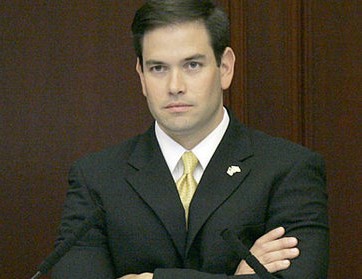
Marco Rubio’s amazing maiden speech in the US Senate

Florida Senator Marco Rubio

Human events reported on Florida Senator Marco Rubio’s first speech on the floor of the US Senate today, and it was AWESOME. (H/T Kathleen McKinley)

Full story:

Freshman Florida Republican Senator Marco Rubio delivered his maiden speech on the floor of the Senate yesterday and it was a speech all GOP presidential contenders should watch.

It was the best speech of the 2012 presidential cycle, except the person who delivered it has all but ruled himself off of the 2012 ticket on numerous occasions.

The GOP presidential field has been criticized for not having passion or conviction, and Rubio’s speech lit up the normally staid Senate chamber to the extent that this is possible. It had a clear argument, an emotional arc, personal tie-ins, and was delivered with conviction. Too often, even in the GOP, politicians talk about American exceptionalism as if it is an academic exercise.

Not Rubio.

Rubio owned it, his words personified it, and his speech was delivered in a way that led one who was watching to to think Rubio was humbled and still awed at America’s exceptional past and promise.

As Republicans learned in 2008, words and stories matter. It draws a public who does not get caught up in the drudgery of modern American politics in to care about the democratic process.
Add in the fact that Rubio is young and a minority, which are the two groups Republicans do most poorly with, and the speech and the messenger become even more dynamic, compelling, symbolic and important.

Rubio said he came “from a hard working and humble family” that “was neither wealthy nor connected,” but that he “grew up blessed in two important ways:” He had a strong and stable family and was born in America.

He realized that “America is not perfect” and “ti took a bloody civil war to free over 4 million African Americans who lived enslaved … and it would take another hundred years after that before they found true equality under the law.”

Rubio then movingly talked about how people who came to give their children a better life contributed to an “American miracle.”

He spoke of how a “16-year-old boy from Sweden, who spoke no English and had only five dollars in his pocket, was able to save and open a shoe store,” and “today, that store, Nordstrom is a multi-billion dollar global retail giant.”

He spoke of a “a young couple with no money and no business experience decided to start a toy business out of the garage of their home, and, “today, that company, Mattel, is one of the world’s largest toy manufacturers”

He spoke of the “French-born son of Iranian parents created a website called AuctionWeb in the living room of his home,” and, “today, that website now called eBay stands as a testament to the familiar phrase, ‘Only in America.'”

Rubio then talked movingly of the American dream and personified it by putting faces on the dream.

He said it was “story of the people who cleaned our office last night” who work hard so they can send their kids to college.”

He said it was “the story of the people who served your lunch today” who “work hard so that one day their children will have the chance to own a business.”

He said, in a reference to his father, the American Dream was also the “story of a bartender and a maid in Florida, whose son now serves here in this Senate, and who proudly gives his testimony as a firsthand witness of the greatness of this land.”

He then pivoted and said while “most great powers have used their strength to conquer other nations” America “is different” for America, “power also came with a sense that to those that much is given, much is expected.”

Rubio said that America’s greatness can be found anywhere in the world, “when someone uses a mobile phone, email, the Internet, or GPS” or “when a bone marrow, lung or heart transplant saves a life.”

Rubio then talked about how he “grew up in the 1980s, a time when it was morning in America” and that the 1980s, like the American century, faced challenges and triumphs but it was a “century where American political, economic and cultural exceptionalism made the world a more prosperous and peaceful place.”

He spoke of how the country is headed toward the wrong direct and that “we do stand now at a turning point in our history, one where there are only two ways forward for us. We will either bring on another American century, or we are doomed to witness America’s decline.”

Rubio said that since “every single one of us is the descendant of a go-getter,” “of dreamers and believers,” and “of men and women who took risk and made sacrifices because they wanted to leave their children better off than themselves” that “we are all the descendants of the men and women who built the nation that changed the world” whether “hey came here on the Mayflower, a slave ship, or on an airplane from Havana.”

Rubio then quoted John F. Kennedy about how America is the “watchmen on the walls of world freedom” and asked if America declined, “who will serve as living proof that liberty, security, and prosperity are all possible together,” or “lead the fight to confront and defeat radical Islam that “abuses and oppresses women, has no tolerance for other faiths and seeks to impose its views on the whole world,” or stand up for children who “are used as soldiers and trafficked as slaves?”

Rubio asked, if America declines, “who will create the innovations of the 21st century?”

He answered that nobody will because “there is still no nation or institution in the world willing or able to do what we have done.”

“Now, some say that we can no longer afford the price we must pay to keep America’s light shining,” Rubio said. “Others say that there are new shining cities that will soon replace us.”

“I say they are both wrong,” Rubio emphatically said because the world “still needs America,” “still needs our light,” and “still needs another American century” and “with God’s help, that will be our legacy to our children and to the world.”

You can watch the video here. The full transcript is here. READ THE WHOLE THING if you can’t watch the video.

You’ll recall that this blog has been a strong supporter of Marco Rubio since the day he announced his candidacy. He, along with Michele Bachmann, Paul Ryan, Allen West and Jim Demint, are my favorite Republicans. I’m probably forgetting some, but those are the ones that come to mind. I think if I had to choose someone who best matched my views across the board, that would be Michele Bachmann. But Marco Rubio best matches my personal story, and my opinion of the United States of America.

Here’s my post on the day he won the seat: Marco Rubio wins Florida Senate race – first tea party senator!

And here’s my post on the day he announced he was running: Conservative Marco Rubio announces for Florida Senate seat.

He will be a great Senator. And some day, maybe he’ll be even more. IFYKWIMAITYD.


What happens if a city decides to privatize all its functions?

Everything good, and nothing bad.

Privatization makes costs go down, and quality go up.