Tag Archives: Life

How common is it for a star to support complex, embodied life?

Circumstellar Habitable Zone

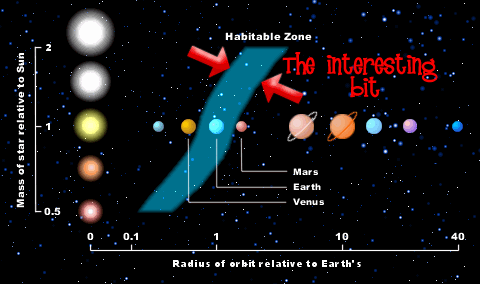
I blogged a while back about the need for a star to be massive, in order to push out the habitable zone far enough that the planet in the zone does not get tidally locked, killing the planet’s ability to support life. Recently, I blogged about another factor that’s needed – large planets further out which catch comets for us have to have a circular orbit, or they will pull us out of the habitable zone.

That’s two factors. But here’s an article from Evolution News that talks about liquid water and tidal locking, but it has even more factors that need to be fine-tuned for habitability.

Excerpt:

Stars with masses of 0.1-0.5 solar mass make up 75 percent of the stars in our Milky Way galaxy.6 These represent the red dwarfs, the M class. But these stars have low effective temperatures, and thus emit their peak radiation at longer wavelengths (red and near-infrared).7 They can have stable continuously habitable zones over long time scales, up to 10 billion years, barring other disruptions. It is also easier to detect terrestrial sized planets around them.8 But a serious problem with red dwarf stars in the K and M classes is their energetic flares and coronal mass ejection events. Potentially habitable planets need to orbit these stars closer, to be in these stars’ habitable zones. Yet the exposure to their stellar winds and more frequent and energetic flares becomes a serious issue for habitability. Because of these stars’ smaller mass, ejections get released with more violence.9 Any planet’s atmosphere would be subject to this ionizing radiation, and likely expose any surface life to much more damaging radiation.10 The loss of atmospheres in these conditions is likely, but the timescales are dependent on several factors including the planet’s mass, the extent of its atmosphere, the distance from the parent star, and the strength of the planet’s magnetic field.11 To protect its atmosphere for a long period, like billions of years, a planet with more mass and thus higher gravity could hold on to the gases better. But this larger planet would then hold on to lighter gases, like hydrogen and helium, and prevent an atmosphere similar to Earth’s from forming.12 Another consequence is that the increased surface pressure would prevent water from being in the liquid phase.13

So again, you need to have a huge, massive star in order to hold the planet in orbit over LONG distances. If it’s a short distance, you not only have the tidal-locking problem, but you also have this solar activity problem (flares, coronal ejections).

But wait! There’s more:

Another stellar parameter for advanced life has to do with UV (ultra-violet) radiation. The life-support star must provide just enough UV radiation, but not too much. UV radiation’s negative effects on DNA are well known, and any life support body must be able to sustain an atmosphere to shield them. Yet the energy from UV radiation is also needed for biochemical reactions. So life needs enough UV radiant to allow chemical reactions, but not so much as to destroy complex carbon molecules like DNA. Just this flux requirement alone requires the host star have a minimum stellar mass of 0.6 solar masses, and a maximum mass of 1.9 solar masses.14

So the ultra-violet radiation that is emitted has to be finely-tuned. (I’m guessing this assumes some sort of chemical origin-of-life scenario)

Still more:

Another requirement for habitable planets is a strong magnetic field to prevent their atmosphere from being lost to the solar winds. Planets orbiting a red dwarf star are also more affected by the star’s tidal effects, slowing the planet’s rotation rate. It is thought that strong magnetic fields are generated in part by the planet’s rotation.15 If the planet is tidally braked, then any potential for a significant magnetic field is likely to be seriously degraded. This will lead to loss of water and other gases from the planet’s atmosphere to the stellar winds.16 We see this in our solar system, where both Mercury and Venus, which orbit closer to the Sun than Earth, have very slow rotation rates, and very modest magnetic fields. Mercury has very little water, and surprisingly, neither does Venus. Even though Venus has a very dense atmosphere, it is very dry. This is due to UV radiation splitting the water molecules when they get high in the atmosphere, and then the hydrogen is lost to space, primarily, again, by solar wind.17

You have to hold on to your umbrella (atmosphere), or you get hit with dangerous rain (solar winds).

So a few more factors there, and remember, this is just the tip of the iceberg when it comes to circumstellar habitability constraints.

New study: gamma ray bursts make life impossible in 90% of galaxies

Galactic Habitable Zone

When you argue for theism from science, you typically use arguments like these:

  • the origin of the universe from nothing (the Big Bang)
  • the fine-tuning of cosmic constants and quantities
  • the origin of the first living cell
  • the sudden origin of animal phyla in the Cambrian explosion
  • the fine-tuning of the galaxy for complex, embodied mind
  • the fine-tuning of the solar system for complex, embodied mind
  • the fine-tuning of the planet (and moon)  for complex, embodied mind

This is a peer-reviewed article from Science, one of the most prestigious peer-reviewed journals. It speaks to the fine-tuning of the galaxy for life.

The article says:

Of the estimated 100 billion galaxies in the observable universe, only one in 10 can support complex life like that on Earth, a pair of astrophysicists argues. Everywhere else, stellar explosions known as gamma ray bursts would regularly wipe out any life forms more elaborate than microbes. The detonations also kept the universe lifeless for billions of years after the big bang, the researchers say.

[…]Astrophysicists once thought gamma ray bursts would be most common in regions of galaxies where stars are forming rapidly from gas clouds. But recent data show that the picture is more complex: Long bursts occur mainly in star-forming regions with relatively low levels of elements heavier than hydrogen and helium—low in “metallicity,” in astronomers’ jargon.

Using the average metallicity and the rough distribution of stars in our Milky Way galaxy, Piran and Jimenez estimate the rates for long and short bursts across the galaxy. They find that the more-energetic long bursts are the real killers and that the chance Earth has been exposed to a lethal blast in the past billion years is about 50%. Some astrophysicists have suggested a gamma ray burst may have caused the Ordovician extinction, a global cataclysm about 450 million years ago that wiped out 80% of Earth’s species, Piran notes.

The researchers then estimate how badly a planet would get fried in different parts of the galaxy. The sheer density of stars in the middle of the galaxy ensures that planets within about 6500 light-years of the galactic center have a greater than 95% chance of having suffered a lethal gamma ray blast in the last billion years, they find. Generally, they conclude, life is possible only in the outer regions of large galaxies. (Our own solar system is about 27,000 light-years from the center.)

Things are even bleaker in other galaxies, the researchers report. Compared with the Milky Way, most galaxies are small and low in metallicity. As a result, 90% of them should have too many long gamma ray bursts to sustain life, they argue. What’s more, for about 5 billion years after the big bang, all galaxies were like that, so long gamma ray bursts would have made life impossible anywhere.

But are 90% of the galaxies barren? That may be going too far, Thomas says. The radiation exposures Piran and Jimenez talk about would do great damage, but they likely wouldn’t snuff out every microbe, he contends. “Completely wiping out life?” he says. “Maybe not.” But Piran says the real issue is the existence of life with the potential for intelligence. “It’s almost certain that bacteria and lower forms of life could survive such an event,” he acknowledges. “But [for more complex life] it would be like hitting a reset button. You’d have to start over from scratch.”

The analysis could have practical implications for the search for life on other planets, Piran says. For decades, scientists with the SETI Institute in Mountain View, California, have used radio telescopes to search for signals from intelligent life on planets around distant stars. But SETI researchers are looking mostly toward the center of the Milky Way, where the stars are more abundant, Piran says. That’s precisely where gamma ray bursts may make intelligent life impossible, he says: “We are saying maybe you should look in the exact opposite direction.”

You need to be able to pick up enough heavy elements from surrounding supernovae to make a metal-rich star, but you have to be far enough away from other stars to avoid getting blasted with gamma rays. The metal-rich star is needed to be able to support the circumstellar habitable zone, which is the zone where liquid water exists on the planet’s surface.

It’s important to understand that this factor in the study just a few of the things you need in order to get a planet that supports life. The more factors you add, the more unexpected complex, embodied life of any kind becomes.

Here are a few of the more well-known ones:

  • a solar system with a single massive Sun than can serve as a long-lived, stable source of energy
  • a terrestrial planet (non-gaseous)
  • the planet must be the right distance from the sun in order to preserve liquid water at the surface – if it’s too close, the water is burnt off in a runaway greenhouse effect, if it’s too far, the water is permanently frozen in a runaway glaciation
  • the solar system must be placed at the right place in the galaxy – not too near dangerous radiation, but close enough to other stars to be able to absorb heavy elements after neighboring stars die
  • a moon of sufficient mass to stabilize the tilt of the planet’s rotation
  • plate tectonics
  • an oxygen-rich atmosphere
  • a sweeper planet to deflect comets, etc.
  • planetary neighbors must have non-eccentric orbits

There’s a good video on the galactic habitable zone for you to watch right here:

It takes a lot to make just one planet that can support complex, embodied life of any kind.

Is marriage a good deal for men? How can we make it a better deal for men?

The Elusive Wapiti, a Christian men’s rights blogger, posted this video from Dr. Helen Reynolds, author of “The Marriage Strike”. In the video, she gives 6 reasons why men are shying away from marriage. I agree with some of her reasons, but I wanted to respond and give the positive case for marriage. Also, I think it is worth reading a very challenging comment from “Gaza” in that post, who says that women are pushing marriage off for too long so that they end up not being prepared for it even if they meet a marriage-minded man.

So, onto to the positive aspects of marriage for men.

Let me quote from this NIH publication, which argues that marriage is a great value for men.

Look:

One of the strongest, most consistent benefits of marriage is better physical health and its consequence, longer life. Married people are less likely than unmarried people to suffer from long-term illness or disability (Murphy et al. 1997), and they have better survival rates for some illnesses (Goodwin et al. 1987). They have fewer physical problems and a lower risk of death from various causes, especially those with a behavioral component; the health benefits are generally larger for men (Ross et al. 1990).

A longitudinal analysis based on data from the Panel Study of Income Dynamics, a large national sample, documents a significantly lower mortality rate for married individuals (Lillard and Waite 1995). For example, simulations based on this research show that, other factors held constant, nine out of ten married women alive at age 48 would still be alive at age 65; by contrast, eight out of ten never-married women would survive to age 65. The corresponding comparison for men reveals a more pronounced difference: nine out of ten for the married group versus only six out of ten for those who were never married (Waite and Gallagher 2000).

And more:

Recent studies based on longitudinal data have found that getting married (and staying married to the same person) is associated with better mental health outcomes. Horwitz et al. (1996), Marks and Lambert (1998), and Simon (2002) present evidence of improvements in emotional well-being following marriage, and declines following the end of a union. Marks and Lambert (1998) report that marital gain affects men and women in the same way, but marital loss is generally more depressing for women. Analyses that control for the selection of the psychologically healthy into marriage, and also include a wider range of measures of mental well-being, find that although there are differences by sex in the types of emotional responses to marital transitions, the psychological benefits associated with marriage apply equally to men and women (Horwitz et al. 1996; Simon 2002).

Marriage is also associated with greater overall happiness. Analysis of data from the General Social Surveys of 1972–96 shows that, other factors held constant, the likelihood that a respondent would report being happy with life in general is substantially higher among those who are currently married than among those who have never been married or have been previously married; the magnitude of the gap has remained fairly stable over the past 35 years and is similar for men and women (Waite 2000).

And more:

A large body of literature documents that married men earn higher wages than their single counterparts. This differential, known as the “marriage premium,” is sizable. A rigorous and thorough statistical analysis by Korenman and Neumark (1991) reports that married white men in America earn 11 percent more than their never-married counterparts, controlling for all the standard human capital variables. Between 50 and 80 percent of the effect remains, depending on the specification, after correcting for selectivity into marriage based on fixed unobservable characteristics. Other research shows that married people have higher family income than the nonmarried, with the gap between the family income of married and single women being wider than that between married and single men (Hahn 1993). In addition, married people on average have higher levels of wealth and assets (Lupton and Smith 2003). The magnitude of the difference depends on the precise measure used, but in all cases is far more than twice that of other household types, suggesting that this result is not merely due to the aggregation of two persons’ wealth.

And more:

Beyond its integrative function, emphasized above, marriage also has a regulative function. Married individuals, especially men, are more likely than their single counterparts to have someone who closely monitors their health-related conduct; marriage also contributes to self-regulation and the internalization of norms for healthful behavior (Umberson 1987). Positive and negative externalities within marriage also play a role: when an individual behaves in a way that is conducive to good health, the benefits spill over to the spouse; similarly, unhealthy behaviors inflict damage not only on the individual but also on the partner. In this way, marriage promotes healthy conduct. In addition, the enhanced sense of meaning and purpose provided by marriage inhibits self-destructive activities (Gove 1973). Consistent with this channel of causality, married individuals have lower rates of mortality for virtually all causes of death in which the person’s psychological condition and behavior play a major role, including suicide and cirrhosis of the liver (Gove 1973). Lillard and Waite (1995) find that for men(but not for women) there is a substantial decline in the risk of death immediately after marriage, which suggests that the regulation of health behaviors is a key mechanism linking marriage to physical health benefits in the case of men.

Now I want to talk about is policies that will help to promote marriage, because that will help to make marriage safer and more attractive to men.

And for that, we go to the Family Research Council.

They write:

Our tax policy should protect and encourage marriage. The marriage penalty should be eliminated, so that married couples do not pay higher taxes than single people or cohabiting couples. Along with the aim of strengthening marriage, our tax policy should encourage childbearing and adoption. The 2001 tax relief bill signed by President Bush provided a gradual phase-out of part of the marriage penalty[75] by 2010, a phased-in doubling of the child tax credit from $500 to $1,000, and a doubling of the adoption tax credit from $5,000 to $10,000. But this tax bill expires in 2011. In his 2003 State of the Union address, President Bush called for more prompt tax relief, including immediate marriage-penalty relief and a permanent increase in the child tax credit to $1,000. Representative Jim DeMint (R-S.C.) recently introduced the Adoption Tax Relief Guarantee Act, which would make the adoption tax credit permanent. These tax measures would ensure that married couples do not pay higher taxes simply because they are married and that families receive much-needed tax relief.

Along with providing tax credits, the government should adequately fund abstinence-until-marriage programs, which are very effective in teaching young people how to save sex for marriage. With one out of three babies born out of wedlock today, young people need this message more than ever. The federal government has provided some abstinence-until-marriage funding in recent years, but comprehensive sex education/contraception programs, which downplay abstinence and encourage sexual activity and condom use, are vastly over-funded in comparison. In 2002, abstinence-until-marriage programs received $102 million, while teen sex education and contraception programs received at least $427.7 million.

[…]Welfare reform should aim to strengthen marriage, because the breakdown of marriage is a root cause of poverty, as most welfare recipients are never-married or divorced mothers.

[…]Historically, welfare laws in the United States have been anti-marriage. The old welfare system, under the Aid to Dependent Families program (AFDC), taught single mothers two lessons: don’t work and don’t get married, or your benefits will decrease. Even though the landmark welfare reform law of 1996 encouraged marriage and imposed the family cap ending the reward for illegitimacy, marriage penalties still exist in the welfare law. The welfare system is composed largely of means-tested aid programs, which reduce benefits as non-welfare income increases. This means that if a single mother marries, she will lose welfare benefits; therefore, it is more lucrative for her to stay single. This anti-marriage bias should be removed or at least reduced in order to encourage marriage and discourage single parenthood and cohabitation.

The problem with that last one is that Obama gutted the Welfare Reform Act of 1996. I think that was favorable to the people who tend to vote Democrat, but not good for those of us who favor marriage. In fact, Democrats in general oppose all three of those pro-marriage policies, as well as supporting no-fault divorce laws and opposing shared parenting laws.

So I guess I am posting these ideas to let women who want to get married know that there are definitely things that are scaring men off of marriage, and that nothing makes a man less scared of marriage than a woman who is aware of these dangers, enthusiastic about the benefits for men, and passionate about pro-marriage policies.