
Tag Archives: Liberty

TCF Bank returns TARP money, rejects government interference in business

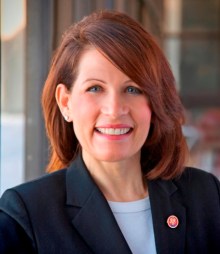
Representative Michele Bachmann

On Michele Bachmann’s blog, she has posted twice about banks that are returning TARP bailout money, rather than accept government control of their business. Michele voted against the TARP bill, which redistributed 700 billion dollars from the honest/productive sector of the economy to the irresponsible/fraudulent sector.

Here is an except from her first post:

The Minneapolis Star Tribune reported yesterday that TFC Financial Corp. has joined Northern Trust and Iberiabank Corp. as financial institutions who are staying clear of the government’s Troubled Asset Relief Program.

The way TCF Chief Executive Bill Cooper views it:

“I don’t want to be part of the new regulatory regime that’s growing up around TARP. Congress is now talking about putting their oar in the water on just about everything we do. That puts us at a competitive disadvantage.”

A more recent post links to a Fox News story on TCF bank. According to the TCF Bank CEO, TCF never made any subprime loans, and therefore they do not need a bailout. Although they were going to take the money, they decided to return it, because they refused to yield their autonomy to the federal government.

Watch the 5-minute clip: (need I mention that Megyn Kelly does the interview?)

Now, for those of you who have read F.A. Hayek’s “The Road to Serfdom”, you know that all our liberties, including our precious freedom of religious expression, hangs on the separation between government and the means of production. If the government controls the means by which you earn your living, then the government controls you.

A summary of the Road to Serfdom is here.

Obama’s plan to eliminate the right of workers not to join unions

According to John Boehner’s blog, Obama wants to pass a piece of legislation called the “Employee Free Choice Act”. EFCA would deny employees the choice to not surrender a significant portion of their wages to left-wing unions, for use in left-wing political activism, (e.g. – redefining traditional marriage in California).

The post by Kevin on Boehner’s blog explains:

Yesterday, President Obama promised union bosses that “We will pass the Employee Free Choice Act,” referring to the mis-named official title of the bill popularly known as “card check.”  Unions came within a few votes of passing “card check” last Congress – and after giving $450 million to the Democratic Party this past election cycle, union bosses are cashing in on their investment by demanding the swift passage of the anti-worker “card check” bill.

Kevin also links to this must-see 6-minute video, produced by the pro-business Chamber of Commerce:

EFCA would cost American jobs because some companies would simply shut down work sites that use expensive unionized labor, rather than pay the additional costs for the same amount of production. They would just ship their plants and jobs overseas. A short policy paper from American Enterprise Institute is cited by Kevin makes the point:

Card check should be seen for what it is: an attempt to rebuild the private-sector union movement by making it dramatically easier for unions to organize American workers.  Adding card check to the already heavy burden of U.S. labor and employment law that companies face today will cost the U.S. economy additional jobs.

Allison Kasic of the Independent Women’s Forum released this short research paper on EFCA last week. I think it is ironic that the party that loudly advocates for “making every vote count” and the right to “privacy” would pass a law that hurts voting rights and privacy rights. Allison explains:

Since Congress enacted the National Labor Relations Act (NLRA) in 1935, most workplaces have organized through secret ballot elections monitored by the National Labor Relations Board. Once organizers have collected signatures from at least 30 percent of workers expressing the desire to unionize, the union submits the information to the company and requests recognition.  Companies can choose to recognize the union based solely on this card check, but more regularly request an election.

The privacy of the secret ballot system protects workers from strong-arm tactics by either the unions or the company in question before and after a vote.  All of that would change under the EFCA. Elections would no longer be necessary.  Instead, a union would be recognized once a majority of workers publicly signed a card supporting unionization.  In fact, once a majority of cards have been signed, holding an election would be illegal.

The Heritage Foundation has a slew of papers on EFCA here, including this recent short research paper by James Sherk, which has a lot more detail on EFCA.

Bobby Jindal defends Rush Limbaugh against hostile Larry King

Hot Air has the video of Jindal kicking butt on Larry King Live. It’s more fun to watch when the left is angry and crazy.

Here’s Hot Air’s blurb about the video:

Bobby Jindal faced off against an unusually hostile Larry King last night over the Steele-Limbaugh contretemps. King kept trying to stuff words into Jindal’s mouth, and Jindal politely but firmly kept spitting them back at King.  King insists that Republicans want the country to fail when it’s clear that not even Rush says that.

CNN has the full transcript! Here’s the best part:

KING: Governor, do you think people are thinking about capitalism now or are they thinking about problems?

JINDAL: Look, clearly, the American people are worried about paying their mortgages, keeping their jobs and paying their health care bills. I think Rush is a great leader for conservatives. I think he articulates what a lot of people are concerned about. And I think it is absolutely true that you can help people keep their jobs, help people afford their health care, help people afford their homes without abandoning the same conservative principles.  For example, Republicans offered ideas like aggressive tax credits to make homes more affordable so people can refinance, can stay in their homes. You’d see more demand for homes. They’ve offered ideas about — instead of nationalizing banks, why not modify the mark to market rules? …

KING: Do you want him to fail?

JINDAL: I want the — I don’t want those policies to be adopted. I want my country to succeed, but I don’t want policies to be adopted that I think –

KING: But what if the… policies actually work?  What if they work?

JINDAL: This is where we have a fundamental disagreement. I don’t think it’s going work to borrow half a — to spend in excess of our revenues.  If you believed everything that the president — if you believed all of his projections, if you believe the economy starts growing again, you believe that we’re not going be spending all that money fighting overseas…if you believe that all of these temporary programs are truly temporary, he’s still projecting deficits of half a trillion dollars per year, under the best case scenario.  Larry, that’s just not sustainable. We cannot continue to do this as a country. China cannot become — continue to be our largest foreign holders of debt. This addiction to debt is what’s caused so many of our problems. The government is not going to be the answer to every problem.  I want my country to succeed. But what I worry about is that simply spending money on new programs — look at every new bailout. You know, you talked today, you know, about the auto bailouts. Then you had the fourth, I think it’s the fourth — it’s hard to keep track — the AIG bailout today. It seems like every time you turn around, there’s another trillion dollar trillion plan. … I’ve yet to hear a coherent exit plan.

KING: So you hope — you hope it doesn’t hurt?

JINDAL: No. I hope that failed policies don’t get adopted. I want my country to succeed. I want the economy to grow. I want — certainly I want the economy to grow again so people can afford their homes.  But I don’t want the Congress to adopt policies that would make the problem worse, not better. … I think it’s our — I think it’s our obligation as Americans when we don’t agree with a policy to speak up against it and to certainly offer different solutions.